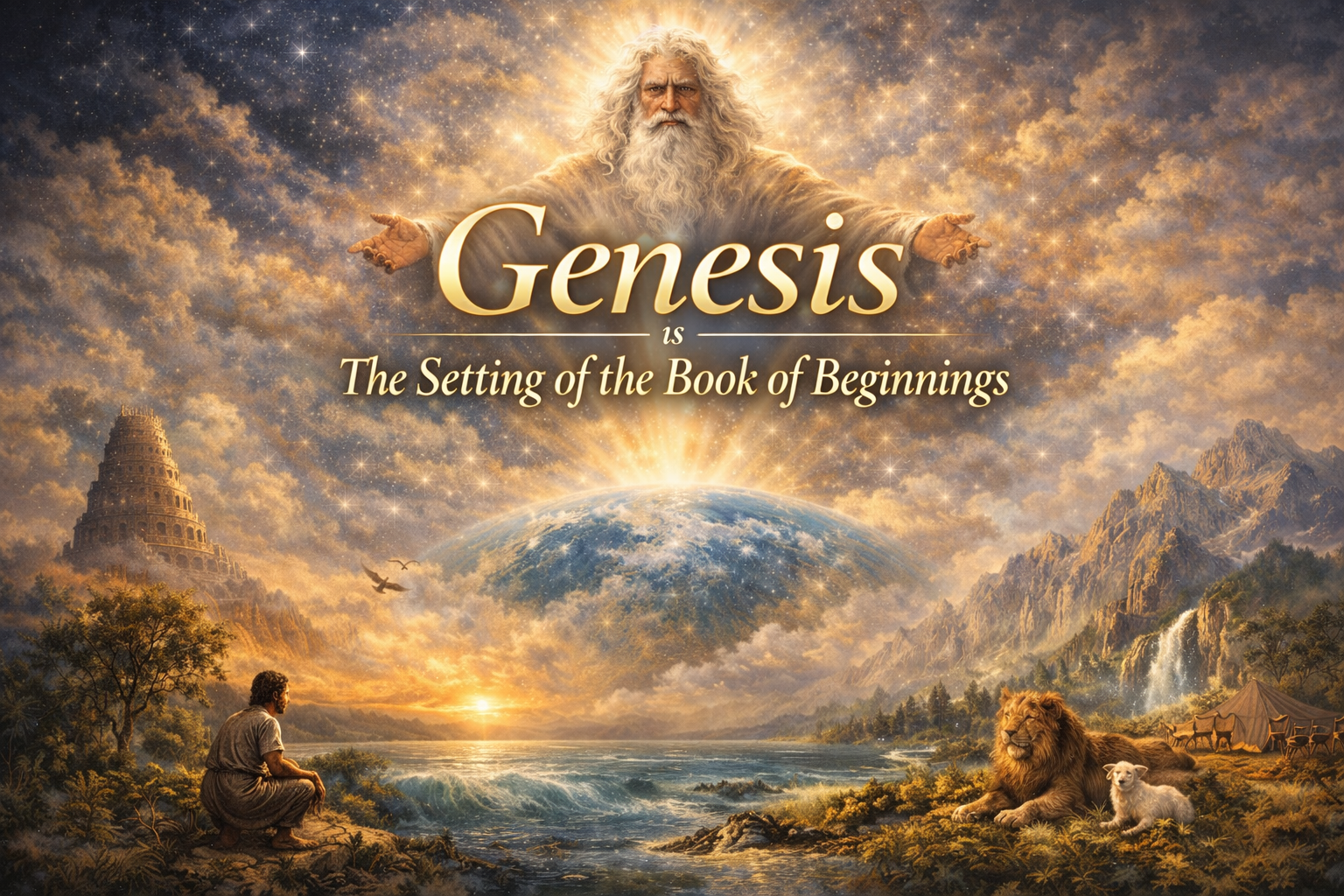
Genesis stands at the head of Scripture not merely because it comes first, but because it sets forth the deepest realities with which all Scripture is concerned. It is the book of beginnings, certainly; but it is also the book of first principles. It introduces God, creation, man, order, life, sin, death, promise, land, seed, and hope. The book is profoundly concerned with relationships: between God and His creation, between God and humankind, and between human beings themselves. Yet beneath all those relationships lies something even more fundamental: Genesis begins by teaching that all things rest upon God Himself.
In the King James Version the opening words are familiar and majestic: “In the beginning God created the heaven and the earth” (Genesis 1:1). Yet the Hebrew is slightly more elusive than that splendid English rendering may suggest. The Hebrew title of the book is Bereshit, from its opening word, and Jewish commentators have long noted that the phrase can also be taken in a more dependent sense, along the lines of “at the beginning of God’s creating” or “when God began to create.” Rashi famously observed that the grammar invites careful thought and is not quite as simple as a flat chronological statement. That does not diminish the truth of Genesis 1:1; rather, it reminds us that the sacred text opens with a depth that resists careless reading. Even the first word asks us to slow down.
What, then, is the setting of Genesis? Before there is earth, there is God. Before there is light, there is God. Before there is man, law, sacrifice, nation, or covenant history, there is God. Moses says in Psalm 90:2, “Before the mountains were brought forth, or ever thou hadst formed the earth and the world, even from everlasting to everlasting, thou art God.” That is one of the great foundations of the biblical mind. God does not arise with the universe. He is not one being within the universe. He is before it, above it, and independent of it. Human thought struggles here, because every human mind is bound to sequence. We think in terms of before and after, beginning and ending, cause and effect. But the God of Scripture is not enclosed within the frame that encloses us. He “inhabiteth eternity” (Isaiah 57:15). We may repeat those words more easily than we can comprehend them.
That difficulty itself is spiritually useful. Genesis humbles the reader at the outset. Modern man likes to suppose that with sufficient learning, method, and analysis he can master every subject. But the eternity of God refuses mastery. One may meditate upon it, worship before it, and confess it; yet one cannot contain it. Ecclesiastes says that God “hath set the world in their heart, so that no man can find out the work that God maketh from the beginning to the end” (Ecclesiastes 3:11). The opening of Genesis therefore calls not only for study, but for reverence. We are reading not merely of the start of things, but of the activity of the One who has no start.
Traditional Jewish reflection has long sensed that Genesis opens not simply with chronology, but with mystery. Bereshit Rabbah presents creation as an act of divine wisdom, even speaking of God as “looking into the Torah” and creating the world accordingly. That is not Scripture, and it must not be treated as though it were inspired; yet it is a striking witness to how deeply Jewish readers felt the first chapter of Genesis to be charged with meaning. The world is not presented as accidental, chaotic, or self-originating. It is the expression of divine intention. Likewise, the classic Jewish concern over why the Torah begins with creation rather than with the first commandment to Israel shows that Genesis 1 was always read as foundational, not incidental. (Sefaria)
Rashi’s opening comment is especially valuable in this respect. He not only notices the grammatical subtlety of bereshit; he also preserves the older rabbinic question as to why Scripture begins here. His answer, following earlier tradition, is that the creation account establishes God’s sovereign claim over the earth. The world belongs to Him before it belongs to any nation, king, empire, or tribe. That matters greatly for the whole Bible. Land, inheritance, promise, and kingdom all rest upon the prior truth that “The earth is the LORD’S, and the fulness thereof” (Psalm 24:1). Genesis is thus the proper opening to the Bible because it sets all later history under the authority of the Creator. (Sefaria)
Yet if God existed before creation, how are we to think about creation’s relation to Him? The biblical text itself is careful. It tells us that God created; it does not offer a metaphysical system. Even so, the whole tenor of Scripture suggests that creation is radically dependent upon God, not merely at its first moment, but at every moment. “For of him, and through him, and to him, are all things” (Romans 11:36). “In him we live, and move, and have our being” (Acts 17:28). In that sense, one may say that the world is not something standing over against God as an independent reality. It proceeds from His will, His wisdom, His word, and His sustaining power. Without Him, it is nothing.
Jewish mystical tradition, especially Kabbalah, pressed this intuition further. Medieval and later kabbalistic teaching speaks of Ein Sof, the Infinite, the boundless divine reality beyond ordinary naming. From that Infinite, according to kabbalistic thought, come the sefirot, the divine emanations or manifestations by which the hidden God becomes known in relation to the world. Later Lurianic Kabbalah adds the idea of tzimtzum, a “contraction” or withdrawal of the Infinite to make room for created existence, followed by emanation into that opened space. These are not the plain words of Moses, and they should not be confused with the literal surface of Genesis 1. Yet they are important as part of the Jewish attempt to speak about a truth the text itself presses upon us: the world does not exist from itself, but from God; all finite being depends upon the Infinite. (Encyclopedia Britannica)
From a Bible students standpoint, one must handle such material carefully. Scripture remains the authority; Kabbalah does not. Still, mystical language can sometimes illuminate questions that straightforward prose leaves standing in silence. If one says that creation was made “out of” God, that must not be understood crudely, as though God were merely cosmic matter or the universe were simply identical with Him in a flat pantheistic sense. The safer biblical thought is that all things come forth from Him and remain upheld by Him, while He nevertheless transcends all that He has made. Kabbalah often moves toward the language of emanation; the Bible more often speaks in the language of word, will, glory, and power. The impulse behind both, however, is to deny that creation is self-grounded. It is from God, through God, and finally for God. (Encyclopedia Britannica)
That distinction matters. To say “the universe is God” without qualification is, in strict doctrinal terms, more than Genesis itself says. Yet there is a contemplative truth lying near that phrase if it is expressed more carefully: the universe is not alien to God, not independent of God, and not outside His sustaining presence. It is His workmanship, His utterance, His disclosure of power and glory. “The heavens declare the glory of God; and the firmament sheweth his handywork” (Psalm 19:1). The cosmos is not divine in itself as though stones and stars were objects of worship. But neither is it a detached mechanism running on its own. It is a world whose reality is ceaselessly borrowed from its Maker. In that sense, the universe is best understood not as God exhausted, but as God expressed. It is from Him, filled by His activity, and unable to be conceived apart from Him.
This makes the setting of Genesis vastly larger than a primitive origin story. The opening chapter is not simply telling us that long ago something happened. It is telling us what reality is. Reality is spoken, ordered, and sustained by God. Light, sea, land, life, fruitfulness, and creaturely existence are not self-explanatory. Their explanation lies beyond themselves. In a deeply reverent sense, creation is the theatre in which the unseen God becomes known through His works. That is why Genesis 1 moves with such measured dignity. “And God said … and it was so … and God saw that it was good.” The repeated formula insists that being itself is obedient to Him.
At this point a modern reader may notice an unexpected echo. Contemporary science does not affirm Genesis in any simple doctrinal sense, nor should theology rest upon every passing theory. Yet it is striking that some recent speculative work in physics and consciousness studies has proposed that consciousness may be more fundamental than matter, space, and time. A 2025 theoretical model from Uppsala University and AIP Advances, for example, explicitly proposed that consciousness comes first and that space, time, and matter arise afterwards. That is not settled science; it is a new and controversial proposal. But it is noteworthy all the same. Even in secular intellectual life, there are thinkers who feel that brute materialism may not reach deeply enough into the nature of reality. (Uppsala University)
One must be sober here. It would be irresponsible to claim that science has proved that “space itself is conscious,” or that modern cosmology has simply rediscovered the doctrine of Genesis. It has not. At most, one may say that some current theoretical work is willing to ask questions that earlier materialist confidence tended to dismiss. For the biblical reader, that does not establish doctrine, but it does offer a suggestive parallel. Genesis begins with mind, word, order, and purpose. Some modern theories, though speculative, are beginning to ask whether reality itself may be more inward, more unified, and more mind-like than mechanistic accounts allowed. (Uppsala University)
That possibility also helps us feel afresh why the eternity of God is so hard for us to grasp. We are creatures formed within time and space, trained by habit to treat matter as the most obvious thing. Genesis reverses that instinct. It begins not with matter, but with God. Not with a thing, but with the One who speaks. Not with a machine, but with purpose. In that sense Genesis is perpetually modern, because every age must be called back from worshipping the visible to acknowledging the invisible source from which the visible comes.
This is why Genesis is the proper setting for all that follows in Scripture. Eden, the fall, the flood, Babel, Abraham, promise, inheritance, and the long history of redemption all stand upon the truths announced here. God existed before creation. Creation depends wholly upon Him. Man is not self-made, but made in the image of God. The world is not meaningless, but purposive. Sin is not a harmless defect, but rebellion in a world already declared good. Hope is possible because the Creator has not abandoned His work. Even the later promises of seed and kingdom make sense only because the opening chapter has already established that history belongs to the God who called all things into being.
So the setting of Genesis is not merely the ancient Near East, nor merely the dawn of the physical universe. Its true setting is the eternal God revealing Himself through the ordered emergence of heaven and earth. The Hebrew Bereshit leaves a certain depth at the threshold; Midrash and Kabbalah, each in their own ways, tried to dwell within that depth; and even some speculative modern theories seem faintly to circle its edges. But Scripture itself remains the surest guide. “In the beginning God created the heaven and the earth.” However one explores the philosophical richness around that sentence, the sentence itself still stands. It tells us that before all things, God is; that because He is, all else may be; and that to understand the world rightly, one must begin where the Bible begins: with God.