Having considered the setting of Genesis—God before all things, creation by His power, and the world as the theatre of His purpose—it is fitting now to trace the shape of the book itself. Genesis is not a loose collection of ancient traditions placed side by side without order. It is a carefully structured and profoundly unified book. It moves from the universal to the particular, from creation to covenant, from the world at large to one chosen family, and from the majesty of cosmic beginnings to the intimate trials of men and women called to walk before God in faith. It is, in that sense, both wide and narrow: wide enough to embrace the origin of heaven and earth, and narrow enough to dwell patiently upon the domestic sorrows, failures, and hopes of Abraham’s house.
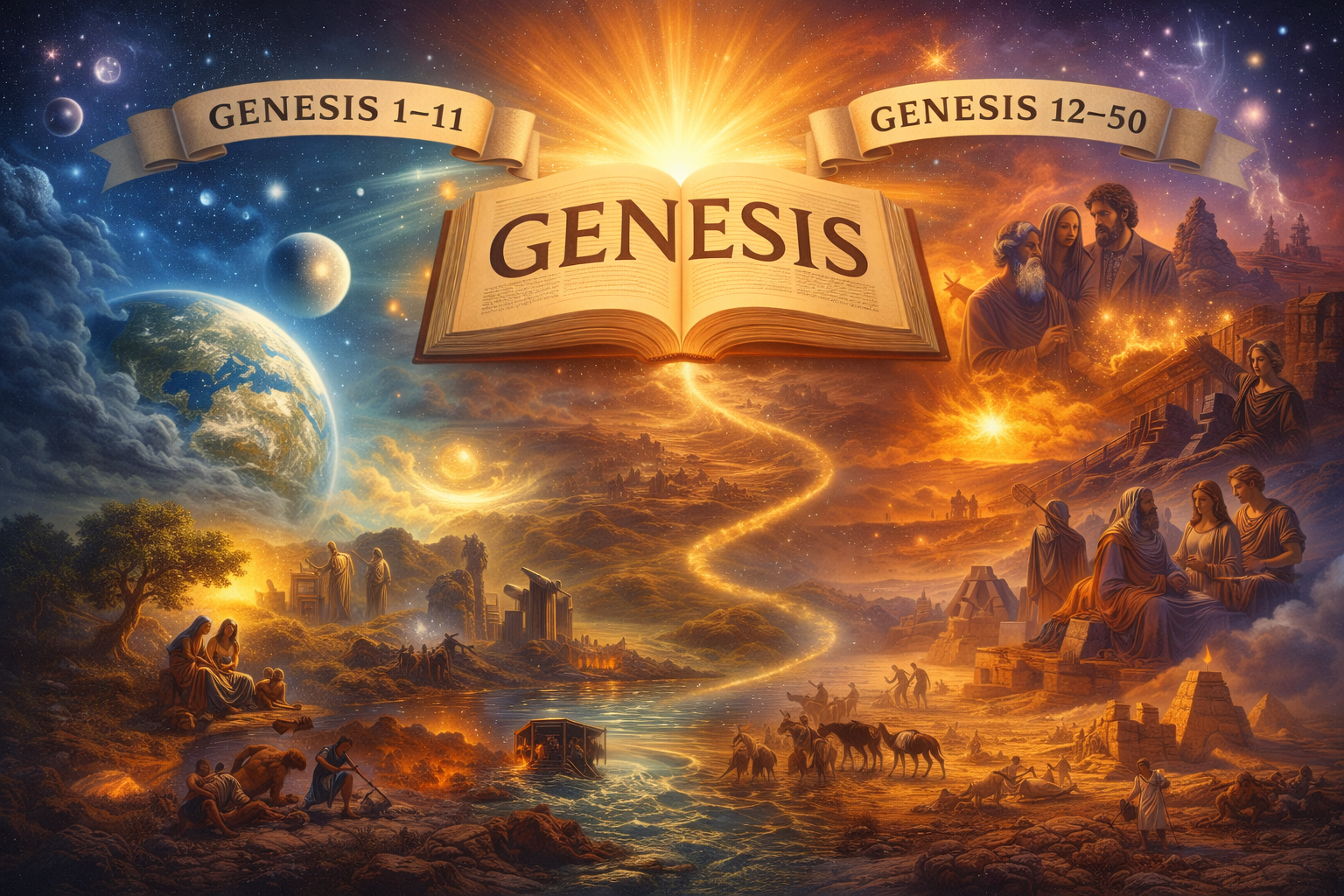
The book may be understood in two large parts. The first part, chapters 1 to 11, concerns the beginnings of the world and of humanity generally. It presents the origins of creation, sin, death, violence, judgment, nations, and languages. The second part, chapters 12 to 50, turns to the patriarchs—Abraham, Isaac, Jacob, and Joseph—and begins to show how God’s redemptive purpose takes historical form through one line of promise. The first section explains the condition of the human race; the second reveals the chosen channel through which blessing will come.
1. Creation and Divine Order (Genesis 1–2)
Genesis opens with the creation account, and this beginning is essential not merely because it comes first chronologically, but because it establishes the moral and theological order of all that follows. The world is shown as ordered, good, and dependent. God speaks, and things come to be. He separates, appoints, blesses, and evaluates. The recurring declaration that creation is “good” teaches that disorder, corruption, and death do not belong to the original ideal. They are intrusions, not necessities.
The movement of Genesis 1 is stately and deliberate. The creation of light, firmament, dry land, vegetation, heavenly bodies, living creatures, and finally mankind reveals an ascending order, culminating in man and woman made in the image of God. Here are laid the foundations for biblical anthropology. Humanity is neither divine nor accidental. Man is formed to bear God’s image in the earth, to exercise dominion under God, and to live within limits set by the Creator.
Genesis 2 revisits creation from a more focused angle, not to contradict Genesis 1, but to deepen it. The attention narrows from the ordered cosmos to the garden, and from the race in general to the formation of man and woman in particular. Eden is introduced as a prepared environment in which human life, labour, fellowship, and obedience may flourish. The chapter establishes marriage, moral responsibility, and the distinctive dignity of human existence. It also introduces the principle that man lives not autonomously, but under divine command. This prepares the way for the crisis that follows.
2. The Entrance of Sin and Death (Genesis 3)
Genesis 3 is among the most decisive chapters in all Scripture. It explains why a good creation becomes the setting of sorrow, alienation, toil, and mortality. The temptation of the woman, the disobedience of the man, and the entrance of shame and hiding disclose the moral fracture at the heart of the human condition. Sin is shown not as immaturity, but as rebellion: a refusal to remain within the bounds of God’s word.
The consequences are immediate and far-reaching. The harmony of Eden is shattered. The man and woman hide from God, blame replaces unity, pain enters human relationships, the ground is cursed, and death becomes the destiny of Adamic life. Yet even here, Genesis does not leave the reader in despair. Judgment is accompanied by a word of future conflict and future hope. The promise concerning the seed of the woman indicates that the serpent’s work will not be final. The chapter therefore sets the pattern for all that follows: human failure under divine scrutiny, yet with divine purpose moving onward despite it.
3. The Spread of Sin in the Early Human Family (Genesis 4–5)
The next stage in the book shows that the fall was not an isolated incident. Sin spreads rapidly outward into family, worship, labour, and society. Cain and Abel stand as the first great contrast in post-Eden life. Abel approaches God acceptably; Cain does not. The murder of Abel by his brother reveals how quickly inward sin ripens into outward violence. With Cain’s defiant question, “Am I my brother’s keeper?”, the reader sees that alienation from God is inseparable from alienation from fellow man.
Yet even in judgment, God restrains and preserves. Cain is marked, not only as judged, but also as spared from immediate destruction. The line of Cain develops culture and civilisation—cities, crafts, music, metalwork—but the moral atmosphere remains dark. Lamech embodies escalating violence and pride. In contrast, the line of Seth begins to represent a distinct current of worship and hope. Genesis 5, with its solemn genealogy, repeatedly reminds the reader of mortality: “and he died.” The chapter is not merely a list of names; it is the tolling bell of the Edenic sentence. Yet Enoch stands out as one who “walked with God,” showing that even in a dying world there is fellowship possible with the Creator.
4. The Flood: Judgment and Preservation (Genesis 6–9)
As Genesis advances, the corruption of mankind becomes comprehensive. Violence fills the earth, and human wickedness is described in sweeping terms. The flood narrative is therefore not an arbitrary catastrophe, but a moral judgment. The same God who formed the world now acts against its corruption. Yet the flood is also a story of grace. Noah finds grace in the eyes of the LORD, and through him a remnant is preserved.
The ark becomes a powerful image of deliverance through obedient faith. Noah responds to divine warning not with speculation but with submission. The flood itself marks a kind of de-creation and re-creation: the waters return, the old order is swept away, and a new beginning emerges when the waters recede. After the flood, covenant language becomes prominent. God blesses Noah and his sons, repeats the command to multiply, and sets the rainbow as the token of His covenant concerning the earth.
This section is important not only for its account of judgment, but for the way it reinforces the moral seriousness of God’s government. The world matters to Him. Violence matters to Him. Human conduct is not invisible or inconsequential. At the same time, the Noah narrative shows that divine purpose persists beyond catastrophe. God is not defeated by human evil; He judges it and moves forward.
5. Nations, Languages, and Human Pride (Genesis 10–11)
Genesis 10, often called the Table of Nations, broadens the scope once more. After tracing one family through Noah, the book now shows the spread of peoples across the earth. This chapter is crucial because it presents the nations not as an afterthought, but as part of the biblical story from the beginning. The world is peopled under God’s eye.
Genesis 11 then narrows the focus again to the tower of Babel, where humanity seeks unity, security, and fame on its own terms. “Let us make us a name” becomes the expression of collective pride. Instead of filling the earth in obedience, mankind seeks centralised greatness in defiance. The confusion of tongues is therefore both judgment and restraint. Human pride is checked by divine intervention. Babel shows that the fractured condition of mankind is not merely unfortunate social development, but judicially bound up with rebellion against God.
This prepares the transition to Abraham in a striking way. At Babel, men seek to make their own name. With Abram, God says in effect that He Himself will make the name great. Thus the answer to proud human self-exaltation is not improved human organisation, but divine calling.
6. Abraham: Call, Promise, and Pilgrimage (Genesis 12–25)
With Genesis 12, the book turns decisively from universal history to covenant history. Abram is called out of Ur and Haran to go to a land that God will show him. This call is one of the great turning points in Scripture. Here the themes of land, seed, and blessing come together. Abram is promised not merely personal prosperity, but a role in God’s universal purpose: “in thee shall all families of the earth be blessed.”
The Abraham narratives explore faith in many dimensions. Abram obeys, journeys, worships, and trusts; yet he also fears, falters, and waits. The book does not idealise him. Instead, it presents faith as a living and often costly response to divine promise. The covenant ceremonies, the separation from Lot, the rescue of Lot, the meeting with Melchizedek, and the long waiting for an heir all deepen the picture of a man living by promise in a land he does not yet possess.
The birth of Ishmael introduces tension between human expediency and divine intention. Sarah’s barrenness tests the household repeatedly. Genesis insists that the promised seed comes not by ordinary human confidence, but by divine fidelity. The covenant of circumcision marks Abraham’s household outwardly, and the destruction of Sodom shows the moral seriousness of the God who covenants. Abraham’s intercession there also reveals the patriarch as one who not only receives promise, but learns something of God’s justice and mercy.
The near-sacrifice of Isaac in Genesis 22 stands as the climax of Abraham’s personal testing. Here faith, obedience, love, and promise converge. Abraham must hold fast to the word of God even when the command before him seems to threaten the very promise previously given. This chapter becomes one of the most powerful foreshadowings in Scripture, not by exhaustive explanation at this stage, but by pattern and principle. Abraham emerges as the father of the faithful, yet always as a man upheld by God rather than a hero who secures blessing by his own strength.
7. Isaac: Continuity of Promise (Genesis 21, 24–27)
Isaac occupies less narrative space than Abraham or Jacob, yet his role is vital. He represents continuity. The promise given to Abraham does not die with Abraham; it passes forward. Isaac’s life is quieter, but the very quietness is instructive. The covenant line is not sustained by constant dramatic action, but by God’s persistent faithfulness across generations.
The securing of Rebekah as Isaac’s wife through providential guidance is one of the most beautiful narratives in Genesis. It shows the interplay of prayer, human action, family decision, and divine leading. Isaac’s later life includes episodes that echo Abraham’s story, especially in relation to wells, land, and dealings with neighbours. These repetitions are not accidental; they demonstrate continuity, but also show that each generation must learn trust afresh.
The blessing scene involving Jacob and Esau is morally complex and deeply significant. The tension between divine election and human conduct becomes more intense here. Isaac loves Esau, Rebekah favours Jacob, and the family is marked by deception and grief. Yet God’s purpose is not overthrown. Genesis will repeatedly show that the line of promise moves through flawed families, not because God approves their failures, but because His purpose is larger than their weakness.
8. Jacob: Transformation through Discipline (Genesis 25–36)
If Abraham is the great figure of promise, Jacob is the great figure of transformation. From the womb onward, his life is marked by struggle. He grasps, schemes, bargains, flees, and fears. Yet he is also chosen. The Jacob narratives are long because they show the slow reshaping of a difficult man under the discipline of God.
Jacob’s dream at Bethel is one of the key moments in Genesis. Heaven and earth are shown as connected under God’s sovereignty, and the covenant promises given to Abraham are reaffirmed to Jacob. Yet Jacob’s story does not immediately become serene. Instead, he enters years of labour, frustration, family conflict, and moral entanglement in the house of Laban. The deceiver is himself deceived. Through this long experience, he learns that blessing cannot be secured by craft.
The growth of Jacob’s household introduces the sons who will become the tribes of Israel. Thus Genesis begins to move from patriarchal biography to national beginnings. Jacob’s return to Canaan, his fear of Esau, and his wrestling at Peniel mark a decisive inner turning point. He limps away blessed, renamed Israel, and permanently altered. The change is not instant perfection, but it is real transformation under divine encounter.
The Jacob section also includes painful episodes, including the violation of Dinah and the violence of Simeon and Levi. Genesis is unsparing in showing the moral instability of the chosen family. Election does not erase the reality of sin. Yet the promises remain active, and the household continues to move toward its appointed role in history.
9. Joseph: Providence in Exile (Genesis 37–50)
The final major section of Genesis is devoted to Joseph, and with good reason. Joseph’s story shows how divine providence works through suffering, injustice, separation, and political upheaval to preserve the covenant family. The narrative is masterfully shaped. Joseph is beloved by his father, hated by his brothers, sold into slavery, falsely accused, forgotten in prison, and then exalted in Egypt. Each reversal contributes to the larger design of God.
What distinguishes Joseph’s story is the relative absence of direct divine speeches compared with earlier patriarchal narratives. God is no less active, but His activity is often seen through events rather than announced beforehand. This gives the section a particular practical power. The reader learns to discern providence not only in miracles or direct promises, but in the hidden weaving together of circumstances.
Joseph’s moral steadfastness also forms an important contrast to other narratives in Genesis. In Potiphar’s house, in prison, and in power, he shows integrity, restraint, wisdom, and reverence. Yet the heart of the Joseph story lies not simply in personal virtue, but in reconciliation and preservation. The brothers who sold him must eventually stand before him. Judah, who once participated in the betrayal, begins to emerge differently in the final chapters. Jacob’s family, fractured by envy and deceit, is brought to a point of painful recognition and eventual reunion.
Joseph’s words in Genesis 50:20 provide a lens through which much of Genesis may be read: “ye thought evil against me; but God meant it unto good.” This is not a denial of evil. The brothers truly sinned. Rather, it is a confession that God’s purpose can overrule human wickedness without being tainted by it. The family comes down into Egypt, and Genesis closes not with fulfilment complete, but with promise carried forward into a new phase of history.
10. The Overall Message of the Book
Taken as a whole, Genesis is a book of beginnings, but never merely of beginnings. It explains the world as it is, yet always with a view toward what God will yet do. It reveals the origin of death, but also introduces the line of hope. It shows the spread of sin, but also the preservation of a seed. It traces the failure of humanity in general, then the calling of one family in particular, through whom blessing will reach outward again.
The structure is therefore deeply purposeful. Creation establishes divine order. The fall explains human ruin. The flood displays judgment and grace. Babel exposes human pride. Abraham introduces promise. Isaac preserves continuity. Jacob reveals transformation through discipline. Joseph demonstrates providence in suffering. By the end of Genesis, the reader understands both the problem and the beginning of the answer, though not yet the full solution.
Genesis also teaches that God works historically, relationally, and patiently. He is not only Creator in abstraction, but the God of households, journeys, altars, famines, marriages, rivalries, births, burials, and reconciliations. His purpose moves through ordinary places as well as extraordinary interventions. The book therefore combines grandeur and intimacy in a way few writings ever have.
In outline, then, Genesis is the unfolding of divine purpose from world-creation to family-preservation. It begins with God alone and ends with a chosen family in Egypt, carrying promise into the future. The distance between those two points is immense, yet the unity is profound. The God who said, “Let there be light,” is the same God who preserves Joseph, remembers Abraham, blesses Jacob, and guides history toward covenant fulfilment. That is the outline of Genesis, and it is why the book stands not only at the start of the Bible, but at the foundation of biblical understanding.