Having considered the setting of Genesis as the great biblical beginning—God before all things, creation by His power, and the world as the theatre of His purpose—it becomes necessary to move forward into doctrine. Genesis does not merely introduce the Bible historically. It establishes the framework within which the rest of Scripture must be understood. If that framework is abandoned, later passages are easily forced into meanings they were never intended to bear. This is especially so in relation to the Trinity, the personality of the Holy Spirit, and the supposed pre-existence or deity of Christ in the trinitarian sense.
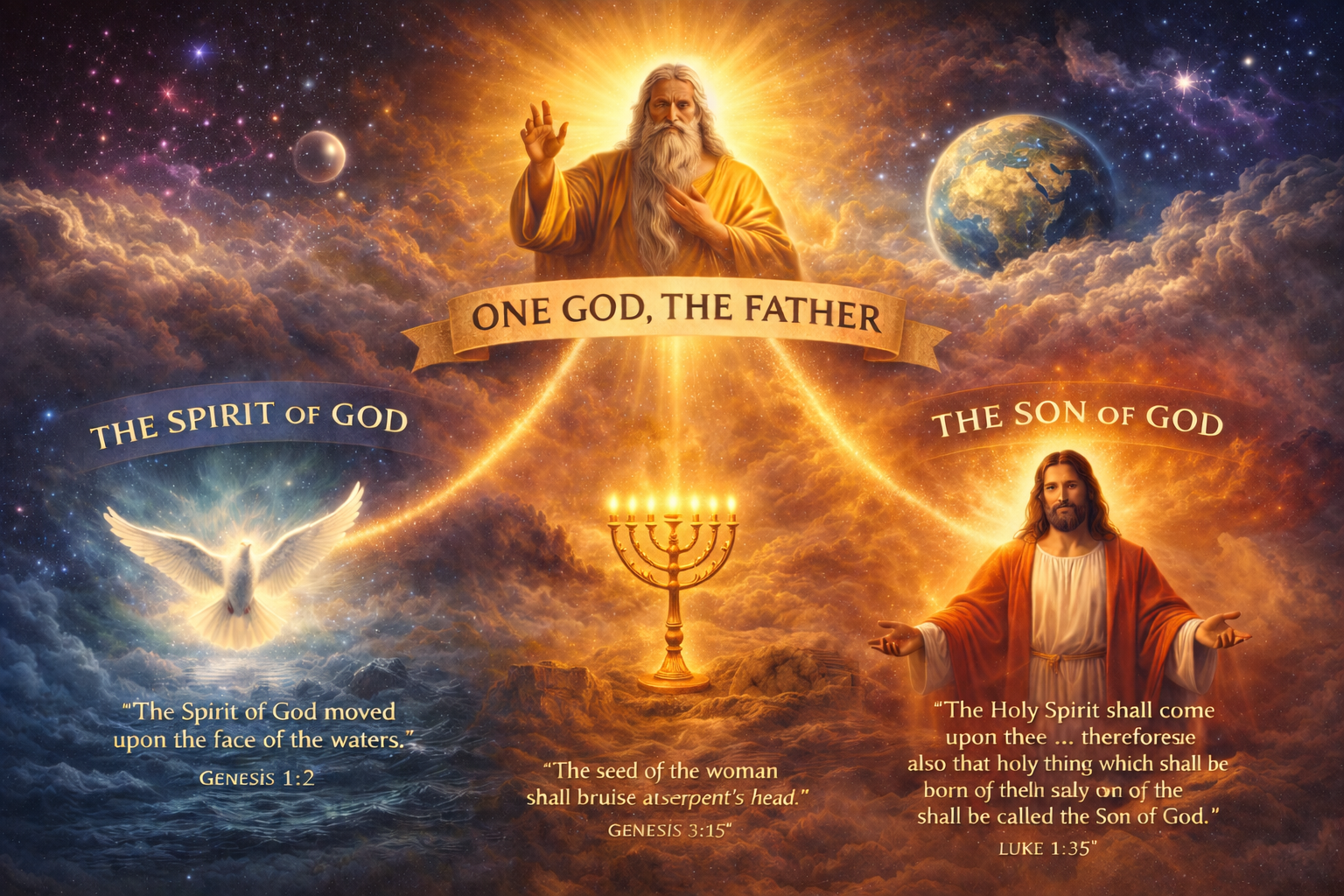
The Biblical position is plain. There is one God, the Father. The Holy Spirit is not a separate divine person, but the power of God in action. Jesus Christ is not an eternal Son who personally existed before his birth, but the Son of God brought into existence by miracle, foreknown and foreordained in the purpose of God from the beginning, and then manifested in history through birth, life, death, resurrection, and exaltation. That position is not reached by philosophical preference, but by the cumulative evidence of Scripture read in its own terms.
It is important to say at once that much confusion in theology comes from reversing the right order of inquiry. Men often begin with difficult passages, or with inherited creeds, and then interpret the whole Bible through that lens. Scripture itself proceeds otherwise. It begins with God. It begins with creation. It begins with the Spirit of God moving upon the face of the waters. It begins with man made in God’s image, and with the seed-promise that will, in due time, lead to Christ. Doctrine must therefore be built in the same order: first God, then His Spirit, then His purpose in promise, and only then the nature and mission of His Son.
The first principle is the unity of God. Genesis 1:1 does not present a plurality of equal persons creating together. It says simply, “In the beginning God created the heaven and the earth.” This is the great scriptural foundation. The God of Israel is one. “Hear, O Israel: The LORD our God is one LORD” (Deut. 6:4). The prophets repeat this insistently: “I am the LORD, and there is none else, there is no God beside me” (Isa. 45:5). The New Testament does not soften this truth, but confirms it. Paul writes, “To us there is but one God, the Father, of whom are all things” (1 Cor. 8:6). Christ himself speaks in the same way: “This is life eternal, that they might know thee the only true God, and Jesus Christ, whom thou hast sent” (John 17:3). The distinction is deliberate. The Father is the only true God; Jesus Christ is the one sent by Him.
This immediately bears upon the question of the Spirit. In Genesis 1:2, “the Spirit of God moved upon the face of the waters.” Trinitarian theology habitually reads this as the action of a distinct divine person. But Scripture itself teaches otherwise. The Holy Spirit is the power of God, His operative energy, His own presence in action. Luke 1:35 is decisive: “The Holy Spirit shall come upon thee, and the power of the Highest shall overshadow thee.” The parallel is explicit. “The Holy Spirit” and “the power of the Highest” are not two different agents. They are two descriptions of the same divine activity. The child to be born is therefore the Son of God, not because a third person of a Trinity fathers him, but because the power of God brought his conception to pass.
The same principle appears elsewhere. Psalm 33:6 says, “By the word of the LORD were the heavens made; and all the host of them by the breath of his mouth.” The word “breath” there is the same Hebrew word often translated “spirit.” Jeremiah 27:5 says, “I have made the earth, the man and the beast that are upon the ground, by my great power.” Jeremiah 51:15 repeats it: “He hath made the earth by his power.” These passages do not speak of a separate divine personality engaged in creation, but of God creating by His own word, breath, and power. That is precisely the sense in Genesis 1. The Spirit of God is God in action, not another god beside Him.
This understanding also explains the personal language used of the Spirit in the New Testament. The Comforter teaches, reminds, guides, and testifies in John 14–16. The Spirit says, forbids, witnesses, and appoints in Acts. Yet such language does not prove a distinct personal being. Scripture frequently personifies things that are not persons. Wisdom crieth in the streets. Sin reigns. Death reigns. The Scripture saith. Abel’s blood crieth from the ground. No one imagines that blood literally speaks or that Scripture is an independent person. The language describes divine communication and operation in vivid form. So when the Holy Spirit “speaks,” it is God speaking by His power. When the Spirit “bears witness,” it is God bearing witness through inspired means.
Indeed, the broader biblical language fits power far more naturally than personhood. Jesus received the Spirit “without measure” (John 3:34). The Spirit was “poured out” (Acts 2:17). It “fell” on those who heard the word (Acts 10:44). The apostles imparted Holy Spirit gifts by the laying on of hands (Acts 8:17-19). Jesus breathed on the disciples and said, “Receive ye the Holy Spirit” (John 20:22). Such expressions are entirely fitting if the Spirit is divine power. They become strained and unnatural if the Spirit is a co-equal divine person. One does not speak naturally of a person being poured out, measured without measure, breathed into others, or transmitted by the laying on of hands.
There is also a remarkable silence in the apostolic writings if the Holy Spirit were truly the third co-equal person of the Godhead. The epistles regularly begin with grace and peace from God the Father and from the Lord Jesus Christ. The Holy Spirit is almost never included in that way. Why, if He is equally God? Why is there no parallel apostolic pattern of invocation addressed to Father, Son, and Spirit alike? Why, in Revelation, is salvation ascribed “to our God which sitteth upon the throne, and unto the Lamb,” with no third throne-occupant named? Why in Acts 7 does Stephen see “the glory of God, and Jesus standing on the right hand of God,” but not the Holy Spirit as a third visible divine person? The silence is not accidental. It reflects the actual biblical structure: one God, the Father, and one Lord Jesus Christ, His exalted Son.
From this foundation we must move to Christ. The Biblical position does not diminish the Lord Jesus. It places him exactly where Scripture places him: as the unique Son of God, the promised seed, the one in whom the purpose of God reaches fulfilment. But to understand him correctly, one must distinguish between pre-existence in purpose and personal pre-existence in fact. Christ unquestionably existed in the purpose of God before he existed in history. He was foreordained before the foundation of the world. He was promised in Eden. He was foreshadowed in sacrifice, priesthood, kingship, and prophecy. But that is not the same thing as saying that he lived consciously as a person before his birth.
Genesis itself points us in the right direction. The deliverer is introduced as “the seed of the woman” (Gen. 3:15). That is human language. It points forward to one who would arise within history, born of woman, and overcome sin. The Abrahamic promises narrow the line further. “In thy seed shall all the nations of the earth be blessed” (Gen. 22:18). Paul later identifies that seed as Christ (Gal. 3:16). But again, the seed is promised, foreseen, and guaranteed long before it appears. It does not follow that the seed already existed as a conscious heavenly person. Rather, it existed in divine promise.
This distinction is essential when approaching the so-called “wrested Scriptures.” Genesis 1:26—“Let us make man in our image”—is often treated as proof of a multi-personal deity. But the text says no such thing. It does not mention Father, Son, and Spirit. It does not teach equality of persons. At most it presents God speaking in a plural form, which may be understood in terms of majesty or of the heavenly court. The same is true of Genesis 3:22, “The man is become as one of us.” These texts do not establish a Trinity; they are made to do work they were never intended to do.
So too Proverbs 8:22, where Wisdom says, “The LORD possessed me in the beginning of his way.” This is poetic personification, not a literal biography of a pre-existent Christ. Wisdom throughout Proverbs is personified as a woman crying, warning, building, and inviting. Christ may embody the wisdom of God, but Proverbs 8 is not a transcript of an eternal Son speaking before the world began. To treat it so is to confuse literary form with doctrinal identity.
The same care is needed with Isaiah 9:6 and Matthew 1:23. The child to be born is called “The mighty God, The everlasting Father,” and “Emmanuel, God with us.” These titles do not require that Jesus is literally the Father, nor that he is a second co-equal person within the Godhead. Scripture often speaks of divine manifestation and representation. God can be present in His appointed agent. His name can dwell there. His authority can be exercised there. To see Christ is to see the Father revealed in him, not because Christ is the same being as the Father, but because the Father is perfectly manifested through the Son. “God was in Christ, reconciling the world unto himself” (2 Cor. 5:19). That is manifestation, not metaphysical identity.
John’s Gospel is frequently marshalled against this view, but when read carefully it supports it. “In the beginning was the Word” (John 1:1) does not require a personally pre-existent Son. The “word” in Scripture often means God’s utterance, intention, wisdom, or self-expression. John does not say, “In the beginning was the Son.” He says, “the Word.” That Word “was made flesh” (John 1:14). It was not transformed from one person into another. Rather, God’s purpose, mind, and revealed will were embodied in the man Christ Jesus. The birth and manifestation of Christ are therefore the making-flesh of the Word, not the migration of an eternal person from heaven into a body.
The language of descent from heaven in John must be read in the same biblical way. Christ is “the bread of God … which cometh down from heaven” (John 6:33). But James says that “every good gift and every perfect gift is from above, and cometh down from the Father of lights” (James 1:17). No one imagines that gifts literally travel as pre-existent persons through the sky. To come down from heaven is to originate in God. Christ came down from heaven because he was God’s provision, God’s gift, God’s ordained means of life. The same applies to John 3:13 and kindred sayings. The emphasis is divine origin and authority, not personal celestial biography.
John 8:58 is similarly misunderstood. “Before Abraham was, I am” is taken by trinitarians as a direct claim to eternal deity. But in the context of the Gospel, Christ is the one whose centrality in the purpose of God antedates Abraham. He is the promised one through whom Abraham’s hope is fulfilled. The language is exalted because the purpose is exalted. So also John 17:5: “the glory which I had with thee before the world was.” This is glory in the divine plan, glory prepared and certain in the foreknowledge of God, later bestowed in reality through resurrection and exaltation. Scripture commonly speaks of things foreknown as though already present. Believers were chosen in Christ before the foundation of the world, yet no one argues that all believers personally existed then.
Passages that speak of honouring the Son, or of the Son being called God in a representative or exalted sense, must also be read carefully. John 5:23 says men should honour the Son even as they honour the Father, but that same Gospel repeatedly shows the Son as the one sent, dependent, obedient, and subordinate. The honour given to him is derived honour because of the Father who sent him. Thomas’s confession, “My Lord and my God” (John 20:28), recognises the full divine manifestation in the risen Christ; it need not overturn the plain words of Jesus himself about the Father being the only true God. Hebrews 1 likewise exalts the Son above angels, but always as the one whom God has begotten, appointed, and anointed. The Son’s greatness is real, but it is bestowed greatness within the purpose of the Father.
Philippians 2, Colossians 1, and Hebrews 1 are often read through later creedal assumptions. Yet Philippians 2 emphasises humility and obedience, not eternal co-equality seized or retained. Colossians 1 presents Christ as firstborn, head, and supreme in the new creation and in the purpose of reconciliation. Hebrews 1 opens not with an eternal Son co-creating alongside the Father, but with a Son “whom he hath appointed heir of all things.” Appointment, inheritance, begetting, anointing, exaltation—these are the dominant categories. They fit the biblical Son of God, not the timeless second person of later orthodoxy.
One should also note that some favourite trinitarian proof texts are textually unstable. 1 John 5:7 in the Authorised Version—“there are three that bear record in heaven”—does not rest on secure Greek manuscript authority and cannot honestly be used as a doctrinal cornerstone. This is a reminder that creedal systems have often leaned heavily on a small number of disputed or misunderstood texts while neglecting the broad simplicity of the Bible’s main witness.
The Biblical conclusion is therefore both scriptural and coherent. The Father alone is the supreme God. The Holy Spirit is His power, not a separate divine person. Jesus Christ is the Son of God by miraculous begettal, the seed promised from the beginning, the one in whom God was manifested, the one who perfectly revealed the Father’s character, the one who died, rose, and was exalted to God’s right hand. He did not personally pre-exist his birth, but he did pre-exist in the purpose, promise, and foreknowledge of God. He is worthy of all honour because the Father has made him Lord and Christ.
This is not a diminished Christ. It is the Christ of Scripture: born of woman, tempted in all points, obedient unto death, raised by the power of God, glorified by the Father, and appointed king over the coming Kingdom. Nor is this a diminished doctrine of God. It is the Bible’s own doctrine: one God, the Father, working by His Spirit-power through His Son for the redemption of the world.
To depart from that simplicity is not to deepen biblical truth, but to cloud it. The Bible does not begin with a Trinity in Genesis, and it does not require one in the Gospel. It begins with one God, whose Spirit moved upon the face of the waters, and whose purpose from the beginning was to bring forth a Son through whom sin would be overcome and blessing would come to all nations. That is the line of revelation, and that is the Biblical stance.