[2] CONSECRATION OBSTRUCTED (By Faithlessness)
Chapter 16:1 to 17:16
At Elim, the Israelites are typically shown the peace and prosperity of the Kingdom, but their faith is not strong enough to lift them above the problems of everyday life. As they move into the barren, arid wilderness of Sin, their food supplies commence to dwindle without any outward evidence of replenishment. Yahweh permits this as a test of faith, but the people fail under test. They recall the comparative luxury of life in Egypt, and compare it with the restrictions now experienced in the wilderness. They overlook the fact that the God who had miraculously drawn them out of Egypt and saved them from the hand of Pharaoh, dividing the sea before them, would not do all this, only to let them perish in the wilderness. They should have realised that necessary food would be provided them. Instead they lift their voices in complaint. Moses also lifts his voice, but in prayer. In consequence of his faith and reliance on Yahweh, meat and manna are provided to relieve the anxiety and hunger of the people. Laws are laid down for the gathering and preparing of the manna which is to be their sustenance for the next forty years; and a pot of it, miraculously preserved for all generations, is stored up as a memorial before Yahweh. They next suffer the rigours of thirst; and Moses is directed to the rock in Rephidim, which, when smitten, provides them with water of life. The Amalekites also attack them, but Yahweh gives His people the victory, in consequence of which a new divine title is pronounced.
CHAPTER SIXTEEN BREAD FROM HEAVEN
Leaving the refreshing water of the oases, and the protective shade of the palm trees at Elim, the Israelites travel into the wilderness of Sin, where the country is harsh and travelling is difficult. Food becomes scarce, and as the pangs of hunger are felt, the people turn upon Moses with yet a further complaint. Again, characteristically, he takes the problem to Yahweh in prayer; with the result that he is able to return to the people with promises of meat and bread. In addition, the people are told that they would see a manifestation of divine glory, as the bread from heaven is miraculously supplied them. At the time appointed, flesh is given the people in the form of quails, and manna falls upon the ground for their daily sustenance. Specific instructions are given as to how it is to be gathered and kept, particularly in regard to its harvesting on the sixth day in preparation for the seventh. Some, however, ignore the instructions, and are rebuked for their sin. Finally, Moses is instructed to lay up an omer of manna which is miraculously preserved over the years, in contrast to that which perishes with the eating of it. Thus the circumstances of the times provide yet another parable of the purpose of Yahweh in Christ who manifested himself as the antitypical 'bread from heaven" (John 6:32-38). Paul comments: "All these things happened unto them for ensamples [or types], and they are written for our admonition" {1 Cor. 10:11).
Hunger At The Wilderness Of Sin - vv. 1-3.
The Israelites arrive at the vast wilderness of Sin, which stretches across the whole of the Sinai tic Peninsula. But they find it devoid of food, and as their supplies begin to be depleted, they murmur against Moses, and lift up their voices in complaint of their lot.
VERSE 1
"And they took their journey from Elim" — Leaving Elim, they moved down the eastern coast of the Red Sea.
"And all the congregation of the children of Israel" — The Hebrew word for "congregation" is edah, the feminine form of ed (witness). See note ch. 12:3.
"Came unto the wilderness of Sin" — After leaving Elim, the children of Israel encamped by the Red Sea, and afterwards moved into the wilderness of Sin.
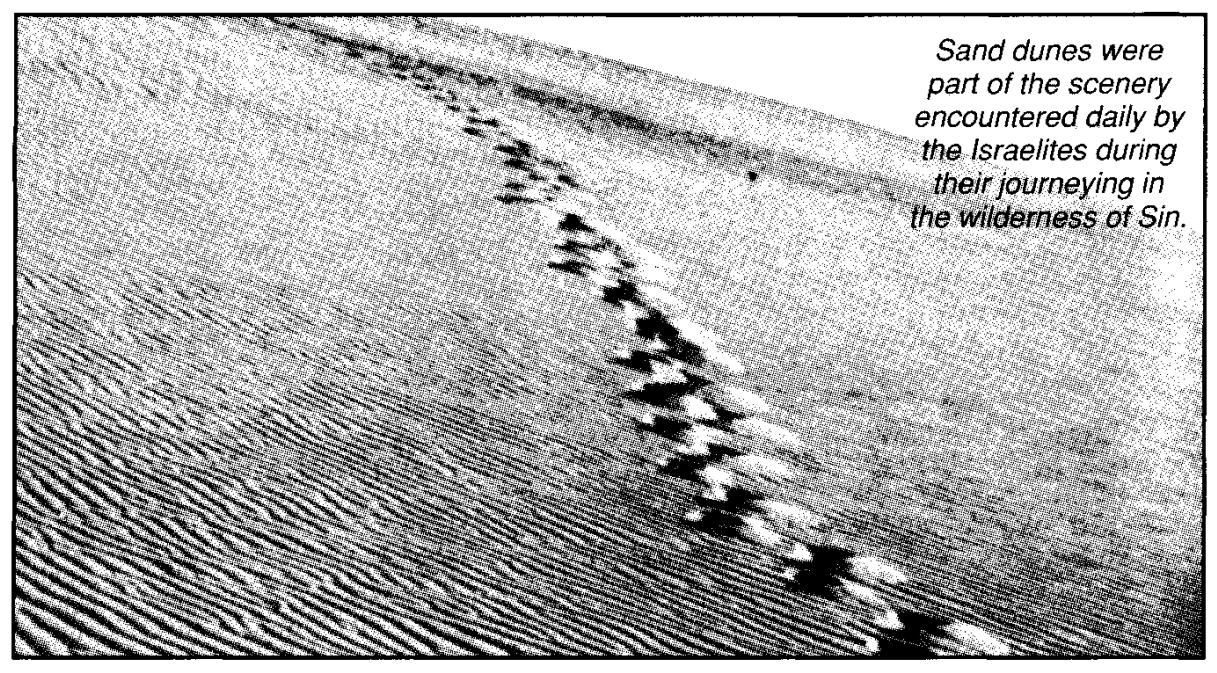
The Red Sea encampment is not recorded in Exodus, though it is found in the enumeration of the journey in Numbers (ch. 33:10-11). It was most likely designed to give the people a final glimpse of the extent of ocean that lay between them and Egypt, should they desire to return to that land. It would demonstrate that the barrier between them and Egypt was so vast that there was no possibility of turning back, and there was but one thing to do: follow the cloud to Sinai, and enter into the covenant that Yahweh would reveal to them there. Therefore, after a brief encampment by the shore of the Red Sea they moved off into the wilderness of Sin. The Hebrew word sin is from a Hebrew word signifying "bush," and evidently is given this name because of the acacia bush that grows therein — the bush that Moses saw burning, without being consumed. The area is identified by some with the plain of El-Kaa, which commences at the mouth of the Wady Taiy-ibeh, and extends along the whole southwestern side of the peninsula. Some connect it with the plain el-Markhah on the coast. G. Sandie writes in Horeb And Jerusalem: "It is a wide, open plain, bounded on one side by the sea, and on the other by a lofty mountain ridge, exhibiting on a large scale the colours of the desert. The central mountain is very grand: a naked alp of red granite, rent by a wild and gloomy gorge, and high upon its slopes lie ridges of pure, white sandstone.
"The Wadi-Markhah extends along the seashore, until it merges into the great plain of El-Kaa. This leads to a magnificent pass, wild, narrow and winding; each turn revealing aspects of grandeur and desolation, strangely impressive. At the end of the ravine, a majestic dark mass of mountain rises as a haggard precipice from the plain; and across its scarred front are broad bands of brightest colours. The plain widens at this part into a recess on one side at its base, and here are small pyramidal hills of the same dark colour, flanked by ridges of the white sandstone. These are so unique as to give the feeling that they have never previously been seen.
"The pass led into Wady Shellal, memorable for its inexpressible confusion of blasted hills of all shapes and colours. Ascending another pass, we looked back over a tumultuous sea of hills of all colours: red, white, green and black. The approach is along a defile shut in by high precipitous granite cliffs over one thousand feet high."
The Israelites would have found some supplies of water throughout this area, but as they toiled up the mountain pass towards Rephidim, they became "faint and weary" (Deu. 25:18), and their supplies became more and more depleted.
"Which is between Elim and Sinai" — The word Sinai is derived from the Hebrew sin or "bush," and denotes Bush of Yahweh. This is a significant name for such a site, emphasizing its relationship with the burning bush, the evidence of the law of Yahweh which sustains His people (cp. Deu. 33:16).
"On the fifteenth day of the second month after their departing out of the land of Egypt" — As there were thirty calendar days for a Jewish month in ancient times, this means that they left Egypt on a Thursday, and that the first Passover was slain on a Wednesday. See note on ch. 12:6. Accordingly, they arrived at their encampment on Saturday, 15th Zif.
VERSE 2
"And the whole congregation" — See note v. 1.
"Of the children of Israel murmured against Moses and Aaron in the wilderness" — See note ch. 15:24. It does not take much to cause the human heart to complain! The slightest restriction of water, food, clothing, or material possessions will test the faith and character of any individual. As a human being, he is naturally dominated by physical desires to such an extent that he becomes impatient at any inconvenience, and tends to forget "what manner of person ought he to be in all holy living and godliness" (2Pet. 3:11). This aspect of Israel's murmuring is constantly attested in the Scriptures (Ex. 15:24; 16:12; 17:3; Num. 14:2,27,29,36; 16:11,41; Num. 17:5, 10; Deu. 1:27; Josh. 9:18; Psa. 106:25).
VERSE 3
"And the children of Israel said unto them, Would to God we had died by the hand of Yahweh in the land of Egypt" — The people did not swear, "Would to God we had died," but "Would that we had died." It was a sigh rather than an oath. There is no word for "God" in the Hebrew. However, there is no exonerating the rest of the statement, which is a cowardly moan, stemming from lack of faith, and quite divorced from reality. The Israelites had not wished to "die by the hand of Yahweh" when they were in Egypt, for then they had cried unto Him for help and relief. Now, the depressing circumstances of their lot, caused them to petulantly lift up their voices with such a complaint. It is dangerous, foolish and futile to use such language in moments of depression or difficulty. The death to which the Israelites referred, was that of the firstborn in Egypt; so they were led by adversity to despise the redemption of Yahweh! The people who, a few weeks earlier, had joyously praised Yahweh, now raised their voices in complaint. Let us exercise care that we are not induced by adverse circumstances to despise the spiritual heritage given to us (cp. 1 Cor. 10:11).
"When we sat by the fleshpots, and when we did eat bread to the full" — Cp. Num. 1 1:5. Both passages make it clear that whatever the sufferings of the Israelites in Egypt, they had abundance of agreeable food.
"For ye have brought us forth into this wilderness, to kill this whole assembly with hunger" — They now accused Moses and Aaron of leading them astray in the wilderness, and thus disclaimed that they had been led by Yahweh. Moses answered the accusation in v. 6. The word "assembly" is the Hebrew qahal from the verb signifying "to convoke or call out." It is the Hebrew equivalent to the Greek ecclesia. See Acts 7:38.
Ample Flesh And Bread Are Promised — vv. 4-8.
There is no doubt that God was aware of the privations of the Israelites, and though He placed them under test, He had intended to feed them. They should have waited in patience for Him to act. Now they are advised that they would receive a certain ration of bread each day. However, even in this, they are placed under test by laws concerning how they were to gather it. He desires them to know that He who brought them out of Egypt is still with them. He declares that His glory will be revealed unto them and they would be given flesh to the full, and bread sufficient for their needs.
VERSE 4
"Then said Yahweh unto Moses, Behold, I will rain bread from heaven for you" — Many attempts have been made to prove that this "bread" was the product of some desert plant. But such could never be described as "bread from heaven," or as in Psa. 78:25, "angels' food," i.e., food supplied by angels.
"And the people shall go out and gather a certain rate every day" — The Godspeed Bible renders this: "A day's ration each day." The provision of manna emphasised the significance of the Lord's prayer: "Give us this day our daily bread." The Lord's petition relates both to material as well as spiritual food. It emphasises the need of a regular daily supply of each. This truth was impressed upon the Israelites by the provision of their ration of food each day.
"That I may prove them, whether they will walk in My law, or no" — There were certain laws that regulated the gathering of manna. They included the amount to be gathered each day, the double portion gathered each sixth day, the method of preparation, and so forth.
VERSE 5
"And it shall come to pass, that on the sixth day they shall prepare that which they bring in" — The preparation of manna for eating was necessary, and typically, this pointed forward to "rightly dividing the Word of God" (2Tim. 2:15), our spiritual manna. Manna had to be measured (v. 18), then pounded or ground, and finally baked (Exo. 16:23; Num. 11:8). On the sixth day, preparation was to be made for two days' supply of manna, to provide for the sabbath rest.
"And it shall be twice as much as they gather daily" — On the sixth day either twice as much was gathered, or else that which was gathered was miraculously increased like Elijah's cruse of oil. The statement of v. 22 suggests the former.
VERSE 6
"And Moses and Aaron said unto all the children of Israel, At even, then ye shall know that Yahweh hath brought you out from the land of Egypt" — This was in answer to their complaint recorded in v. 3: "Ye (Moses and Aaron) have brought us forth into this wilderness, to kill this whole assembly with hunger." In the supply of meat and manna, they would have proof of Yahweh's hand working on their behalf, and receive a complete answer to their question.
VERSE 7
"And in the morning, then ye shall see the glory of Yahweh" — The glory of Yahweh would be revealed in the manna provided each morning.
"For that He heareth your murmur-ings against Yahweh, and what are we that ye murmur against us?" — In these words, Moses taught that when the Israelites murmured against Yahweh's accredited representatives who were setting forth His will, they murmured against God. In fact, Moses had no authority of his own: it stemmed from Yahweh. The same principle was stated by the Lord Jesus, who was God manifested in the flesh (John 5:23; 7:16-19; 8:54), therefore, when the Jews rejected the Lord, they "rejected Me," declared Yahweh (Zech. 12:10; John 13:20).
VERSE 8
"And Moses said, This shall be when Yahweh shall give you in the evening flesh to eat, and in the morning bread to the full" — The words rendered in italics in the AV ("This shall be") should be omitted to give the sense. Rotherham has: "And Moses said, In that Yahweh giveth you..."
"For that Yahweh heareth your murmuring, which ye murmur against Him" — Rotherham renders this: "In that Yahweh heareth..."
"And what are we? Your murmur-ings are not against us, but against Yahweh" — Rotherham, more correctly, has: "What then are we..." A sin against Yahweh's accredited agent is treated as a sin against Him (ISam. 8:7; ICor. 8:12; Jn. 5:23; 7:16-19; 8:54; 13:10; Zech. 12:10).
The Glory Of Yahweh Manifested - vv.9-12.
Moses promises the people that they will see the glory of Yahweh revealed prior to the miraculous supply of meat (quails) and bread (manna) on the following evening and morning respectively. Both quails and manna are typical of the manifestation of the glory of Yahweh in Christ, who was given for the needs of His people.
VERSE 9
"And Moses spake unto Aaron, Say unto all the congregation of the children of Israel" — For the significance of the word "congregation," see notes on v. 1.
"Come near before Yahweh, for He hath heard your murmurings" — There was need for adequate preparation of the mind in readiness for the manifestation of the glory to be revealed, and the food about to be supplied. For that purpose, the people were gathered together, in order that "the glory" might appear before them. In the antitype, this was achieved by the preaching of John the Baptist. The people were drawn together by his ministry, in order that they might perceive in the Lord "the glory of the only begotten of the Father, full of grace and truth" (John 1:14).
In the miraculous provision of quails and manna, the ministry of the Lord Jesus was foreshadowed in remarkable detail:
[a] Aaron's initial exhortation (v. 9), foreshadowed the preaching of John the Baptist (Luke 3:2-15).
[b] The congregation was caused to look towards the wilderness (v. 10). See Mat. 3:1, 13.
[c] The glory of Yahweh appeared (v.10). See John 1:14; Luke 3:6.
[d] Flesh was provided between the evenings (Exo. 12:6, mg.), that is, between 3 and 6 pm. See John 19:14.
[e] In the morning dew was seen (v. 13). This is indicative of the resurrection (Isa. 26:19). See John 20:1; Rom. 1:4.
[f] When it ascended, manna remained (v. 14). See John 6:56-58.
[g] The Israelites continued to eat of it until they reached the Promised Land (v. 35). See John 6:53-58.
VERSE 10
"And it came to pass, as Aaron spake unto the whole congregation of the children of Israel" — His speech anticipated John Baptist's message (Mat. 3:6, 13).
"That they looked toward the wilderness" — From whence also came John the Baptist (Mat. 3:1,13).
"And, behold the glory of Yahweh appeared in the cloud" — The cloud that led them by day became exceedingly luminous (see Exo. 24:17; Lev. 9:6, 23; Num. 14:10, 21-22; 16:19, 42 etc.). Peter wrote concerning Christ, the antitype of the glory in the midst of Israel, "We were eye-witnesses of his majesty. For he received from God the Father, honour and glory, when there came such a voice to him from the excellent glory, 'This is My beloved Son, in whom I am well pleased'." (2 Pet. 1:16-17).
VERSE 11
"And Yahweh spake unto Moses, saying" — As Moses proclaimed to Israel the Word of Yahweh delivered unto him, so did the Lord Jesus (John 7:16; 12:49).
VERSE 12
"I have heard the murmurings of the children of Israel" — The generation of Israelites that came out of Egypt was dominated by lack of faith, rendered in Heb. 3:18-19 as "unbelief." This was the cause of their murmurings.
"Speak unto them, saying, At even ye shall eat flesh" — "Even" is literally "between the evenings" (see note ch. 12:6). This was the time of the day at which Christ died. Moreover, the appearance of the Lord at his first advent comprised the "evening" of Israel's national existence, for shortly afterwards it came to an end. It constituted the "last days" of Judah's Commonwealth (Heb. 1:2; 9:26), the termination of the Mosaic epoch and covenant. Christ described the period of his absence from the earth as "night" (John 9:4-5). It was the time predicted by Micah: "Therefore night shall be unto you, that ye shall not have a vision; and it shall be dark unto you, that ye shall not divine; and the sun shall go down over the prophets, and the day shall be dark over them" (Mic. 3:6).
Prior to this epoch, Christ gave himself in sacrifice, that his disciples may "eat flesh at even." To them, the Lord declared: "Truly I say unto you, Except ye eat the flesh of the Son of man, and drink his blood, ye have no life in you. Whoso eateth my flesh, and drinketh my blood, hath eternal life, and I will raise him up at the last day" (John 6:53-54).
In Eureka vol. 1, p. 311, Brother Thomas expounds upon this theme: "He that believes the written testimony of the Logos concerning Jesus, set forth in the prophets and apostles, and becomes the subject of repentance and remission of sins in his name, eats his flesh and drinks his blood, and 'hath aion-life' in the sense of Rev. 22:14, 'blessed they doing God's commandments, that they may have the right to the Wood of Life;' 'and I will raise him up at the last day' (John 6:54). Thus, 'he that eateth me, even he shall live by me,' and none else.
"The Christ, then, or the Logos become flesh, is the 'spiritual meat' represented by the flesh and manna in the wilderness. Hence, the apocalyptic manna is representative of the last Adam, whom Paul styles 'a life-imparting Spirit;' and to eat from this manna, is to be the subject of incorruptibility of body and life, which together constitute 'immortality,' in the thousand years' Aion; which deathlessness is imparted by the Spirit which raised up Jesus from among the dead.
"We may here recall the attention of the reader to the four points already before him. These were typical conditions, the antitypes of which may be stated thus in a corresponding order:
1. It was typically necessary that Israel see the Glory of Yahweh before they eat heaven's flesh at even, and eat from the manna in the morning;
2. That they eat the flesh first;
3.That they eat the bread afterwards;
4.That they eat both before they obtain Aion-possession of the land promised to Abraham and his Seed.
"And in the morning ye shall be filled with bread" — The morning typically points forward to the morning of the future age, the millennial day of Christ's rule (Mai. 4:2). In that day, those "who overcome" will be invited "to eat of the hidden manna" (Rev. 2:17), symbolising eternal life (see John 6:48-53).
"And ye shall know that I am Yahweh your God" — The miraculous supply of flesh and bread demonstrated the reality of Yahweh. In the antitype such knowledge forms a basis for the ultimate bestowal of life eternal (John 17:3).
Quails And Manna Supplied - vv. 13-14.
As promised, numbers of quails appear, flying low over the camp of the Israelites, and are caught by the waiting people. It is normal for these birds to migrate across the Sinaitic Peninsula at this time of the year, and, exhausted by their long flight, are easily caught near the ground. On this occasion, however, the flocks are greatly increased, so that there is adequate flesh for all. The following morning, the manna is seen on the ground.
VERSE 13
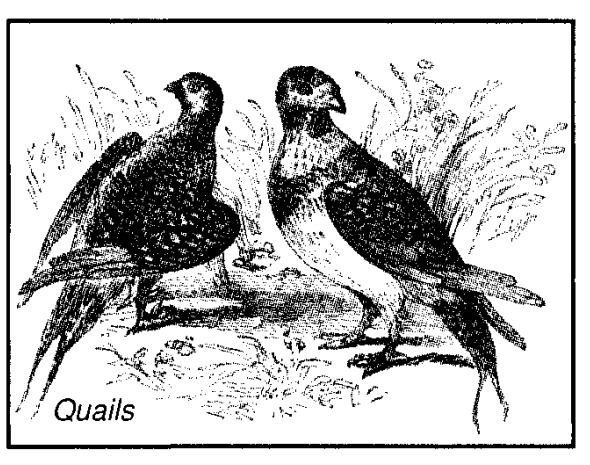
"And it came to pass, that at even the quails came up, and covered the camp" — The Hebrew for "quail" is selav, derived from a root signifying "sluggishness," which is indicative of the slowness of the bird in flight, caused by its weight. As such it is a suitable type for the flesh, and typifies the Lord in the days of his flesh (Jn. 6:63). The quail is a migratory bird which moves up from Arabia to Israel in spring, appearing in immense numbers. Quails are easily caught, being without guile (cp. IPet. 2:22).
"And in the morning the dew lay round about the host" — The Hebrew word for "dew" is tal, and denotes "covering." The dew covered the manna, and reflected the glory of the early morning sun. Millions of gems would flash forth from the heavy fall of dew as the sun of a new day appeared over the horizon (Mal. 4:2). Speaking of the resurrection to life, Isaiah declared: "Thy dew is as the dew of herbs, and the earth shall cast out the dead" (Isa. 26:19). The word for "herbs" is lights in Hebrew referring to the sparkling reflection of the sun's rays in the morning dew. In the morning of the new day, when the "Sun of righteousness shall arise with healing in his beams" (Mai. 4:2), the reflection of his glory shall be seen in those who arise out of the dust to a resurrection unto life. Brother Thomas comments: "They remain in this dew-state until the Sun of Righteousness acts upon them, and transforms them into manna; that is, makes them corporeally like himself — transforms the body that comes out of the grave into a like form to that with which he descends from heaven (Phil. 3:20). To be the subject of this transformation by the Spirit is 'to eat of the manna which has been concealed'." (Eureka, vol. 1 p 313)
VERSE 14
"And when the dew that lay was gone up" — The antitype is seen in the ascension of the Lord (Acts 1:11). Though he ascended into heaven, the manna of his teaching remained to feed spiritual Israel; and was revealed in its fulness for the first time (Rom. 1:3-4).
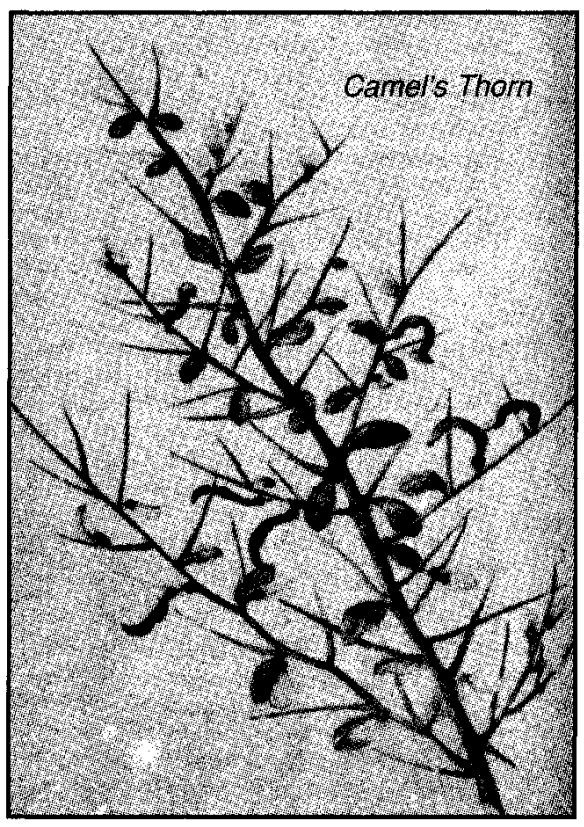
"Behold, upon the face of the wilderness there lay a small round thing, as small as the hoar frost on the ground" — "Hoar frost" is one word in the Hebrew: kephor, and denotes "cover." Frost is white in colour, suggesting a covering of righteousness. Some, in an attempt to rationalise the miracle, suggest that the manna was the natural product of a desert plant, but surely it would constitute a greater miracle than that suggested in the Bible, if suddenly desert plants exuded sufficient gum to satisfy the hunger of two million people! There is a plant called Alhagi camelorum or camel's thorn which grows to a height of about 90cm (3 ft), and exudes a sweet gummy substance often called "manna." If a small insect punctures the stem of the plant, the sugary liquid oozes out to harden into drops which are collected and gathered into baskets by the Arabs. The plant is common throughout the Middle East, and its gum is often called Manna hebraica and Sinai manna, though this should not be confused with the manna sent from heaven to feed the Israelites. This manna was miraculously supplied. It was not known before or after (Deu. 8:3, 16; Josh. 5:12).It was rained down from heaven (Psa. 78:24; John 6:31-32), and appeared only on six days, and not on the seventh (Exo. 16:24-27). Both Jesus and Moses taught that the manna came from heaven, and not from human agency (Jn. 6:31-32; Exo. 16:6,12-13, 15).
Instructions Regarding Manna - vv.15-21.
The "bread" supplied is something unique to Israel, which the people have never seen before. They do not know what to call it, hence the significance of the word "manna." Moses explains that it is bread supplied from heaven, and he instructs the people as to how they are to gather and prepare it.
VERSE 15
"And when the children of Israel saw i7, they said one to another, It is manna; for they wist not what it was" — This statement, as it appears in the A.V. is a contradiction in terms. However, the Hebrew mahn hu does not define an object, but asks a question. It should be rendered, "What is this?" (mg.). The Israelites did not know what it was they found on the ground, and, therefore, did not know what to call it. They were as mystified concerning it as the people were of the Lord Jesus Christ, the manna from heaven, some 1,500 years later (see John 3:3; 4:10; 8:25; 12:34, 38). It is clear, however, that the question they asked in the wilderness demonstrates that the supply of manna was no natural phenomenon, the product of a desert plant, as suggested by some who find the miracle an embarrassment. Moses was used to the area, having dwelt in Midian for forty years, but had no explanation for it, except that it was given of God. Though similar in some respects, the natural substances of the desert plants identified by some as manna, are not large in quantity, nor could they be a principal food. Also, they appear only during a short season of the year. The manna of the Bible [1] was to be Israel's chief nourishment for forty years; [2] it was supplied in large quantities; [3] it was given throughout the whole year; [4] it appeared only on six out of the seven days of the week; and [5] it bred worms if kept two days, except on the sabbath. Clearly this manna was a miracle of Yahweh, and is a type of Christ who, like the manna, was a product of heaven by the Spirit (Luke 1:32-33; John 6:32-40).
The word "wist" in this verse, is Anglo-Saxon for witan, "to know;" thus, "they knew not what it was."
"And Moses said unto them, This is the bread which Yahweh hath given you to eat" — In Neh. 9:15 this is described as God "giving them bread from heaven," which words were cited by the Jews of Capernaum in their discussion with the Lord (John 6:31). The Lord took up the statement, and contrasted the manna then given with "the true bread from heaven" (John 6:32), and in explanation declared: "I am the bread of life; he that cometh to me shall never hunger." In his discussion, the Lord explained that he had come down from heaven in the same way as the manna had been supplied "from heaven." How was that done? Was sufficient of the desert bread manufactured in heaven, and wafted down through boundless space, from God's dwelling place to the earth beneath? Or did God send forth His spirit and manufacture it upon the earth for the use of His people? Undoubtedly the latter, for it is explained that it was done "by the hand of Moses Thy servant" (Neh. 9:14). In similar manner, Yahweh sent forth His spirit, and Jesus, the true bread from heaven was born. This is the statement of Gabriel to Mary, the mother of the Lord (Luke 1:35). In this way, therefore, though not corporeally, the Lord Jesus could claim that he "came down from heaven" (John 6:38).
VERSE 16
"This is the thing which Yahweh hath commanded, Gather of it every man according to his eating" — The word for "man" is ish denoting a principal man, the head of the family. Such were to be responsible for the gathering of the manna. The expression "according to his eating" does not relate to the personal appetite of such an one, but to the number of dependents in his household. The same expression is used in regard to the Passover (see ch. 12:4, and notes there).
"An omer for every man, according to the number of your persons" — For the measure, see note on ch. 16:36.
"Take ye every man for them which are in his tents" — A large family would require more manna than a smaller one.
VERSE 17
"And the children of Israel did so, and gathered, some more, some less" —
The Israelites obeyed Moses, and gathered what they supposed to be the specified amount; but, as a matter of course, some of them exceeded the amount, while others fell short of it. There was no wilful disobedience in this. Some had the strength, ability, dedication, or opportunity to gather more than others.
VERSE 18
"And when they did mete it with an omer" — On returning to their tents with the manna they had collected, the Israelites proceeded to measure it according to the instructions given.
"He that gathered much had nothing over, and he that gathered little had no lack" — Some had been able to gather more than their quota, whereas others were not so fortunate. Nevertheless, when it was all divided out, and a proper distribution made, it was found that there was adequate for all. This taught a powerful lesson which Paul proceeds to expound when citing this passage (2Cor. 8:15). He extracts the lesson that the privileged have a responsibility to help those not so fortunate. He calls upon the affluent brethren of Corinth to assist those who are not as well off, or in want, so that there might be established a sufficiency for such. This principle can be taken further, to illustrate that stronger communities of the faithful have a responsibility to extend themselves to help those who are weaker. If that is done, there will be found a sufficiency for all. The providing of manna in the wilderness demonstrated that Yahweh is the "giver of every good and perfect gift," that all such things come from Him, and therefore, His children are but custodians of those spiritual and material blessings that they receive of His bounty (ITim. 6:16-18).
"They gathered every man according to his eating" — Every family, according to its size, received its proper measure of food.
VERSE 19
"And Moses said, Let no man leave of it till the morning" — In following this instruction, the Israelites demonstrated their trust in Yahweh to supply them each day with their daily bread, so teaching the spiritual principles set forth in the following verses: Deu. 8:3; Mat. 6:33-34; Phil. 4:11: ITim. 6:8; Heb. 13:5. Similar instructions were given in relation to the Passover Lamb, suggesting that the principles expressed thereby should be applied from day to day (see Exo. 12:10).
VERSE 20
"Notwithstanding they hearkened not unto Moses" — This refers to the people as a whole.
"But some of them left of it until the morning, and it bred worms, and stank" — Those referred to in this statement did not manifest full trust in Yahweh to provide them with the necessities of life. Their prayer was not "Give us this day our daily bread," and the result was that the accumulation of the food proved a hindrance rather than a help.
"And Moses was wroth with them" — Like the Lord (Mark 3:5), Moses, though the meekest of men, manifested anger at the disobedience of the people (Num. 12:3; cp. Eph. 4:26).
VERSE 21
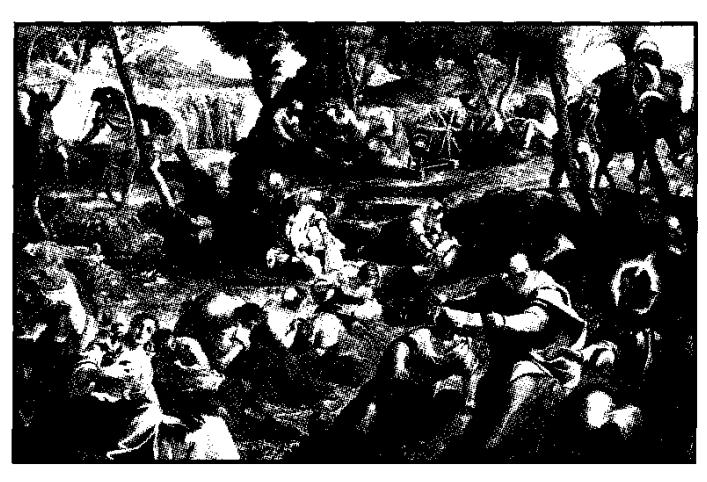
"And they gathered it every morning, every man according to his eating" — Manna was collected in the freshness of the early morning. There is no better time of the day for gathering spiritual manna than when the golden rays of the sun have driven away the darkness of the night (see Psa. 63:1; 108:2), and the mind is rested. This is reflected in the Lord's practice (Mark 1:35). As the Law instructed that the chief men of Israel should each gather food for his family, so it is the responsibility of the heads of families to see that sufficient spiritual manna is supplied to each member under their care.
"And when the sun waxed hot it melted" — Emphasizing the need to gather it early, at the first opportunity. The hoarfrost that covered it prior to this, provided a means of preservation through natural refrigeration. This warns us not to wait until faced by trial and difficulty (when the power of the "sun" of circumstances is felt), but to prepare early to obtain the needful spiritual food for later in the day of opportunity.
Instruction Regarding The Sabbath - vv.22-26.
The Israelites are instructed that manna will be supplied for six days, but not on the seventh. On that day the people are to rest, learning dependence upon the goodness of their Creator. This is the first instruction given concerning this practice, and the first mention in scripture of a sabbath law for man, though the Elohim rested on the seventh day of creation (Gen. 2:21).
The word "sabbath" is used 76 times in the singular, and 35 times in the plural in the O.T., and 60 times in the singular in the NT. The Hebrew is "shabbat" meaning "rest," from a root denoting "to repose." Sabbaths are appointed for the seventh day (Exo. 20:10), some eighth of first days (Lev. 23:39), as well as movable days called "high days" (John 19:31). There were sabbaths of different lengths such as a day (Exo. 16:23-29), a year (Lev. 25:4), and even seventy years (2Chr. 36:21). During the wilderness wanderings, a miracle occurred every sabbath in that the manna, which on every other day went bad if kept, was preserved for that day. This pointed forward to the manna of eternal life, promised by the Lord, to be supplied on the seventh millennium from creation (Rev. 2:17).
VERSE 22
"And it came to pass that on the sixth day they gathered twice as much bread, two omers for one man; and all the rulers of the congregation came and told Moses" — During the previous six days, the people had learned by experience, that it was of no benefit to keep any of the manna above the prescribed amount, as it went bad. But on the sixth day, it was supplied in such abundance that twice as much was gathered, and Moses was approached in order to determine what should be done with the additional omer.
VERSE 23
"And he said unto them, This is that which Yahweh hath said, Tomorrow is the rest of the holy sabbath unto Yahweh" — if the translation were correct, the previous institution of the sabbath, and the knowledge of it by the Israelites, could be argued on the grounds that reference to "the rest of the holy sabbath" implies their familiarity with the practice. But there is no definite article in the Hebrew. It reads: "This is what spoke Yahweh: a festival of rest, a rest of holiness to Yahweh is tomorrow..." (A New Old Testament Interlinear). The appointment of the sabbath law was something entirely new to the Israelites. This is obvious from the narrative that follows, for the people required special instructions as to how it was to be kept (vv. 29-30). Even Moses needed specific instruction as to what punishment should be meted out to those who deliberately broke the sabbath (Num. 15:29-36).
The institution of the sabbath, like that of the passover, preceded the rest of the Law, probably because both were governed by time — for the beginning of the year was changed when Israel left Egypt, to synchronise with the beginning of a new national life in separation from the land of bondage (Exo. 12:2; 13:3-5). Thus Israelites were taught that the sabbath was given by Moses (Neh. 9:14), again implying that it was not inherited from the fathers, Abraham, Isaac and Jacob. The patriarchs were aware of the seven days' division into weeks, but not of a peculiar observance of the seventh day as a day of rest.
The phrase, "the rest of the holy sabbath" is formed of the Hebrew words shabbathoun ("a festival of rest") shab-bath ("rest"). The former defines the purpose of the day: to be devoted as a religious festival; and the latter denotes how the day was to be kept: to be given over to rest. Spiritually, it taught the need for a man to "rest from his own works," to rest from his own labour to satisfy the flesh, and to devote the time exclusively to Yahweh (see Isa. 58:13-14; Heb. 4:10). As a parable it anticipated the millennial rest of Christ's thousand years' reign on earth (Heb. 4:9; 2Pet. 3:8-9).
The Law, however, could not provide a complete rest from the works of flesh, or of sin, for it only emphasised the reality of man's failure to keep God's law (Rom. 7:7-10). This pointed forward to the invitation of Christ: "Come unto me all ye that labour and are heavy laden, and I will give you rest" (Mat. 11:28). Thus life in Christ comprises the true sabbath rest. See further comments on Exo. 20:8-11.
"Bake that which ye will bake today, and seethe that ye will seethe; and that which remaineth over lay up for you to be kept until the morning" — They were to do all their cooking, whether by roasting or boiling of the manna, on the sixth day, so as to be free of all such encumbrances of the seventh.
VERSE 24
"And they laid it up till the morning, as Moses bade: and it did not stink, neither was there any worm therein" — According to Dake's Commentary, this miracle was performed on the 2080 sabbaths held during the wanderings of the children of Israel, which, with the daily provision of manna, comprised some 12,530 miracles performed in the forty years. Unfortunately, after the lapse of time, the daily provision of manna was taken for granted, much the same as the daily miracle of the rising of the sun, and the annual sending of rain on "just and unjust" alike, is taken for granted.
VERSE 25
"And Moses said, Eat that to day; for to day is a sabbath unto Yahweh; to day ye shall not find it in the field" — Again it is obvious that the manna supplied was not the product of a desert bush, for such does not observe the sabbath rest, nor make decisions as on which day it would bloom!
VERSE 26
"Six days ye shall gather it; but on the the seventh day, which is the sabbath, in it there shall be none" — Israelites who heeded Moses' instruction would ensure that on the sixth day they made provision for the future.
Rebuke For Sabbath Breakers - vv. 27-30.
Despite the explicit instructions of Moses, some persist in seeking for manna on the sabbath day. However, they find none, and earn the rebuke of their leader. They are like those who will lack oil in their lamps at the appearance of the bridegroom (Mat. 25:8-13).
VERSE 27
"And it came to pass, that there went out some of the people on the seventh day for to gather, and they found none" — Lack of conviction, or faithlessness, characterised that generation of Israelites (Heb. 3:18-19). They did not go out because of lack of manna, for they had gathered twice as much on the sixth day, but because they doubted Moses1 word that it would not breed worms if kept on the sabbath.
VERSE 28
"And Yahweh said unto Moses, how long refuse ye to keep My commandments and My laws?" — Though Moses had not personally sinned in the way indicated, as the representative of the people he was identified with the national sin. In like manner, Christ is identified with the sins of his people (Heb. 7:27).
VERSE 29
"See, for that Yahweh hath given you the sabbath, therefore He giveth you on the sixth day the bread of two days; abide ye every man in his place, let no man go out of his place on the seventh day" — Moses is ordered to observe a closer supervision of the people, so as to ensure that the sabbath is properly observed. The people should have recognised the solemn religious importance of the day, and honoured Yahweh by observing it properly. Jewish rabbinical tradition has deduced from this context the prohibition that no Israelite shall go further than 2,000 metres from his place of abode on the sabbath. This is called a "sabbath day's journey" (Acts 1:12).
VERSE 30
"So the people rested on the seventh day" — The word "rested" is shab-bathoun indicating that they observed a "festival of rest." This implies that the sabbath was not to be given over to idleness, but constituted a cessation of fleshly duties and thoughts, and the performance of Yahweh's will and pleasure, in the spirit of Isa. 58:13.
Manna Described — v. 31.
A summary of the appearance and flavour of manna is now supplied by Moses in his explanation of the divine law to the Israelites.
VERSE 31
"And the house of Israel called the name thereof Manna" — The term "house of Israel" is an unusual expression, reserved for the nation when engaged in religious exercises (Exo. 40:38). This implies that they recognised the divine provision in what was given. They called it "manna" because it was something new and totally incomprehensible to them; as much as the Lord, the antitypical manna, was to the Jews of his day. His origins and his purpose were entirely misunderstood (Isa.53:2.
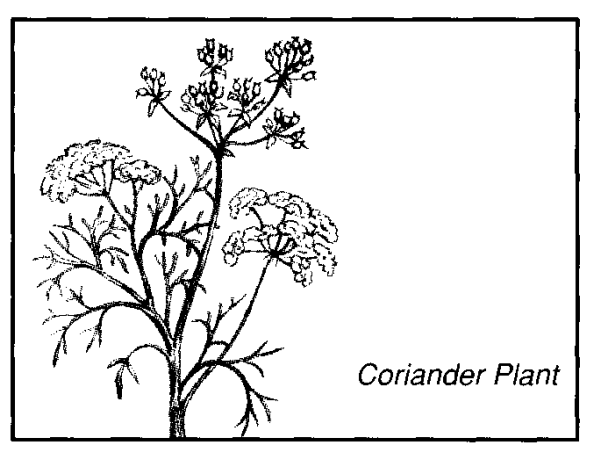
"And it was like coriander seed" — The coriander plant grows wild in the Middle East, producing greyish white seeds, a little larger than hemp, with a pleasant, spicy flavour.
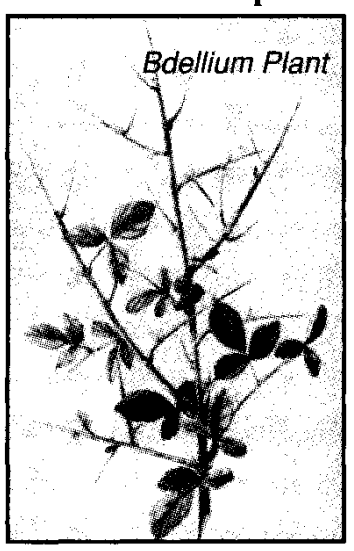
"White" — This suggests purity and righteousness. In Num. 11:7 it is described as bdellium, which Moffatt renders as "resembling pearls." Bdellium (see Gen. 2:12) is an aromatic gum famous for its medicinal qualities. The word is from a root signifying "to separate," and is rendered by some as "pearl."
"And the taste was like wafers made with honey" — Honey is a laxative, soothing, and strengthening. It is related to the Word of God in Psa. 19:7-10 which is also calculated to expel poisons, soothe. and strengthen. In Num. 11:8, the manna is described as having the "flavour of fresh oil." It is said that the Egyptians were accustomed to making cakes of grain, honey and oil, so that the Israelites would be used to the flavour of manna.
The Memorial Pot of Manna - vv. 32-36.
A further miracle is now described in that a pot containing an omer of manna is laid up before Yahweh, to be kept for future generations, so that these might know and ponder the kind of bread that sustained their forefathers throughout their wilderness wanderings. Paul refers to this "golden pot of manna" in the "holiest of αΙΓ (Heb. 9:3-4).
Whether the command was given to Moses at this time, or when the Ark of the Covenant was constructed, is not revealed. It can be assumed that Moses added this section to the Book of Exodus near the end of his life, for "The Testimony" (v. 34) refers to the Ten Commandments which were also deposited in the Ark of the Covenant. This section concludes with an explanation of the measurements used.
VERSE 32
"And Moses said, This is the thing which Yahweh commandeth" — Whenever this command was given, it was obviously carried out after the construction of the tabernacle. It is inserted here by Moses as appropriate to the narrative. See v. 34.
"Fill an omer of it to be kept for your generations" — The golden pot of manna, referred to by Paul, was to remain as a memorial to the goodness of Yahweh as exhibited in the heavenly bread provided during the wilderness wanderings. What happened to it eventually?
According to 2Macc. 2:8, the ark and the golden altar of incense were hidden in a cave which later could not be found. The same record declares that Jeremiah claimed that it "shall be unknown until the time that God gather His people again together, and receive them unto mercy," i.e., until the latter-day restoration.
"That they may see the bread wherewith I have fed you in the wilderness, when I brought you forth from the land of Egypt" — For the purpose to permanently impress upon them the spiritual lessons, as well as the literal, which were later repeated by the Lord when he instructed his disciples to pray: "Give us this day our daily bread."
VERSE 33
"And Moses said unto Aaron, Take a pot, and put an omer full of manna therein, and lay it up before Yahweh, to be kept for your generations" — The manna stored in the pot was miraculously preserved throughout the years. It constituted the "hidden manna" of eternal life (Rev. 2:17). The lesson before the Israelites underlined the teaching of Paul that "godliness is profitable unto all things, having promise of the life that now is [the daily manna], and that which is to come [the preserved manna]" (ITim. 4:8).
VERSE 34
"As Yahweh commanded Moses, so Aaron laid it up before the Testimony, to be kept" — The "Testimony" was not the ark, but the tables of the Law which were likewise placed in the ark with the pot of manna (Heb. 9:4).
VERSE 35
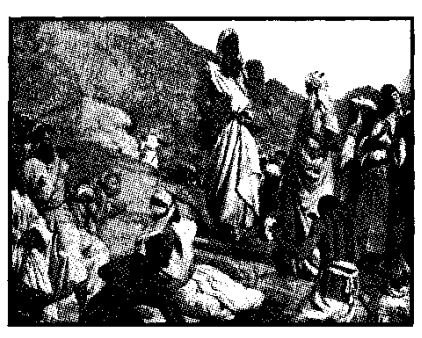
"And the children of Israel did eat manna forty years" — Though manna remained the main article of diet for the Israelites, it was occasionally supplemented by other food (cp. v. 12; Num. 9:2-14). Whatever flocks and herds may have been brought from Egypt would have soon been depleted through supplying flesh for so many people. Already they had been travelling a month (Exo. 16:2), and although they had left with "very much cattle" (ch. 12:38), by now the herds would have been considerably reduced (ch. 17:3). The period of forty years here given, does not lead the narrative beyond the time of Moses, so that there is no reason why Moses could not have written this statement just prior to his death, and inserted it at this place.
"Until they came to a land inhabited" — Even when the Israelites travelled north through the more fertile region east of the Arabah, they continued to receive the daily ration of manna. The type points to the necessary "bread of life," the daily ration of which is essential until the kingdom is reached.
"They did eat manna until they came unto the borders of the land of Canaan" — The manna ceased when they reached the Land of Promise, and therefore continued one month less than forty years (Josh. 5:10-12).
VERSE 36
"Now an omer is the tenth part of an ephah" — The word "omer" is rendered "sheaf in Lev. 23:10, where it relates to the "wave offering" that also types the Lord. In itself, the word signifies "heap," and is reckoned at about 5.1 pints. The ephah was a measure well known to the people, but not the omer, which was not generally used as a measure, and the size of which must be now given.
The description, "the tenth part of an ephah" is significant, for this was the amount given back to Yahweh in sacrifice (Lev. 5:11; 6:20; Num. 5:15; 28:5), so that in sacrifice there was given back to God the amount He had given the people during their wanderings.
In Bible numerics, the tithe is representative of the whole; so there was a sufficiency for all.
Comments