446. EXODUS - CHAPTER NINETEEN
BEFORE THE MOUNT OF GOD
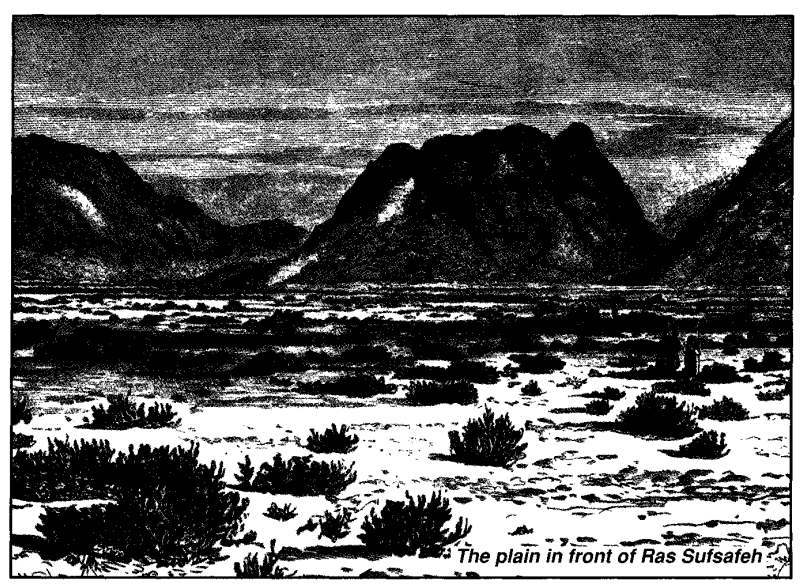
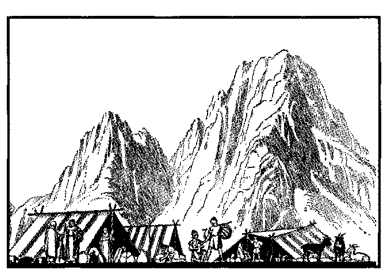
The Children of Israel move from Rephidim to the wilderness of Sinai and encamp before Mount Horeb. They encamp in the Wadi er-Rahah before the cliff Sufsafeh (Horeb) which rises some three hundred metres (1000 ft) before the plain and fifteen hundred metres (5000 ft) above the sea level. The plain itself is broad, beautiful and unobstructed. It has been ascertained that it is sufficiently spacious to satisfy all the requirements of the Scripture narrative. It is not cut up by water courses as are others, but is remarkably level, sweeping in a grand breadth right onwards to the precipitous cliffs of the mountain, which arise with sheer abruptness, and under which they can assemble. From such a mountain the people can, as the narrative requires, remove uafar off" as they did in view of the frightening phenomena when the Voice ceased. The length of the plain is about three and a half kilometres (2 miles), and the multitude can well be imagined seeking for shelter from the immediate terrors of the scene, amid the rugged hollows and ravines at the far end. Whilst Moses ascends the mount, the people remain on the plain, and later are brought before Horeb. In the face of the awful theophany of darkness, smoke, thunder, lightning, earthquake, sounding trumpet and angelic voice, however, the people tremble in terrible fear. Again Moses ascends the mount to meet the angel of Yahweh. But he is instructed to return to the plain and set barriers against the mount lest the people in their curiosity break through to gaze upon it to their destruction.
Yahweh Proclaims His Covenant To Moses — vv. 1-6.
Arriving at Mount Horeb, Moses ascends the mount to receive the invitation covenant relationship with Him.
VERSE 1
"In the third month, when the children of Israel were gone forth out of the land of Egypt, the same day came the into the wilderness of Sinai" — It is conjectured that the Israelites moved towards Sinai by the two passes known as Wady Solaf and Wady es-Sheikh which converge on Wady er-Rahah. The month was Sivan, and the statement "the same day" is literally "on that day," that is, the day the month began. This was forty-six days after leaving Egypt and the forty-third day after of Yahweh to the nation to enter into the first sabbath, and was a Sunday. The giving of the Law itself took place on the fiftieth day from Passover, and was afterwards called the Day of Pentecost (Lev. 23:15-16).
It is of great significance that at the same day of the year, the Holy Spirit was outpoured upon the apostles, and the Truth was publicly proclaimed in the name of Christ for the first time (Acts 2:1). The Law required that Israelites "count the days" (Lev. 23:15) to Pentecost, the idea being for them to recall the circumstances of those days leading to the giving of the Law: the divine miracle and providence, as compared with their faithlessness, complaining, and murmuring against Moses. By so doing, they could recognise their errors and resolve to overcome such failings in the future. The apostles, also, could do the same, bringing to mind their strivings in the upper room, their weakness in the Garden of Gethsemane, their lack of understanding as they tied the cross; their doubts when told that the Lord had risen from the dead, their great joy at the realisation of his triumph; their changed hearts in consequence of his instruction, and their determination to speak forth the Truth faithfully and fearlessly when directed so to do.
The children of Israel arrived at the Wilderness of Sinai on the New Moon, the first day of the month. This was the forty-third day since the seventh day of the week of Passover. On the second day after the arrival Moses ascended the mount to receive the invitation of Yahweh to the nation to enter into covenant relationship with Him. On the third day he received the people's reply. On the fourth day he made his second ascent, and was commanded to institute a two day's preparation (v. 15), at the conclusion of which the revelation was given. This was the fiftieth day, the Day of Pentecost. Maimonides, the celebrated Jewish commentator writes: "We count the days that pass since the preceding festival, just as one who expects his most intimate friend on a certain day counts the days, and even the hours. This is the reason why we count the days between the anniversary of our departure from Egypt, and the anniversary of the law-giving. The latter was the aim and object of the exodus from Egypt."
VERSE 2
"For they were departed from Rephidim, and were come to the desert of Sinai, and had pitched in the wilderness; and there Israel camped before the mount" — Stanley describes the large plain before the cliff known as Ras Suf safeh, or Mount Horeb: "That such a plain should exist at all in front of such a cliff is so remarkable a coincidence with the sacred narrative, as to furnish a strong internal argument, not merely of its identity with the scene, but of the scene itself having been described by an eye-witness. All the surroundings are such as exactly suit the narrative. The awful and lengthened approach, as to some natural sanctuary, would have been the fittest preparation for the coming scene. The low line of alluvial mounds at the foot of the cliff exactly answers to the 'bounds' which were to keep the people off from 'touching the mount.' The plain itself is not broken and uneven and narrowly shut in, like almost all others in the range, but presents a long, retiring sweep, against which the people could 'remove and stand afar off.' The cliff, rising like a huge altar in front of the whole congregation, and visible against the sky in lonely grandeur from end to end of the whole plain, is the very image of 'the mount that might be touched,' and from which the voice of God might be heard far and wide over the plain below, widened at that point to its utmost extent by the confluence of all the continuous valleys. Here, beyond all other parts of the peninsula, is the adytum, withdrawn as if in the end 'of the world' from all the stir and confusion of earthly things."
Another writer has observed: "No spot in the world can be pointed out, which combines in a more remarkable manner the conditions of a commanding height and of a plain in every part of which the sights and sounds described in Exodus would reach an assembled multitude of more than two million people."
There are disputes as to the identity of Mount Sinai, but in answering these it should be pointed out that the Bible is the only source of information concerning the site. The evidence of Scripture requires two peaks connected in some way with each other, one of which is Mount Horeb and the other Mount Sinai. What is known as Ras Sufsafeh and Jebel Musa, together with the remarkable plain in front of the former, provide what is necessary to the narrative. The Jews point to Ras Sufsafeh as Mount Sinai, but, in fact, it is Mount Horeb, whereas Jebel Musa is Mount Sinai. The children of Israel were gathered before mount Horeb to receive the Law, whilst Moses, in turn, ascended both Mount Horeb and Mount Sinai. In camping before "the mount," the Israelites camped before Ras Sufsafeh or Horeb. The forepart of the plain would have been kept clear for the assembling of the people, and the tents of the Israelites would have stretched back in the approaching wadis.
HOREB AND SINAI
The requirements of Scripture are [1J a ''mount that might be touched;" [2] an elevation from whence might sound the voice of God proclaiming the ten commandments to the people; [3] a summit from whence Moses could neither see nor hear the revelries beneath when told by the angel that the people "had corrupted themselves" (Exo. 32:7); [4] a stream descending from the mount to the plain.
All are provided for at the area of modern Ras Sufsafeh and Jebel Musa.
The record of Exodus 32 is important in identifying the twin peaks of Horeb and Sinai. Moses had ascended Sinai, leaving Joshua at an adjoining point. When told by the angel to return, both men walked back discussing as to what the circumstances of the crisis might be, and it was only when "they came nigh unto the camp" (v. 19) that the scene of wickedness opened out to them. Now if they had merely ascended the precipitous cliff of Sufsafeh (identified by the Jews as Sinai), they could have seen what was taking place from the inception. It is only 500 metres (1600 ft) high above the plain, and commands an excellent view of it. It is evident, therefore, that a discrimination must be made between Horeb, from whence the people heard the voice of God, and Sinai up into which Moses ascended: and a careful reading of Scripture will reveal that they are two different peaks of a plateau, and, in fact, are about five kilometres (3 miles) distant one from the other.
SINAI
Here Moses received the Tables of Stone, and remained for forty days. It is defined as the "top of the mount" (Exo. 19:20; 24:16-17; 34:2). Sinai is about 5 kilometres distant from the plain where the Israelites were encamped, agreeing with the narrative that represents Moses and Joshua as hearing and seeing nothing of the revelry taking place until they came closer to the site (Exo. 32:1-20). On arrival at Sufsafeh the scene burst upon them, and in anger Moses descended on the camp and smashed the Tables of Stone at the foot of the mount (Exo. 32:19).
HOREB
Horeb is called "the mount of God" (Exo. 4:27; 18:5; 24:13; IKings 19:8). It is always described as distinct from Sinai which is either given that name or called "the top of the mount" (both Horeb and Sinai are on a plateau). Horeb is close to the plain, at "the nether part of the mount" (Exo. 19:17), "before Yahweh under the mount" (Deu. 4:10-1 1), which expressions require a precipitous cliff, and not the more gradual slopes of Jebel Musa. Yahweh is represented as speaking "face to face" with the people (Deu. 5:4). He could not do that from Jebel Musa, but it is certainly appropriate to Ras Sufafeh. This cliff rises abruptly from the plain and overhangs it, whereas Jebel Musa (the Mount of Moses) throws out from its base a number of spurs and rocky undulations far into the plain. Sufsafeh, therefore, answers to the description of "a mountain that might be touched" (Heb. 12:18), and such as required a barrier to prevent the people coming too near (Exo. 19:23).
YAHWEH SPOKE FROM HOREB
When Yahweh addressed the people it was from Horeb; when He spoke with Moses "face to face," it was from Sinai. In either case, it was not Yahweh personally, but His angelic manifestation that appeared. When He spoke with the people, they were gathered together before Horeb for that purpose (Deu. 4:10; 5:4,26). They heard and understood the words addressed to them (Deu. 4:12, 33, 36; 5:23; Exo. 20:22). This would hardly be possible if the voice thundered to them from a hidden eminence five kilometres (3 miles) distance. Such utterance would be broken up with echoes, so that the words would not be distinguishable. Nor would there be need to "gather the people together," if it sounded for such a distance. Yet later when the people retired to their tents, they no longer heard the voice, suggesting the need to come close to the mount to do so (Exo. 20:21; Deu. 5:27-32). When Yahweh spake thus to the people, Moses was on the plain, not up on Sinai (Exo. 24:1-3).
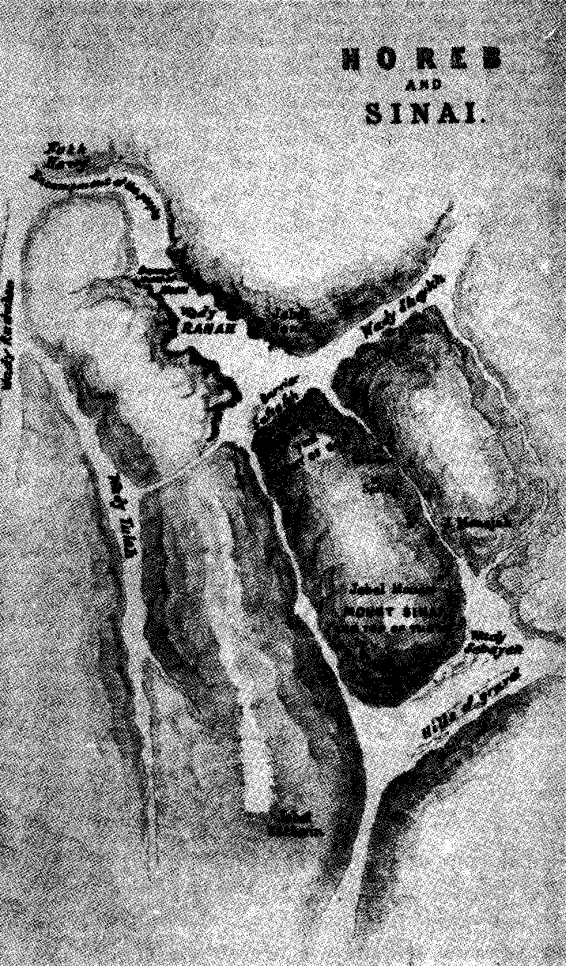
The plain at the foot of Sinai does not answer to the description of the narrative, whereas that in front of Sufsafeh does.
Unlike that in front of Horeb, it is a narrow, rugged, winding valley with spurs from the mount reaching far into it. Therefore, by gathering together all relevant details, we conclude that Horeb and Sinai are two peaks on a mountainous plateau.
Reference to the former is usually described as the "Mount of God," or as Horeb reference to the latter is either by the name of Sinai, "the top of the mount," or some such designation. Where reference is made merely to "the mount" as unnamed, it generally includes the entire range of which Horeb and Sinai are two peaks. Our notes will define each place as we move through the narrative.
VERSE 3
"And Moses went up unto God" — Moses had encamped at the "mount of God" (Exo. 18:5), which elsewhere is defined as Horeb (Exo. 3:1) or Ras Sufsafeh, and it was this cliff that he now ascended (Deu. 5:2).
In all, Moses made seven ascents to either Horeb or Sinai as follows: [1] First ascent (Exo. 19:3-6), descent (vv. 7-8); [2] Second ascent (Exo. 19:8-12), descent (vv. 14-19); [3] Third ascent (Exo. 19:20-24), descent (v. 25); [4] Fourth ascent (Exo. 20:21), descent (Exo. 24:3); [5] Fifth ascent (Exo. 24:12-32:14), descent (Exo. 32:15-30); [6] Sixth ascent (Exo. 32:31-33), descent (Exo. 32:34-34:3); [7] Seventh ascent (Exo. 34:4-28), descent (vv. 29-35).
The giving of the ten commandments was after the third ascent (Exo. 20:1-24:8). The "ascent" of Exo. 24:9-11 was not up into the mount, but only "to" it, as the elders did not ascend the mount with Moses.
"And Yahweh called him out of the mountain, saying" — This was a theophany: Yahweh in manifestation, not in person. God did not personally leave His throne in the heavens. He spoke to Moses through His Elohim (cp. Exo. 20:1-2; 24:9-11). Moses only saw the angel upon whom was placed the Name of Yahweh (Exo. 23:20-23), described as "the similitude of Yahweh" (Num. 12:8). In consequence, Stephen declared that Moses "received the law by the disposition of angels" (Acts 7:53).
"Thus shalt thou say to the house of Jacob, and tell the children of Israel" — The use of both names, Jacob and Israel constitutes a reminder to the people that they can and should develop from one status to the other. From being Supplanters they can become Princes with El, being a kingdom of priests (v. 6).
VERSE 4
"Ye have seen what I did unto the Egyptians" — What Yahweh did to the Egyptians was a great contrast to His protective care of the children of Israel.
"And how I bare you on eagles' wings" — Compare Deu. 32:11 where the metaphor is considerably expanded. The strength and might of Yahweh's sustaining care, and His loving tenderness, are especially observed, particularly His oversight for their welfare in disciplining them. By testing them, He taught the lesson of endurance and faith, never trying them beyond what they were able to bear (1 Cor. 10:13).
The metaphor is drawn of the eagle, or vulture, which is said to stir the fledglings out of the nest to teach them to fly, but continues to hover nearby to bear them up if they fall. In every trial of Israel, whether threatened by the Egyptians, suffering the pangs of hunger and thirst, or challenged by the Amalekites, Yahweh was ever ready to help, and always responded to the prayer of faith uttered by Moses. The Israelites knew that, and therefore were in a position to respond to the appeal of His words.
"And brought you unto Myself — To draw Israel to Himself had been the purpose of Yahweh from the beginning. They had been slaves in Egypt, unlawfully claimed by Pharaoh as his own. They had been snatched from the oppressor, and brought into the presence of God. Now the terms of the covenant by which a permanent relationship could be secured were about to be given them.
VERSE 5
"Now therefore, if ye will obey My voice indeed, and keep My covenant" — The fulfilment of Yahweh's part of the covenant was conditional upon the obedience of the Israelites (see Psa. 81:13-16). At the same time, their acceptance of the covenant was a command obligatory upon them to obey: "a covenant which He commanded them to perform" (Deu. 4:13; 29:1; Psa. 105:8). Knowledge brings responsibility to obey; the alternative being death.
Some imagine that they have a choice in their destiny and that they can continue to defy God with impunity so long as they have not accepted the covenant in baptism. But that was not the case under the Mosaic covenant, and certainly is not so in relation to the Christ-covenant. What would have been the fate of Israel if they had defied the "commandment" to embrace the covenant? The nation would have been left to die. Notice that God does not address Israel as if the nation had any alternative but to obey: He does not set before them the choice as to whether they accept the covenant or not, but rather orders obedience to it.
The word "covenant" is the Hebrew berith which is from the root barah, meaning, to cut or carve, and so denotes a binding agreement established upon the slaying of a covenant-victim with the two parties passing through the divided pieces (Jer. 34:18-19). The antitype is seen in the Lord Jesus who is represented as the covenant-victim of the everlasting covenant (Heb. 9:15-17 — see Diaglott).
"Then ye shall be a peculiar treasure unto Me" — The term segullah signifies "shut away, guarded." It defines a precious possession to be esteemed highly and to be carefully guarded from all that might injure it (see Psa. 135:4). The same word is rendered "jewels" in Mai. 3:17, and there relates to the true Israel of God to be revealed at the Lord's return.
Peter draws upon this promise in stating the privileged position to which believers attain in Christ, for Israel, having rejected their Messiah, the opportunity has been opened for Gentiles to become part of the "Israel of God" (Gal. 6:16), and hence His "peculiar people."
"Above all people" — Amim, and should be rendered in the plural "peoples," and as such it denotes the nations generally. The promise is that no other nation would attain unto the status that Israel would hold, or be equally precious in God's sight. The channel of divine grace and salvation is still through Israel (Eph. 2:11-12), even though the nation, temporarily, has been "cast off."
"For all the earth is Mine" — These words are cited in Psa. 24:1 and 1 Cor. 10:26-28, to illustrate that as Possessor of heaven and earth, Yahweh controls all things. As all the earth is His, in a sense all nations belong to Him, and have a responsibility to render unto Him the obedience due to His name. But in a special sense, He has chosen Israel to be His people (Deu. 14:2), and therefore the people should set an example to others in regard to the obligation of all to obey.
VERSE 6
"And ye shall be unto Me a kingdom of priests" — The Septuagint renders this as "a royal priesthood," constituting the Israelites as both "kings and priests." As a nation, Israel was designed to represent God to other nations: to both rule them and to draw them to truth and righteousness (see Deu. 4:6-8). But the people broke the covenant when Moses was in the mount, and the priesthood was given to Levi (Exo. 32:25-29), and, later, the government to Judah. In Christ, both will be restored as originally intended. All believers are called to be kings and priests (IPet. 2:5, 9), and in the Age to come will constitute a royal priesthood (Rev. 5:9-10), acting as kings and priests with Christ for a thousand years (Rev. 20:4; 1:6. See also Heb. 5:1-3; 2Tim. 2:12; Mat. 19:28).
"And an holy nation" — "Holy" in this relationship means separated. Israel was designed to be different from all other peoples: a nation consecrated to the service of Yahweh, a people outwardly marked out as His by the symbol of circumcision, and demonstrating that they were truly His by the manner in which they clave to Him, and obeyed His laws. They were to reflect the characteristics of Yahweh: "Thou art an holy people unto Yahweh thy God" (Lev. 19:2; 20:26); "He hath chosen thee to be a special people unto Himself, above all people that are upon the face of the earth" (Deu. 7:6). Israel is yet to attain unto this state under Messiah (Isa. 62:12).
Meanwhile, believers "taken out of the Gentiles" to be "a people for the name (Acts 15:14) are constituted the "Israel of God" (Gal. 6:16), and are called to manifest holiness in Christ. Thus, He who said to Israel, "Be ye holy for I am holy" now sets the same ideal before Gentile believers (1 Pet. 1:14-16). Separateness is absolutely essential to sonship in Christ. See 2 Cor. 6:17-18.
"These are the words which thou shalt speak unto the children of Israel" — An elaborate exposition was not necessary: the question was a simple one: Were they prepared to obey, and so build into their individual lives and into the nation as a whole, the divine qualities of the God they worshipped?
The People Accept The Terms — vv. 7-9.
The issue is clear and simple: either accept Yahweh's terms or perish! The people are utterly dependent upon Him for food, drink and protection; to reject His covenant is to die in the wilderness. The people agree to the terms.
VERSE 7
"And Moses came and called for the elders of the people, and laid before their faces all these words which Yahweh commanded him" — Moses descended the mount to the waiting people, called the elders together, and set before them the requirements of Yahweh. They, in turn submitted them to the people.
VERSE 8
"And all the people answered together, and said, All that Yahweh hath spoken we will do" — The decision was unanimous, endorsed by the people as a whole not only on this occasion, but on subsequent occasions as well (Exo. 24:3,7; Deu. 5:27). After all, they had received clear and concrete evidence of the loving-kindness of Yahweh in the care that He had lavished upon them. Common gratitude demanded that they should obey His will.
"And Moses returned the words of the people unto Yahweh" — He ascended Mount Horeb for this purpose. This being the second ascent, it probably took place the following day: a Wednesday according to our calendar.
VERSE 9
"And Yahweh said unto Moses, Lo, I come unto thee in a thick cloud" — The expression literally is, "in darkness of clouds." The angel who bore the name of Yahweh (Exo. 23:21), and who displayed His glory, would veil himself in clouds, in order to speak directly to the people. The full shining forth of divine glory, even through created beings, would be too much for flesh (cp. Mat. 28:3-4). Yahweh dwells in unapproachable light" (1 Tim. 6:16), and must veil Himself in His approach to man. It is an evidence of His goodness that He condescends to do so.
"That the people may hear when I speak with thee, and believe thee forever" — Yahweh determined to speak directly to the people to convince them that Moses was divinely appointed and sent, and that he was not performing his miracles through sorcery or enchantment as did the magicians and priests of Egypt. Nevertheless, the effect upon the people was devastating. They preferred to treat with God through His appointed mediator, Moses (Exo. 19:18-22; 20:18-21; Deu. 4:11-13,36; 5:5,22-29; Heb. 12:18-21), witnessing that the way into the Holiest for individuals was not yet revealed (Heb. 10:18-20).
Meanwhile, the fact that Yahweh offered to speak to the people, implies that He must have done so from Mount Horeb, and not from Sinai which was five kilometres (3 miles) distant from the plain upon which they stood. Nor did the divine voice reverberate among the valleys like a trumpet, for if it did, it would be so broken up by echoes that the words would be almost indistinguishable. On the contrary it was clear and comprehensible. It was more like the "still, small voice" that Elijah also heard at this spot, for when the people in fear withdrew from before the mount, they could no longer hear it, and had to depend upon Moses transmitting the instructions of Yahweh to them (Deu. 5:27-28). To hear the voice of God direct, was a great privilege, well calculated to impress the people with the divine mission of Moses (cp. Deu. 4:10, 33-39).
"And Moses told the words of the people unto Yahweh" — He again reiterated that the people were prepared to accept the terms of the covenant, and obey the voice of God.
Moses Instructed To Sanctify The People — vv. 10-13.
The people are now to be made ready for the greatest experience in human life: the hearing of God's voice. Three things are to happen: God shall appear veiled in cloud: the people shall hear when He speaks and Moses will be believed for ever after. Special preparations are required for this, such as will occupy two days. Moses is instructed to return to the people and prepare them for the occasion.
VERSE 10
"And Yahweh said unto Moses, Go unto the people, and sanctify them to day and tomorrow" — The word "sanctify" is from the Hebrew qadash and signifies "to set apart, to make clean, to purify." On this occasion, the cleansing was to be accomplished by ceremonial washing and abstinence. Thus the sanctification referred to, as in Gen. 2:3 and Exo. 13:2 does not, in itself, denote a moral cleansing, but a setting apart unto God. The sanctification before the mount occupied two days in preparation for the third day, and it made the people ready to hearken to God's voice, and to receive the Law at His mouth (vv. 10-11, 14-15).
In addition, the mount was sanctified, or set apart (v. 23), showing that physical sanctification does not necessarily denote a moral change. In spiritual numerics, "3" has the significance of baptism and resurrection, for on the third day the earth appeared above the waters, and brought forth growth (Gen. 1:10-13), and on the third day the Lord was brought again from the grave. After two millennial days, the nation will be revived in accordance with Bible prophecy (cp. Hos. 6:2).
The two-day sanctification before the mount was to prepare the people for a new life before God.
"And let them wash their clothes" — The people were directed to a ceremonial washing or cleansing as indicative of what was required morally. The priests separated themselves, or sanctified themselves from the people, for the same purpose (Exo. 19:22). Bathing the body always was associated with washing the clothes. Both were considered necessary in order to meet with Yahweh (Lev. 14:8-9; 15:5; 17:15-16; 22:6, etc.).
VERSE 11
"And be ready against the third day" — The Day of Pentecost when the Law was given. Notice the instruction of the Lord to his disciples likewise to be ready and "wait for the promise of the Father, which ye have heard of me" (Acts 1:4). On that day, they, too, received a new revelation, and proclaimed a new law in the name of Christ.
"For the third day Yahweh will come down in the sight of all the people upon mount Sinai" — This was fulfilled on the Day of Pentecost when the Ten Commandments were proclaimed to the people as the basis of the Covenant. But as "3" is the number of resurrection (ν. ΙΟ-Ι1), we, today, await the prophetical fulfilment of the antitype when "all the people" will be gathered before Yahweh manifested in His Son. For the fulfilment of this promise, see v. 20.
VERSE 12
"And thou shalt set bounds unto the people round about" — A barrier was to be erected at the foot of the mount before which they were gathered. This was Mount Horeb, today known as Ras Suf-safeh, at the foot of which there is a line of low alluvial mounds. These could have provided support for the artificial barrier, or fence, that was also erected at the instruction of Moses.
"Saying, Take heed to yourselves" — A personal instruction to every individual. In similar manner, on the Day of Pentecost following the Lord's ascension into heaven, the apostles urged the people: "Save yourselves from this untoward generation" (Acts 2:40). Earlier the Lord had impressed the apostles with the fact of personal responsibility by an exhortation that reaches down to our day: 'Take heed to yourselves..." (Luke 21:34).
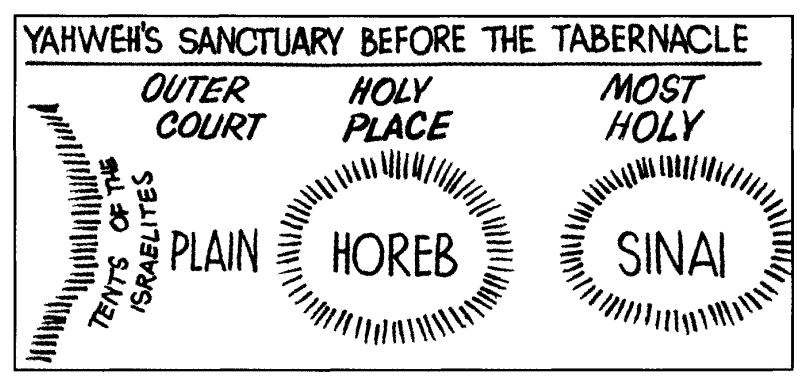
"That ye go not up into the mount, or touch the border of it " — The mount where God's glory was about to be revealed would, for the time being, be a sanctuary, endowed with the unapproachable sacredness of the ark or the Holy of Holies in the tabernacle to be built. In that relationship, Horeb and Sinai stand related to each other as the holy place and the most holy did in the tabernacle, whereas the plain before the mount was as the outer court where later the people assembled for worship.
"Whosoever toucheth the mount shall be surely put to death" — These words are cited by the apostle in contrasting the Covenant of Law with the benefits of the Covenant of Grace (Heb. 12:20). The former brought home to the people a recognition of sin and the reality of death (Rom. 7:10-14); the latter offers life through the forgiveness of sins. The type of the former is Mount Sinai; that of the latter is Mount Zion (Heb. 12:18-24; Gal. 4:24-26). There was no prospect of eternal life in the Covenant of Law because it would be impossible for flesh in its weakness to completely fulfil all its requirements (Rom. 8:3), but in Christ, man is delivered from the curse of the Law (Gal. 3:13). Because of his very nature, man is utterly dependent upon the mercy of God, leading the apostle Paul to conclude: "Ye are come... to Jesus the mediator of the new covenant, and to the blood of sprinkling, that speaketh better things than that of Abel" (Heb. 12:24). The blood of Abel cried out for justice and vengeance (as did the Law), but that of Christ proclaimed grace and mercy. The Old Covenant demonstrated the dire need of a Redeemer; the New Covenant provided the One promised, and so supplied that which was lacking in the Old.
In commanding the people to abstain from touching the mount, and threatening them with death if they did so, the Law demonstrated that all that the Old Covenant could offer in the face of disobedience was death. This led Paul to conclude that "the commandment, which was ordained to life, I found to be unto death" (Rom. 7:10). The Law emphasised the weakness of the flesh, and in doing so, highlighted the need of a Redeemer. Thus it acted as a schoolmaster to bring the people to Christ that they "might be justified by faith" (Gal. 3:24).
VERSE 13
"There shall not an hand touch it" — The pronoun should be "him" not "it." The reference is to the transgressor. The guilty party must not be seized by the hand, as that would cause a repetition of the offence. Guilt, or ceremonial uncleanness under the Law was transmittable from one person to the other. See the question and answer recorded in Hag. 2:13.
"But he shall surely be stoned, or shot through; whether it be beast or man, it shall not live" — The purpose of death by stoning or spear was to avoid contact with the guilty party, for to touch such was deemed as having identified oneself with the crime, and so to be accounted unclean. The law taught the basic truth that mankind easily succumbs to influences of sin and wickedness.
"When the trumpet soundeth long" — The word for "trumpet" is yubale, more commonly known as jubilee, and is rendered in the margin as "cornet." The instrument referred to is also called "the ram's horn," because it is shaped like one.
"They shall come up to the mount" — Permission was given the people to ascend to the mountain at the sounding of the trumpet. Though the verb alah signifies "to ascend," it does not always have that meaning (cp. Jos. 10:4, 6; Jud. 15:10, etc.). To "come up to the mount," can mean to advance up the slope to the foot of Horeb, and this is evidently what is meant by the invitation. Cp. v. 12.
The People Are Sanctified — vv. 14-15.
In accordance with the instructions given Moses, the people sanctify themselves for two days in preparation for the meeting with God on the third.
VERSE 14
"And Moses went down from the mount unto the people" — This constituted the second descent from Horeb.
"And sanctified the people, and they washed their clothes" — See note v. 10.
VERSE 15
"And he said unto the people, Be ready against the third day" — They were to make mental preparation as well as engaging in ceremonial cleansing in preparation for the third day.
"Come not at your wives" — They were to avoid sexual intercourse, so as to give their undivided concentration to the revelation to be given. See 1 Sam. 21:4-5; 1 Cor. 7:5.
The Trembling People And Awe-inspiring God — vv. 16-25.
All preparations having been made, the day of the theophany dawns amid thunders, lightnings, thick cloud, and earthquake (Psa. 77:18). The ear-splitting sound of the shophar trumpet reverberates throughout the valleys sounding louder and louder, causing the people to tremble in fear. Yahweh descends in fire on to the heights of Mount Sinai five kilometres distant, and smoke ascends far into the heavens, so that the people in their tents can see it. Moses, likewise moved with fear, nevertheless, in accordance with the instructions of Yahweh, leads the trembling people to the north-western side of the mountain plateau to meet with God.
Meanwhile the trumpet sounds louder and louder, until its noise fills the valley causing even Moses to express his fears. He is ordered to leave the people and ascend to the top of the Sinai. After fulfilling this mission he is instructed to return to the people with further warnings against touching the mount. Despite his assurances that this has already been done, he is ordered back to the people with a message of warning to deliver to them.
VERSE 16
"And it came to pass on the third day in the morning" — See note v. 11.
"That there were thunders and lightnings, and a thick cloud upon the mount" — In treating with this incident, the Psalmist implies that there was also a storm of rain (see Psa. 77:16-18; 97:2-5; Heb. 12:18-19, 26; Deu. 4:10-12). The mount also quaked (v. 18).
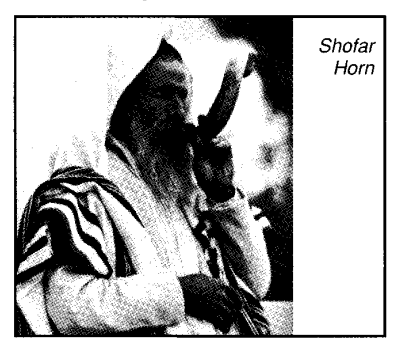
"And the voice of the trumpet exceeding loud" — Here the word for "trumpet" is shophar. The shophar sound is an ear-splitting, clear, sharp, cutting note that comes in short bursts, in contrast to the yobale (v. 13) which gives a long, continuous note. Evidently the noise was continuous: the shorter notes of the shophar gradually becoming longer until they merged into the yobale note.
In Lev. 25:9, both words are used in conjunction "the trumpet {shophar) of the jubilee {yobale) to sound." The shophar trumpet is sometimes called the "ram's horn" (Jos. 6:5). Its sharp commanding notes represented the voice of authority, and therefore were appropriate at Sinai, as well as on subsequent occasions when there were calls for action (Jos. 6:5; Jud. 3:27; 6:34; 7:16-18). The word is rendered "cornet" in IChr. 15:28; 2Chr. 15:14; Psa. 98:6; Hos. 5:8. Some see shophar as denoting "ram" or "ram's horn" (see Gese-nius and cp. Jos. 6:4,6, 13).
The shophar was heard at Sinai (Exo. 19:16), on the Day of Atonement (Lev. 23:24), at the beginning of the year of jubilee (Lev. 25:9), to announce the new moon (Psa. 81:3). It gave warning of judgment and war (Jos. 6:5; Jud. 3:27; 6:34; 7:16-18). It was used when issuing commands and directions (ISam. 13:3; 2Sam. 2:28); for proclaiming the accession of a king (lKgs. 1:34), or to warn of approaching danger (Jer. 4:5; Eze. 33:3; Joel 2:1).
It was thus the Voice of Authority. It proclaimed the principles of divine justice and awful majesty in the staccato blasts at Sinai. But when the priest sounded the long, drawn-out jubilee note in the year of Jubilee, it announced His mercy and grace (Lev. 25:9). On the Day of Atonement, it called the people to humble themselves in contrition (Lev. 23:24); at Jericho and in the time of Gideon, it warned of impending and inevitable judgment on Israel's enemies.
The loud, harsh, staccato note of the trumpet, waxing louder and louder, instilled fear into the hearts of both people and leader on that day when they had to meet with their God.
The effect of the pre-emptory, strident, warning note of the shophar trumpet at Sinai is recalled on every Jewish New Year's Day which is set aside as "a memorial of blowing of trumpets" (Lev. 23:24 — the seventh month of Israel's religious year is the first month of its civil year). The significance of this memorial has been explained by the Jewish commentator Maimonides, as follows: "The sound of the shophar, consisting, as handed down by tradition, of three distinctive shophar notes (tekiah, shavarim, teruah) has been looked upon from time immemorial as a call of contrition and penitence, as a reminder of the shophar sound of Sinai; and the Day of Memorial, the beginning of the ten days of Repentance, which culminate in the Day of Atonement (Lev. 23:27), as a time of self-examination and humble petition for forgiveness. The scripture injunction of the shophar for the New Year's Day has a profound meaning. It says, 'Awake, ye sleepers; and ponder over your deeds; remember your Creator and go back to Him in penitence. Be not of those who miss realities in their pursuit of shadows, and waste their years in seeking after vain things which cannot profit or deliver. Look well to your souls and consider your acts; forsake each of you his evil ways and thought, and return to God so that He may have mercy upon you."
At Sinai, Yahweh deliberately instilled fear into the people for a very good reason: not merely to frighten them, but to fill them with reverence, causing them to more clearly recognise their solemn obligations towards Him. "The fear of Yahweh is the beginning of knowledge" (Pro. 1:7 — the word "beginning" signifies "firstfruits" — see also Psa. 111:10; Pro. 2:5; 8:13), whereas "love is its completion" (Col. 3:14; 2Jn. 6). Fear was induced at the giving of the Old Covenant; love is manifested in the New. Both are necessary for true worship. The former prevents the latter from becoming too familiar; the latter prevents the former from deteriorating into mere servility. A blend of both fear and love elevates the respect and filial affection that is due to Yahweh, resulting in Him being obeyed as a Master and honoured as a Father (Mal. 1:6).
"So that all the people that was in the camp trembled" — Even Moses trembled (Heb. 12:21); a great contrast to Christ, the mediator of the New Covenant (see 1 Jn.4:18).
VERSE 17
"And Moses brought forth the people out of the camp to meet with God"— This was in obedience to the command of v. 13. See also Deu. 4:10.
"And they stood at the nether part of the mount" — The word tachtiy, rendered "nether," signifies the lowermost. The people moved to the foot of the mount: the base of the precipitous cliff of Horeb (Deu. 4:10) where the barriers had been erected.
VERSE 18
"And mount Sinai was altogether on a smoke, because Yahweh descended upon it in fire" — Mount Sinai is about five kilometres (8 miles) distant from the plain, so that the theophany was far removed from the people. However, as the smoke billowed up they were able to see it in the sky above.
"And the smoke thereof ascended as the smoke of a furnace, and the whole mount quaked greatly" — The smoke ascended up into the very heart of heaven (Deu. 4:11), blotting out the light of the sun, causing an unnatural darkness. As though that were not enough, the quaking of the earth added to the terror of the moment.
VERSE 19
"And when the voice of the trumpet sounded long, and waxed louder and louder" — The shorter notes of the shophar became longer and louder, echoing among the valleys until the people were encompassed with its earsplitting harsh noise.
"Moses spake" — Moses does not record what he said, though, according to Paul, he was so overcome with the awful grandeur of the theophany that he declared: "I exceedingly fear and quake" (Heb. 12:21). In speaking thus he represented the feelings of his people.
"And God answered him by a voice" — No message is recorded; yet the fact that Moses was invited to ascend the mount was encouragement and reassurance to him not to fear the consequences
of the divine manifestation.
VERSE 20
"And Yahweh came down upon mount Sinai, on the top of the mount" — See previous notes on Sinai. In the sanctuary of the mount, Sinai represented the Most Holy, while Horeb stood for the Holy Place. Though, from where the people were standing on the plain of Er-Rahah at the foot of Horeb, they could not see Sinai, they could see the smoke and other evidences of the presence of Yahweh in
manifestation. In that way, therefore, He came down upon mount Sinai "in the sight of all the people" (v. 11).
"And Yahweh called Moses up to the top of the mount; and Moses went up" — He ascended to the height of Sinai some five kilometres (8 miles) distant. We can imagine the trepidation with which Moses would make his way up the steep slopes of Sinai into the midst of such terrifying manifestations of divine power and glory. But though among the meekest of men, Moses possessed great faith and courage. He not only feared, but also loved Yahweh, and had implicit trust and confidence in Him.
VERSE 21
"And Yahweh said unto Moses, Go down, charge the people, lest they break through unto Yahweh to gaze, and many of them perish" — Irreverent gazing on holy things was forbidden by the Law (Num. 4:20). In view of the fear that dominated the Israelites at the foot of the mount, one would imagine that there was little need to warn them to keep back, and this is how Moses reasoned when requested to return with such a message. But there is no plumbing the desperate wickedness of the human heart, and some may have attempted to look out of mere bravado, in order to gain reputation from others. The great God, who knows the wilfulness and presumption of flesh, thought good to return Moses with this message.
VERSE 22
"And let the priests also, which come near to Yahweh, sanctify themselves, lest Yahweh break forth upon them" — Prior to the consecration of Aaron and his sons to the priesthood, the legal firstborn of a family acted as a priest. Subsequently, because of national transgression, such priests were superseded by the Levites (Num. 3:45; 8:16).
At this point, however, the legal firstborn, as priests, are ordered to sanctify themselves, by separating themselves from the main body of the people.
VERSE 23
"And Moses said unto Yahweh, The people cannot come up to mount Sinai: for Thou chargedst us, saying, Set bounds about the mount, and sanctify it" — Moses placed more confidence in the man-made barriers and in people than did God! This is typical of flesh.
VERSE 24
"And Yahweh said unto him, Away, get thee down, and thou shalt come up, thou, and Aaron with thee" — Moses is ordered to return to the people, in order to supervise them. This is very necessary as far as flesh is concerned. It soon forgets fear and becomes defiant.
Yahweh's further instruction to Moses to come "up to the mount" with Aaron, does not mean that they were to ascend it, but that they were to leave the body of the people and come closer to its foot. Moses was with the people when the Ten Commandments were given and did not again ascend until instructed to do so (see Exo. 24:1).
"But let not the priests and the people break through to come up unto Yahweh, lest He break forth upon them" — From these instructions it would appear that the Israelites were divided into three groups: [1] the body of the people [2] the priests: [3] Moses and Aaron.
VERSE 25
"So Moses went down unto the people, and spake unto them" — He solemnly instructed them as he was commanded to do, and was with them when God proclaimed the Ten Commandments as the basis of the Covenant.
Comments