CHAPTER TWENTY-ONE
FURTHER JUDGMENTS
The Ten Commandments formed the basis of the Mosaic Covenant (Exo. 34:28; Deu. 4:13), whereas the additional judgments now outlined comprised portion of the Book of the Covenant (Exo. 24:7). Both the Ten Commandments, and the Book of the Covenant, provided the nucleus upon which the rest of the Law was based. All this was proclaimed from Horeb: the Ten Commandments to the people, and the Book of the Covenant to Moses. Later the Ten Commandments were inscribed on stone and given to Moses (Exo. 31:18). As harsh as the judgments of the Law might appear, in the Christ covenant capital offences are treated even more severely (Heb. 10:28-30). Therein unreasonable hatred is considered as equivalent to murder (Uohn 2:9,11; 3:15; 4:20); anger without due cause is treated as the intent to murder (Mat. 5:21-22). The respect that the Law demanded of children towards parents is made subordinate to that due to Christ (Luke 14:26; Mat. 10:37). The Law permitted retaliation in non-capital offences, but Jesus, whilst recognising that the Law was just, asked that love and forgiveness prevail (Mat. 5:38-44). He warned that if his followers do not do so, the law of retaliation will be applied against them at the Judgment Seat (Mat. 7:1-2; cp. Rev. 16:6; 18:6-7). See how the same law of retaliation is applied in the exercise of love (Luke 6:38), and in the consideration that should be shown towards servants etc. (Eph. 6:9; Col. 4:1). In short, the believer in Christ will apply the principles of the Law more stringently than the Mosaic Code required. He will go beyond the Law, and seek to apply the spirit of its commandments. Thus, in Christ, he is not so much delivered from the Law, as delivered from its curse; the Law remains as a guide and a teacher now.
Concerning Masters And Servants — vv. 1-11.
The Law carefully legislates against abuse, when an individual, through necessity, has to sell himself into slavery. These rules apply only to Hebrew slaves (Lev. 25:44-46), and are designed to protect their individual rights. It is important to observe the typical or prophetical application of the various laws.
VERSE 1
"Now these are the judgments which thou shalt set before them" — The people had withdrawn to their tents, and the angel now addresses Moses, delivering unto him these judgments. The word is mishpatim and signifies "verdicts" or "decrees." Given whilst the Israelites were in the wilderness, they were more particularly to be the basis of the social foundation of the new order to be established when they were settled in the promised land (Deu. 4:14).
VERSE 2
"If thou buy an Hebrew servant" — An example of the application of this judgment is given in Jer. 34. Many poor Hebrews had been compelled to sell them
selves to their more wealthy brethren, and the latter were warned against going beyond the limitations of service set down by this decree. It was because they failed to carry out Yahweh's requirements in that regard, that the nation was taken into captivity (Jer. 34:18-20). Hebrews became slaves through poverty (Lev. 25:35), and sometimes also through crime (Exo. 22:3).
"Six years he shall serve: and in the seventh he shall go out free for nothing" — The seventh year referred to in this verse is the seventh year of his servitude, and not the sabbatical year.
This is a parable of Yahweh's bondservants. In Romans 6, Paul sets forth the analogy of God's servants as those who have been purchased from the slave-owner Sin (the flesh) to serve Righteousness (Rom. 6:18). Such servitude has continued for six days of a thousand years each (cp. 2Pet. 3:8), but for those who have laboured faithfully for God it will terminate in the glorious freedom of the millennium when they shall be rewarded with eternal life (Rom. 6:23).
VERSE 3
"If he came in by himself, he shall go out by himself — Under normal conditions servitude brought no gain. A Hebrew might sell himself through poverty, and would receive food and clothing during the six years of his service, but that would be all. He came in "with his body" (see margin), and he went out with his body.
"If he were married, then his wife shall go out with him" —If he were married when he went into servitude, she went out with him.
VERSE 4
"If his master have given him a wife" — If the slave was unmarried when he went into servitude, or if his wife died, and his master then gave him a wife from among his female slaves, the master was not to lose his property in his female slave by reason of having permitted the marriage. When the man claimed his freedom at the end of the sixth year, he was to "go out" alone.
"And she have born him sons or daughters; the wife and her children shall be her master's, and he shall go out by himself — The children belonged primarily to the mother, and therefore remained with her.
VERSE 5
"And if the servant shall plainly say, I love my master, my wife, and my children; I will not go out free" — Masters were commanded to treat their slaves as hired servants, bearing them every consideration (Lev. 25:39-43). If a slave was well treated by his master, and had married and obtained a family, he might well prefer to remain in servitude. Very often the condition of slaves in a good household was better than that of free men in the hurly-burly of life. This was the case in less enlightened ages with negroes and similar slaves, and would certainly be so in a home governed by the Word, in which the head of the house recognised that he has a Master in heaven to whom he must give account.
This legislation concerning slaves not only regulated life in Israel, but constituted a prophecy of Yahweh's purpose with His people. They were in servitude to sin. They brought nothing in except their body, and it was certain they would take nothing out (see ITim. 6:8). They might have received benefits during life, in wives, sons and daughters, but when the time of release came, having fulfilled the term of their service, they obtained freedom only for themselves.
But if a slave had been given a wife, and had gained sons and daughters, he was permitted to remain with them in perpetual servitude; in which case he waived the opportunity to be freed.
That is exactly what the Lord Jesus did. He came as Yahweh's suffering servant, upheld by his heavenly Master who delighted in him (Isa. 42:1). During the period of his servitude, he obtained a wife and children. The wife constituted "Jerusalem which is above" (Gal. 4:26; Rev. 21:9-10), the children, the members of various ecclesias concerning whom he declared: "Behold I and the children which God hath given me" (Isa. 8:18; Heb. 2:13).
When the time of "release" came, he refused to accept it, and instead continues to serve his Master in heaven on behalf of his wife and family, in loving service both to them and to Yahweh. A slave who had come to love his master, his wife and chilldren, would appreciate the motives of Christ.
VERSE 6
"Then his master shall bring him unto the judges"— The word "judges" is elohim, the same word so frequently translated "God," and is the word rendered "angels" in Psalm 8:5. The term is used for the administrators of Yahweh's Law in Israel, because in doing so they became His representatives (see Psa. 82:6).
Notice also the Lord's use of this title in John 10:34-36. He asked the Jewish leaders who accused him of blasphemy because he claimed to be the Son of God, how they could reconcile their charge with the fact that "those to whom the Word of God came," are called "gods" {elohim) in the O.T. Scriptures! The Lord could certainly claim the title, for he was the complete manifestation of the Father.
As in the legislation before us, the willing slave was presented before earthly elohim (the judges), antitypically the Lord Jesus Christ was brought to the heavenly Elohim (see IPet. 1:12; Dan. 7:13-14; Acts 1:9).
"He shall also bring him to the door, or unto the door post"— The slave was brought to the entrance of his master's house, its most prominent and public part, and affixed by the ear to it, symbolising that he was ready to hear and obey all that was asked of him. Figuratively the Lord did likewise in regard to his Father's "house," the ecclesia. He is identified with "the door" (Jn. 10:7; 14:2; Heb. 3:6).
"And his master shall bore his ear through with an aul"— The word for "aul" is martsea from a root to pierce. The typology of the act proclaimed that the servant, or slave, had voluntarily agreed to serve that house forever, and therefore his ear was permanently opened to all that was required of him in relation to it. The type is used of the Lord Jesus Christ. In a Messianic Psalm (Psa. 40:6-8), prophetically setting forth the principles of Christ's sacrifice, the Spirit is represented as saying:
"Sacrifice and offering Thou didst not desire; Mine ears hast Thou opened: Burnt offering and sin offering hast Thou not required. Then said I, Lo, I come; In the volume of the book it is written of me, I delight to do Thy will, Ο my God: Yea, Thy law is within my heart."
These words are cited in Hebrews 10:5-8 and applied to the Lord. The statement: "Mine ears hast Thou opened," is rendered by the R.V. as "Mine ear hast Thou pierced." Pierced ears, or "digged ears"(see A.V. mg) are ears opened to receive the instruction and teaching of God, and because of this, become part of a body prepared" to do the will of the Father. Hence the explanatory rendering of Heb. 10:5. The Lord's willingness to serve the Father because of his great love for both Him and his Bride is thus prophetically expressed in the ordinance concerning willing slaves provided for in the Law. Hence, here again, the Law becomes a "shadow of good things to come"(Heb. 10:1).
"And he shall serve him for ever"— Josephus and others maintain that the law of the jubilee release overruled this enactment, but there is no confirmation of this in scripture. If the willing servant loved his master as well as his wife, he would doubtless prefer to continue in association with him beyond any period of jubilee, for servitude under those circumstances becomes a joy. When a person finds pleasure in his labour, he does not want release from it, no matter how exacting or how difficult the work might be. His joy is in its completion and in the pride of accomplishment. Most of the industrial strife of today stems from complete boredom in work, in the refusal to find pleasure in labour.
What does the Psalm say? "I delight to do Thy will, Ο my God; yea, Thy law is within my heart" (Psa. 40:8). It was this that made the Lord's offering so acceptable, for as the Psalm implies, Yahweh does not desire ritual "sacrifice and offering" in the absence of such an attitude. He desires necessary sacrifices, only when properly presented: salted with the offerer's delight in performing that in which God takes pleasure. Love of God will motivate an offerer to render such a service.
Perhaps we can see a little more in the statement, "He shall serve him for ever," when applied to the substance of the divine purpose (of which the Law was but the shadow). How could the servant serve his master for ever? It was a physical impossibility, for in the course of nature both would die. But what of those who have been "bought with a price," and constitute "the slaves of righteousness?" For how long is their service? If you are among their number (Rom. 6:18), Ο reader, you have been called to an eternal service. So Paul concludes: "For the wages of sin (our previous slave owner — see v. 17) is death; but the gift of God (the gracious gift that He extends to those servants who love Him, and whom He loves in return) is eternal life through Jesus Christ our Lord" (Rom. 6:23).
Christ loved his Father, and his captive spouse, and the children that were given him, and would not be released from his undertaking, but engaged to serve in it for ever (Isa. 42:1-4). Great cause have we to render unstinted service back to God. We have every reason to love our Bridegroom espoused during the period of our common servitude, and to rejoice in the love he has shown towards us. Christ told his apostles, "I will not leave you comfortless" (John 14:18). In that fact, in the assurance that he will extend himself to help us in every circumstance, we can reach to the peace which passes the understanding of man (John 14:27). As the Lord has been prepared to remain in servitude to help us, we can look forward to the future with every confidence.
VERSE 7
"And if a man sell his daughter to be a maidservant" — There are different Hebrew words to denote "maidservant" (ct. Exo. 20:10). Here the word is amah, and signifies a female servant. The term is sometimes used deprecatorily in the spirit of humility (1 Sam. 1:11,16; I Kings 1:17), but in the present context, it denotes one acquired to be made the concubine, or secondary wife, of the purchaser. If this intention were carried out, then she was entitled to her status and maintenance as a wife during her lifetime, even though her husband might take another legitimate wife (cp. v. 10, and see the term used in this sense, for married concubines in Gen. 20:17; Jud. 9:18).
The same Hebrew word is rendered "bondwoman" in Gen. 21:10, 12-13; and "handmaid" in Exo. 23:12; Ruth 3:9. Most significantly of all, the word is used of Mary, the mother of the Lord, in her relationship with Yahweh (Psa. 86:16; 1 16:16). That faithful young woman recognised her status when the news was brought to her by Gabriel that she was to be the mother of the Lord. She willingly responded: "Behold the handmaid of the Lord; be it unto me according to Thy word" (Luke 1:38). By this means, the Lord became the "born servant of Yahweh." Thus the very ordinances of the Law shadowed forth the gospel.
"She shall not go out as the menser-vants do" — If she is married during the term of servitude, she is to remain in that marriage all her life, under the protective care of her husband. Her term as such did not cease at the end of six years' service. Marriage, even under those circumstances, was for life.
VERSE 8
"If she please not her master, who hath betrothed her to himself — The word for "betrothed" is not the normal word, but is ya'adoth, rendered "espoused" in the R.V., signifying, according to Strong's, "to fix upon her by agreement, designated, appointed." The statement evidently means that the master purchased her with the purpose of marriage, so in a sense it was a tentative betrothal, but not one that was completely binding. For example, through extreme poverty, a man might have sold his daughter when she was quite young, to one whom he hoped would marry her when she grew up. But if that did not eventuate, the Law legislated that the master must arrange for her release.
Note that Yahweh applied this very law to Israel, representing Himself as purchasing her as a young girl with the ultimate purpose of marriage (Eze. 16:8).
"Then let her be redeemed" — The word is not the usual goel, but padah, "to sever." The Hebrew is: "He shall allow her redemption." He must treat her with every care and consideration, seeking someone else to purchase her, or allowing her to go free.
"To sell her unto a strange nation he shall have no power" — In fact, Yahweh did this to His "Bride," but only because she had wantonly turned to strange nations, and spiritually had played the harlot.
"Seeing he hath dealt deceitfully with her" — He had purchased her with the object of marriage, and had not carried it out. His responsibilities towards her did not cease even though he had determined not to proceed with the proposal of marriage; the matter must be terminated properly as prescribed by law.
VERSE 9
"And if he have betrothed her unto his son" — A man might purchase the maiden for this purpose. In fact, that is what Yahweh did in providing a Bride for His Son, for "we are bought with a price."
"He shall deal with her after the manner of daughters" — Such a maiden was given the status of a daughter, and therefore was taken into the family of the one purchasing her. So the Law made provision for the redemption of the Lamb's Bride.
VERSE 10
"If he take him another wife" — This is supposing he marry the maiden he has purchased, and now desires to take another wife.
"Her food, her raiment, and her duty of marriage, shall he not diminish" — She shall retain all the privileges granted her when she became the man's wife. The "duty of marriage" includes shelter and right of cohabitation. Whatever the man might do, her status as a wife must be upheld.
VERSE 11
"And if he do not these three unto her" — The three things referred to are those expressed in vv. 8-10: either fl] marry her himself; [2] marry her to his son; [3] care for her if he marries another wife.
"Then shall she go out free without money" — She shall not be retained as a drudge, a mere maidservant without her rightful status, but shall be permitted to leave the home a free woman, without payment for her freedom.
Laws Concerning Physical Injuries — vv. 12-36.
The sixth commandment made clear that unlawful killing was to be strictly prohibited. The rules now outlined set forth judgments concerning capital offences (vv. 12-17), and non-capital offences (vv. 18-36). The penalty to be observed in regard to capital punishment, was usually death by stoning.
• Capital Offences — vv. 12-17.
VERSE 12
"He that smiteth a man, so that he die, shall surely be put to death" — The Law prescribed death for murder. Christ went further, and warned that "whosoever is angry with his brother without a cause shall be in danger of the judgment" (see Mat. 5:21-22). When the Jewish leaders cried concerning Christ, "His blood be on us and on our children," their words were taken very literally by God and resulted in the overthrow of the State (Mat. 26:52). See the reiterated warnings against unwarranted anger in Eph. 4:26; Titus 1:7; 1 John 2:9; 4:20. So homicide was punishable with death, as it will be also at the Judgment Seat of Christ (1 John 3:15).
VERSE 13
"And if a man lie not in wait" — The Law established a distinction between deliberate and accidental homicide.
"But God deliver him into his hand" — This did not mean that God deliberately did this, but that He permitted it to happen. All things are known of God (Luke 12:6-7), but for His inscrutable purpose, He permits certain circumstances to occur that He could prevent if He desired to intervene. The principle of individual volition, and of freewill, which is incidental to His relationships with humanity at present, does not permit Him to so interfere, and things are left to what men call "chance" (see Ecc. 9:11). Thus we must not presume on God's protection, but exercise care. If we flout the laws of God or man, we may well suffer the consequences. Meanwhile, the expressions of this verse relate to accidental deaths, whilst at the same time recognising that God knows all. Of this, a true Israelite will be always conscious.
"Then I will appoint thee a place whither he shall flee" — The appointment of these cities of refuge (see Num. 35:11, 22-28; Deu. 4:41; Josh. 20:2) enabled justice and mercy to be admirably blended, whilst setting forth principles illustrative of the gospel (see Heb. 6:17-19).
VERSE 14
"But if a man come presumptuously upon his neighbour, to slay him with guile" — The Hebrew is ormah, which signifies "trickery," and thus suggests a scheming in complete disregard of the will of God as revealed in the restrictions of the Law (see Num. 15:30). It relates to a man who in fierce anger determines to take the law into his own hands, to exact the vengeance that he feels himself a right to demand.
"Thou shalt take him from Mine altar, that he may die" — The most sacred associations will not save him. After all, it would be somewhat incongruous for one who has spurned the will of God in exacting vengeance, to seek the help of God to avoid the punishment that God himself has decreed for such an offence! See the case of Joab who was completely irreligious when the Law of Yahweh stood between him and his ambitions, but rushed to the altar (though in vain) to escape the just punishment that was ultimately inflicted upon him (1 Kings 2:28-34).
VERSE 15
"As he that smiteth his father, or his mother, shall be surely put to death" — The Law promised that long life would be the reward of those who suitably honoured their parents (Exo. 20:12; Eph. 6:2-3); now it legislates that merely to offer them the indignity of a blow, and so to ignore this provision of the Ten Commandments, was punishable with death (see Pro. 30:17).
VERSE 16
"And he that stealeth a man, and selleth him, or if he be found in his hand, he shall surely be put to death" — See ITim. 1:10. Joseph suffered this indignity (Gen. 37:28), and so did Jesus (Luke 22:4-6,48), Judas dying as a result. Such kidnapping is described in Deu. 24:7 as "making merchandise of him," an expression used by Peter (2Pet. 2:3) to describe the effect of the heretical doctrines of false teachers. They brought their dupes into captivity with the object of getting rich.
VERSE 17
"And he that curseth his father, or his mother, shall surely be put to death" — The word "curseth" is qalal, "to make light, despise, revile, etc." There are constant warnings against this sin (see Lev. 20:9; Pro. 20:20; 30:11, 17. The Law is cited in Mat. 15:4; Mk. 7:10). This and blasphemy against Yahweh were the two sins of the tongue punishable with death (Lev. 24:16).
• Non-capital Offences — vv. 18-36.
VERSE 18
"And if men strive together, and one smite another with a stone, or with his fist, and he die not, but keepeth his bed" — In assault, the normal rule was that of strict compensation (vv. 24-25), but where an attack was so severe as to cause a person to take to his bed, so as to be "hospitalised," additional payment was required. How much better is it to cultivate love and consideration for others, rather than the spirit of vengeance, for "love is the fulfilling of the Law."
"If he rise again, and walk abroad upon his staff, then shall he that smote him be quit" — If he recover sufficiently to leave his bed, and get about with a stick to lean on, his hurt was not to be brought up against the injurer, for the injured party had himself contributed to it (cp. v. 18).
"Only he shall pay for the loss of his time, and shall cause him to be thoroughly healed" — The injured party was to receive compensation for loss of time and medical expenses required in his cure.
VERSE 20
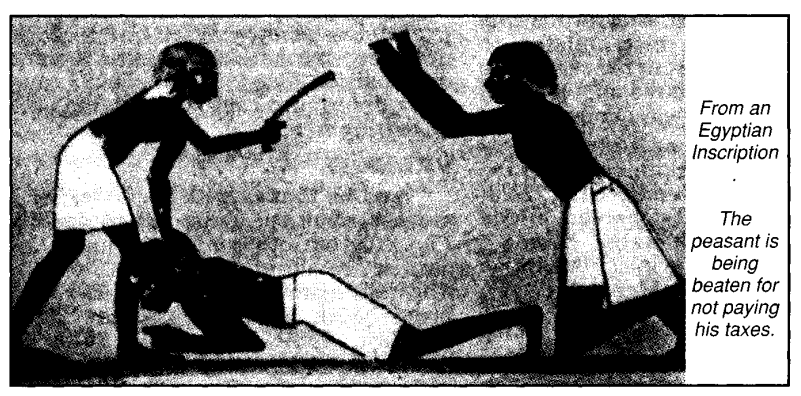
"And if a man smite his servant, or his maid, with a rod" — This was the instrument normally used for correction. See Pro. 10:13; 13:24. The rods wherewith Egyptian slaves were chastised appear upon the monuments. They were long canes, and could be used cruelly. It is not unknown for criminals to die under the bastinado.
"And he die under his hand; he shall be surely punished" — The penalty of homicide of slaves was not clearly defined, each case being judged on its merits. Hebrew slaves were expected to be treated especially well, and their status was nearly on a par with that of hired servants (see Lev. 25:39-41). A slave-owner, therefore, had to be careful as to how he treated those under his care.
VERSE 21
"Notwithstanding, if he continue a day or two, he shall not be punished; for he is his money" — The slave being the property of the owner constituted presumptive evidence that the latter did not intend to kill him, but only to punish him. The fact that he was denied his services for some days due to the severity of the punishment, so that the slave-owner experienced some financial loss, was considered sufficient punishment. On the other hand, slaves had to recognise their responsibility to serve their masters properly, and so avoid the severe punishment that could result otherwise. We need to do likewise in regard to our Master.
VERSE 22
"If men strive" — Under the law of Christ they are warned against doing so (2 Tim. 2:24).
"And hurt a woman with child, so that her fruit depart from her" — Women naturally, are apt to interfere in the quarrels of their men, and run the risk of injury by so doing. Because of this the Law warned against men striving at all, because the repercussions can be extremely evil as in the case cited in this verse (see also Pro. 30:33).
"And yet no mischief follow" — The woman does not die as a result. The word "mischief is often used in that relation (Gen. 42:4, 38; 44:29).
"He shall be surely punished, according as the woman's husband will lay upon him" — Though the man might be considered only half responsible for the "mischief that ensued seeing both men were guilty of "striving," he had to pay compensation for the miscarriage. In view of this judgment, a man engaged in such strife had best retire from so doing if a woman with child intervened. Otherwise tragedy and loss could result.
"And he shall pay as the judges determine" — He was wholly at the mercy of the injured father, and if he thought the sum demanded was excessive he could appeal to the judges. Here the word is paliylim, and signifies magistrates. Cp. with "judges," the elohim of v. 6.
VERSE 23
"And if any mischief follow, then thou shalt give life for life" — This statement does not mean that if the woman in question died, the life of the one responsible was taken in consequence; it means that he would be compelled to pay compensation according to the damage suffered. This is shown in the parallel passage, Lev. 24:18, 21: "He that killeth a beast shall make it good: beast for beast... He that killeth a beast, he shall restore it." It would accomplish nothing if the injured party killed a beast of the offending party in retaliation for his own loss, but it would advantage him if due and proper compensation were paid. And that is what is meant in the verse before us.
The only crimes which were not atoned for by monetary compensation were capital offences, like murder (cp. Num. 35:31). The law of compensation provided the basis for true justice. It not only eliminated the need of jails, but reduced crime drastically, as it would do if enforced today. Where there is no fear of punishment, the crime rate must inevitably increase; but if a person were compelled to make compensation for every loss his criminal action imposed on others, it would be to the good of all.
VERSE 24
"Eye for eye, tooth for tooth, hand for hand, foot for foot" — This law is further cited in Mat. 5:38, and, in accordance with the comments above, indicates that compensation should be commensurate with the crime.
VERSE 25
"Burning for burning, wound for wound, stripe for stripe" — These enactments form the basis of justice to be meted out through adequate compensation, and were not intended to be carried out literally. How, for example, could one tell the exact measure of the hardness of a blow, or the severity of a wound, so as to administer one of equal hurt! A literal "eye for an eye" would be flagrantly unjust for a one-eyed man; and certainly it would not be for the public good to augment the number of mutilated people in society. The Law demanded equal compensation, so that "the punishment fit the crime," and these are legal terms expressing this.
VERSE 26
"And if a man smite the eye of his servant, or the eye of his maid, that it perish; he shall let him go free for his eye's sake" — This legislation would make the unmerciful slave owner more humane and considerate, lest he lose his valuable slave-help.
VERSE 27
"And if he smite out his manservant's tooth, or his maidservant's tooth; he shall let him go free for his tooth's sake" — Repeated as in v. 26, to emphasise that judgment must be always just; again, this reminds masters of the need for consideration towards their servants. See Eph. 6:8; Col. 4:1.
VERSE 28
"If an ox gore a man or a woman, that they die: then the ox shall be surely stoned, and his flesh shall not be eaten; but the owner of the ox shall be quit" — The ox, in such a case, would suffer the same penalty as a human murderer. Once dead, its body was to be considered as accursed, and the owner had to suffer the monetary loss of his valuable animal.
VERSE 29
"But if the ox were wont to push with his horn in time past, and it hath been testified to his owner, and he hath not kept him in, but that he hath killed a man or a woman; the ox shall be stoned, and his owner also shall be put to death" — If the owner knew that his ox was notoriously dangerous, requiring supervision, and this had not been effected, the blame rested upon the owner who, by neglect, had contributed to a homicide, and was "guilty of death."
VERSE 30
"If there be laid on him a sum of money, then he shall give for the ransom of his life whatsoever is laid upon him" — A man guilty of death under the terms of v. 29 could save his life by paying due compensation, such as was not permitted for one guilty of murder (Num. 35:31-32). As a matter of fact, except for first degree murder, there were hardly any circumstances under the Law when death was enforced as a punishment.
VERSE 31
"Whether he have gored a son, or have gored a daughter, according to this judgment shall it be done unto him" — Such a ransom was also allowed if the slain person were a son or daughter. Most likely, if the family asked too high a price, the judges were called in for a settlement (v.22).
VERSE 32
"If the ox shall push a manservant or a maidservant; he shall give unto their master thirty shekels of silver, and the ox shall be stoned" — This was the amount of money paid to Judas for the betrayal of the Lord (Mat. 26:15; cp. Zech. 11:12-13), and, in the prophetic type, it was an amount appropriate to the circumstances. In order to effect the atonement on behalf of believers, the Lord "took upon him the form of a servant" (Phil. 2:7), and in his death was figuratively gored by a bull. The leaders of Jewry who secured his death are likened to "bulls of Bashan," ready to attack him (Psa. 22:12-13).
However, though the leaders of Jewry looked upon the Lord as a nonentity, he was actually the Son of Yahweh, and the Law made provision for compensation to be made in such a case.
But the nation refused this, saying, "His blood be upon us and our children." Through the priests, the amount paid was that of a mere slave, and not satisfactory to the Father. In fact, the nation was guilty of murder (Acts 7:52). As a consequence, the political death of the nation followed in AD70. The very Law upon which its leaders rested prescribed the penalty which removed both it and them.
VERSE 33
"And if a man shall open a pit, or if a man shall dig a pit, and not cover it, and an ox or an ass fall therein" — Pits in the ground were dug as storage places for water or grain. If left uncovered, they could be dangerous.
VERSE 34
"The owner of the pit shall make it good, and give money unto the owner of them; and the dead beast shall be his" — The landowner had to assume responsibility over his property, and so reimburse the owner of the animal which fell into the uncovered pit. When this was done, he could claim the body of the dead beast. Apparently there was the right of open range for the livestock. The Law taught the need of thoughtful consideration for others.
VERSE 35
"And if one man's ox hurt another's, that he die; then they shall sell the live ox, and divide the money of it; and the dead ox also they shall divide" — Out on open ranges animals grazed together, and one ox might kill another. In that case justice was meted out to both the owners.
VERSE 36
"Or if it be known that the ox hath used to push in time past, and his owner hath not kept him in; he shall surely pay ox for ox; and the dead shall be his own" — If the ox doing the damage was known to be dangerous, its owner had to take full responsibility for its action; he must pay the full value of the ox in compensation, though he could keep the carcase. In disputed cases, there would be witnesses called before the judges, and in such decisions, proof of serious negligence was considered important.
There are spiritual lessons to be learned from these judgments. They underline the principle of personal responsibility. A person was held accountable if others were adversely affected through his negligence.
In ICor. 9:9, Paul shows that the law relating to oxen had a spiritual application to the preaching of the gospel. So also with the principles advanced above. It is good for a spiritual shepherd to be diligent in "knowing the state of his flocks, and looking well to his herds" (Pro. 27:23). Such an one will learn to restrain dangerous animals under his care so that they do not bring him loss ultimately.
See how the Lord, as the Good Shepherd, accounted to his Master in heaven for the whole of the flock placed in his care: John 17:12.
Comments