CHAPTER SEVEN
MOSES BEFORE PHARAOH
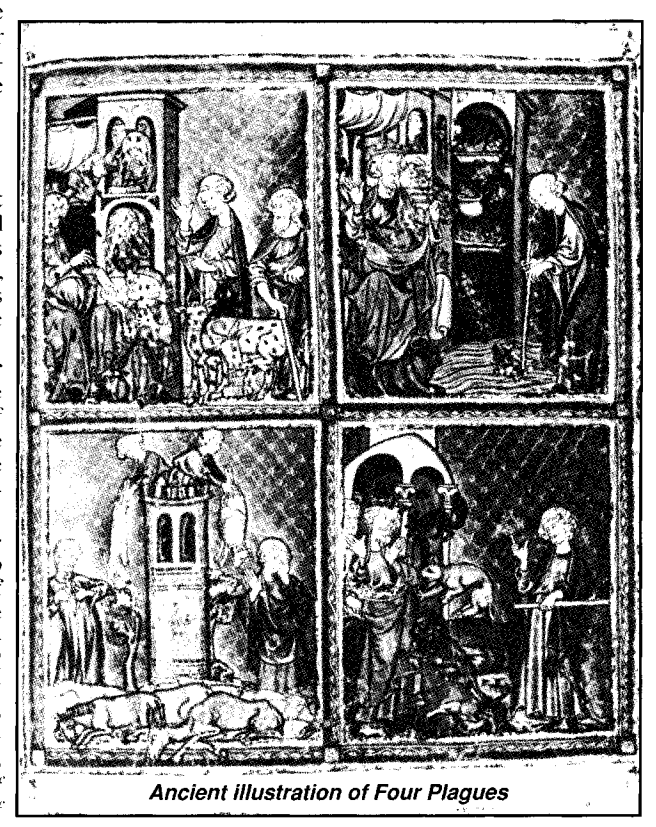
Armed with their divine commission and the power of miracle, Moses and Aaron appear before Pharaoh and display their credentials in the signs given them. These are imitated by the magicians, so that Pharaoh's heart is hardened, and he refuses to grant the request of the Israelites. In consequence, the first of the plagues smites Egypt. The water of the Nile is turned into blood, so that the fish die. Again, the magicians imitate the miracle. Pharaoh's heart is again hardened; he again refuses to let the people go, so that for seven days there is a dire shortage of water.
Moses' first sign contrasts with Christ's first sign: turning water into wine (Jn. 2:11). But whereas Moses caused the people to mourn, Christ caused them to rejoice.
VERSE 1
"And Yahweh said unto Moses, See, I have made thee a god to Pharaoh" — The authority thus conferred upon Moses was bestowed in view of objection stated in ch. 6:30. He was also strengthened and encouraged to the task before him by the promise of supernatural powers that he would manifest.
By this means Moses would become "a god (Heb. elohim)" a manifestation of Yahweh unto Pharaoh. In this he typed the Lord Jesus Christ (Jn. 20:28). The title elohim, literally mighty ones, is thus used of men who acted in God's place before their fellows (see ch. 21:6; 22:8-9 where elohim is rendered "judges"; Psa. 82:1, 6; and Christ's comment in Jn. 10:34-35. See also Ex. 4:16). Those "in Christ" live in hope of the glory of God (Rom. 5:2), of divine nature (2Pet. 1:4), and of bearing the name of God (Rev. 3:12). Thus to bear the title of God is to be a manifestation of the power and authority of the Almighty.
"And Aaron thy brother shall be thy prophet" — By "prophet" is meant "spokesman," the original meaning of the Semitic root of the Hebrew nabi, prophet.
Aaron would speak forth the words communicated by God to Moses, or the thoughts which He put into the mind of Moses with reference to Pharaoh.
The prophets were inspired spokesmen of God's will. They set forth the divine Word, presented exhortations to faithfulness, and warned the people of the consequences of disobedience, as well as often foretelling events as a secondary feature of their work.
VERSE 2
"Thou shalt speak all that I command thee" — The Septuagint adds: "to him," that is, to Aaron.
"And Aaron thy brother shall speak unto Pharaoh, that he send the children of Israel out of his land" — Aaron was to be spokesman to Pharaoh, giving voice to the request of Moses (Ex. 4:15-16).
VERSE 3
"And I will harden Pharaoh's heart" — See note Ex. 4:21. The word, here, is chazaq, and signifies to make bold, stubborn. Pharaoh's heart was hardened by Yahweh's manipulation of circumstances and events, not by any direct compelling influence on him personally. When Pharaoh saw that Moses' miracles could be imitated by the magicians, he hardened his own heart (1 Sam. 6:6).
"And multiply My signs and My wonders in the land of Egypt" — Signs are given to point to a certain way, or to convey a message, such as by the three already given (Ex. 4:3-9); wonders are miracles that speak of supernatural power, the ability to perform the extraordinary. An incident can be both: it can signify a sign and a wonder, as did the three already given to Moses. These signs and wonders poured out upon Egypt, were long remembered by that nation, as by others (Jer. 32:20; cp. Josh. 2:10). Pharaoh's stubbornness resulted in Yahweh increasing His miracles and therefore contributed to His power being more widely known, and His judgments more extensive.
VERSE 4
"But Pharaoh shall not hearken unto you, that I may lay My hand upon Egypt" — The expression "that I may lay My hand" denotes that God would display His almighty power.
Pharaoh's obstinacy was foreknown and permitted because it advanced Yahweh's purpose. The very stubbornness of the resistance revealed His omnipotence, and brought the amazing deliverance of His people before the notice of all people (Ex. 9:15-16; 15:14-16; Deu. 2:25; 11:25; Josh. 2:10).
That also is the case today. In remarkable circumstances, Israel has revived as a nation. Though small in number, and minute in size, the existence of Israel has been impressed upon people everywhere. Yahweh's purpose is advanced by the very resistance of the opposition as it was in the times of Moses (cp. Jer. 32:20-21).
"And bring forth Mine armies" — See note on ch. 6:26. Israel was to march out as conquerors, in military order, with Yahweh (represented by the cloud and fire) at the head as Commander (Psa. 80:1).
"And My people the children of Israel, out of the land of Egypt by great judgments" — This repeats the expression of ch. 6:6-26, etc. There is ever a need of constant reminders of Yahweh's purpose.
VERSE 5
"And the Egyptians shall know that I am Yahweh" — The verb yada signifies "to know in reality" by personal observation; to actually see the revelation, and not merely to know it by report or instruction.
Yahweh declared that the Egyptians shall be brought to see the power of His covenant Name, so that they will be compelled to acknowledge that what He proclaims, He will surely accomplish.
"When I stretch forth Mine hand upon Egypt" — There are various Hebrew expressions for "hand." The word here is yod, and signifies the open, pointing hand, indicative of power, means and direction. It is the symbol of activity. See its use in Psa. 119:73-80.
"And bring out the children of Israel from among them" — The divine purpose is to bring out a family from mankind for the honour of the Name (Acts 15:14), and this was now to be manifested in the redemption of Israel by Moses.
VERSE 6
"And Moses and Aaron did as Yahweh commanded them, so did they" —
This general statement anticipates the activity of Moses and Aaron at this time, and summarizes what they accomplished during the course of their ministry. The simple statement that they "did as Yahweh commanded" sums up the secret of true success in life (Josh. 1:7-8; 2 John 6).
VERSE 7
"And Moses was fourscore years old, and Aaron fourscore and three years old, when they spake unto Pharaoh" — Aaron was the elder of the two brothers, but Miriam was older still (cp. Ex. 2:4).
VERSE 8
"And Yahweh spake unto Moses and unto Aaron, saying" — The words were given to Moses, and relayed through Aaron to Pharaoh.
VERSE 9
"When Pharaoh shall speak unto you saying, Shew a miracle for you" — Such a request would be made in order that Pharaoh might consider their divine credentials.
"Then thou shalt say unto Aaron, Take thy rod and cast it before Pharaoh, and it shall become a serpent" — The Hebrew word for "serpent" in this verse is tannin, whereas that in ch. 4:3 is nachash. This is most significant. The serpent referred to in Ex. 4:3 denotes "the snake" as in Genesis 3, and that sign illustrated Moses' power over sin.
But tannin, as in this case, relates to a different animal altogether, a sea-monster. Rotherham renders it as "sea-serpent," while elsewhere it is translated "dragon" (Isa. 27:1; 51:9; Eze. 29:3), and there used for the crocodile, as a national, political symbol for Egypt.
As a sign, the miracle implied that Moses and Aaron, through the divine power vested in them, could control the movements of Egypt. In the symbolism of The Apocalypse, the dragon (tannin) and serpent (nachash) are united as Sin in political manifestation (Rev. 12:9), as representative of Babylon the Great: Rome (v. 3; 17:9), and elsewhere identified spiritually with Egypt (1 1:8), the historic
Some attempt to explain the plagues as merely natural phenomena, perhaps somewhat intensified, and then given a theological interpretation by Moses. They point out that the Nile becomes reddish in color at certain times of the year; frogs multiply, and so forth. But the fact that the narrative of Exodus presents the plagues as miracles is beyond all doubt. Whatever natural phenomena might reveal, there is an intensification of frogs, insects, murrain and so forth, far beyond any ordinary occurrence. There is the fact of prediction: Moses proclaims the moment of arrival and departure of the various plagues. There is discrimination: certain plagues do not occur in Goshen where Israel abode. There is a gradation: a gradual, increasing severity of plagues culminating in the death of the firstborn. There is the moral or religious purpose: the plagues are directed against "all the gods of Egypt" (Ex. 12:12; 18:11; Num. 33:4). In each case, a god was involved, revealing to Israel and Egypt alike, the omnipotent power of Yahweh and the worthless-ness of idolatrous terms of worship. oppressor of God's people.
Moses had already demonstrated his power over the serpent; now he is called upon to do so over the dragon. It is left to Christ to crush the former on the head, and destroy forever the influence of the latter, as revealed in The Apocalypse. The first conquest was personal, as Christ destroyed the diabolos sin-power within himself (Heb. 2:14); the latter represents the conquest of the nations to be accomplished at his return to earth (Isa. 60:12).
Moses' Contest With The Magicians — vv. 10-13.
Moses and Aaron are granted an audience with Pharaoh, at which Aaron displays their credentials: his rod becomes a crocodile. But the miracle is imitated by Egyptian magicians who do likewise, and Pharaoh's heart is consequently hardened.
According to Paul (2Tim. 3:8), there were two leaders of the magicians, matching the two leaders of Israel. He gives their names as Jannes ("He who Seduces") and Jambres ("He who makes Rebellious"), and states that they "withstood Moses " with their imitation of spirit power, even as false religion, with its pretensions of possessing Holy Spirit power, withstands the Truth today.
VERSE 10
"And Moses and Aaron went in unto Pharaoh, and they did so as Yah-weh had commanded" — Courageously they stood before the monarch of Egypt, and did so with the commission of the great Monarch of heaven.
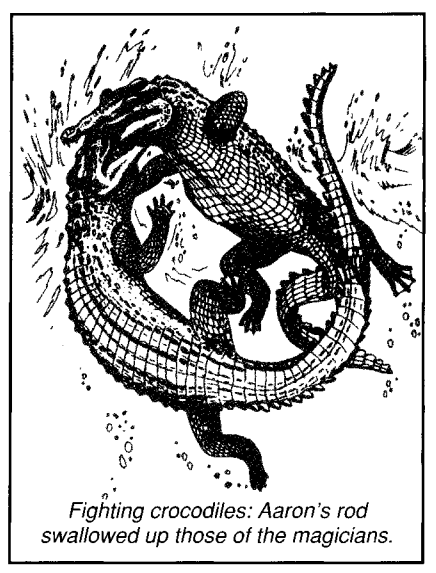
"And Aaron cast down his rod before Pharaoh, and before his servants, and it became a serpent" — It became a crocodile (Heb., tannin) a national emblem of Egypt, worshipped by the people. Aaron's action implied power over the national gods of the land.
VERSE 11
"Then Pharaoh also called the wise men" — The Hebrew word is chakamim and denotes men of learning, skilled in magic. The contest that ensued was more than one of skills: it was religious in character. Yahweh and His ministers challenged the gods of Egypt and their ministers.
Egypt was a very religious nation. The multitude of shrines, inscriptions and religious objects of its ancient culture are a constant reminder that nothing in it was really secular. Therefore, Moses' challenge to Pharaoh, who was considered divine by the people, constituted the declaration of a religious war (cp. Ex. 12:12).
"And the sorcerers" — Heb. mekashephim, signifying, "to whisper (a spell); to enchant," and therefore to practise superstitious magic, as Rome does today (Rev. 18:23).
"Now the magicians of Egypt" — The word "magicians" is chartomim, from a root cheret, "to engrave," and therefore to act as a horoscopist who looks to the heavens for signs, guidance and inspiration. The word has been rendered "sacred scribes," or "bearers of sacred words."
These men were very skilled in their practices, as are many today who claim supernatural powers of healing and performing miracles. Paul warned Timothy against the deluding pretensions of such (2Tim. 3:8), and Christ predicted the uprise of false teaching and lying superstition which would be so expertly paraded as to "deceive the very elect" (Mat. 24:24).
"They also did in like manner with their enchantments" — As a counterpart of the miracle-working magicians of Pharaoh's court, The Apocalypse refers to the "miracles" performed by the "false prophet" of Rome in his attempt to destroy the witness of Truth (see Rev. 13:14; 19:20).
Egypt was ridden with superstition, so that the description of Exodus is in accordance with archaeology. In Moses and the Gods Of Egypt, J. J. Davis writes: "We know from ancient documents that magic and sorcery were not only common throughout the land of Egypt, but played a significant role in the lives of the Pharaohs. From the Old Kingdom period comes a very interesting and informative tale about King Khufu and the magicians (Papyrus Westcar in Berlin). While the story relates to King Kheops, the builder of the great pyramid, the present papyrus manuscript dates back only to the Hyksos period. The story concerns tales told by the son of Kheops relating to the wonders which magicians had performed in the past. Later one of his sons informed him that he knew a living magician who could work miracles. This magician was brought before the king and worked miracles in the king's presence, and in addition to that predicted the future. What precisely do we mean when we speak of 'Egyptian magic?' Included in this multifaceted subject is 'cursing' (included killing); curing, erotic magic; agricultural (including weather); divination; and resurrection. Since magic and medicine are hard to untangle, and since the Egyptians did not, as a rule try to untangle them, we will discuss curative magic under medicine..."
The work of the magicians, therefore, was no clumsy contrivance as we might imagine, but the skilful opposition of a highly trained and deeply respected section of the community, in a nation of outstanding cultural development. They constituted the scientists of the day to whose instruction men everywhere gave heed. In The Visible Hand Of God, page 78-79, Bro. Roberts states: "The miracles in Egypt were a necessity. They had a logical relation to the result to be accomplished.
They were not mere prodigies like the legendary feats of the heathen. They were rationally connected with an object aimed at. Moses at the time, and David long after, recognised and proclaimed this connection. David's recognition is briefly but pointedly expressed in one of the foregoing quotations: 'He saved Israel for His Name's sake, that He might make His mighty power to be known' (Psa. 106:8). Moses repeatedly alludes to the matter in the magnificent addresses delivered to Israel at the end of the forty years' sojourn in the wilderness, just before their entry into the Land of promise. Let an example or two suffice: 'Your eyes have seen all the great acts of the Lord which He did: Therefore shall ye keep all the commandments which I command you this day' (Deu. 11:7-8); "Hath God assayed to go and take Him a nation from the midst of another nation, by temptations, by signs, and by wonders, and by war, and by a mighty hand, and by a stretched out arm, and by great terrors, according to all that the Lord your God did for you in Egypt before your eyes? Unto thee it was shewed, that thou might-est know that the Lord He is God: there is none else beside Him' (Deu. 4:34-35)."
The very strength and skill of the opposition Moses encountered served Yahweh's purpose, inasmuch as it demonstrated His great power before His people, and enabled both them and Egypt to recognise His omnipotence.
The record states that the magicians imitated Aaron's miracle "with their enchantments." The Hebrew word lahatim is from lahat and signifies "to burn, set on fire, blaze up, to flame." It is rendered "flaming" in Gen. 3:24, and implies that fire and smoke were used in performing the "miracle." By clever manipulation of the hands, probably covered and partly hidden by a cloud of burning incense or smoking sacrifices, the magicians imitated Aaron's sign and Pharaoh readily accepted as miracle the seeming evidence of his eyes.
The Greek Septuagint uses the word pharmakeiais for "enchantments," a word that is rendered "witchcraft" in Gal. 5:20, and there described as a "work of the flesh." It is from a root signifying "to drug," and in its NT usage implies the stupefying and deceptive effects of false religion (see Rev. 9:21; 18:23;21:8).
See additional comments on the magicians at Ex. 9:11.
VERSE 12
"For they cast down every man his rod, and they became serpents" — The word is tanninim, and can be rendered "crocodiles."
It would have been a great relief to Pharaoh, to see Aaron's miracle imitated by his own magicians.
"But Aaron's rod swallowed up their rods" — This demonstrated that the power wielded by Moses and Aaron was greater than that of Jannes and Jambres, the leaders of the Egyptian magicians. The sign was prophetic, indicating that no matter how Pharaoh and his supporters might resist the demands of Yahweh, He will prevail ultimately
VERSE 13
"And He hardened Pharaoh's heart, that he hearkened not unto them" — The literal Hebrew is "and was hard the heart of Pharaoh" (A New-Old Testament). Pharaoh hardened his own stubborn heart as he witnessed Aaron's miracle imitated by his own magicians, and closed his eyes to the subsequent action of Aaron's "serpent" in swallowing up the others.
The word for "hardened" in this place is chazaq, for which see note at Ex. 4:21. Why should Pharaoh thus harden his heart? Because to do otherwise would be to abdicate his position. The wise men, sorcerers, magicians and priests of Egypt comprised an important professional class in the nation, high in the positions of state organisation. For them to submit to the demands of slaves within their midst would be to acknowledge that their wisdom was not divine. In addition, Pharaoh was considered a god. His birth was announced as a divine act. In Egyptian mythology he was considered as being begotten by Amon-Ra upon the queen mother, and therefore treated as a child of the gods, possessing the property and authority of a god. As regards his divine potency, he was Horus, the son of Hathor. As such a god, Pharaoh had sole rule over the people. To capitulate to Moses was to publicly acknowledge his fallibility in the face of Israel, to abdicate his position as god-king, and to abandon everything upon which Egyptian supremacy was established. Astonished at the miracle of Aaron, he gratefully witnessed the apparent ability of his magicians to equal it, and so hardened his heart.
"As Yahweh had said" — Confirming the prediction spoken to Moses, and thus demonstrating the foreknowledge of Yahweh.
First Plague: Water Into Blood - vv.14-21.
The first plague involves the water of the Nile, the important river of Egypt. Moses is commanded to accost Pharaoh early in the morning with his demand, and on refusal, to smite the water of the river with the serpent rod. The water turns to blood with disastrous effect upon Egypt, causing death offish-life and bringing dis-may throughout the land. In contrast, the "first sign " of the Lord Jesus was the turning of water into wine, which resulted in great rejoicing at the marriage feast.
VERSE 14
"And Yahweh said unto Moses, Pharaoh's heart is hardened, he refuseth to let the people go" — The Hebrew word for "hardened" in this place is different from that in the previous verse. It is kabed, "to be heavy, i.e. difficult, burdensome, severe, stupid," and denotes the natural condition of Pharaoh's heart. See note Ex. 4:21.
VERSE 15
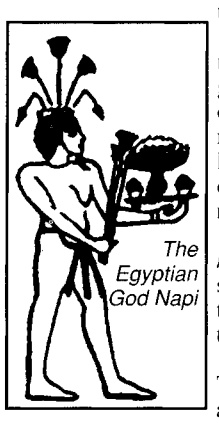
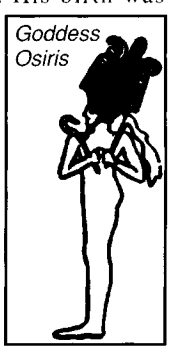
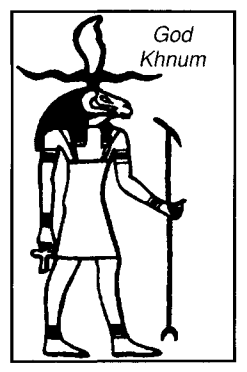
"Get thee unto Pharaoh in the morning; lo, he goeth out unto the water" — It was customary for Pharaoh to visit the Nile in the morning (cp. Ex. 8:20). The purpose of the visit is not recorded, but most likely it was for some religious ceremony, some act of worship. The Nile was the very lifeline of Egypt, and the centre of many of its religious beliefs. For example, the god Khnum was considered the guardian of the Nile sources. Hapi was believed to be the "spiritof the Nile" and its "dynamic essence." According to Unger's Bible Dictionary, Osiris, one of the greatest gods revered in Egypt, the god of judgment and of the dead, was worshipped as the god of the Nile. The Egyptians believed that the river Nile was his bloodstream, so that it was appropriate that its waters should be turned into blood by Yahweh!
The Nile also was worshipped in the god Hapi, considered to be the Sustainer of the People. In the Hymn of the Nile, its worshippers are represented as honouring it as "The bringer of food, rich in provisions, creator of all good, lord of majesty, sweet of fragrance." What a shock when that same river is seen as blood; with its banks lined with dead fish, and the smell of rotting carcases filling the air.
The religious, political and economic wellbeing of Egypt were all dependent on the Nile, and would have been adversely affected by this miracle.
The Nile is at its lowest point in May. Its rise begins around June and the main flood waters reach the country in July and August, with the peak around September. However, we have no indication as to what time of the year the miracle occurred.
"And thou shalt stand by the river's brink against he come" — The word for "river" is ye'or and is of Egyptian origin. It is used both for the Nile and for the channels that were constructed from it. It doubtless was at the Nile where the encounter took place.
"And the rod which was turned to a serpent shalt thou take in thine hand" — This was Moses' rod, not that of Aaron. The word for "serpent" is nachash, as in Ex. 4:3, and not tannin as in Ex. 7:10.
VERSE 16
"And thou shalt say unto him, Yahweh God of the Hebrews hath sent me unto thee, saying, Let My people go, that they might serve Me in the wilderness, and, behold, hitherto thou wouldest not hear" — For the divine Name used on this occasion see note at Ex. 3:15, 18.
VERSE 17
"Thus saith Yahweh. In this thou shalt know that I am Yahweh" — Contrast this statement with Pharaoh's earlier boast (Ex. 5:2,4).
"Behold, I will smite with the rod that is in mine hand upon the waters which are in the river, and they shall be turned to blood" — The waters of the river Nile, the source of life of Egypt, would become a river of death. The the Gods. Thus, the miracle would cause a religious problem.
The word "lothe" may be rendered "weary themselves" (cp. Gen. 19:11). They were to exert themselves in vain to find a remedy to make the water of the Nile palatable.
VERSE 19
"And Yahweh spake unto Moses, Say unto Aaron, Take thy rod, and stretch out thine hand upon the waters of Egypt" — There were evidently two phases to the miracle: firstly, Moses smote the water of the Nile with his rod in the sight of Pharaoh and his servants: and secondly, Aaron extended his rod towards the channels and pools of water throughout the land.
expression of the verse need not mean any more than that the water should have the appearance of blood as in Joel 2:31, 'The sun shall be turned into darkness, and the moon into blood." Whatever the nature of the miracle, the water would have all the physical appearance, taste, and smell of blood.
It is alleged, that at certain times, the Nile has a reddish tinge, a discoloration caused by the red soil of Abyssinia or other ingredients. The archaeologist. Flinders Petrie, states that the Nile has a tendency at certain times to become stagnant and red with microscopic organisms. He tried to explain the miracle as denoting nothing more than that. But we can be sure that Pharaoh would not mistake the miracle of Moses for a natural phenomena of which he would have been very familiar; nor would such discoloration result in the death offish.
VERSE 18
"And the fish that is in the river shall die" — The Egyptians lived largely upon fish, so that the miracle was to create an economic problem.
"And the river shall stink" - The smell of blood and of death would permeate the land. The miracle was to become a pollution problem.
"And the Egyptians shall lothe to drink of the water of the river" — The Nile is noted for the sweetness of its water, and was praised for this by the ancient Egyptians in their religious ceremonies. The river was styled The Father of Life, and The Father of
"Upon their streams" — The canals that were constructed to irrigate the land.
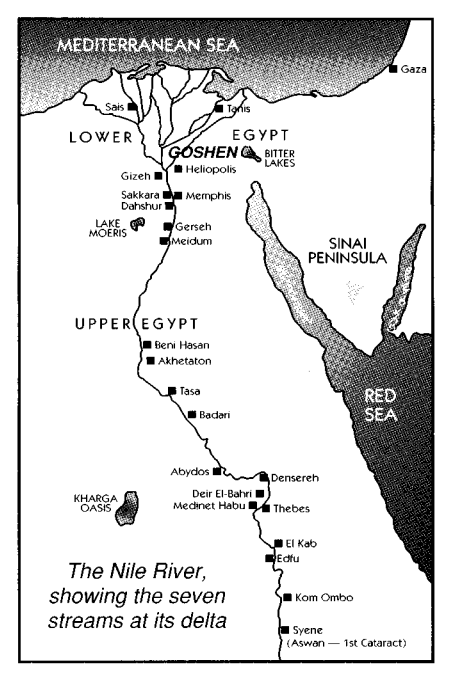
"Upon their rivers" — The seven divisions into which the Nile was divided throughout the Delta as it emptied itself into the sea (see Herodotus 2:17).
"And upon all the pools of water" — The Hebrew has "the gathering of their waters" (mg.). These would constitute the artificial reservoirs established throughout the land.
"That they may become blood; and that there may be blood throughout all the land of Egypt" - The effect of the miracle was felt throughout the whole nation, with the exception, evidently, of the land of Goshen (see v. 24).
"Both in vessels of wood, and in vessels of stone" — The water of the Nile is muddy and must be treated before being drunk. The Egyptians filtered it through various kinds of pots. The vessels of wood could relate to some form of filter, after which it was stored in those of stone. To the amazement and dismay of the people, the water stored in their homes, suddenly appeared as blood, and became undrinkable.
VERSE 20
"And Moses and Aaron did so, as Yahweh commanded" — Both took part in the action.
"And he lifted up the rod, and smote the waters that were in the river, in the sight of Pharaoh, and in the sight of his servants" — See Psa. 78:44; 105:29. The "he" evidently relates to Moses who initiated the action, which was then continued by Aaron (see Exo. 8:5).
"And all the waters that were in the river were turned to blood" — The dramatic action confirmed the divine instruction.
VERSE 21
"And the fish that was in the river died; and the river stank, and the Egyptians could not drink of the water of the river; and there was blood throughout all the land of Egypt" — The miracle caused a national disaster. We can imagine the horror of Egyptians as they viewed their sacred river, previously an object of joy, beauty and reverence, now apparently flowing with blood, its banks lined with dead and stinking fish, whilst other animals, such as crocodiles, crawled away from its precincts. What would the worshippers think of Hapi the god of the Nile who was sometimes manifest in the form of a crocodile! In a temple in Thebes, the god Sepek was worshipped in the form of a crocodile, whilst the sacred animal was accommodated in a separate pool attached thereto. That pool, as with others throughout the land, was now filled with blood!
Miracle Imitated and the Heart Hardened — vv. 22-25.
In desperation, Pharaoh seeks the help of his magicians, and they are able to counterfeit the miracle. Their deception is sufficient for Pharaoh, and restores his confidence in the gods of Egypt. Accordingly he dismisses the request of Moses. Through his stubbornness the miracle is continued for seven days, and the people are greatly distressed. But as Pharaoh has slaves to dig wells for him, he gives no thought to the plight of his people.
VERSE 22
"And the magicians of Egypt did so with their enchantments" — The word for "enchantments" in this place is different from that in v. 11. It comes from a root signifying "that which is covered," and has been translated "secret arts" (A New Old Testament).
Previously, the magicians imitated Moses' miracle behind a smoke-screen of incense or similar; now they produced a "miracle" secretly, and not open to the view of all, as was that of Moses and Aaron.
But if all the water of the land was affected, where did the magicians obtain water for their experiment?
There were two stages in the miracle. First, the water of the Nile was affected; and afterwards, as Aaron turned his rod towards all points of the compass, the water throughout the land became polluted. The statement of v. 23 implies that the contest between Moses and the magicians took place as Pharaoh was by the bank of the river. They evidently obtained a small amount of water prior to the water throughout the land being polluted, and brought it to Pharaoh, probably in vessels, upon which to perform their trickery.
"And Pharaoh's heart was hardened" — He was easily pleased, and accepted the deception as evidence of the divine power in his own magicians. To do otherwise would be to abandon the very foundation of Egyptian power, worship and culture. Pharaoh viewed the apparent success of the magicians against the demands of Moses and Aaron as a triumph for his gods.
"Neither did he hearken unto them" — He repudiated the testimony of Moses and Aaron.
"As Yahweh had said" — His stubbornness was actually a vindication of Yahweh.
VERSE 23
"And Pharaoh turned and went into his house" — Implying that the contest between Moses and the magicians had been concluded before Aaron turned his rod upon the other water of the land (v. 20).
Having rejected the warning of Yahweh, the miracle was now extended throughout all Egypt.
"Neither did he set his heart to this also" — Pharaoh refused to thoroughly examine the evidence; he became self-deceived because he wanted to believe the evidence of the magicians.
VERSE 24
"And all the Egyptians digged round about the river for water to drink" — The Egyptians did this, but not the Hebrews. Apparently the water of Goshen, the settlement of the Israelites, was unaffected.
"For they could not drink of the water of the river" — Evidently the wells thus dug were not affected, which served to emphasise the miraculous nature of what had been done.
VERSE 25
"And seven days were fulfilled, after that Yahweh had smitten the river" — For seven days there was a dire want of drinking water throughout Egypt, although, apparently, supplies could be obtained from nearby Goshen.
Comments