CHAPTER EIGHT
THE FINGER OF GOD REVEALED
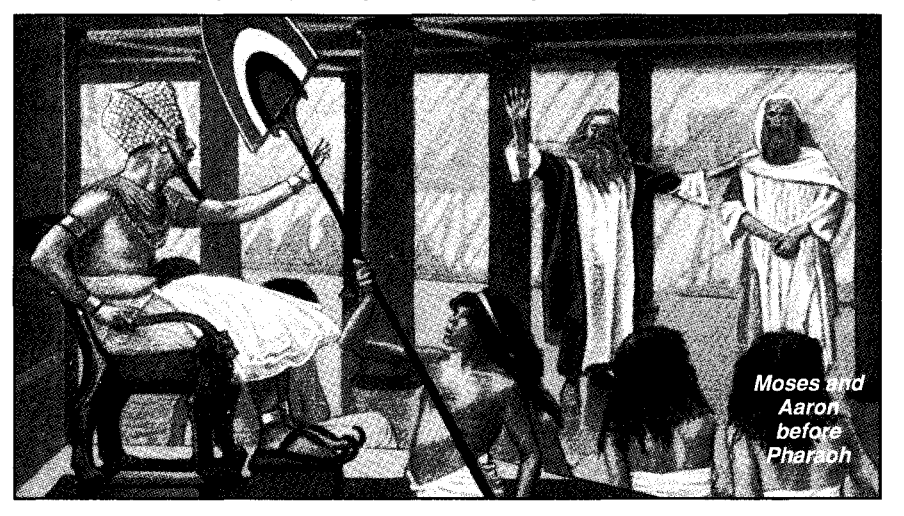
Again Moses is sent to Pharaoh with the request, Let Yahweh's people go! The king is warned that Egypt will be plagued with frogs if he refuses. This merciful warning is ignored, and with the stretching forth of Aaron's rod, the plague commences. It is imitated by the magicians, who, however, fail to be able to rid Egypt of the plague, so that Pharaoh is forced to plead the help of Moses to that end. With the respite that follows, the king's heart is hardened, and, in consequence, the nation is afflicted with a third plague: that of lice. On this occasion, the magicians fail to imitate the plague, declaring, "This is the finger of God." But now Pharaoh even ignores their warning, and so Egypt is afflicted with the fourth plague, that of flies. Pharaoh learns that Goshen is exempt from the plague, and, at last compromises with a partial agreement to do as requested. But when the plague ceases, he again refuses to cooperate.
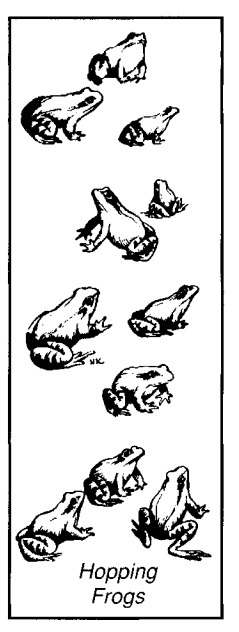
Second Plague: Frogs Multiply — vv.1-6.
Pharaoh is warned that if he does not comply with Moses' request, the land will be plagued with frogs. He refuses the request to let the people go, and frogs multiply from the river to swarm over the land. They invade the homes and are found in bedrooms, kitchens, and cling to even the persons of the Egyptians.
VERSE 1
"And Yahweh spake unto Moses, Go unto Pharaoh, and say unto him, Thus saith Yahweh, Let My people go, that they may serve Me" — The repetition might have sounded monotonous, but, at least it made the issue clear! One thing only was required of Pharaoh, and it became an oft-repeated demand: Let My people go!
VERSE 2
"And if thou refuse to let them go, behold, I will smite all thy borders with frogs" — The word for "frogs" is tesphardaim, derived from tsaphar, meaning "to skip about," and denotes a swamp-jumper or marsh-leaper. The second plague was also a contest between Yahweh, and certain aspects of the Egyptian system of superstition. It struck a blow at the worship of Heqt, the wife of the great god Khnum. Heqt was a frog-headed goddess and the frog was sacred to her. It was the symbol of the resurrection, and the emblem of fertility. According to H. Rimmer in Dead Men Tell Tales, the frog "was reverenced by the people, and to have one around the dwelling place was a sign of good fortune and was supposed to ensure a fertile year for farm and family alike." At the same time "the frog was unclean to the Egyptians and their invasion would be abhorrent" (Animals of Bible Lands).
The Egyptians were to have quite enough of frogs, before they got through this second plague!
VERSE 3
"And the river shall bring forth frogs abundantly, which shall go up and come into thine house" — Ancient Egyptians were noted for their extreme cleanliness (see Herodotus 2:37), and this invasion of their homes must have been both disagreeable and disgusting. The frogs even clung to their persons (v. 4).
"And into thy bedchamber, and upon thy bed, and into the house of thy servant, and upon thy people, and into thine ovens, and into thy kneading-troughs" — With a little imagination the description becomes quite humorous, but must have been most distressing to the Egyptians! Frogs were everywhere: in the streets, in the houses, in utensils. The revolting creatures were in the very bread troughs, and got tangled up in the dough, thus adding a rather quaint flavor to the bread!
The bread could not be baked, however, as the ovens crawled with frogs, and swamped the fire. "Like a blanket of filth, the slimy, wet monstrosities covered the land, until men sickened at the continued squashing crunch of the ghastly pavement they had to walk upon. If a man's feet slipped on the greasy mass of their crushed bodies, he fell into an indescribably offensive mass of putrid uncleanness, and when he sought water to cleanse himself, the water was so solid with frogs, he got no cleansing there" {Dead Men tell Tales).
Another writer (L. Untermeyer, in Moses) graphically describes the presence of myriads of frogs: "Small green peepers, no larger than locusts; distended toads, the colour of excrement; mottled frogs like bloated vegetation; frogs that were lumps of bronze; frogs with eyes of unblinking demons; frogs subtler than salamanders; frogs motionless; frogs that leaped into the laps of screaming children; wart-breeding frogs; frogs like droppings of mud; frogs tailing their slime after them; flying frogs that built nests in high reeds; frogs that died and bred death. Once again the sacred Nile was the source of pollution."
VERSE 4
"And the frogs shall come up both on thee, and upon thy people, and upon all thy servants" — They invaded even the palace, and hopped onto Pharaoh himself, perhaps to the amusement of others, but certainly not that of the king.
VERSE 5
"And Yahweh spake unto Moses, Say unto Aaron, Stretch forth thine hand with thine rod over the streams, over the rivers, and over the ponds, and cause frogs to come up upon the land of Egypt" — There was to be a complete demonstration of the power of Yahweh. See comment on ch. 7:19.
VERSE 6
"And Aaron stretched out his hand over the waters of Egypt; and the frogs came up, and covered the land of Egypt" — In Hebrew, the word "frog" in this verse is in the singular number: "the frog," though elsewhere it is plural. The frogs moved as an united army to invade the land. They came hopping out of the river, along the roads to invade the cities and houses of Egyptians. Their noisy croaking deafened the people.
Miracle Imitated: But Pharaoh Seeks Moses' Intercession — vv. 7-11.
The magicians imitate the miracle, but it is evident that they cannot remove the plague, so that Pharaoh is forced to seek the intercession of Moses.
VERSE 7
"And the magicians did so with their enchantments, and so brought up frogs upon the land of Egypt" — For "enchantments" see note ch. 7:22. Evidently, by some sleight of hand or some secret covering of their action (as the word suggests), the magicians imitated the miracle of Moses. But their heart was not in it, as the following verses reveal. They recognised that they were in the presence of a miracle, and that the effect of the miracles demonstrated by Moses and Aaron was increasing. Each miracle built upon those before.
VERSE 8
"Then Pharaoh called for Moses and Aaron, and said, Intreat Yahweh, that he may take away the frogs from me, and from my people" —The monarch suffered the terrible conditions, and on behalf of his nation now pleaded with the Hebrews to remove the threat.
"And I will let the people go, that they may sacrifice unto Yahweh" — In this promise, Pharaoh recognised Yahweh as a god, but, as subsequent events revealed, he had reservations as to His real power.
VERSE 9
"And Moses said unto Pharaoh, Glory over me" — This was probably a phrase of normal courtesy signifying that Moses was prepared to submit to the request of Pharaoh. The margin renders: "Have this honour over me." The Sep-tuagint and Vulgate render it as "Appoint thou unto me."
"When shall I intreat for thee, and for thy servants, and for thy people, to destroy the frogs from thee and thy houses, that they may remain in the river only?" — Rotherham renders this: "For what time shall I intreat...?" The margin has "Against when..." Moses invited Pharaoh to have the honor of naming the very time when the miracle should be performed in reverse as proof that Yahweh had power, both to afflict and to heal.
VERSE 10
"And he said, To morrow" — The Hebrew is as the margin: "For tomorrow." Pharaoh desired the plague to instantly come to an end, that very day, that "tomorrow" might be free of the plague.
"And he said, Be it according to thy word: that thou mayest know that there is none like unto Yahweh our God" — Moses accepts the date fixed by Pharaoh, and makes an appeal to him to recognise the power and authority of Yahweh, if the event corresponds with the time agreed upon.
VERSE 11
"And the frogs shall depart from thee, and from thy houses, and from thy servants, and from thy people; they shall remain in the river only" — From this it would appear that the frogs had invaded more than one of Pharaoh's palaces.
Respite: Heart Hardened — vv. 12-15.
Moses' prayer unto Yahweh is successful, and the land is relieved of the plague. Pharaoh, however, dishonors his word and again refuses to let the people go.
VERSE 12
"And Moses and Aaron went out from Pharaoh" — The meeting was terminated in order that the plague might be removed, and Pharaoh given opportunity to respond to the demands of the Hebrews.
"And Moses cried unto Yahweh because of the frogs which He had brought against Pharaoh" — The expression used is a strong one, and denotes particular earnestness in the prayer. The word signifies "to shriek." Rotherham renders it: "Moses made outcry." He had ventured to promise Pharaoh that the plague would be removed at a specific time, and now gave himself to earnest prayer to Yahweh that it might be vindicated in accordance with the agreement with Pharaoh.
Moses' attitude reveals the need for earnest concentration of mind upon such a request. Elijah "prayed earnestly" in similar fashion and was granted his request, upon which James comments: "The effectual fervent prayer of a righteous man availeth much" (James 5:16). Prayer must represent the "sacrifice of the lips" to be really effective (Hos. 14:2; Heb. 13:15). We must earnestly desire the things prayed for, and feel the communion of prayer in order to make it powerful.
VERSE 13
"And Yahweh did according to the word of Moses" — A clear example of answered prayer.
"And the frogs died out of the houses, and out of the villages, and out of the fields" — The RV renders "villages" as "courts." Rotherham has a footnote: "enclosures — perhaps courtyards." Egyptian houses were generally built with a courtyard attached. These now became filled with the dead bodies of frogs, heaped up everywhere so that the stench of dead and decaying bodies afflicted the nostrils of Egyptians. One would imagine, that after such a plague as this, there would be somewhat of a decline in the fervency of frog worship by that generation of Egyptians!
VERSE 14
"And they gathered them together upon heaps: and the land stank" — Heaps of dead, decaying and stinking corpses of frogs, all over the land, were a constant reminder of the power of Yahweh, and of the inefficacy of the Egyptian gods.
VERSE 15
"But when Pharaoh saw that there was respite, he hardened his heart, and hearkened not unto them" — See ISam. 6:6. The word "respite" is literally "a breathing space." Pharaoh was autocratically stubborn, but it must also be recognised that for him to capitulate meant reversing all that both he and Egypt stood for. Egypt was a theocracy, and Pharaoh himself considered as a god. Therefore the demand, "Let My people go," required that Pharaoh recognise the existence of Yahweh, and His superiority over all other forms of worship. It was upon those forms of idolatrous worship that the greatness of Egypt was established, and for this reason, and not only stubbornness of heart, Pharaoh grasped at every opportunity to evade what was demanded of him.
"As Yahweh had said" - This addition to the narrative emphasises that the very resistance of Pharaoh was indicative of the truth of Yahweh's prophecy.
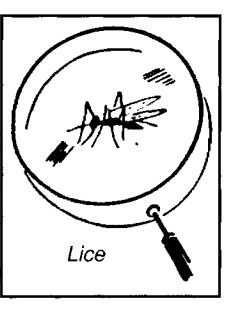
Third Plague: Dust Into Lice - vv. 16-19.
Again Aaron's terrible rod is outstretched, and the dust becomes swarming with lice, tormenting men and beasts. To add to the irritation of the Egyptians, the Israelites are exempt from the plague whilst they, the lords of the land, itch and scratch away like monkeys as they are subjected to the misery of this vicious pest. Again, one of the two thousand two hundred different gods and goddesses that archaeologists have been able to name as being worshipped by the Egyptians, is humbled.
VERSE 16
"And Yahweh said unto Moses, Say unto Aaron, Stretch out thy rod" — This was Aaron's rod as distinct from the rod used by Moses (cp. ch. 7:10).
"And smite the dust of the land" — According to E. Budge in Dwellers On the Nile, the earth itself was worshipped through the god Geb.
"That it may become lice throughout all the land of Egypt" — The Heb. kennim is from a root signifying "to fasten." This is thought to be the mosquito-gnat, and not lice as rendered in the AV. The specie is so small as to be hardly visible to the eye, but it has a very irritating and powerful sting. The Hebrew term may be derived from the Egyptian khennems, "gnats" or "mosquitoes."
VERSE 17
"And they did so; for Aaron stretched out his hand with his rod, and smote the dust of the earth, and it became lice in man, and in beast" — In afflicting man, the plague would have included the official priesthood of Egypt, to the great humiliation of its members. In afflicting beasts, it would also have humiliated the sacred animals of Egypt which were worshipped as gods. It is said that the mosquito-gnat flies into the nostrils and eyes of animals driving them to maniacal fury.
"All the dust of the land became lice throughout all the land of Egypt" — The dust became impregnated with these mosquito-gnats. Every step taken in the soil which Egyptians normally worshipped, caused a cloud of these irritating creatures to arise and settle upon the body, resulting in painful and irritating bites.
Magicians Thwarted — vv. 18-19.
Again Pharaoh appeals to his magicians to demonstrate their skill, but on this occasion they are unable to do so. They claim it reveals the finger of God in such a way as is beyond their ability to perform.
VERSE 18
"And the magicians did so with their enchantments to bring forth lice, but they could not" — For some reason the trickery of these magicians failed, and they claimed that this was due to supernatural powers beyond their control. It is obvious from the text that they attempted to imitate the miracle. Why were they not successful? Perhaps Pharaoh demanded that they do so openly without covering up their actions. He had obviously been humbled to the extent of recognising the existence of Yahweh (v. 8); now he wanted incontestible evidence of the power of his gods, and called upon his priests to demonstrate their ability beyond all doubt. This they failed to do.
"So there were lice upon man and upon beast" — The nation continued to suffer whilst Pharaoh wasted his time with the magicians.
VERSE 19
"Then the magicians said unto Pharaoh, This is the finger of God" — Lit. "This is the finger of a god" — it is supernatural, beyond the power of man. See the expression used elsewhere with the same emphasis: Ex. 31:18; Deu. 9:10; Psa. 8:3; Luke 11:20.
"And Pharaoh's heart was hardened, and he hearkened not unto them" — The magicians had given up the
unequal contest and urged upon him to do likewise; but too much was at stake for that to happen!
"As Yahweh had said" — Again, the opposition received from Egypt served to emphasize the omniscience of Yahweh.
Fourth Plague: Flies, Goshen Immune - vv.20-24.
Pharaoh's stubbornness results in yet another plague, and the sphere of judgment widens. Previous plagues affected water, river and earth; now the air becomes the arena of punishment as it is filled with insects afflicting the Egyptians, humbling yet another of the gods.
VERSE 20
"And Yahweh said unto Moses, Rise up early in the the morning, and stand before Pharaoh; lo, he cometh forth to the water" — The early morning visit of Pharaoh to the Nile was obviously for religious purposes: an appropriate time for him to be accosted on behalf of the God of Israel. See also ch. 7:15.
"And say unto him, Thus saith Yahweh, Let My people go, that they may serve Me" — Behind this reiterated demand is the principle that apart from separation from Egypt, Israel cannot effectively serve Yahweh. See 2Cor. 6:15-18.
VERSE 21
"Else, if thou wilt not let My people go, behold, I will send" — The first nine plagues can be divided into three groups of two in each, with a warning, and the third without. Note: Ex. 8:16; 9:8; 10:21.
"Swarms of flies upon thee, and upon thy servants, and upon thy people, and into thy houses: and the houses shall be full of swarms of flies, and also the ground whereon they are" — Reference to this plague is also made in Psa. 78:45; 105:31. But what flies, if any, are meant? Rawlinson comments: "The exact character of the fourth plague depends on the proper translation of the word 'arob. The Jewish commentators connected this word with 'ereb and 'arab, words meaning 'mingled' or 'mixed'; and supposed a mixed multitude of animals — beasts, reptiles, and insects — to be meant. But the expression used throughout, which is har-'arob, the 'arob,' marks very clearly a single definite species. So much was clear to the Septuagint, who rendered the word by kunomuia, 'the dog fly' which is not the common house-fly (musca domestica), but a distinct species (musca canina). Flies of all kind are said to constitute a terrible affliction in Egypt: but they attack men chiefly, and do no harm to houses or to the fruits of the field, whereas the 'arob is spoken of as a pest in the houses, and as 'destroying the land' (v. 24).
It has been, therefore, suggested that the blatta orientalis, or kakerlaque, a kind of beetle, is really intended. These creatures suddenly appear upon the Nile in great numbers; they 'inflict very painful bites with their jaws; gnaw and destroy clothes, household furniture, leather, and articles of every kind, and either consume or render unavailable all eatables' (Kalisch). They sometimes drive persons out of their houses; and they also devastate the fields."
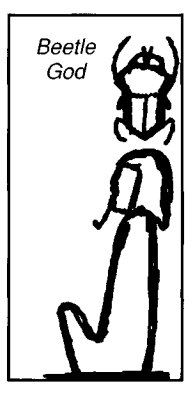
The beetle was sacred to Ra, the sun god (Dwellers On The Nile), so that the miracle demonstrated that Yahweh controlled the very forms of nature which Egyptians worshipped.
In Dead Men Tell Tales, H. Rimmer suggests that the ichneumon fly is intended in the record. He writes: "the ichneumon fly is a symbol of this god (i.e. Uatchit), and their figures in tiny statues and on papyri are well known to the modern archaeologist. They are a brilliant and beautiful insect, somewhat prized by the entomologists of our day as specimens, but they can be a pest when they come in too numerous companies!"
However, the description of the text of the verse before us favors the beetle more than the fly, particularly the statement: "the ground whereon they are." This describes the beetle, but not particularly the fly.
As the result of the plague, these biting, gnawing creatures were found everywhere: outside, inside, swarming on people and property alike, biting, consuming, destroying; sending people mad with their painful presence.
In commenting upon this plague, the Psalmist declares: "He sent divers sorts of flies (one word in Hebrew, "arob) among them, which devoured them." The ichneumon fly does not attack people, but the kakerlaque beetle will do so.
VERSE 22
"And I will sever in that day the land of Goshen, in which My people dwell, that no swarms of flies shall be there" —
This does not necessarily mean that the previous plagues had afflicted the land of Goshen, but is an invitation to Pharaoh to observe that this severance was, in fact, the case. It demonstrated that the plagues could not be explained away merely as unusual manifestations of nature, but were, in fact, miraculous manifestations of divine power on the part of the God of Israel. Though the immunity of the land of Goshen had not been specifically noted previously, it had been strongly implied. For example, Moses records that the Egyptians dug wells for water during the period of the first plague, but is silent about any such action on the part of the Hebrews, implying that they were not affected by it.
"To the end thou mayest know that I am Yahweh in the midst of the earth" — The ultimate purpose of Yahweh is that all mankind might recognise His power and honour His purpose (see use of the phrase in the prophecy of Ezekiel: ch. 32:15; 33:29; 34:30; 35:4,9, 12, 15, etc.
VERSE 23
"And I will put a division between My people and thy people" — The literal Hebrew for the word "division" (peduwth) signifies, "a redemption." This, together with the comparison established by the pronouns "My people" and "thy people," clearly shows that the One whose power had been manifested in the previous plagues, would once again save His people from the Egyptians.
The word peduwth is in the feminine gender, signifying "deliverance" and "distinction." The Septuagint renders it by the Greek diastole, rendered "difference" in Rom. 3:22; 10:12. Pharaoh was bluntly told that Yahweh had established a difference between Hebrews and Egyptians, and that the purpose of the division was the redemption, or deliverance of His people. The feminine form of the word is appropriate to His purpose, for it implied that Yahweh had selected His people to become His national Bride for marriage. Thus Isaiah declared: 'Thy Maker is thine husband; Yahweh of hosts is His name" (Isa. 54:5; cp. Eze. 16:6-14).
Compare the application of the word, on the background of these events, as used in Isa. 50:2"1. 1 11:9; 130:7-8. "He sent redemption unto His people," declared the Psalmist.
The message of Yahweh to Pharaoh announced that God was claiming His people, and that Pharaoh must no longer view the Israelites as his slaves.
"Tomorrow shall this sign be" — Particulars of time and place are stated beforehand, to demonstrate that the visitation would not be by chance, but by divine interposition.
VERSE 24
"And Yahweh did so" — Confirming the declaration of Moses, demonstrating that Almighty God was the power behind the threat against Pharaoh.
"And there came a grievous swarm of flies into the house of Pharaoh, and into his servant's houses, and into all the land of Egypt" — By the following day. Pharaoh literally "felt" the effect of the plague, for the gnawing, biting little creatures had invaded the palace as well as the houses of his ministers, bringing pain or ruin to everything they attacked.
"The land was corrupted by reason of the swarm of flies" — The margin supplies the word "destroyed." The reference is to the land, suggesting that the beetles seriously damaged the growing crops.
Pharaoh Stubbornly Refuses To Honor His Promise — vv. 25-32.
The frightful damage caused by the fourth plague is followed by an urgent appeal from Pharaoh to Moses to remove it. He promises to allow the Israelites to sacrifice in the land, but Moses is insistent upon leaving Egypt for the purpose. The monarch agrees to let the people go, and again, at the request of Moses, the plague is stopped. Nevertheless Pharaoh further hardens his heart.
VERSE 25
"And Pharaoh called for Moses and for Aaron, and said, Go ye, sacrifice to your God in the land" — In this comment, Pharaoh, at least, recognised the status of Yahweh as the God of the Hebrews, though he endeavoured to limit the concession he was prepared to grant them to worship Him.
VERSE 26
"And Moses said, It is not meet so to do; for we shall sacrifice the abomination of the Egyptians to Yahweh our God" — The word "abomination" is from towebah, derived from the root ta'ab, "to loathe, detest." It is used in Jer. 16:18 and 44:4 for idolatry. It could well be that Moses used the term in that sense, and warned Pharaoh that the Hebrews would be compelled to sacrifice animals that were sacred to the Egyptians.
Pharaoh, however, could have understood it to mean that the form of Hebrew worship would be considered abominable by Egyptians, which also would be the case. Both men viewed the problem from different perspectives.
"Lo, shall we sacrifice the abomination of the Egyptians before their eyes, and will they not stone us?" — In speaking of the local worship as "the abomination of the Egyptians," Moses effectively revealed that the two forms of religious exercise were entirely irreconcilable, and demanded complete separation. Rother-ham renders the statement: "Lo! could we sacrifice that which is an abomination to the Egyptians before their eyes, and they not stone us!" Sacrifice was essential to the worship of Yahweh, and this would have resulted in some of Egypt's sacred animals, such as bulls or heifers, being put to death. The result could well have resulted in bloodshed.
VERSE 27
"We will go three days' journey into the wilderness and sacrifice to Yahweh our God, as He shall command us" —
The exact form of service, required by Yahweh, had not then been revealed, as Moses again informed Pharaoh at a later date (Ex. 10:26).
VERSE 28
"And Pharaoh said, I will let you go, that ye may sacrifice to Yahweh your God in the wilderness; only ye shall not go very far away" — Pharaoh makes it plain that he is not prepared to allow the Israelites to escape altogether, and therefore agrees to let them go on the proviso that they remain close to Egypt's borders. Moses did not oppose that proposition, being prepared to leave the working out of the divine plan of redemption to Yahweh.
"Intreat for me" — See note on v. 8. Pharaoh no longer retained confidence in the mediation of his Egyptian priests and counsellors.
VERSE 29
"And Moses said, Behold, I go out from thee, and I will intreat Yahweh that the swarms of flies depart from Pharaoh, from his servants, and from his people, to morrow" — As Pharaoh had fixed the time for the cessation of the second plague (v. 10), Moses does so now for the fourth.
"But let not Pharaoh deal deceitfully any more in not letting the people go to sacrifice to Yahweh" — As Moses' confidence increased, he became bolder in his speech. What now of his earlier excuse: "I am slow of speech, and of a slow tongue" (Ex. 4:10)! The power of divine proclamation and his abhorrence of Pharaoh's duplicity shows now in Moses' forthright challenge.
VERSE 30
"And Moses went out from Pharaoh, and intreated Yahweh" —The word "intreat" is athar, and signifies "to burn incense." This suggests that because of the importance of the occasion and of the request, a careful, ceremonial approach was made to Yahweh.
VERSE 31
"And Yahweh did according to the word of Moses; and He removed the swarms of flies from Pharaoh, from his servants, and from his people; there remained not one" — Divine intervention was shown in the removal, no less than in the infliction of the plagues. The sudden and complete disappearance of the pests was as abnormal as their coming.
VERSE 32
"And Pharaoh hardened his heart at this time also, neither would he let the people go" — See Ex. 7:13, 22.
Comments