CHAPTER TEN
THE FINAL INTERVIEW WITH PHARAOH
Once again Pharaoh hardens his heart, and Yahweh tolerates it for two reasons: [1 ] That He might reveal His signs before him and all the world; [2] That future generations of Israelites might recall His power and never forget the amazing deliverance thus effected. Moses and Aaron again warn of a further devastating plague — this time of locusts. They give notice that locusts will devour the remaining crops if the king does not submit. With growing confidence, Moses and Aaron deliver the ultimatum, and without awaiting Pharaoh's reply, abruptly leave his presence.
Appalled at the devastating effect of the plagues, Pharaoh's servants begin to remonstrate with him. Moses and Aaron are recalled, and a proposition of compromise is offered diplomatically to them. They reject it, and are driven from the palace of the king. Soon afterwards a cloud of locusts darkens the land, and the worst locust plague in history devastates what crops have remained after the storm. Again Moses and Aaron are hastily recalled. Their help is sought, and through their mediation the locusts are driven from Egypt.
Again, Pharaoh's heart is hardened, and the ninth frightening plague follows. The sun is blotted out, and complete darkness follows, so gloomy that it could be felt. Pharaoh suggests a further compromise which is rejected. In anger, his temper asserts itself, and he orders Moses and Aaron from his presence, warning them that should they appear before him again, they would die. Moses accepts the decision, and leaves, to prepare his people for the last contest with Egypt.
Pharaoh Warned but His Servants Plead in Vain — vv. 1-11.
The hardened heart of Pharaoh is used by Yahweh to demonstrate both to Egypt and to His people the remarkable deliverance He is about to effect. Pharaoh is warned of the severity of the plague of locusts that will devastate the land if he persists in his folly. In terror, the servants of Pharaoh hear the threat of further trouble to come, and urge the king to capitulate to the demands of the Hebrews. Moses and Aaron are recalled to the presence of Pharaoh, who suggests compromise. When this is rejected, the king erupts in anger, repeats the offer, and warns Moses and Aaron of the consequences of their refusal to accept what he places before them, ordering them out of his presence. In view of the punishment already inflicted on Egypt, Pharaohys threat has but a hollow sound.
VERSE 1
"And Yahweh said unto Moses, Go in unto Pharaoh; for I have hardened his heart" — The word for "hardened" is kabed, "to make dull; burdensome" It suggests the natural characteristic of Pharaoh, and because of his dullness, Moses was commanded to interview him once more.
"And the heart of his servants" — With the increasing severity of the plagues, and the wavering of the king's determination, the influence of the court officials became more pronounced. Notice the emphasis given to them in Ex. 9:34; 10:7.
"That I might shew these My signs before him" — Had Pharaoh yielded earlier, the last and greatest plagues, including the slaying of the firstborn leading to the Passover, would not have been wrought. But in that case, some of the Egyptians would not have been convinced of Yahweh's power. Thus God prolonged the plagues because of the stubbornness of Pharaoh, so that all were made conscious of His glory (see Jer. 32:20-21). The circumstances illustrated important principles of redemption as Paul outlined in Rom. 9:17-23.
VERSE 2
"And that thou mayest tell in the ears of thy son, and of thy son's son, what things I have wrought in Egypt, and My signs which I have done among them" — The deliverance was dramatised in the Feast of Passover which also emphasized the spiritual lessons to be obtained thereby (Ex. 13:8-9, 14; Deu. 4:9; 6:20-22; Psa. 44:1). Thereafter, the mighty deeds of Yahweh in Egypt were constantly recalled (Psa. 78:4-6; 105:23-38; 106:6-16; 77:14-20; 81:5-6; 114:1-3; 135:8-9; 136:10-15). Those "in Christ" are also enjoined to "remember" the mighty deliverance effected in their lives by the true Passover Lamb (Eph. 2:11-14).
"That ye may know how that I am Yahweh" — As the name Yahweh is prophetic of the purpose of Deity to manifest Himself in a people of His choice, the deliverance from Egypt provided signs indicative of this. The signs illustrated that Yahweh separates a people unto Himself, overshadows their lives for good, delivers them from the slavery of sin that leads to eternal death, provides them with a law, and brings them into covenant relationship with Himself. The fulness of His Name, therefore, was dramatised by such means.
The Name had been proclaimed before, but was not "known" experimentally until then, for it awaited the divine determination to be manifested in a family. This was to be seen in the separation of Israel from Egypt, and the constitution of the nation as the people of God.
The crossing of the Red Sea illustrated the dramatic separation between Egypt and the people of Yahweh, comprising a vindication of the Name (Ex. 15:3; Jer. 32:20; Isa. 63:12). Eight hundred years later, Yahweh declared through Ezekiel: "I wrought for My Name's sake, that it should not be polluted before the heathen, among whom they were, in whose sight I made Myself known unto them, in bringing them forth out of the land of Egypt" (Eze. 20:9, 14,22).
Notice that the acknowledgement of the Name is associated with separation from the Gentiles, and compare this principle in 2Cor.6:17-18.
VERSE 3
"And Moses and Aaron came in unto Pharaoh, and said unto him, Thus saith Yahweh God of the Hebrews" — See note on this significant divine title at ch.3:15, 18.
"How long wilt thou refuse to humble thyself before Me? Let My people go, that they may serve Me" — This was a very imperious demand to be made by the leaders of slaves to the world's most powerful monarch, but, of course, Moses and Aaron did not only represent the people, but Yahweh, the "great King" of the heavens, who is above all the Elohim (Psa. 95:3), and their words were dictated in His Name. This was the seventh, and final demand made to Pharaoh, to let the people go (see Ex. 5:1; 7:16; 8:1,20; 9:1,33; 11:1); an appropriate number, seven (Heb. sheva) being the number of the covenant or completeness.
VERSE 4
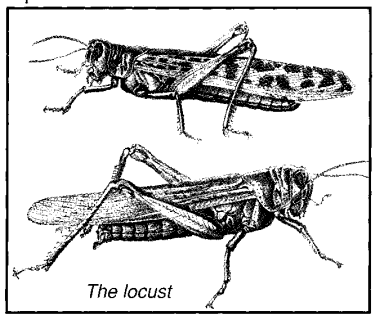
"Else, if thou refuse to let My people go, behold, tomorrow will I bring the locusts into thy coast" — The locust was so dreaded in Egypt, that peasants regularly prayed to the locust god Serapis, who was supposed to protect the land from their destructive activities.
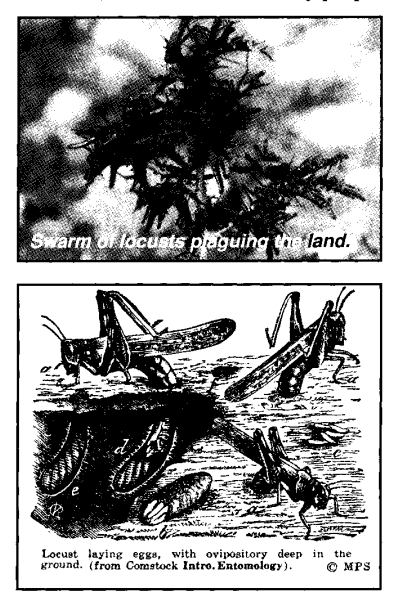
The word "locust" is from the Hebrew arbeh, derived from a root signifying "to increase." The name is indicative of rapid multiplication. Locusts are said to multiply quicker than most other insects. It is estimated that a square mile of a swarm will contain from 100 million to 200 million of the creatures; and swarms covering more than 400 square miles have been recorded. Flying locusts are regarded as marvels of stamina; they are able to flap their wings continuously for seventeen hours, and to fly at a cruising air speed of twelve to fifteen kilometres an hour for twenty hours or more. In Moses And The Gods Of Egypt, the author explains: "No one who has ever seen the locust at work accuses the Bible account of hyperbole. In 1926 and 1927, small swarms of the African migratory locusts were spotted in an area 50 by 120 miles on the plain of the river Niger near Timbuktu. The next year swarms invaded Senegal and Sierra Leone. By 1930 the whole of West Africa was flailing away at the pests with everything movable. But the locusts didn't seem to notice; swarms reached Khartoum, more than 2,000 miles to the east of Timbuktu, then turned south, spreading across Ethiopia, Kenya, the Belgian Congo, and in 1932, striking into the lush land of Angola and Rhodesia. Before the plague finally sputtered out, fourteen years after it began, it affected five million square miles of Africa, an area nearly double the size of the United States."
Moses' threat to Pharaoh, therefore, was a very real one, and calculated to cause him a chill of fear.
VERSE 5
"And they shall cover the face of the earth, that one cannot be able to see the earth" — Locusts are known to achieve a depth of 30 centimetres. The expression indicates the extreme conditions that would afflict the land.
"And they shall eat the residue of that which is escaped, which remaineth unto you from the hail, and shall eat every tree which groweth for you out of the field" — The Egyptians already had suffered considerable loss as the result of the previous plague. It would have been difficult to save the wheat after the battering it received. Now the information is given that even what remained would be destroyed. Locusts eat every appearance of verdure in the district attacked by them. In an incredibly short time, trees are stripped bare, crops are devoured and the previously green and smiling field is turned into a brown desert. A locust is capable of eating its own body-weight daily.
VERSE 6
"And they shall fill thy houses, and the houses of all thy servants, and the houses of all the Egyptians; which neither thy fathers, nor thy fathers' fathers have seen since the day that they were upon the earth unto this day" — This describes impossible living conditions, with locusts carpeting the floors several inches thick, leaping upon the tables, upon the beds, devouring the food, making life movable.
The plague was to be unprecedented in the history of man. In describing one experience, Burckhardt commented: "They penetrate by thousands into the private dwellings, and devour whatever they can find, even the leather of the water vessels."
"And he turned himself, and went out from Pharaoh" — Moses did not wait for any answer from Pharaoh. In the name of Yahweh, he had issued an ultimatum, and now actions, not words, were required.
VERSE 7
"And Pharaoh's servants said unto him" — Under the hardships they experienced, Pharaoh's servants and ministers were becoming more vocal (cp. Ex. 9:34; 10:1). The magicians already had acknowledged the hand of God (Ex. 8:19).
"How long shall this man be a snare unto us?" — The word denotes a noose or trap to catch animals, and thus signifies to endanger.
"Let the men go, that they may serve Yahweh their God: knowest thou not yet that Egypt is destroyed?" — The word for "men" is enoshim and denotes mortals, whether male or female (ct. v. 11), with particular reference to weakness of mankind.
VERSE 8
"And Moses and Aaron were brought again unto Pharaoh" — This evidently was instigated by Pharaoh's courtiers, and not by the king himself, who, however, sulkily agreed to the interview. He could sense a feeling of revolt among his own subjects.
"And he said unto them, Go serve Yahweh your God: but who are they that shall go?" — Pharaoh commenced to bargain with Moses and Aaron, in a sad attempt to retain the dignity of his status.
VERSE 9
"And Moses said, We will go with our young and with our old, with our sons and with our daughters" — This was a reasonable request which Egyptians would have appreciated, for it was usual, according to Herodotus {Book 2:60) for Egyptian children to attend religious festivals with their parents. It is a principle with the Father that children accompany their parents in worship, so that the family is not separated (cp. Psa. 148:12). See the antitype in Isa. 65:23. It is a sad commentary on current trends that young people are encouraged to separate from the older, and distinctions are made in ecclesial activities. A stronger ecclesia, and a more fervent worship, is developed when all members of the spiritual family are encouraged to joint participation in its exercises.
"With our flocks and with our herds will we go; for we must hold a feast unto Yahweh" — The flocks and herds were required for sacrifice. However, this part of the demand must have surely rubbed salt into Pharaoh's wounds, as he contemplated that his own flocks and herds had been destroyed!
VERSE 10
"And he said unto them, Let Yahweh be so with you, as I will let you go, and your little ones: look to it; for evil is before you" — These words appear clumsily in the AV, and read as though Pharaoh granted permission for Israel to leave. The RSV amends it as follows: "Yahweh be with you, if ever I let you and your little ones go. Look, you have some evil purpose in mind." The Berkeley Version renders it: "He said, May Yahweh be with you if I intend to let you and your little ones go! Look out! You are plotting mischief." It adds the comment that mockery, derision, arrogance and anger mark this insulting harangue. The king began to feel that he was beaten and he resented it. Notice also, that, for the first time, his refusal revealed one of the main reasons for his obstinacy. He feared that Moses was plotting to leave Egypt to join with some other enemy, and to return to conquer Egypt (see Ex. 1:10); he warned him that both spokesman and nation would suffer the consequences of such contemplated action if they persisted in their demands.
VERSE 11
"Not so: go now ye that are men, and serve Yahweh; for that ye did desire" — The Hebrew for "men" is ha giborim and denotes adult men in the full vigour of physical power. Pharaoh was prepared to let such men go if they left their families behind, for he knew that, under such conditions, they would return. The condition, however, was unacceptable to Moses; he would not separate the adult members from the children.
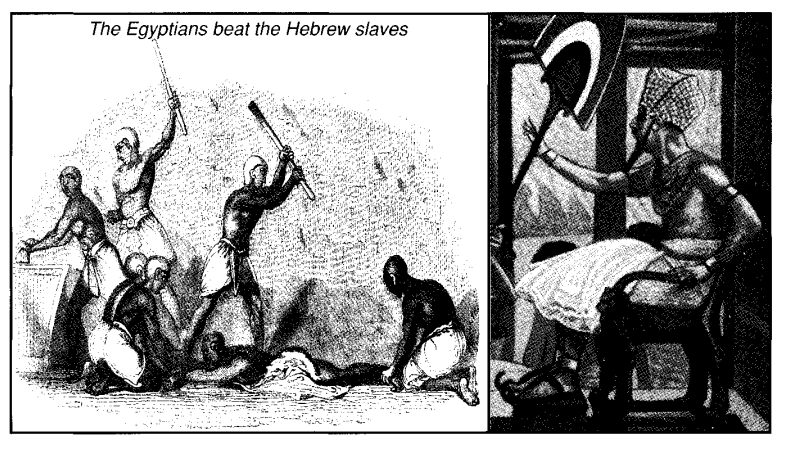
"And they were driven out from Pharaoh's presence" — The literal Hebrew is "he drove out them from the face of Pharaoh." Pharaoh showed his displeasure, and Moses and Aaron were thrust out of his presence by an officious attendant. This was an insult not previously suffered by the brothers. It was obvious from Moses' increasing firmness, and Pharaoh's mounting impatience, that the crisis was moving to a climax.
Eighth Plague: Locusts Darken the Earth — vv. 12-15.
Moses stretches forth his rod, and a strong east wind commences to blow, which continues without ceasing for a day and a night. On the following morning come the locusts. They come in such numbers as have never previously been seen, and darken the sky. What harvest is left is soon devoured; what trees have growth, are soon bared of all foliage, and even homes are invaded.
VERSE 12
"And Yahweh said unto Moses, stretch out thine hand over the land of Egypt for the locusts, that they may come up upon the land of Egypt, and eat every herb of the land, even all that the hail hath left" —See ch. 9:32.
VERSE 13
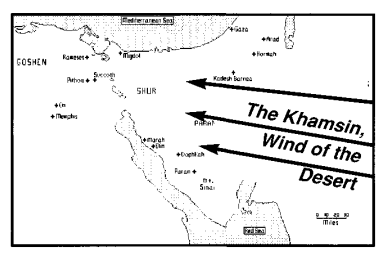
"And Moses stretched forth his rod over the land of Egypt, and Yahweh brought an east wind upon the land all that day, and all that night" —The east wind (Qadim) crosses sandy wastes before reaching Egypt. It blows with violence, and is the prevailing wind from February to June. Known as The Khamsin, or "Wind of the Desert," it commonly visits Egypt about the time of the vernal equinox. It is accompanied by an awful and weird darkness, caused by the dense clouds of fine sand that are whipped up by the wind, and which intercept the sun's rays, producing darkness. It usually blows for the space of about two, or at the most, three days.
"And when it was morning, the east wind brought the locusts" — Locusts normally ride with the wind. An east wind would have brought them from northern Arabia, which is noted as the home of the insect. The Hebrew for "locust" (arbeh) can sound like "arab" (see Rev. 9:3).
VERSE 14
"And the locusts went up over all the land of Egypt, and rested in all the coasts of Egypt" — The area of Egypt is about 840 kilometres (520 mis) long by 32 km (20 mis) wide. Clouds of locusts, 800 km (500 mis) in length, are not uncommon.
"Very grievous were they; before them there were no such locusts as they, neither after them shall be such" — The Hebrew word rendered "grievous" signifies to be heavy, and its use indicates that the plague rested heavily upon the nation of Egypt. The plague was unique, not only in its extent, but because the remarkable locusts avoided the lush land of Goshen, and in that way went right against their natural instincts.
VERSE 15
"For they covered the face of the whole earth, so that the land was darkened" — They carpeted the whole of Egypt, so that the land could not be seen. People out walking had to crunch their way through locusts. The insects invaded the homes, leaping upon everything, making life a perfect misery (v. 6).
"And they did eat every herb of the land, and all the fruit of the trees which the hail had left: and there remained not any green thing in the trees, or in the herbs of the field, through all the land of Egypt" — Thus the original creative work by God in forming the garden of delight, with herbs and trees (Gen. 1:11) was reversed, because of the obstinacy of Egypt. Joel describes the effect of locusts by stating: "The land is like the garden of Eden before them; and behind them a desolate wilderness" (Joel 2:3). Egypt was reduced to that state.
Moses Again Intercedes For Pharaoh — vv. 16-20.
With the effect of the plague heavy upon Egypt, and with locusts penetrating even the precincts of the palace, Pharaoh urgently calls for Moses and Aaron, and, acknowledging his fault, pleads with them to intercede with Yahweh on his behalf. In consequence, a strong west wind drives the plague of locusts into the Red Sea, and Egypt again has peace. But once again the stubbornness of Pharaoh asserts itself, and he does not grant permission to Israel to leave.
VERSE 16
"Then Pharaoh called for Moses and Aaron in haste" — With what little crops that had remained, now destroyed, and the land laid bare, Pharaoh urgently sought the aid of Moses.
And he said, I have sinned against Yahweh your God, and against you" — See Ex. 9:27. The confession and acknowledgement of a divine act was meaningless in the absence of action to remedy acknowledged failings.
VERSE 17
"Now therefore forgive, I pray thee, my sin only this once, and intreat Yahweh your God, that He may take away from me this death only" — Pharaoh had been humbled enough to seek forgiveness, but it was academic only: a shallow mouth-confession that was not vindicated by action (see Pro. 28:13). It was merely designed only to gain relief from the plague, which was so severe as to threaten to destroy the nation. Pharaoh, as representative of the people of Egypt, sought help to avoid the death that threatened.
VERSE 18
"And he went out from Pharaoh, and intreated Yahweh" — Once again the power of prayer was demonstrated.
VERSE 19
"And Yahweh turned a mighty strong west wind, which took away the locusts" — The Hebrew words for "west wind" are ruach yam, "wind (or spirit) of the sea," i.e. the Mediterranean. The "wind from the sea" was powerful enough to sweep the locusts eastwards into the Red Sea.
"And cast them into the Red Sea; there remained not one locust in all the coasts of Egypt" — The Hebrew yam suph signifies "sea of reeds." Some claim that it was so called because of the abundance of algae or sea-weed found in it. However, there is little sea-weed to be found in the Red Sea! Perhaps the reference to reeds, or weeds, is figurative of sin (cp. Heb. 6:8). The Septuagint has "Red Sea," and this seems correct. Certainly a shallow lake of reeds, separate from the Red Sea itself, as some claim it to be, would scarcely be sufficient to destroy a plague of locusts of the magnitude of this one!
This is the first time in Scripture that reference is made to the Red Sea, a sea that subsequently played such a prominent part in the divine purpose. It is about 2,170 klms (1,350 mis) long and 400 klms (250 mis) wide at the mid-section, gradually diminishing towards the Suez Canal. It is divided into the Gulf of Suez and the Gulf of Aqaba. The territory of Edom extended down to the Red Sea, which suggests another reason why it received that name, Edom meaning "red" and standing for sin (see Gen. 25:25).
VERSE 20
"But Yahweh hardened Pharaoh's heart, so that he would not let the children of Israel go" — Though the harvest was ruined, the locusts were gone, and food could be replenished from some other source. The respite Yahweh permitted, caused Pharaoh, in the stubbornness of his heart, to again foolishly resist the divine command and, perhaps, to barter as to who should go. Yahweh's contribution to this hardening, was the removing of the plague: Pharaoh's natural dullness did the rest.
Ninth Plague: Darkness Over the Land — vv. 21-23.
Without warning to Pharaoh, Moses, following the instructions of Yahweh, stretches his hand towards heaven, and suddenly the land of Egypt is plunged into total, gloomy darkness for three days, as the light of the sun is completely obscured. It is a supernatural, eerie darkness, such as can be felt. Even the moon and the stars are not shining. It is a darkness, so severe, that the people remain in their dwellings for three days, though, in Goshen there is light in the dwellings of the Hebrews. This plague therefore resulted in indignities being experienced by the highest of the Egyptian gods: Ra, the god of the sun, and Thoth, who is represented as setting the sun and moon in their places, and so giving light day and night — as well as others of the Egyptian pantheon.
VERSE 21
"And Yahweh said unto Moses, Stretch out thine hand toward heaven, that there may be darkness over the land of Egypt, even darkness which may be felt" — Such a darkness may have been induced by an extremely severe khamsin, a very harsh wind of the desert, that normally afflicts Egypt. It has been known to blot out the light of the sun, and in doing so induces an awful and weird darkness, caused by dense clouds of fine sand. It drives people indoors and is extremely unpleasant. It generally lasts for two or three days.
On one visit to Egypt, we personally experienced this very condition when the khamsin began to blow. The morning had commenced pleasantly enough, but by 10 a.m. the light of the sun had been obscured. We had to catch a plane to Lebanon, and to brave the biting, cutting sand to do so. Our plane was the last to leave, after which the authorities were compelled to close down the air terminal until the khamsin blew itself out. From aloft, we were able to look down upon the blanket of dust that covered the land for hundreds of miles. If it were the khamsin that was used by Yahweh against Pharaoh, it was of supernatural severity.
Such a gloom is prophesied to figuratively cover the whole earth at the time of the Lord's return. Isa. 60:2 speaks of a time when "darkness shall cover the earth, and gross darkness the people." This will repeat in the moral and political conditions of the earth in the latter days, what physically occurred in the land of Egypt in the times of Pharaoh.
VERSE 22
"And Moses stretched forth his hand toward heaven; and there was a thick darkness in all the land of Egypt three days" — This plague struck at the very heart of Egyptian worship. Ra, the god of the sun, was among the chief of the gods. To the Egyptians, his unfailing faith in providing the light of the sun, day after day, was the subject of great rejoicing and confidence. The sun was worshipped through other gods also, such as Horus and Atum.
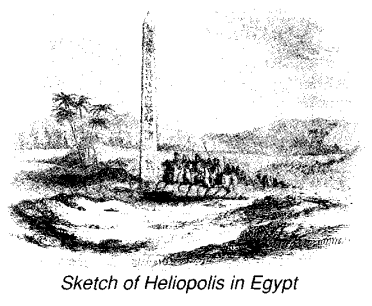
The headquarters of the worship of Atum was at Heliopolis, the city of the sun. It is given the name of On in Gen. 41:45 and was the city from whence came Joseph's wife. Aten (or Aton), another god which was worshipped in the form of a deified sun disk, and whose headquarters were at Amarna, was very prominent in Egyptian theology. Indeed, when Pharaoh Akhenaton endeavoured to overthrow the polytheism of Egypt, and replace it by the worship of one god, he selected Aten for that purpose.
Even the Trinity had its form of worship in Egypt, and was associated with the sun. It was found in the triune worship of Amon-Ra, his wife Mut, and their son Khons. Other gods also deified the sun, moon and stars, all of which were blotted out by the thick darkness of this plague. Thus, whereas earlier plagues had brought about the destruction of property, personal discomfort, pain and even death, this one blotted out the gods themselves, and caused the total immobilisation of the nation. It also challenged the status of Pharaoh for he was considered a representative of Ra. See the significance of his name in the comments on Ex. 6:1.
The three days of darkness over Egypt are figurative of the three days during which the Lord Jesus resided in the darkness of the grave, awaiting the new day of resurrection. The leaders of Jewry, who acted as did Pharaoh in Egypt, refused to acknowledge the divine character of the Son of God, and to accept his teachings.
VERSE 23
"They saw not one another" — This indicates the extreme nature of the visitation, far worse than any normal khamsin. If it were the khamsin that caused darkness, the wind and the sand would quench any artificial light.
"Neither rose any from his place for three days" — This does not mean that they did not move about indoors, but that they did not venture outside. A similar expression is used in Ex. 16:29 indicating this situation. The air, thick with sand, made even artificial light difficult.
"But all the children of Israel had light in their dwellings." — This light was miraculously provided by Yahweh, concerning whom Israelites later sung: "Yahweh is my Light and my Salvation" (Psa. 27:1. See also Psa. 112:4; 118:27; 119:105, 130). For the antitype consider IPet. 2:9; Phil. 2:15 — the Truth, as it is in Christ Jesus, is able to illuminate the lives of its believers, even though darkness surrounds the civilisation of the world (Isa.60:2).
Pharaoh Pleads For Relief,
But Remains Obstinate — vv. 24-29.
In desperation, Pharaoh again calls for Moses and bargains with him. He agrees to let Israel go, but the animals must remain behind. Moses rejects the compromise, and states as an ultimatum that there must be a complete withdrawal of Israelites and their flocks, herds and possessions. Pharaoh's stubbornness erupts in fierce anger and he orders Moses out of his presence, warning that if he returns he will be put to death. Moses accepts the challenge and retorts that he will not return. The crisis has reached a climax.
VERSE 24
"And Pharaoh called unto Moses, and said, Go ye, serve Yahweh; only let your flocks and herds be stayed: let your little ones also go with you" — Nearing the breaking point, Pharaoh concedes everything but the flocks and herds, convinced that this will act as a deterrent on Israel, requiring the people to return to Egypt. The term "your little ones" is "your families" in Hebrew.
VERSE 25
"And Moses said, Thou must give us also sacrifices and burnt offerings, that we may sacrifice unto Yahweh our God" — To grant this request, Pharaoh would have to compromise with his religion, for he worshipped the very animals Israel would use in sacrifice! Moses leaves no doubt as to what he meant by his following words.
VERSE 26
"Our cattle also shall go with us; there shall not an hoof be left behind; for thereof must we take to serve Yah-weh our God; and we know not with what we must serve Yahweh, until we come thither" — Moses absolutely refuses any thought of compromise. He plainly states that the Israelites must leave in their entirety, and with all their possessions. Their future movements would be governed by the instructions of Yahweh.
Similarly, when believers seek to worship Yahweh, they must separate completely from the environment of Egypt. It is impossible to properly worship Yahweh if we seek to continue our association with spiritual Egypt (cp. Lk. 9:62; 17:32-33).
VERSE 27
"But Yahweh hardened Pharaoh's heart, and he would not let them go" — See v. 20.
VERSE 28
"And Pharaoh said unto him, Get thee from me, take heed to thyself, see my face no more; for in that day thou seest my face thou shalt die" — Pharaoh's impotent stubbornness erupted in violent anger and fury. To concede what Moses demanded, required that he give up his worship, abdicate his position, deny his very status as a son of the gods. To his mind, he would be condoning a sin of the greatest magnitude, if he granted permission to Moses to take from Goshen animals that were revered in Egypt in order to sacrifice them to an "unknown God." Pharaoh would rather give up his life, and the life of Egypt, than abandon his worship. So rage took possession of him, and he ordered Moses from his presence. And anger begot anger, for Moses likewise turned to the King and bluntly issued an ultimatum, including words of personal warning to Pharaoh (see Ex. 11:8). The interview with Pharaoh is continued in Ex. 11:4-8.
VERSE 29
"And Moses said, Thou hast spoken well, I will see thy face again no more" — Thus all negotiations between the two men were now completely brought to an end.
Prior to leaving, however, Moses spoke the words recorded in Ex. 11:4-8, for the words of vv. 1-3 should be in parenthesis. They indicate that before Moses obeyed the command of Pharaoh to come into his presence, Yahweh had revealed to him. His future intentions in the outpouring of the last and most terrible plague that was to come upon Egypt, one that would finally bring all resistance to an end.
Comments