VERSE 1
"And Yahweh spake unto Moses saying" — This statement, as usual, introduces a new facet of the theme under consideration.
VERSE 2
"If a soul sin, and commit a trespass against Yahweh" — The word "trespass" is mahal for which see note Lev 5:15. This description of a "trespass" shows that though it may be done against a neighbour, it is treated as being an offence "against Yahweh". for in fact Yahweh's law was breached.
"And lie against his neighbour in that which was delivered him to keep" — Lying is specifically forbidden (Lev.19:11: Eph. 4:25: Col. 3:9). However, the false-hood referred to in this statement relates to a falsehood in regards to things left with another in trust that have been lost (see Exod. 22:7-13) A person might attempt to escape his obligation by alleging the amount left with him was lesser than it actually was.
"Or in fellowship" — This is literally putting of the hand, an action by which one joins himself to another, and hence gives rise to the descriptive statement: "the right hand of fellowship" (Gal. 2:9). In the case before us, a person has given his hand, or entered into a pledge, in relation to certain items of property. In so doing, he has guaranteed their return or repayment.
"Or in a thing taken away by violence" — An item that has been obtained through violent robbery.
"Or hath deceived his neighbour" — Something that he has acquired by deceit or fraud.
VERSE 3
"Or have found that which was lost, and lieth concerning it, and sweareth falsely" — The action required in regard to the finding of lost property is described in Deut. 22:1-3. Anybody finding lost property had to care for it so as to restore it in proper condition to its rightful owner. In case of a doubt arising as to what had become of property delivered to another to keep, there was required "an oath of Yahweh between them both" denying that the user had "put his hand unto", or stolen, his neighbour's goods (Exod. 22:11). A dishonest person would swear falsely. Wrong done to a fellow man is a sin against God in every instance: but it "becomes particularly so when such an oath is taken.
"In any of all these that a man doeth. sinning therein" — This is a preamble introducing the penalties that follow.
VERSES 4-7
These verses repeat the legislation of Lev. 5:16-19. for which see notes.
PART TWO THE PRIESTHOOD (MEDIATION)
Chapters 6:8-10:20 (see p. 16)
Having set in order the various offerings that could be made. The Book of Leviticus now legislates for mediators who were appointed to help believers in their worship. In "The Law of Moses" (Ch. 17) the comment is made: "The appointment of a Tabernacle and its various appurtenances as a meeting place between God and Israel (for such
God declared it to be — Exod. 29:43). necessitated the appointment also Of an order of men to act as intermediaries: how otherwise could Israel acceptable draw near. Israel was unfit to draw near. Even as sacrifice would be "transformed" by the action of fire: a type of the "transformation" caused by the spirit word: the renewing of the mind, which will cause a believer to offer himself as a living Burnt offering unto Yahweh (Rom. 12:1-2).
The evening sacrifice burned slowly all through the night, and was supplemented by the morning sacrifice which burned throughout the day. With the other offerings that were made, this meant that the altar was constantly in use: a fitting type of Christ our altar (Heb. 13:10). On the Christ-Altar, as well, sacrifices are constantly being offered: it is always in use. The constant use of the altar during Mosaic times, meant that at any time Israelites could look towards the altar, and see the ascending smoke of the burnt offering. We, too, can Figuratively look towards Christ, and see in his complete dedication, the anlitypical burnt offering always at work. In the Mosaic ordinance, each morning and evening, the ashes were removed, the fire was replenished, and the burning continued. The lesson is clear. Let us daily, each morning and evening, remove the "ashes" by bearing up our faults before God for forgiveness; let us replenish the fire, by constant recourse to the word: and let us dedicate ourselves anew in His service, so offering our lives as "a living sacrifice" unto Him. "And the Tire of the altar shall be burn ing in it" — See note v. 13.
VERSE 10
"And the priest shall put on his linen garment, and his linen breeches shall he put upon his flesh" — The priest had to be suitably attired. He put on his linen clothes so as to cover the flesh in a garment of righteousness. Our priest, the Lord Jesus, did likewise. We. as priests should follow his example. See Psa. 29:2.
"And take up the ashes which the Tire hath consumed with the burnt offering on the altar, and he shall put them beside the altar" — The word for "ashes'" is deshen, "fat" (see note Exod. 27:3). The term relates to the fat and residue that is not converted into smoke. This was placed beside the altar in order that it might cool, for it would be extremely hot.
VERSE 11
"And he shall put off his garments, and shall put on other garments" — When the priest divested himself of his garments he no longer stood before the people in his priestly status; he was reduced to the standing of a lay man. And as a layman he took away the ashes. This pointed forward to the purpose of Yahweh in Christ. It demonstrated that at the death of Christ (the completion of the burning) there was required "a change in the law" (Heb. 7:12) to provide for a new form of priesthood, the Melchisedec. as manifested by the Lord himself.
"And carry forth the ashes without the camp unto a clean place" — We have noted before that the Burnt-offering pointed forward to the offering of the Lord. His life was given in complete dedication to Yahweh, and in complete denial of the flesh. When he died, the flesh remained to be taken away and placed in a clean place: the sepulchre of Joseph of Anmalhea "wherein was never man yet laid" (John 19:41). Hence in a very complete and beautiful manner, every detail of the type was carried out. It was only after the Lord had risen that the Apostles recognised this. When the Lord died upon the cross, the work of sacrifice was completed. He had submitted to death voluntarily (John 10:17-18) howbe-it at the command of God. and his supporters conveyed his body to a clean place. Though lay men they did the work of the priest.
VERSE 12
"And the fire upon the altar shall be burning in it: it shall never be put out" — The fire of the altar represents the spirit word, concerning which, the Apostle exhorted: "Quench not the spirit" (1 Thess. 5:1°). The fire of the word must constantly bum. for "without faith it is impossible to please God" (Heb. 11:6). and "faith cometh by hearing the word of God" (Rom. 10:17). An offering motivated by means other than the spirit word, is not satisfactory to God.
It was no ordinary fire upon the altar, for as noted above, it represented the Spirit word. The fire came from Yahweh. as is recorded in Lev. 9:24: and thence, afterwards, was never permitted to go out. It was carried from place to place, probably by a censer, as Abraham took tire with him when he ascended the mount for worship and sacrifice (Gen. 22:6-7). Wherever a saint might go. he should take the divine fire of the Word with him.
"And the priest shall burn wood on it, every morning" — This taught that the fire must be stimulated every morning. We are reminded of the words of Paul to Timothy, and the application that can be given to our circumstances, even though the power of the Holy Spirit has been withdrawn: "Wherefore I put thee in remembrance that thou stir up the gift of God. which is in thee" (2 Tim. 1:6). There is also a further application of the type to the Lord himself. The apex of his Burnt-offering, was his death on Calvary, when he was nailed to the wood of the tree, giving significance to the wood on the altar which kept the fire burning.
"And lay the burnt offering in order upon it" — See note Lev 1:8.
"And he shall burn thereon the fat of the peace offerings" — The portions of the Peace-offering that were to be placed on the altar are listed in Lev. 3:3.9.14. The peace offering was joined with the Burnt offering because true fellowship is only possible in conjunction with a truly dedicated life. The former provides the basis for the latter.
VERSE 13
"The fire shall ever be burning upon the altar; it shall never go out" — The fire was divine fire (Lev. 9:24). and no sacrifice was acceptable without it. It typifies the spirit-word.
______________________________
THE BURNT OFFERING AS A TYPE
The animal was first slain on the north side of the altar (Lev. 1:11). foreshadowing the north of the Temple. It was then skinned, dismembered into separate parts, and carefully washed. This taught that the inner man must be opened to God's inspection, and must be "clean" in His sight in all his parts (see Heb. 4:13). Christ, as the antitypical burnt offering, was perfectly "clean" in the sight of God and of man. so that he could boldly declare to his contemporaries: "Who of you convinceth me of sin" (John 8:46).
The animal was placed upon the altar, and was completely consumed by the divine fire, typical of the spirit-word. The antitype is seen in the Lord: "I delight to do Thy will. O my God: yea. Thy law is within my heart" (Psa. 40:8). "The zeal of Thine house hath eaten me up" (John 2:17). The fire was fed by wood heaped upon the altar (Lev. ft: 12). pointing forward to the tree that brought the dedicated life of the Lord to its consummation (Acts 5:30).
As a burnt offering was made every morning and evening, to slowly consume by day and by night, the altar was constantly in use (cp. Psa. 134:1). So also is the Christ altar (Heb. 13:10). for upon it. by day and by night are placed the sacrifices of saints (Rom. 12:1-2). A Hebrew could ever look towards the altar, and be assured by the rising smoke, that God was active on his behalf. So also with the Christ altar. Found at present at the right hand of the Father, the Lord intercedes and acts continually on behalf of his followers (cp. 1 John 2:1-2: 1 Pet. 3:22). '
A priest, appropriately clad in a priestly robe of righteousness (Psa. 132:4) presided over the offering whilst it was being consumed (Lev. 6: 10). and placed by the side of the altar, what remained of the beast at the conclusion of the burning. Then, after changing his garments, so as to appear as a layman acting as a priest, he conveyed the remaining consolidated fat away to a clean place (Lev. 6:11). This was fulfilled when Joseph of Arimathea and Nicodemus. though laymen. acted the part of the priests, in removing the remains of Jesus for burial after his dedication was completed in his death on the cross. For they took him and placed him in a clean tomb "wherein was never man yet laid" (John 1:41). The change of garments which resulted in the priest appearing as a layman. foreshadowed the change in the Law required to elevate Christ to the Melchize dek priesthood: "For the priesthood being changed, there is made of necessity a change also of the law" (Heb. 7:12). It is significant that the priest was required to change his clothes at the very point of time at which the burnt offering was entirely consumed (Lev. A: 11). The presiding priest was given the skin of the burnt offering (Lev. 6:11). Whereas he ate portion of the sacrifices as Yahweh's representative: he received the skin of the offering as the peoples representative. It taught Israelites the need of an adequate covering, as dramatised in Eden, and provided by the Lord (Gen. 3:21 f Gal. 3:27). Bui as Christ was the antitype of both altar, priest and sacrifice, it also taught that he himself was in need of redemption, and that his offering was an element in his own salvation (Heb. 13:20). The peace offering was associated with the burnt offering (Lev. 6:12). for personal dedication (the burnt offering) is a necessary adjunct to true fellowship, typified by the peace offering. Christ's sacrifice provided the basis of true fellowship between the Lord's followers and his Father.
______________________________
Instructions Concerning The Meal Offer - vv.14-18
The general rules for the meal offering are outlined of Lev. 2:1-16. Portion of the meal offering called "the memorial" is burnt upon the altar, whilst the bulk of it given to the priests to be eaten by them in the court of the Tabernacle, called "the holy place". (Lev. 7:9-10). The portion burnt upon the altar is called "the memorial" because it represents a token of the whole: a token of man's best labour given unto Yahweh. because the production of the meal offering; requires the co-operation of man. The antitype is the labour that Christ and his brethren offer unto Yahweh. He is the Memorial lot the others He declared "My meat is to do the will of Him that sent me, and to finish His work" (John 4:32-34); and saints are called upon to exclude leaven from their character-offerings unto God (1 Cor 5:6-8). The eating of the meal offering by the priests was an act of fellowship: and in conformity therewith. Christ likened the eating of the "living bread from heaven" as the basis of true fellowship 1 John 6:51). The meal offering; had to be eaten in the holy place, where wants are figuratively found now, and all those touching it were accounted holy, typifying the state of believers qw "holy brethren, partakers: of the heavenly calling" (Heb.3:1).
VERSE 14
"And this is the law of the meal offering" — Cp. with Lev. 2:1-11
"The sons of Aaron shall offer it before Yahweh. before the altar" — It was first ceremonially presented in Yahweh and then offered on the altar. As such it was His, and whal it typified should be rendered unto Him by the offerer in sacrificial devotion. "Before" is "faces". The "faces" of Yahweh comprise the Elohim: the "faces" of the altar are the priests who officiate the meal.
VERSE 15
"And he shall take of it his handful, of the flour of the meal offering, and of the oil thereof, and all the frankincense which is upon the meal offering, and shall burn it upon the altar for a sweet savour" — Oil and frankincense is offered with the meal offering (cp. Lev. 2:21). What a wonderful symbol. The meal offering (for the "meal" of the AV relates lo Brain) was a combination of the labour of God and man. God caused the grain to grow. develop and ripen, but man prepared il for food. So the offering represented the labour of man in cooperation with Yahweh. It was offered with oil. representing the spirit-word, and frankincense, the symbol of prayer. All these elements must be in evidence before any labour we put into the Truth is acceptable with him.
"Even the memorial of it unto Yahweh" — The portion taken by the priest was a "memorial" of the whole; it represented the whole, as Christ represents the whole Body. This memorial was a token that the offerer was presenting the fruits of his finest labour to Yahweh on the altar. The antitype is Christ who told the Apostles: "I have meal to eat that ye know not of" (John 4:32-34). Paul, on the other hand, snowed how that the "meal offering" can become polluted (see 1 Cor. 5:6-8). The meal offering comprised the basis of fellowship, for. said Christ: "I am the living bread thai came down from heaven: if any man eat of this bread, he shall live for ever" (John 6:51).
VERSE 16
"And the remainder thereof shall Aaron and his sons eat: with unleavened bread shall it be eaten" — Rotherham clarifies this statement by rendering it in unleavened bread shall it be eaten" The bread was publicly eaten in the holy place thus demonstrating to all common Israelites the manner of life expected of them as being members of the priestly nation Their labour should be rendered back to God: they should show dependence upon Him for the necessities of life: they should reveal themselves as a holy community, masticating the unleavened bread of sincerity and truth.
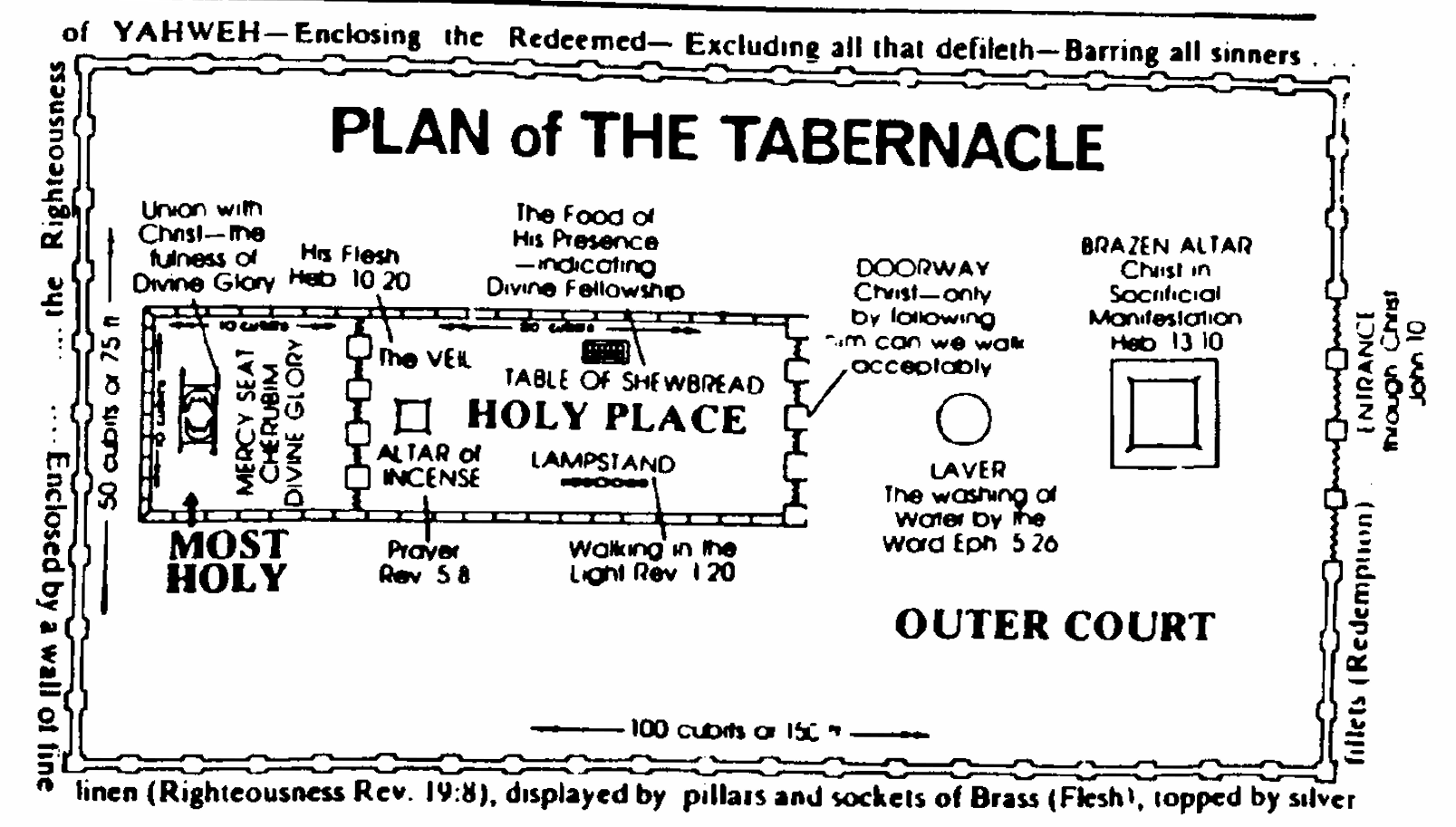
"In the holy place; in the court of the tabernacle of the congregation they shall eat it" — In the scheme of God manifestation exhibited by the plan of the Tabernacle, the outer-court with its altar of burnt offering and its laver. represented the Mate of preparation. Therefore, it is here called "the holy place" because the whole area of the Tabernacle was set apart for divine use. It is also called "the court of the Tabernacle of the congregation", and inasmuch as the priests are found therein showed that it represented them as mortals before Yahweh. The Hebrew word for "congregation" is mowade. See note Lev. 1:1. The R.V. renders it: "tabernacle of meeting". This suggests that the eating of the meal offering took place when people were gathered together at the Tabernacle. The action thus constituted a public witness of fellowship with the Father on the part of the people through their representatives, the priests The basis of fellowship was the ritual offering up of the result of their labour, carefully prepared by grinding, and finally cooked with oil so as to become palatable before Him. See Note Lev 2: 10. On this symbolism. Brother W. F Barling; has this to say in Law and Grace: "Meal offering in all its forms had to be anointed with oil and permeated by it: that is their works had all to be prompted and hallowed by the influence of God's Spirit upon them. On the material plane, oil was an essential adjunct in order that the meal might be made palatable to the men who ate it: so, also, the Meal Offering could only be pleasing food' to God (that is. their works could only give Him true satisfaction if sanctified by His Spirit and thus attended by His blessing. That is their works had essentially to be good works
"Yet. one further thing was necessary Over and above both meal and oil was placed an offering of frankincense whereas part only of the meal and oil was appropriated ritually by God through the action of the Altar lire Ithat part, of course, typifying the whole, with the effect that the residue could with propriety be consumed by the priests as types of Him. In pointed contrast, the whole of the incense had to be burnt with the memorial (Lev 2:2.16). As this was confirmed by the flames it gave out a most fragrant scent which, invisible yet all-pervading, rose heavenwards — the perfect symbol of that true spiritual worship of the Holy One above which ensures that works are done not for their own sake, but solely to the honour and glory of His Name."
VERSE 17
"It shall not be baken with leaven" — The meal, representing works offered unto Yahweh. must be pure from that which symbolises wrong, ulterior motives. Contrast the prohibition of the use of leaven, with the complete use of frankincense (Lev. 2: 16).
"I have given it unto them For their portion of My offerings made by fire" — Thus, before all Israel, the priests enjoyed a fellowship meal with Yahweh. He shared the offerings made to Him with His ministers and they ate in the holy place. See 1 Cor. 9:13 :10: 18: Heb. 13:10 and compare with 1 John 1:3.
"It is most holy, as is the sin offering, and as the trespass offering" — This teaches that fellowship should not be treated lightly.
VERSE 18
"All the males among the children of Aaron shall eat of it" — Special provision is made in the Law for males. They had the sign of the covenant in their flesh (Gen. 17:10; Lev. 12:3): they belonged to Yahweh in a special sense (Exod. 13:12. 15): they had to represent the whole family by appearing before Yahweh three times in a year as specified (Exod. 23:17; Deut 16.16) In the family circle, the husband represented God in status (1 Cor 11:3). and this was impressed upon Israelites by such ordinances as this verse For that reason, women were called upon to manifest subjection.
"It shall be a statute for ever in your generations concerning Ihe offerings of Yahweh" — As the priests represented Yahweh to the people it was important that they should cat of the sacrifices in the manner specified to illustrate the principle of fellowship before all.
"Every one that toucheth them shall be holy" — Contact with "holy flesh " transmitted holiness to others: and hv holiness is meant separation for divine use (see Hag. 2:11-14). As contact with the altar and its offerings sanctified that presented thereon, there was a need for those who ministered thereat to manifest holiness in action in order to grace the holiness of state which was their's (see Isa. 52:11).
At The Consecration Of A Priest — vv. 19-23
A special meal offering is required at the consecration of a high priest: typifying that he is about to enter into a special form of service. He is to offer a tenth pun of an ephah of fine flour baken in a pan with oil. The cakes thus formed shall be presented, half in the morning and half in the evening, to be entirely consumed as a burnt offering on the altar. Such an offering will be continued day after day at the time when the morning and evening lambs are also offered tF.xod. 29:.1S~16). The offering denoted that the best of the high priest' s labour will be given to Yahweh. from the time he enters into his ministry until it closes (morning and evening) The antitype is found in the Lord Jesus, who completely dedicated himself to "his Father's business" with total self-ahsorption. and finally, at the end of a life of perfect devotion had his flesh changed into divine nature. This prophecy is proclaimed every day by the "minchah" offered by the high priest.
VERSE 19
"And Yahweh spake unto Moses saying" — This preamble introduces a new section of the subject.
VERSE 20
"This is the offering of Aaron and his sons, which they shall offer unto Yahweh in Ihe day when he is anointed" — The high priest on the day of his consecration, and assisted hv subordinate priests, was required lo make Ihe offering described
"The tenth part of an ephah of fine flour" — Sec Note Lev 2:1. "Fine flour" denotes the best of a man's labour for the support of lite The measure defined, links the offering with the amount of manna assigned by Yahweh each day for the sustenance of life (see mile Lev. 5:11). Therefore. in this offering, the high priest was depicted as giving hack to Yahweh that which He has given unto man: the means of life whereby he can serve Him. Hy his offering, the priest publicly testified that he would render unto God the best of his lime, energy, thought, intellect, study and labour. The fulness of the antitype is seen in Christ, our high priest: and he provides an illustration of what is required on the part of all his followers. Therefore "his sons", a description given to saints in Heb. 2:13. should aim to follow the example of the Lord, thus initiating "the sons of Aaron" who co-operated with their father in the offering he made.
"For a meal offering perpetual" — This is better rendered a continual food offering (See Interlinear Hebrew Bible). The Hebrew minchah rendered "meat offering" denotes a bloodless offering as described in the requirements of these verses. This is here called a continual meal offering, indicating that it was offered, not once, but day after day by the high priest. He commenced these duties at the time of his ordination, and continued them until his death.
"Half of it in the morning, and half thereof at night" — Thus the whole of the offering was given unto Yahweh. spread over the whole day. teaching that there was no cessation in the dedicated service that the Lord rendered during his life-time. From the beginning to the end of his life he was intent upon performing "his Father's will" and in so doing, gave an example to all who would follow him. and who are described as being "in him" In Christ, even mundane occupation can assume the status of dedicated labour unto Yahweh. and so become an avenue of service to Him (see Eph. 6:1-5)
VERSE 21
"In a pan it shall be made with oil" — See notes Lev 2:4-6 (pp. 32-33). Oil typed the spirit-word, teaching that all service unto Yahweh must be motivated by faith (Heb. 11:6) which comes from hearing Ihe Word (Rom. 10:17).
"And when it is baken, thou shall bring it in" — Baking consolidated the dough and formed the cake, so that hv that means it was brought to maturity Baking types the trials of life that are necessary to mould a character, and make it fit for Yahweh Faith is tried and perfected by fire (1 Pet. 1:7). and helps in bring forth fruits unto perfection, necessary for complete justification (James 2:24)
VERSE 22
"And the priest of his sons that is anointed in his stead shall offer it" — This teaches that the ordinance was continued by the priest who followed in the succession of Aaron as high priest.
"It is a statute for ever unto Yahweh" — It is a stature not to be overlooked. It is important to constantly reaffirm the need of total dedication such as this offering emphasised.
"It shall be wholly burnt" —The word wholly is from gatar, "to turn into fragrance by fire". Therefore, the statement can read: "it shall ascend in fragrance through fire as a whole burnt offering". The offering: typified the complete dedication of the Lord, who was "well pleasing" unto the Father (Matt. 3:17). His life and character was as fragrant incense to Yahweh.
VERSE 23
"For ever* meal offering for the priest shall be wholly burnt: it shall not be eaten" — This instruction is doubled for emphasis. Christ, as the antitype illus-trated the complete dedication required of him. Those "in Christ' should attempt to follow in his footsteps They should give themselves up to Yahweh in self-dedication, labouring in season and out of season" in His service (2 Tim. 4:2).
Instructions Concerning The Sin Offering vv. 24-30
The general instructions are given in Leviticus 4, and here the priestly rules are outlined. The sin offering is designated "most holy", and the flesh. representing the offerer is solemnly, and exclusively, appropriate to the use of the mediating priests (cp. Lev. 10:17). The far-reaching symbolism of the offering met its perfect fulfilment in Christ, who came in our nature, and who appropriated believers unto himself The typology of the offering as applying to the Lord is complete. It was treated as "most holy": so also was Christ (Luke 1:35). It was slain on the north side of the altar (Lev. 6:25) and Calvary is on the north side of Jerusalem. It was slain "before Yahweh": as also was Christ (John 16:32). The offering for the rulers and for the people was eaten by the priests to signify acceptance by Yahweh and resumption of fellowship: and the fulfilment is seen in the fellowship established between Yahweh mul believers through the Lord. The offering for the priest and congregation was burnt without the camp, implying that the complete forgiveness of sin. and bodily redemption was beyond the power of the Law (cp. Hewb. 13:11-14) and Christ brought a to light by the Gospel of grace John 1:17; 2 Tim 1:10. The sin offering was not invariably associated with actual transgression, but also took cognisance of the sin nature which is the author of such infraction (cp. Lev. 12:6; 15:30): so Christ's offering witnessed that the flesh has lit he suppressed, or figuratively put to death, so that his offering was for himself as (or those he came to save (Heb. 7:24-28; Phil. 2:6-9).
VERSE 24
"And Yahweh spake unto Moses, saying ..." — The preamble for a new section.
VERSE 25
"Speak unto Aaron and to his sons, saying. This is the law of the sin offering" — The instructions that follow are specifically for the priests: the general instructions are given earlier. See Lev. 4:3.
"In the place where the burnt offering is killed" — That place was on the north side of the altar: and answers to Calvary which was north of the Temple and City of Jerusalem.
"Shall the sin offering be killed" — The association of the sin offering! with the burnt offering! is significant, lt teaches that the dedication of self is required as well as the forgiveness of sins, for the attainment of eternal life. In seeking forgiveness of our sins, let us be specific, and confess them openly to Yahweh and not trust vaguely to the provisions of mercy. Moreover, something is required of us to ensure the forgiveness of Yahweh: namely the dedication of self — Ihe offering of ourselves as a burnt offering unto Him.
"Before Yahweh" — Our dedication of self must be offered to Him. and not done merely to impress others. Christ was always conscious of the reality of Yahweh. See John 16:32.
"It is most holy" — This means that it belongs exclusively to Yahweh. This term is applied to the Lord Jesus in Luke 1:35.
VERSE 26
"The priest that offereth it for sin shall eat it" — The word "sin" is chottah signifying to miss the mark, and hence to tail in the ideal set before one (see Phil. 3:14). The presentation of this offering was an admission by the worshipper that he had committed some specific offence against God's revealed will (Lev. 4:2), and an indication of his desire for the forgiveness of Ihe guilt which he had in consequence incurred (Lev. 4:26). The eating; of it by the priests (who. in this way represented Yahweh) was a token that the offering: was accepted by God: "Aaron and his sons . . . shall eat those things wherewith Ihe atonement was made, to consecrate and to sanctify them" (Exod. 29:32). By eating the flesh of the sin offering, the priests absorbed it into their very beings, and thus identified themselves with those for whom he mediated, as the Lord likewise does. Moses explained to Aaron that "God hath given it you to bear the iniquity of Ihe congregation, to make atonement for them before Yahweh'" (Lev. 10:17).
"In the holy place shall it be eaten, in Ihe court of the tabernacle of Ihe congregation" — See note v. 16. Christ bore sin's flesh in the sight of all, in the anti-typical holy place. Thus he identified himself with the people he came to save, for his nature was the same as theirs. It is recorded of him that "his own self bare our sins in his own body on the tree" (1 Pet. 2:24) How did he do that? By possessing our nature, a nature which through its very weakness leads all others to sin" (Mark 7:21-23). Christ, however, never gave way to the lusts of Ihe flesh: but instead subdued them. So. of him il is recorded: "We have not an high priest which cannot be touched with the feeling of our infirmities: but was in all points templed like as we are yet without sin. Let us therefore come bodily unto the throne of grace, that we may obtain mercy, and find grace Io help in lime of need'" (Heb. 4:15-16). Thai lesson was ceremomally taught the people by the action of the priests in eating the sin offering in the holy place.
VERSE 27
"Whatsoever shall touch the flesh (hereof shall be holy" — See note v. 18. The flesh of the sin offering was considered most holy. See Huggai 2:12. It typified Christ who came in our nature and through his righteousness unto death provided an atonement for all sin (Phil. 2:7; Heb. 2:9-18; 9:12-28: 1 Pet. 1:18-23; 2:24). As those who touched the sin offering were accounted holy, so those who make contact with Christ are treated as "holy brethren, partakers of the heavenly calling" (Heb. 3:1).
"And when there is sprinkled nf Ihe blood thereupon upon any garment, thou shall wash that whereon it was sprinkled in the holy place" — The blood was considered holy, and therefore was to remain within (he holy place; it must not be taken outside. So with the antilypical blood, representative of the cleansing medium of Christ. It is found only in the "holy place", within the Ecclesia. and not in the world.
VERSE 28
"But the earthen vessel wherein it is sodden shall be broken" — Whereas Ihe fat of the offering was burned upon the altar (Lev. 4:8-10); the flesh-was boiled (or "sodden") as food for the priests. When this was done in an earthen vessel (representative of the flesh) it was afterwards broken as of no further use. The antitype is found in the Lord Jesus. He is the antitypical sin-offering: and the priests of Ihe age to come memorialise the work he has performed by figuratively "eating his flesh and drinking his blood" in the holy place. But once the Lord completed the sacrifice which afterwards was tokened in the bread and wine, the flesh was changed into divine nature. This was typified by breaking the earthenware vessel.
"And if it be sodden in a brasen pot, it shall be both scoured, and rinsed in water" — Brass is used in Scripture to typify flesh purified (see Num. 31:23). The scouring and rinsing in water indicates the cleansing of that which had been used Io prepare "the offering. Again il represented the Lord Jesus, cleansed, as far as nature is concerned, by attaining unto divine nature.
VERSE 29
"All the males among Ihe priests shall eat thereof; it is most holy" — See note v. 18.
VERSE 30
"And no sin offering whereof any of the blood is brought into the tabernacle of the congregation to reconcile withal in the holy place, shall be eaten; it shall be burnt in the fire" — The blood of the sin offering for priests or congregation was taken into the tabernacle proper, and therefore the flesh was burned outside the camp. The details are given in Lev. 4:5-18. and see our notes thereupon. The offerings of the priests and of the congregation (treated as a priestly nation) were treated differently to that of an individual who had sinned. For the priests had no mediator to act on their behalf, and therefore the eating of the flesh (the prerogative of the priestly mediator) would have been incongruous. Accordingly, it was burnt outside the camp, representing that there was no mediator to save, and direct access had to be made to Yahweh beyond the limitations of the Law.
Comments