THE CONSTRUCTION OF THE ALTAR, LAVER AND COURT: AND THE SUM OF THE PEOPLE'S OFFERINGS
The work of construction is completed by the workmen especially endowed for the purpose. A correct accounting of the people's offerings is made.
VERSES 1-7
See notes, Exo. 27:1-8.
VERSE 8
"And he made the laver of brass" — The instructions concerning the laver are briefly given in Exo. 30:18-21, and further details are now supplied. Before attending at the altar, or before entering the Holy Place, the priests were required to wash hands and feet in the laver (Exo. 40:30-31).Paul identifies the laver with the Word of God (see Eph. 5:26 where "washing" from the Gr. loutron, can be rendered "laver," and see Tit. 3:5; John 15:3; Psa. 119:9). The action of the priests, therefore, demonstrated the constant need of application to the Word as a cleansing agent.
"And the foot of it of brass" — See notes, Exo. 30:18-19.
"Of the looking glasses of the women" — "Looking glasses" is better rendered as mirrors. They comprised highly polished bronze or copper plates, circular or oval in shape, with long handles. Illustrations of these have been found on Egyptian monuments, and samples are displayed in the Cairo Museum.
Normally these were items of vanity, but the women sacrificed their interest in mere display, so as to donate the metal for the construction of the laver at which the priests would wash. The action of these women set an example that sisters today can follow in the strengthening of the hands of brethren in their work in the Truth. Let them also sacrifice some of their objects of vanity that the latter may be served. This is in accordance with the instructions of Paul to Timothy in which he calls upon brethren to act as priests (1Tim. 2:8), whilst he exhorts sisters to set aside objects of vanity in order to give themselves to useful service in Christ (vv. 9-10). Peter does likewise (1Pet. 3:3-4). When these instructions are carried out, many a heart-break in the home will be avoided, for the home in which both parents are devoted to the work of the Truth, is the one in which true happiness is found.
"Assembling, which assembled" — The Hebrew is given in the margin, assembling in troops. The expression denotes the enthusiasm for religious reform which swept Israel at that time, and in which the women played an important part.
"At the door of the tabernacle of the congregation" — This "tabernacle" was the temporary tent set up by Moses pending the building and erection of the proper tabernacle. However, it is obvious from such expressions as are found in 1Sam. 1:9-12; 2:22 that the practice of gathering at such places of worship was followed by godly Israelitish women even after the tabernacle proper was set up.
VERSES 9-20
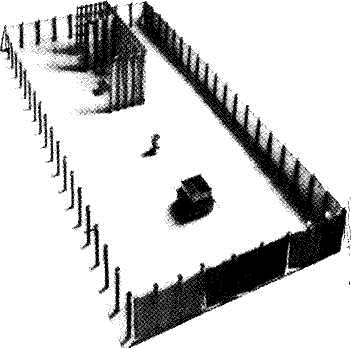
See notes, Exo. 27:9-19. However there is an addition supplied in v. 17, in that the pillars surrounding the court are described as having chapiters of silver. The Hebrew for "chapiters" is roshi, signifying "heads." They were made of silver which is the metal of redemption, for redemption money was paid in silver (Exo. 30:15; Lev. 5:15; 1Pet. 1:18-20). Hence the sixty pillars surrounding the court of the tabernacle had their heads lifted high in proclaiming redemption, illustrating the exhortation of the Lord: "Lift up your heads for your redemption draweth nigh" (Luke 21:28).
Again in v. 18, there is a further addition in regard to the hanging for the gate of the court, in that it is stated that "the height in the breadth was five cubits answering to the hangings of the court" (cp. with Exo. 27:18). This implies that the material was woven in pieces exactly this width, so that the linen fence was made in four-square sections, again illustrating the Israelitish nature of the worship established (see Acts 28:20).
Summary Of The Metals Used — vv. 21-31.
The various metals willingly provided by the Israelites, and used in the construction of the tabernacle, are now listed. While the total cost is large, it is difficult to ascertain what it would be in view of changing values in this age of constant inflation. Actual values of gold and silver can be estimated only approximately. A talent of gold was once estimated to be worth $30,000 and a talent of silver at about $2,000; a shekel of gold at $10, and a shekel of silver at 65 cents. But today it would be considerably in excess of that, emphasising the preciousness of redemption in Christ (see 1Pet. 1:18-20).
VERSE 21
"This is the sum of the tabernacle, even of the tabernacle of testimony, as it was counted, according to the commandment of Moses" — Meticulous accounting was made of all contributions given to the work of Yahweh. This is a wise provision at any time.
"For the service of the Levites" — Note that "for" is in italics and substitute it with "as." The accounting of the materials supplied was a work, or service, performed by the Levites.
"By the hand of Ithamar, son to Aaron the priest" — Ithamar supervised this work, or service, performed by the Levites (see note, Exo. 6:23). He acted as treasurer.
VERSE 22
"And Bezaleel the son of Uri, the son of Hur, of the tribe of Judah, made all that Yahweh commanded Moses" — See note, Exo. 31:2, 6. Bezaleel was the chief overseer, and Aholiab acted as his assistant. Thus the direction of the whole work was under the charge of Bezaleel, though he did not personally construct every item.
VERSE 23
And with him was Aholiab, son of Ahisamach, of the tribe of Dan" — See note, Exo. 31:2, 6. As stated above, he acted as assistant to Bezaleel.
"An engraver" — The word signifies an artificer without any special application as to metals or cloth.
"And a cunning workman" — More correctly, "a skilled weaver."
"And an embroiderer in blue, and in purple, and in scarlet, and fine linen" — Aholiab's particular duties in regard to the tabernacle were in relation to textile fabrics.
VERSE 24
"All the gold that was occupied for the work in all the work of the holy place, even the gold of the offering" — Whereas the instruments and furniture of the court were constructed of brass or bronze, gold was freely used in the Holy Place.
"Was twenty and nine talents, and seven hundred and thirty shekels, after the shekel of the sanctuary" — In his translation Berkeley (over thirty years ago) estimated this as 3800 lb at a cost of $877,300. But the inflationary spiral of recent years would add considerably to this total. With gold at $200 per ounce, the gold of the tabernacle would exceed $32m in cost!
VERSE 25
"And the silver of them that were numbered of the congregation" — See note, Exo. 30:12-16, for the half shekel of silver demanded as the ransom cost of atonement.
"Was an hundred talents, and a thousand seven hundred and threescore and fifteen shekels after the shekel of the sanctuary" — This, according to Berkeley is about 12,000 lb, and then represented $201,000 in monetary value. To provide for modern inflation that sum could be increased ten times!
VERSE 26
"A bekah for every man" — Berkeley rates this as about 65 cents per male. See comment on Exo. 30:12-16.
"That is, half a shekel, after the shekel of the sanctuary, for every one that went to be numbered" — See note, Exo. 30:12-16.
"From twenty years old and upward, for six hundred thousand and three thousand and five hundred and fifty men" — See also Num. 1:46. It has been computed that this number of adult males of such an age would provide for a total population (with children) of approximately two million. We have discussed this previously. The number agrees exactly with the sum total of the tribes as listed in Numbers 2 (cp. v. 32), which was exclusive of the 22,000 Levites who were not numbered with the others.
VERSE 27
"And of the hundred talents of silver were cast the sockets of the sanctuary, and the sockets of the vail; an hundred sockets of the hundred talents, a talent for a socket" — See notes, Exo. 26:14-29, 33-34. For the use of the talents, see note on Exo. 26:19. Consider how beautiful is the symbology of the tabernacle. In the numbering of the people, each man had to pay a half shekel of silver as a ransom for his life. It was a very small amount for such a purpose, and demonstrated that each individual Israelite, according to the flesh (cp. John 6:63), was of little real value. But Yahwen took hold of all those half shekels and made them of value in His tabernacle. It taught that though the flesh "profits nothing" in itself, God can make it of value in His service (Rom. 6:13). So whereas Israelites were humbled when they considered that Yahweh only put a value of 65 cents on their lives, they were encouraged to consider, by the use Yahweh made of the payment, that they could become of value to Him.
VERSE 28
"And of the thousand seven hundred seventy and five shekels he made hooks for the pillars, and overlaid their chapiters, and filleted them" — For the pillars and their hooks see vv. 10-17; for the chapiters that were evidently made of wood and overlaid with silver, see note, ch. 27:19. The "fillets" were connecting rods that linked the pillars one with the other(cp.ch.38:19).
VERSE 29
"And the brass of the offering was seventy talents, and two thousand and four hundred shekels" — See note, Exo. 35:24. There was an exact and correct accounting of all materials supplied, as there should be in the things of the Truth. In that regard, ecclesial treasurers and arranging brethren have a great responsibility to do likewise in the use of money "given to Yahweh." It should be used to the best advantage. Careful accounting in ecclesial activities creates confidence in the general management of ecclesial affairs, and is an encouragement to giving and working in co-operation. It prevents squandering money on the part of those who may have no personal responsibility in regard to it. Money given to the service of the Truth is the Lord's money, and should be treated with extreme care.
VERSE 30
"And therewith he made the sockets to the door of the tabernacle of the congregation, and the brasen altar, and the brasen grate for it, and all the vessels of the altar" — See notes, Exo. 27:1-8; 26:37; 36:38.
VERSE 31
"And the sockets of the court round about, and the sockets of the court gate, and all the pins of the tabernacle, and all the pins of the court round about" — See note, Exo. 38:11-20. Nothing is said concerning the pillars of the outer court which apparently were made of shittim wood in conformity with those of the tabernacle.
The reference in Exo. 27:1, 10, therefore, evidently signifies that the pillars were of shittim wood, and only the sockets were of brass.
The "pins" were tent pins which were used to give added strength to the tabernacle and outer court by connecting the uprights therewith by cords.
Comments