THE PEACE OFFERINGS
The general instructions regarding peace offerings are laid down in this chapter, whilst the priestly rules relating to them are outlined in Lev. 7:11-21. The Hebrew word for peace is from Shalam, with the general idea of uniting together as one, and thereby suggesting the idea of divine fellowship. By the means of such a sacrifice, Yahweh, the priestly mediator and the worshipper were united as one by a sacrificial feast (Lev. 7:15). In actual practise, the peace offering was the last to be offered. The normal procedure would be, first the sin offering as providing the means of atonement; then the Burnt-offering as representing the complete self-surrender of the worshipper to Yahweh; followed by the meal offering which expressed the loyal submission of the offerer in the gift he thus made of His use of Yahweh s blessing; finally the peace offering, which, with its meal, expressed the joy of fellowship with God. This order is not followed in setting forth the various feasts, because until the Law was revealed which demonstrated the "sinfulness of sin" nothing is recorded of a sin offering. Therefore, in setting forth the various offerings in the order that it has, the Law first took hold of those which were familiar to man to that point of time. This chapter shows that offerings can be drawn from the herd or flock, and provides variations from those appropriate for the Burnt-offering which we have already considered.
The Hebrew is lebah shelamim. The first word, rendered "sacrifice"' signifies "to slaughter"; the second word denotes "peace" and unity. Its basic meaning is to "bring as one" suggesting the idea of fellowship. Hence the word shelamim is in the plural number, because more than one are involved. The offering was designed to unite Yahweh. the pnesily mediator, and the offerer as one by the sacrificial feast incorporated in the Peace-
a. Or The Herd — vv. 1-5
Cattle, either male or female can be offered as a peace offering; the worshipper following the instructions now laid down.
VERSE 1
"And if his oblation"—The word is korban, and denotes a gift "brought near" to the altar. See note Lev. 1:2.
"Be a sacrifice of peace offering" — The Hebrew is lebah shelamim. The first word, rendered "sacrifice"' signifies "to slaughter"; the second word denotes "peace" and unity. Its basic meaning is to "bring as one" suggesting the idea of fellowship. Hence the word shelamim is in the plural number, because more than one are involved. The offering was designed to unite Yahweh. the pnesily mediator, and the offerer as one by the sacrificial feast incorporated in the Peace-offering: the priest and the worshipper ate together, whilst Yahweh's part was consumed on the altar.
The Peace-offering points forward to the work of the Lord Jesus as such. "For he is our peace", wrote Paul (Eph. 2:14) . . . "to make in himself of twain one new man, so making peace; and that he might reconcile both (i.e. Jew and Gentile) unto God in one body by the cross, having slain the enmity thereby" (Eph. 2:14-16). The Greek word for peace eirene is likewise from a root signifying "to join together" as one; and this unity is a cause of great rejoicing as the word suggests. The preaching of the Gospel basically was the preaching of peace, or the offer of peace to man (see John 14:27; Acts 10:36; Rom. 3:17; 5:1; 10:15; Eph. 2:14-15; 4:3; 6:15; Col. 1:20; Heb. 7:2). The Peace-offering could take various forms, and these are outlined in the instruction of Lev. 7:11-21. Basically, it spoke of rejoicing in the privilege of fellowship.
"If he offer it of the herd" — The Peace-offering could take the form of cattle as in the case of the Burnt-offering (Lev. 1:3-9).
"Whether it be a male or female" — Here is an important variation from the Burnt-offering which was strictly limited to a male beast. This teaches that whilst the work of reconcilation was to be effected by a male (the Lord Jesus Christ), females can rejoice in the privileges thereby opened out. Commenting upon this provision of the Peace-offering, Brother Roberts notes: "It certainly shows that woman is not excluded from the work of salvation, though she was not to figure in the first degree. It was a man that was to be the saviour . . ."
"He shall offer it without blemish before Yahweh"—In Lev. 22:23 we read of a relaxation of this rule in regard to the Peace-offering. It is apparent, therefore, as Bro. W. Barling notes in Law And Grace: "Here the insistence on the absence of blemish bore a specific relation to the qualities of the offering viewed as something to be eaten, viewed as food. Provided the value of the animal as food was unimpaired, some slight disproportion which in Sin-offering and Burnt-of-fering would have been incongruous and unbecoming, was in the case of a Voluntary Peace Offering tolerated without any actual compromise of principle." This implies that Yahweh would have none withhold his worship of love, even though conscious of personal inadequacy to render it.
VERSE 2
"And he shall lay his hand upon the head of his offering, and kill it at the door of the tabernacle of the congregation" — See notes Lev. 1:4.
"And Aaron's sons the priests shall sprinkle the blood upon the altar round about"—The offerer thus gave recognition that fellowship demands the sacrifice of self (the death of the animal), and the dedication of one's life to Yahweh (sprinkling the blood upon the altar on every side). See note Lev. 1:5.
VERSE 3
"And he shall offer of the sacrifice of the peace offering an offering made by fire unto Yahweh" — "Offer" is from garab signifying "to bring near, or "approach". So render: "he shall bring near from the sacrifice of the peace offering, a fire offering to Yahweh." The portions to be consumed by upon the altar are then defined. So the worshipper would approach near the altar, where he would see his Burnt-offering smouldering thereon, representing his complete self-surrender to the will of Yahweh. On the basis of that, the pieces of the Peace-offering would then be given; and they would be placed on the pieces of the Burnt-offering that still remained to be consumed. What a wonderful lesson! The dedication of self had been offered to Yahweh. and now He is about to accept the pieces of the Peace-offering that will bring the joy of complete fellowship to the offerer.
"The fat that covereth the inwards"— This refers to the caul or transparent membrane which has upon it a network of fatty tissue. It forms a protection to vital parts of the viscera. Fat is the richest pan of un animal, representing stored energy, and as such should be given to Yahweh in worship. Fat is always used as a sign of healthfulness and vigour. Consider such expressions as "the fat of the mighty" (2 Sam. 1:22); "the fat of kidneys of wheat" (Deut. 32:14) etc. The term is expressive of that which is healthy, abundant, and full of goodness. Those who are completely self-centred in their prosperity are described as being "inclosed in their own fat" (Psa. 17:10). "the fat of oil, the fat of wine, and of the wheat" (Num. 18:12 mg). Considered the richest part of the sacrifice, this was offered to Yahweh upon the altar. In removing it, the vital inwards of the sacrifice were brought into view, reminding the offerer that "all things are naked and open" that he should give the richest and best of his energy and being into doing the will of God; and inasmuch as this is figuratively laid upon the altar of Christ (Heb. 13:10), the innermost parts of our being are open to His eyes.
"And all the fat that is upon the inwards"—This refers to the lumps of suet that are found upon the intestines of healthy animals.
VERSE 4
"And the two kidneys, and the fat that is on them"—The kidneys are vital parts of the body upon which greater "honour" needs to be bestowed (1 Cor. 12:22). They are situated in the back part of the abdomen, one on each side of the vertebral column, and surrounded by a mass of fat and areolar tissue. They are for the purpose of separating from the blood certain materials which, when dissolved in a quantity of water, also separated from the blood, constitute the urine. Hence their vital work is to separate and help to expel poisons from the body. Their purpose on the altar is therefore clear. It tokened that the offerer undertook to expel from his life those spiritual poisons that can produce bad spiritual health, and so give his emotions unto Yahweh. The word "kidneys" is also rendered reins. When Yahweh possesses our "reins" He can guide us into right ways, and cause us to act in a spiritual healthy way. Hence, the Spirit, prophetically declared of the Lord: "Thou (Yahweh) has possessed my reins (kidneys)" (Psa. 139:13). The "reins are considered:
The organs of feeling, as the seat of impulse, affection, and moral sentiments (for when emotionally disturbed or moved, we feel it in the kidneys — see Psa. 26:2; Jer. 11:20; 12:2; 17:10: 20:12). Hence, Yahweh "trieth the reins" (Rev. 2:23), that is. He tests our true feelings for Him.
The seat of conscience: so the Psalmist said: "I was pricked in my reins" (Psa. 73:21), and therefore the judge of motive ("my reins shall rejoice" — Prov. 23:16).
As such, the feelings, conscience, and motives shall be governed by Yahweh ("Thou hast possessed my reins" — Psa. 139:13). Accordingly, when the worship-feelings, conscience, and motives unto Yahweh.
The Hebrew word for "kidneys" is in the feminine gender. This is appropriate in view of the fact that, generally, women are more susceptible to the influences of intuition and feelings than are men. However all such should be governed by the word and will of Yahweh.
"Which is by the flanks"—The "flanks" are the internal muscles of the loins near the kidneys, to which the fat adheres, and therefore stand for the viscera in general. The Hebrew word is kecelim, and, as a word, is rendered not only "flanks" or "loins" but also "confidence" (Prov. 3:26), "hope" (Job 8:14). "folly" (Psa. 49:13). In Psa. 38:7 it is rendered "loins", and it is aligned with "loathing". In Job 15:27: "coliops of fat in his flanks" denotes the result of self-pampering. This illustrates the figurative application of the word, and its relation to the peace offering upon the altar. The kidneys, as representing the innermost feelings, were taken from their position close By the flanks, and offered upon the altar. By this requirement, Israelites were taught to allow Yahweh to govern their feelings placing their confidence and trust in Him.
"And the caul above the liver, with the kidneys, it shall be take away" — The word "caul" is from the Hebrew yoihe-reth. It signifies "excess", from a root denoting to jut over", to "exceed". It has been defined as the liver-net or stomach-net, or lobe. The lower omen-tum, a layer of the inner lining of the cavity of the belly, partly enveloping the liver, and connecting it with the kidneys. In this fellowship offering, therefore, the inner, vital pans of the body were laid open for inspection, and the seat of life, with that part of the body that represented the inner feelings were revealed. That which previously hid and protected these vital pans, were given to Yahweh. See Psalm 51:6; Heb. 4:12-13.
VERSE 5
"And Aaron's sons shall burn it on the altar upon the burnt sacrifice, which is upon the wood, that is on the (ire: it is an offering made by fire, of a sweet savour unto Yahweh"—From this instruction we learn that the Peace-offering followed the Burnt-offering, and therefore presupposes the previous reconciliation of the offerer with Yahweh (Lev. 1:7). Without the dedication of self unto Him there can be no true fellowship: no full peace (see 1 John 1:6).
b. Or A Lamb —vv. 6-11
A Peace-offering could be offered from the flock.
VERSE 6
"And if his offering for a sacrifice of peace offering unto Yahweh be of the flock: male or female, he shall offer it without blemish" — See notes v. 1.
VERSE 7
"If he offer a lamb for his offering, then shall he offer it before Yahweh"—See
Notes v.1.
VERSE 8
"And he shall lay his hand upon the head of his offering, and kill it before the tabernacle of the congregation: and Aaron's sons shall sprinkle the blood thereof round about upon the altar"— This is a repetition of the instructions previously given in regard to an offering from the herd.
VERSE 9
"And he shall offer of the sacrifice of the peace offering, an offering made by fire unto Yahweh; the fat thereof, and the whole rump, it shall he take off hard by the backbone"—The R.V. renders "rump" as fat tail. The Hebrew.word denotes the "strength" or stout part of the Oriental sheep. These are not "tailed" as sheep are in Australia, and. in consequence, develop very large tails. Thompson in The Land And The Book notes: "Cooks use this mass of fat instead of Arab butter, and may prefer it. as it is fresh and sweet, while the other is often rancid. No doubt this is the "rump' so often mentioned in the Levi-tical sacrifices, which was to be taken off hard by the back-bone. It is. in fact, not properly a tail, but a mass of marrow-like fat. which spreads over the whole rump of the sheep, and down the caudal extremity until near the end". The burning of the fat tail upon the altar, together with the internal fat. is the only point in which the ritual to be used when offering a sheep differed from that used in offering an animal from the herd. The offerer was taught to give his strength, the choicest part of his life, unto Yahweh.
"And the fat that coverelh the inwards, and all the fat that is upon the inwards"— See Notes v. 3.
VERSE 10
"And the two kidneys, and the fat that is upon them, which is by the flanks, and the caul above the liver, with the kidneys, it shall be taken away"— See Notes above.
VERSE 11
"And the priest shall burn it upon the altar; it is the flood of the offering made by fire unto Yahweh"—The use of this expression is significant. It implies food for eating, and suggests that in the Peace-offering in a fellowship meal with the offerer. The altar is representative of the Table of Yahweh (see Mal. 1:7). and can be related to the "table of the Lord" in the communion of the bread and wine. In fact, the Hebrew word for "food" is lechem, elsewhere rendered "bread". It therefore was appropriate for the Lord to take bread in his hands, and say: "This represents my body given for you". The word "burn" is qatar and signifies to "burn as incense", thus the offering ascended as a sweet savour unto Yahweh. Who is represented as partaking of this feast of fellowship.
d. Of A Goal — vv. 12-17
A goat could be offered as a Peace-offering. The instructions are similar as those for a lamb.
"A lamb" —The word used here is keseb. and denotes a young lamb. It is from a word signifying "to dominate", and therefore relates to an animal that has begun to develop so as to dominate or act independently.
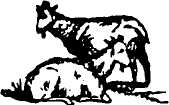
The body, was given to Yahweh. indicating that we should give unto Him the best of our strength and ability.
VERSE 17
"It shall be a perpetual statute for your generations throughout all your dwellings, that ye eat neither fat nor blood"—The all-embracing nature of this statute implies that it had to be observed at all times, and not merely when the Israelites were in the Land. Even when travelling elsewhere, it had to be observed. Even in dispersion, and having no access to the altar, true Israelites maintain this law. Fat and blood are listed together because of the figurative meaning attached to both. The poured out blood represented life given back to God; the fat represented the strength or virility of the body likewise given back to God on the altar. Thus a man giving his time. love, service and substance unto Yahweh. figuratively offers the blood (life) and fat (strength) of his existence on the altar of service. And Yahweh is well pleased.
Comments