___________________
(1) OPPRESSION PROPOSED
EXODUS CHAPTER ONE
Israel in Egypt rapidly increases in number, until the problem of their presence is brought to the attention of the authorities. A new king ascends the throne with a new policy toward the problem. He considers that the large and increasing numbers of Hebrews present a threat to the stability of the nation, and decides upon a ruthless policy of extermination. Forgetting the benefits Egypt already had received from the Israelites, he reduces them to the status of slaves, appointing them difficult and degrading tasks. But this fails to accomplish his purpose. The more the Israelites are afflicted, the more they multiply in number. This causes consternation among the Egyptians, and results in an even more extreme policy being adopted. Pharaoh issues a decree that all male children are to be destroyed at birth and orders the Israelitish midwives to murder such babes as soon as they are born. The midwives, however, resist the policy of Pharaoh, and are blessed of God for so doing. Driven to desperation, Pharaoh incites his people to the most ruthless acts of antiSemitism. He orders them to destroy all Hebrew male children that are born. The chapter reveals how God overshadowed His people for good: when few in number (vv. 5-7); when under oppression (vv. 8-14); when threatened with extinction (vv. 15-22).
Introduction: The Death of Joseph—vv. 1-6.
The names of the children of Israel who went into Egypt are repeated from Genesis, and this section of the history concludes with the recording of the death of Joseph and all of his generation.
Verse 1
“Now these are the names of the children of Israel” – “Now” is vau in Hebrew, and literally, “And”. This conjunction joins this book with the previous one, Genesis. Both Leviticus and Numbers begin the same way, while Deuteronomy is similarly linked with that which goes before. This shows that the five books of the Pentateuch are really five divisions of one book: The Law. Many other books of Scripture are similarly linked with those that precede them (cp. Josh. 1:1; Jud. 1:1; Ruth 1:1; 1 Sam. 1:1; I Kings 1:1, etc). This is unique in a book of many authors, and indicates that each of the writers of the inspired Word instinctively felt that he was contributing a section of a single book: the complete revelation of God.
The Hebrew title of the book is Ve-elleh Shemoth forming its introductory statement: “And these are the names.”
The English title is from the Septuagint, Exodus, signifying “going out,” or “departure”. The book contains somethirty-five references to the “going out” of Egypt; and this “departure” is described as Israel’s “redemption” (ch. 6:6; 15:13) whereby God “made Himself an everlasting name” (Isa. 63:12). Thus Exodus is pre-eminently the Book of Redemption.
The word “exodus” is used in the Greek text of Luke 9:31, translated as “decease;” thus the discussion of the Lord with Moses and Elijah concerned his “way out” by which was accomplished his Redemption.
“Which came into Egypt” — They first "came out" of the loins of Jacob (v. 5), and then entered into Egypt. God subsequently brought them out of Egypt to enter into covenant with Him: “He brought us out, that He might bring us in” (Deu. 6:23).
“Every man and his household came with Jacob” — This important addition reveals how the Israelites increased into such a large number in so short a time. The seventy that went into Egypt, took their households with them. We do not know how many this constituted, but Abraham had 318 males of responsible age in his household (Gen. 14:14), and it is quite possible that these groups were also of considerable number. The “household” of each individual patriarch could have been incorporated into his tribe as it developed.
VERSE 2
“Reuben, Simeon, Levi, and Judah” — The meaning of these names joined together make up the exhortation: "See a son... hear [him]... join and... praise him."
VERSE 3
“Issachar, Zebulun, and Benjamin” — These names add to the thought: "He will Reward... [by providing a] Dwelling... [with the] Son of His right hand."
VERSE 4
“Dan, and Naphtali, Gad, and Asher” — This can be paraphrased: "[After] Judgment... [and] Wrestling... [with a] Company... [of the] Blessed." See comments on the names of the patriarchs as listed in Genesis 49, in The Christadelphian Expositor: Genesis.
VERSE 5
“And all the souls that came out of the loins of Jacob were seventy souls” — See comments on Gen. 46:8-27.
“For Joseph was in Egypt already” — Cp. Gen. 37:28-36;39:1-50.
VERSE 6
“And Joseph died, and all his brethren, and all that generation”— This statement links Exodus with Gen. 50:26. It is the inevitable law of nature that, in the absence of Christ's coming, leaders and fathers in Israel will eventually rest from their labours in death. This provides opportunity for those who are left to continue the work of the Truth and to undertake a measure of responsibility. Instead of vainly lamenting the fact that a leader has departed, the new generation must take over where the previous one left off, profiting from the faithfulness manifested by those who have gone before or learning from the mistakes recorded of them.
New King and a New Policy — vv. 7-14.
The Israelites are experiencing unprecedented prosperity, increasing in numbers and possessions, to fill the land of Goshen. To match this new generation, a new king arises in Egypt. He views with concern the growing prosperity of the foreigners in the midst of his land. He reminds his ministers of the problem that could arise if Egypt were attacked, and the Israelites joined forces with the enemy. He proposes a policy of oppression in order to restrict the opportunity for the Jews to develop further and sets the people tasks that cause them grief. Their lives are embittered with hard bondage.
VERSE 7
“And the children of Israel were fruitful and increased abundantly” — Moses (Deu. 26:5) and, later, Stephen (Acts 7:17) referred to this fact, which was a development of the instruction of God to Adam (Gen. 1:28) and fulfilled His promise to Abraham (Gen. 15:14; 17:6). This population growth evidenced God's blessing upon the people (Psalm 127:3). The term "increased abundantly" signifies in Hebrew to teem, or swarm, as in marine life.
“And multiplied, and waxed exceeding mighty” — The Hebrew emphasizes the rapid increase and prosperity of the people. They not only were great in number, but also “exceeding mighty,” becoming powerful and influential in the land. In this phrase, health and vigour are suggested, as the people later were required to recall: “A Syrian ready to perish was my father, and he went down into Egypt, and sojourned there with a few, and became there a nation great, mighty, and populous” (Deu. 26:5). In this is seen the divine hand of blessing, overshadowing all the experiences of the Jewish people.
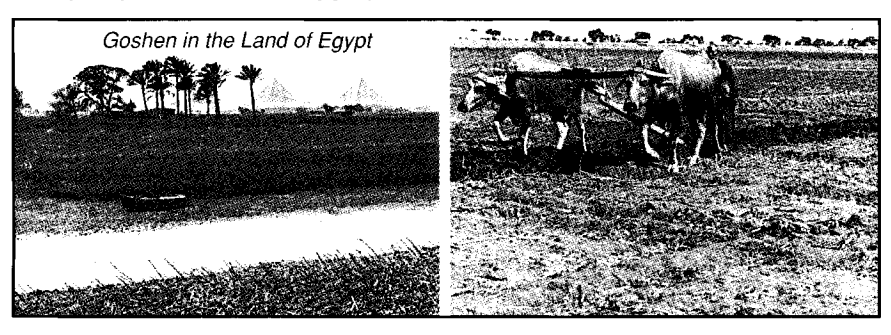
“And the land was filled with them” — This evidently refers to the district of Goshen, where Jacob originally settled with his family (Gen. 45:10; 47:1); but as the people grew in number, they probably spread outside the borders of this area to mingle more generally with the Egyptians. Ultimately, this was their downfall, for it led to the people being influenced by the evil principles of the surrounding society.
VERSE 8
“Now there arose up a new king over Egypt, which knew not Joseph” — This statement suggests the establishment of a new dynasty, and not merely the elevation of a new king. For about 150 years, about the time of Joseph, Egypt was ruled by foreigners, the Hyksos dynasty. However Pharaoh Amosis (bc1580) organised resistance from Thebes, and ultimately drove them out, about BC1570 (according to the “received” dating). The new dynasty looked with disfavour upon the growing Israelitish minority in Goshen, fearing that it might rise to dominance over the nation, as the Hyksos had before it. That is the sense in which the word know is used in this verse (see similar use of the word in Jud. 2:10; Psa. 78:6; 31:7). It would appear that the new dynasty, the eighteenth, hated all persons associated with the earlier kings, so that the Hebrews, as a whole, came under its disapproval. The benefits received by Joseph's wise administration were overlooked, as the reigning monarch saw a potential threat to his rule in the presence of so many foreigners whom he considered sympathetic to the Hyksos dynasty recently deposed. The statement of this verse is quoted by Stephen as constituting the point of crisis of Israel in Egypt at the time (Acts 7:18).
VERSE 9
“And he said unto his people, Behold, the people of the children of Israel are more and mightier than we” — As it stands in the AV, this is a deliberate exaggeration designed to instil fear into the hearts of the people.
However, Rotherham renders the statement as: “the people... are too many and mighty for us!” This rendition suggests that the numbers of the Hebrews had grown to the extent that they constituted them a threat to the nation, should it be attacked or should they seek to overthrow it. The statement of Pharaoh is supported by the declaration of the Psalmist, who recognised the growing numerical strength of the Israelites as indicative of Yahweh's care for His people (Psa. 10:14).
VERSE 10
“Come on, let us deal wisely with them” — Pharaoh recognised a real threat in the presence of so many foreigners in the midst of Egypt, and presented to his ministers a subtle policy designed to guard against any national emergency. His policy was probably dictated by fear as to what the Israelites might do if the Hyksos kings attempted to regain power in the land.
Thus, in a remarkable manner, typical in its application, he anticipated the anti-Semitic fears of modern nations. Gentiles have ever been suspicious of Jews and have reacted accordingly.
Notice, too, how the expressions used link the action of Pharaoh with the serpent in Eden. Pharaoh had said, “Let us deal wisely...” Stephen adds that he “dealt sub-tilly with our kindred” (Acts 7:19). Genesis teaches: “The serpent was more subtle than any beast of the field” (Gen. 3:1). It is significant, therefore, that one of the signs given Moses was control of the serpent-rod (Exo. 4:2-4), for the serpent, in Scripture, is used as a symbol for Egypt.
“Lest they multiply, and it come to pass, that, when there falleth out any war, they join also unto our enemies, and fight against us, and so get them up out of the land” — Pharaoh's suspicions reveal his awareness of an expectation among the Israelites concerning some future migration from Egypt to the land of Promise. This would have been in response to the dying message of Joseph: “God will surely visit you, and bring you out of this land unto the land which He sware to Abraham, Isaac, and to Jacob” (Gen. 50:24). Their expectation then, foreshadowed the modern efforts of Jewry to re-establish their nation in the land. Brother Thomas interpreted the passage in that way, writing: "From this it would seem that the idea prevailed in Pharaoh's court that the Israelites contemplated a wholesale emigration to some other country. His policy, however, was to prevent it, and to maintain the numerical superiority of the Egyptians, by exhausting the Israelites by oppressive toil, and destroying their children at birth.
But what can the policy of kings effect when they undertake to combat the purposes of God? The cup of Egypt's iniquity was well nigh running over. They had not retained God in their thoughts, being wholly given up to the basest superstition and idolatry. They had forgotten their obligations to God, who had saved their nation by the hand of Joseph, whose posterity they had enslaved, and cruelly destroyed.
What, then, remained, but that God should judge them? That He, the Lord of all the earth, should step in between the profane tyrant and those whom He purposed to be His people, and give to Egypt according to its works? Israel's four hundred years of affliction were accomplished. They had served the oppressor long enough; and the time had at length arrived when the nation which had reduced them to servitude should be judged, and themselves remunerated for their past sufferings and services, by the spoil of their adversaries." (Elpis Israel, page 286). How clearly the events of the past foreshadowed the present! Today, the world of Gentilism is repeating the folly of Egypt, and God will shortly intervene to save His people.
VERSE 11
“Therefore they did set over them taskmasters to afflict them with their burdens” — The word "taskmasters" is from the Hebrew sari massim signifying lords of tribute or lords of service. It was the official Egyptian title for overlookers of forced labour. The word signifies a burden so as to cause to faint, thus, lords of heavy burdens.
“And they built for Pharaoh treasure cities” — In lKgs. 9:19 and 2Chr. 8:4, mickenoth, here rendered "treasure cities," is translated "store cities." They were centres where provisions and goods were stored for the use of the people.
“Pithom and Raamses” — Pithom is identified with Tell el-Maskhuta on the northeastern border of Egypt.
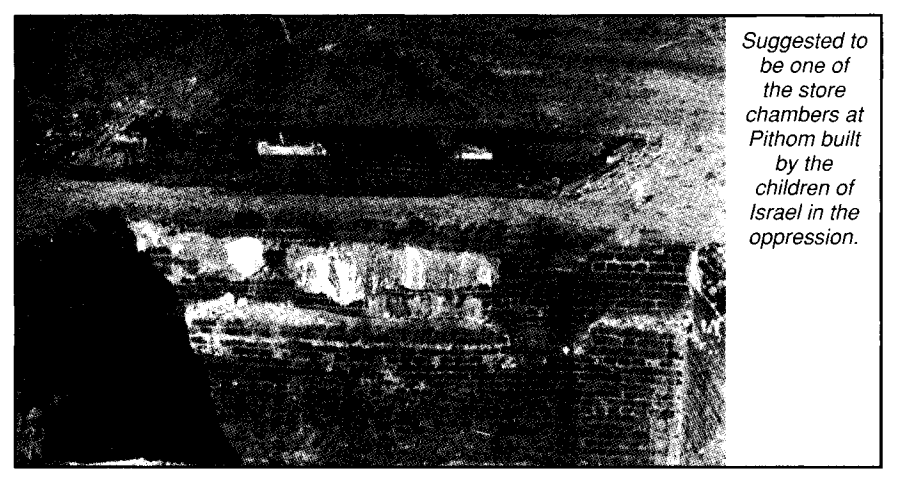
Dr. E. Naville (AD1833) excavated in the area, and was convinced that the ancient place was called Per-Atum, The House of Atum, a close approximation to "Pithom." He discovered a number of rectangular chambers, without doors, separated from one another by thick walls of brick, which he assumed to be storehouses built by the Hebrews. His conclusions have been questioned by some archaeologists, though endorsed by others. He found bricks of three varieties. Those of the lowest level were made of clay mixed with chopped straw; higher up the straw, apparently being no longer available, was replaced with reeds; at the top level the bricks had no binding substance at all! This supports the fact that, at first, the Hebrews were given straw to use in their brickmaking, but that later this was withdrawn, and they were expected to find it for themselves. Apparently, as pressure was exerted upon them, they omitted to gather straw at all, and used only clay.
Raamses has been identified with ancient Zoan. It was situated on the northeastern frontier, on the east bank of the Tanaitic Nile. The city had been established as early as the sixth dynasty of Pharaoh Pepi (BC2300), and later became the headquarters of the Hyksos kings (cp. Num. 13:22). Raamses II practically reconstructed the place, which continued until about ad451, when it began to decline, ultimately to become a heap of ruins in the midst of a village called "San" (similar to Zoan).
The temple of Tanis in Zoan was one of the largest structures in Egypt, and measured 300 metres (1000 ft) long. It included a colossal statue of Raamses n, some 28 metres (92 feet) high, weighing 900 tonnes. The large toe of this huge statue was the size of a man's body.
Some of the archaeological findings of ancient Zoan are today in the Cairo Museum.
The fact that Exodus records that the Israelites built the storehouses of Raamses, indicates that Raamses II was the Pharaoh of the oppression. Many dispute this on chronological grounds; however, we have shown in our introduction, that Egyptian chronology cannot be trusted, and, most certainly, should not be urged as an argument to dispute biblical claims. In Light From The Ancient Past, Finegan states: "Unless we are to regard Exodus 1:11 as an erroneous or anachronistic statement, we must conclude that Ramesis n was the Pharaoh under whom the oppression of the Israelites reached its climax. This is in harmony with our knowledge of his vast building activities, and, particularly with the fact that he resided in the Delta and devoted the opening years of his reign largely to building operations at Tanis (Zoan or Raamses). The general impression given by the book of Exodus is that the Israelites were settled not far from Pharaoh's court, and in Psa. 78:12,43 they are definitely said to have lived 'in the land of Egypt, in the fields of Zoan.' Zoan is the Hebrew name for Tanis, as the rendering in the Septuagint shows, and thus we have a picture of the Israelites as living in the vicinity of Tanis at a time when Pharaoh's court was there. The situation is fulfilled in the time of Rameses n, but not in the earlier days of Thutmos in" (page 119).
Those who dispute that Rameses n was the Pharaoh of the oppression, and yet endorse the Bible as true, claim that the use of the word in Exo. 1:11 is a modernisation of an archaic place-name by an unknown writer, after the death of Moses — but surely this would suggest that the Bible record is unreliable. Naville claims that he found an inscription of Rameses n on the gateway of Pithom: "I built Pi-tum at the mouth of the East." Fisher, of the University Museum of Pennsylvania (1922) found at Bethshean in Israel, a stele of Rameses n, 2.4 metres (8 feet) high on which he says, he "built Raamses with Asiatic Semitic (i.e. Hebrew) slaves."
However, it is claimed by those who reject Rameses as being the Pharaoh of the oppression, that he was a great plagiarist, taking to himself credit for some of the labors of his predecessors, having his own name carved on their monuments.
Those scholars who hold to the earlier date for the Exodus and Thotmes in as the builder of these cities, take these inscriptions to mean that Rameses n rebuilt or repaired them with Hebrews who did not go out with Moses (see Halley's Bible Handbook).
To our mind, the statement of the verse before us is conclusive evidence that Rameses III was the Pharaoh of the oppression, and that Egyptian chronology should be adjusted accordingly.
VERSE 12
“But the more they afflicted them, the more they multiplied and grew” — Pharaoh pitted his puny strength against the might of Yahweh but failed in his objective, for God was with His people (see Psa. 105:24; Pro. 21:30). The experiences of Israel in Egypt illustrate two important principles of divine revelation: "All things work together for good to them who are the called according to His purpose" (Rom. 8:28); [2] "Whom Yahweh loveth He chasteneth" (Heb. 12:6-11). Though the state of the people became extremely difficult, it drove them to God, and made them conscious of their need of Him. Ultimately this proved to be to their advantage.
“And they were grieved because of the children of Israel” — The Hebrew quts signifies "vexed; weary." The word "expresses a mixture of loathing and alarm." The Israelites were rapidly growing into a powerful minority of over two million people, and this was sufficient to cause the greatest alarm on the part of the Egyptian authorities, inducing them to view the Hebrews with loathing. See Gen. 46:34.
VERSE 13
“And the Egyptians made the children of Israel to serve with rigour” — The word "rigour" is significant. It is from the Hebrew perek which derives from a root meaning to break apart, crush, or fracture. Their lives were embittered by the harsh oppression and the constant opposition and loathing they experienced from the Egyptians (see Exo. 2:23; 6:9). But true Israelites are expected to learn from their experiences, and to avoid inflicting similar suffering on others (Lev. 25:43, 46, 53). The same word is rendered "cruelty" in Eze. 34:4. The exercise of cruelty, either inflicted mentally or physically, is to be avoided by God's people.
VERSE 14
“And they made their lives bitter with hard bondage” — "Bitter" is the Heb. marah, the word used by Naomi to describe her bitter experiences in the land of her exile (Ruth 1:20).
“In morter, and in brick, and in all manner of service in the field” — Their labour involved digging the clay to make bricks; kneading the clay to its proper consistency; forming the bricks; drying them in the sun; using them for the construction of buildings. The "service in the field" may also have involved the digging of canals and trenches for purposes of irrigation. The Israelites were a rural people, unaccustomed to the industry of brick-making, so that they found it difficult and degrading.
“All their service, wherein they made them serve, was with rigour” — Note the repetition of the word "rigour" (v. 13) to emphasize the difficulties faced. The Egyptian taskmasters went out of their way to harry the Israelites, taking them from their normal work, and making unreasonable demands in regard to such labor for which they were not fitted. Their objective in this overwork, this constant drudgery of toil, and the deep affliction that it induced, was to so wear out the people as to stop any further increase in their numbers. In this, however, they failed, leading Pharaoh to take a further measure.
The Faithful Defiance Of The Hebrew Midwives — vv. 15-21.
Pharaoh, who thought to "deal wisely" with the Hebrews, devised the plan of crushing them and preventing them from increasing by sheer hard labour. Finding his plan of no avail, he now resorts to violence. Egypt had a guild of midwives, including a group of Israelitish women who ministered to the necessities of expectant mothers in their community. Pharaoh now issues secret orders to the two chief Hebrew midwives, and through them to the rest, that all male babies must be put to death. The midwives, ufearing God," disobey the king's command, for which Yahweh blesses the children of Israel.
VERSE 15
“And the king of Egypt spake to the Hebrew midwives” — Pharaoh evidently spoke to the two chief midwives, who were expected to pass his decree on to those under them. Two midwives would not be sufficient to serve the needs of such a large community as Israel had developed into, particularly in view of the rapid increase of the people.
“Of which the name of the one was Shiphrah, and the name of the other Puah” — Shiphrah signifies beauty, splendor, glory. Puah is from a root signifying to cry out, suggesting the pain of birth. The two names combined convey the thought of the manifestation of glory and splendor through a new life in birth. The king's demand, therefore, was a negation of their life's labor, as expressed in the meaning of their names.
VERSE 16
“And he said, When ye do the office of a midwife to the Hebrew women, and see them upon the stools” — The Hebrew obnayim rendered "stools" is literally double stones or birthstool. This was a chair of peculiar form used in Egypt upon which the expectant mother sat during parturition. Illustrations of these appear on Egyptian monuments.
“If it be a son, then ye shall kill him” — This brutal decree demanded of the midwives that they negate their training, occupation and title as expressed by their names (see v. 15). It was the command of a tyrant driven by fear. When fear dominates, it turns men into cowards, and when a coward rules, he becomes a bully and a tyrant.
“But if it be a daughter, then she shall live” — Pharaoh considered he had little to fear from a nation of women!
VERSE 17
“But the midwives feared God, and did not as the king of Egypt commanded them, but saved the men children alive” — The midwives were both faithful and courageous. In manifesting those characteristics, they walked in the way of wisdom (Pro. 1:7), rectitude (ch. 16:6), and life (Gen. 42:18).
Later the apostles manifested the same faithful courage, refusing to obey the commands of the authorities when they conflicted with the commands of God; showing that it is better to obey God than man (Acts 4:19; 5:29).
Scripture requires that believers should obey the laws of the land until they conflict with the law of God (Rom. 13:1-7). That principle was followed by the faithful midwives in Egypt.
VERSE 18
“And the king of Egypt called for the midwives, and said unto them, Why have ye done this thing, and have saved the men children alive?” — The king's enquiry contained an implied threat, and that he would exercise the terms of his decree. Cp. Ecc. 8:4.
VERSE 19
“And the midwives said unto Pharaoh, Because the Hebrew women are not as the Egyptian women; for they are lively; and are delivered ere the midwives come in unto them” — The Hebrew chayoth, translated 'lively" signifies strong, vigorous, and the explanation of the midwives was evidently strictly according to fact. Women who lead an active life, normally have little inconvenience in childbirth. Therefore, the very labour that Pharaoh had put upon the Israelites, under God, contributed to the defeat of the monarch's plan.
That being the case, contrary to the usual interpretation of the incident, there was neither lie direct, nor deceit, in the explanation of the midwives. Indeed, it would appear, that their services were rendered largely unnecessary, by the intervention of God and the natural condition of the Hebrew women, partly induced by Pharaoh's own action. Pharaoh would have easily discovered the deception of the midwives if their statement had been false.
VERSE 20
“Therefore God dealt well with the midwives” — God showed His pleasure at the faithful attitude of the midwives who had manifested a greater fear of offending Him than Pharaoh.
“And the people multiplied”— They received the especial providence and blessing of God. Normally, in a state of slavery the increase is small, and child mortality high, because the women, through excessive labour cannot care properly for their offspring.
"And waxed very mighty" — The Hebrew atsam, rendered "mighty" signifies bony, substantial and therefore strong. As the bones of a body give it strength, so the body-politic of Israel was built up in strength by God, in spite of Pharaoh's attempts to destroy it.
VERSE 21
“And it came to pass, because the midwives feared God, that He made them houses” — Thus the action of the midwives contributed largely to the defeat of Pharaoh's scheme, and ensured the continuity of the various "houses" into which Israel was divided.
In the Hebrew, "God" is ha-elohim, with the definite article, and signifies: "the God" in contrast to the Pharaoh, who was worshipped as a deity by the Egyptians.
"Them" (Heb. lahem) is in the masculine gender, showing that the "houses" did not relate to the midwives, but to Israel generally as divided in its twelve tribes with lesser divisions. See the promise of Psalm 68:6, "God setteth the solitary in families," i.e., in a house (see margin), that is, within a large and numerous community.
The action of the midwives, brought about by fear of God, contributed to the development and continuance of the "houses" or family and tribal divisions of Israel. Their fearless courage exhibited the quality of their faith and worship, for they feared and worshipped the true God.
The term "house" is used especially of progeny, as in the expression " the house of David." The book of Exodus commences by drawing attention to the "households" that came into Egypt (v. 1), and moves on to reveal how that they continued in being.
Pharaoh's Ruthless Decree — v. 21.
All other stratagems having failed, Pharaoh resorts to murder, and orders that the people generally co-operate in seeing that every Hebrew male child born is killed. It introduces a great crisis in the nation.
VERSE 22
“And Pharaoh charged all his people, saying, Every son that is born ye shall cast into the river, and every daughter ye shall save alive” — The whole Egyptian population was now incited to acts of violence against the Hebrews. Spying and informing were made acts of loyalty, whilst compassion and friendliness were treated as high treason. Whilst many would hesitate to adopt the measures suggested, others would take a special delight in carrying out the decree of the king.
Moreover, as the Nile was held to be a sacred river by the Egyptians, the form of death suggested by this murderous and heartless decree, could be considered as sacrificial in its significance.
Pharaoh's controversy with the Hebrews, therefore, now became a holy war between the god of Egypt and the God of Israel.
Comments