EXODUS CHAPTER FIVE
PHARAOH REJECTS MOSES' MISSION
This chapter records the first visit of Moses to Pharaoh. The children of Israel await the outcome with excitement. Knowing that Yahweh has promised to help them, they expect their deliverance to be swift and easy. But, as Moses has been warned, the reverse proves to be the case. Instead of relief from their burdens they find them increased. Accusing them of idleness, Pharaoh orders that they now gather the straw as well as make the bricks. In disappointment they turn on Moses and blame him as the cause of their increasing problems. In turn, he takes the complaint to Yahweh in prayer.
Moses Interviews Pharaoh — vv. 1-4.
The time has arrived when the real test must be made. Moses and Aaron are equipped for it, and instructed in what to do. It is an exciting time. The people appear ready to follow Yahweh, and to seek freedom in the land of promise from the servitude of Egypt. It is time to confront the tyrant Pharaoh. In the name of Yahweh, Moses seeks permission for the people to hold a religious feast in the wilderness; but his request is rejected out of hand.
VERSE 1
"And afterward Moses and Aaron went in, and told Pharaoh, Thus saith Yahweh God of Israel, Let My people go that they may hold a feast unto Me in the wilderness" — The name of the Pharaoh who succeeded Rameses π was Merneptah, a weak, self-opinionated prince. His reaction to Moses' demand as recorded in this chapter, is in true accord with his character as indicated in historical records.
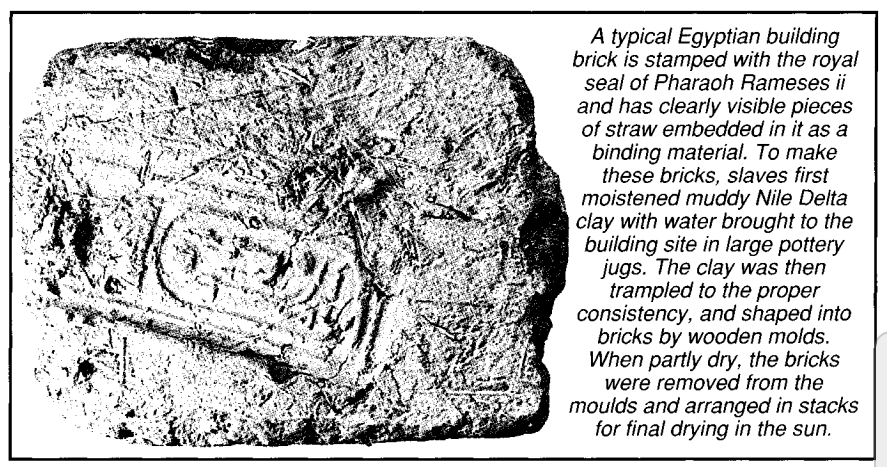
The request to hold a religious festival in the wilderness was a reasonable one, particularly in view of the explanation given by Moses in Ex. 8:26, yet it was rejected by the king. During the course of the negotiations, Moses made the same request seven times (Ex. 5:1; 7:16; 8:1, 20; 9:1, 13; 10:3). Seven is the covenant number, and Yahweh had covenanted to deliver His people. Notice the basis of Yahweh's demand on Pharaoh: "I have remembered My covenant" (Ex. 6:5).
VERSE 2
"And Pharaoh said, Who is Yahweh, that I should obey His voice to let Israel go?" — This was the reaction of flesh to the grand proclamation of the Memorial Name. That Name became the ground of antagonism between those called by it (Acts 15:14) and the world at large.
The attempt to manifest the qualities of that Name (Ex. 34:6-7) effectively separates a true Israelite from the world at large.
Pharaoh's answer, therefore, is understandable, though not justified. He knew of many gods, but nothing of Yahweh, and contemptuously repudiated His authority to demand or command.
"I know not Yahweh, neither will I let Israel go" — Pharaoh disclaims any knowledge of Yahweh, but declares that even if he did, he would refuse to let Israel go-
His use of the term Israel shows that it had become a national title for the people. It is also significant that the name Israel appears on the stele of Merneptah, and is the only reference to God's people found on the ancient Egyptian monuments. The stele, which claims that "Israel is destroyed" is today in the Cairo Museum.
VERSE 3
"And they said, The God of the Hebrews hath met with us" — This statement was in explanation of the Name of Yahweh in v. 2. The title Elohim was used generally for "God," whether pagan or otherwise. But the term "God of the Hebrews" signifies "God of the Separated Ones," and sets both the people and their God apart from Egypt. In delivering this message to Pharaoh, Aaron (being spokesman for the brothers), expressed Yahweh's request in the very language He had instructed them to use (see Ex. 3:18). In claiming that God had "met with them," Aaron set forth a special divine manifestation and revelation to them. In doing so, they used language that was quite familiar to Pharaoh, for he, too, claimed revelations from the gods.
"Let us go, we pray thee, three days' journey into the desert, and sacrifice unto Yahweh our God" — Three is the number of completion in Bible numerics, of new life. It was on the third day that life appeared for the first time upon the earth (Gen. 1:11-13).
"Lest He fall upon us with pestilence, or with the sword" — The reference to the sword suggests war, and therefore invasion. As Goshen was on the northern border of Egypt, the Israelites would be the first to be attacked in the event of any invasion from that direction. Aaron's claim indicated that Egypt would be adversely affected if Pharaoh did not grant the request of the brothers. It was a challenge to the monarch's status and pride, and he reacted accordingly.
VERSE 4
"And the king of Egypt said unto them, Wherefore do ye, Moses and Aaron, let the people from their works? Get you unto your burdens" — Pharaoh rejected the request out of hand, and threatened the two leaders of his slaves with punishment. Basically his answer was: "What right have you to interfere in my affairs and in my conduct of the nation?" He then ordered both leaders and people to busy themselves with their labours.
Pharaoh Increases Israel's Workload — vv. 5-9.
Concerned with the increase in the number of the children of Israel and interpreting their demand as an indication of their growing power and rebellion, Pharaoh decrees even more repressive measures.
VERSE 5
"And Pharaoh said, Behold, the people of the land now are many, and ye make them rest from their burdens" — The population explosion among the Israelites was causing secret fear to the rulers of Egypt. They were concerned that if an enemy invaded the land, the invaders might well receive help from the Israelites (Ex. 1:9-10).
Aaron's reference to "the sword" evidently increased the concern. Merneptah's fears of invasion were far from groundless, for a large force of Libyans invaded Egypt during his reign.
VERSE 6
"And Pharaoh commanded the same day" — Pharaoh lost no time in his determination to crush any insurrection. Therefore, by heavy labour, he sought to prevent the children of Israel convening meetings in order to agitate against the government. Perhaps the reason why he did not further restrain Moses and Aaron as the leaders of the people was fear of a revolt. He recognised that their followers were "many," and did not want to goad them to the point of rising against him in rebellion.
"The taskmasters of the people" — The Hebrew word is nogeshim and signifies exactors or oppressors. It is a different word from that used in Ex. 1:11. The "taskmasters" referred to there probably were general superintendents, comparatively few in number, and of high rank. The nogeshim were more numerous, and were inferior in status.
"And their officers" — The word shoterim signifies scribes. They were Hebrews employed to keep tally of the number of bricks made. They were beaten when the total fell below that required. See v. 14.
VERSE 7
"Saying, Ye shall no more give the people straw to make brick, as heretofore" — This was a further restriction, making the task of the Israelites more difficult.
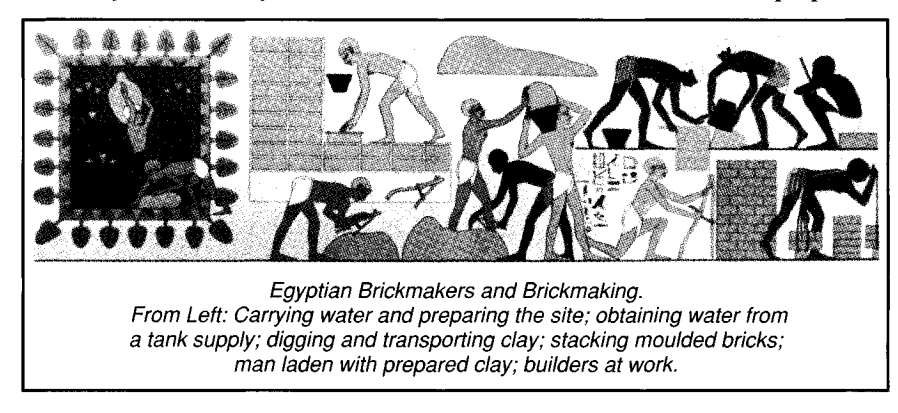
Some writers have commented: "The manufacture of bricks gave employment to a great number of slaves and others, for almost every building in Egypt, with the exception of the temple, which was of stone, was made of unbaked bricks. The muddy soil of Egypt was particularly suitable for brickmaking, for it was free from stones and could be easily mixed with water and kneaded with the hands into a paste of the necessary consistence. A mass of paste was thrust into a wooden mould of the size of the brick required and the top of it smoothed with a flat stick, and when the brick was dry enough to take out of the mould it was laid in a row with others on the ground to dry in the sun; in a day or two it was ready for use. Bricks varied in size from 10 to 15 inches in length, from 472 to 7Ίι inches in width, and from 5 to 6 inches in thickness" (E. A. Budge, The Dwellers On The Nile, p. 119).
"The making of bricks in ancient Egypt was a process which involved breaking up the Nile mud with mattocks, moistening it with sand and chopped straw. After that it was formed in moulds and taken out and baked in the sun. Among the makers and layers of bricks pictured in Rekmire's tomb are Asiatic foreigners, and the accompanying inscription refers to the 'captives brought by his majesty for the works of the temple of Amun.' The bricklayers are quoted as saying, 'He supplies us with bread, beer, and every good sort,' while the taskmasters say to the builders, 'The rod is in my hand; be not idle." (From Light From The Ancient Past, p. 100). Brickmaking, therefore, was considered labour for slaves.
"Let them go and gather straw for themselves" — Previously the straw which the Hebrew slaves mixed with the clay was brought to the brickfields. Now they had to gather it for themselves. This required a greater number of workmen, for they had to scatter over the harvest fields to gather the straw in order to bring it to the brickfields.
VERSE 8
"And the tale of the bricks, which they did make heretofore, ye shall lay upon them" — The term tale signifies total, or number.
"Ye shall not diminish ought thereof: for they be idle" — The Amplified Bible renders "idle" as "lazy."
"Therefore they cry, saying, Let us go and sacrifice to our God" — Pharaoh claims that the reason Moses and Aaron had given for leave of absence was false. He did not believe that Yahweh had met with them, and in view of his fear of an uprising, he was determined to break the spirit of the people.
VERSE 9
"Let there more work be laid upon the men, that they may labour therein" — The margin supplies the Hebrew: "Let the work be heavy upon the men." Pharaoh was determined to wear the people out with toil. He saw that the Israelites still had some leisure, for they were able to find time to cultivate their fields (Deu. 11:10). He therefore increased their labour. Actually, whilst denying the Israelites the right to worship as they desired, and increasing their toil, Pharaoh looked after their material needs very well. Later, they recalled the tasty food they had enjoyed in Egypt, and hankered after it (Num. 11:5). In a very shrewd manner, whilst denying the people the privilege of true worship, Pharaoh devised a policy that supplied them with material wants, and filled their time with activity. The modern world repeats the policy of Pharaoh. It supplies all material wants to those who are prepared to give their time entirely to its service, whilst discouraging spiritual development. Unfortunately, spiritual Israelites today, like Israel in Egypt, all too often succumb to the pressures brought to bear upon them in that way.
"And let them not regard vain words" — The expression "vain words" describes words without any truth or substance in them. The R.V. renders it as "lying words." Pharaoh did not accept that Yahweh had manifested Himself to Moses; he rejected Moses' claim that a revelation of the divine purpose had been given him.
In like manner flesh frequently deprecates the wisdom of God, and spurns the requirements of His Word. In advising, "Let them not regard vain words," Pharaoh recommended that the people cease attending meetings convened by any "agitators;" that is, religious meetings organised by Moses and Aaron.
Israel's Miseries Increase — vv. 10-14.
Pharaoh's orders are carried out by the taskmasters. The Israelites are scattered over the land to gather in the straw; and are pressed on by their overseers who are anxious to maintain their own position. When the manufacture of bricks falls in number, the officers are beaten, and the miseries of the people are increased. It appears as if Moses has completely failed in his attempt to deliver the people.
VERSE 10
"And the taskmasters of the people went out, and their officers, and they spake to the people saying, Thus saith Pharaoh, I will not give you straw" — They left the palace where they had been summoned to hear Pharaoh's decree, and were compelled to collaborate in his iniquitous demands upon the people (cp. Pro. 29:12).
VERSE 11
"Go ye, get you straw where ye can find it; yet not ought of your work shall be diminished" — Straw could be obtained from the harvest fields after reaping. Corn and grass were so plentiful through the flooding of the Nile, that straw was not required for fodder. But though straw was plentiful, the gathering of it exacted a greater toll of time and labor by a people already under oppression, and required to fulfil extreme exactions. Expecting deliverance through the intervention of Moses, the people were dismayed at this ruthless demand for more work.
VERSE 12
"So the people were scattered abroad throughout all the land of Egypt to gather stubble instead of straw" —
"Straw" is teben in Hebrew, and signifies "chopped straw." Previously this had been provided for the people, but now they had to gather the long stalks of stubble, and chop them up themselves. The stubble was plentiful enough, but gathering it and chopping it into small parts so as to mix with the clay, involved additional long labour.
VERSE 13
"And the taskmasters hasted them99— The word uwts rendered "hasted" signifies "to press." The RV has "were urgent." The taskmasters kept at the people, urging them on, subjecting them to extreme pressure, wearing them out by ceaseless demands.
"Saying, Fulfil your works, your daily tasks, as when there was straw" — The people were set an impossible quota to fulfil, whilst the taskmasters, fearful of their own position, kept hounding them to complete their scheduled quotas.
VERSE 14
"And the officers of the children of Israel, which Pharaoh's taskmasters had set over them" — See comment in v.6 to the Hebrew "officers."
"Were beaten, and demanded, Wherefore have ye not fulfilled your task in making brick" — The officers received a severe punishment. The common method of beating in Egypt was by the bastinado. The victim lay on the ground face down with his legs drawn up, and was beaten on the soles of his feet. This sometimes crippled him for life.
"Both yesterday and today, as heretofore?" — The expression "yesterday and today" is a Hebrew idiom for "recently."
Pharaoh Refuses To Relieve The Burdens — vv. 15-19.
An appeal is made by the officers to Pharaoh to relieve the people, on the grounds that some mistake has occurred, as they feel sure that Pharaoh would not make such impossible demands. But any optimistic notions they may have had regarding his mercy, are soon dispelled, for he orders them to fulfil their quota of bricks, and pre-emptorily dismisses them.
VERSE 15
"Then the officers of the children of Israel came and cried unto Pharaoh, saying, Wherefore dealest thou thus with thy servants?" — Smarting under a feeling of injustice, believing that they had an excellent case to present to the ruler of Egypt, and perhaps having appealed to the taskmasters in vain, they now bypass them and make a direct approach to Pharaoh.
VERSE 16
"There is no straw given unto thy servants, and they say to us, Make brick" — They claimed that the fault was with the Egyptian overseers controlling them, and whom they accused of acting tyrannically. The Hebrew is in the present continuous tense: "they are saying" that is, "they keep saying." Thus: "the overseers are constantly pressurising us to do the impossible."
"And, behold, thy servants are beaten; but the fault is in thine own people" — They are convinced that a mistake has been made, and that Pharaoh will treat their reasonable request with proper consideration.
The word for "fault" is chataoth, a plural word which signifies to "miss the mark," and is frequently rendered "sin" (see its usage in Jud. 20:16, where the word is translated "miss"). They advise Pharaoh that his taskmasters are guilty of extreme injustice towards them by the unreasonable demands made, and that they were sinning in so doing. This was a hint to Pharaoh that the tyrannical conduct of the overseers constituted a sin that might call down the punishment of heaven on the nation. Pharaoh's answer shows that he was impervious to the point made, and reacted sarcastically to the complaint.
VERSE 17
"But he said, Ye are idle, ye are idle: therefore ye say, Let us go and do sacrifice to Yahweh" — The king could hardly claim that the people were idle, nor did he say that. The Amplified Bible renders his words as "You are lazy." Pharaoh mocked at the overworked people, rejecting again their claim that they had been given a revelation from their God. He pretended that they had time to spare and thus sought opportunity to "do sacrifice." He thus condemned their religion for causing "laziness."
VERSE 18
"Go therefore now, and work, for there shall no straw be given you, yet shall ye deliver the tale of bricks" —
Pharaoh's statement clearly showed the Israelites that if there was sin in the demands of the taskmasters, he was the author of it!
VERSE 19
"And the officers of the children of Israel did see that they were in evil case, after it was said, Ye shall not minish ought from your bricks of your daily task" — They recognised that they could expect no justice from Pharaoh; he was determined to humiliate them, and ultimately to exterminate them as a people. There was only One to whom they could really appeal (see Deu. 32:36; Ecc. 5:8), but in the extremity of their position, they overlooked this. Berkeley renders "evil case" as "grave trouble."
Moses Blamed By The People, Pleads for Yahweh's Help — vv. 20-23.
Having failed in their appeal to Pharaoh, the Hebrew officers blame Moses and Aaron for the grave trouble in which they now find themselves. Typically, Moses turns to Yahweh, seeking His help and direction in the troubles now afflicting both him and the people.
VERSE 20
"And they met Moses and Aaron, who stood in the way, as they came forth from Pharaoh" — The literal Hebrew renders this: "Moses and Aaron standing to meet them at their going out" (A New-Old Testament). It was not by accident, but by design, that the Jewish officers met the two brothers as they left the palace of Pharaoh. Knowing of the approach being made to the king, Moses and Aaron had come to the palace to await the result of the officers' appeal.
VERSE 21
"And they said unto them, Yahweh look upon you and judge; because ye have made our savour to be abhorred in the eyes of Pharaoh" — In their disappointment, irritation, and lack of faith, the officers call upon Yahweh to punish Moses and Aaron for the evil they allegedly had brought upon the people. The Hebrew (see margin) states that they claimed that Moses had made them "to stink" in the nostrils of the king, signifying that he could not bear their presence near him.
"And in the eyes of his servants, to put a sword in their hand to slay us" — By "a sword," they meant a pretext in order to bring them to ruin. Thus the people commenced to complain.
This is the first of twelve such complaints, and this characteristic became an element in the subsequent failure of the people to manifest the divine quality of patience (Exo. 5:21; 14:10; 15:24; 16:2; 17:2; 32:1; Num. 11:1; 11:4; 14:1; 16:41; 20:2; 21:5).
VERSE 22
"And Moses returned unto Yahweh" — The Hebrew expression shuwb does not necessarily mean to return, as though Moses had deserted Yahweh, but also signifies "to turn to," or "to retreat to." He turned to the shelter of Yahweh, recognising that "the name of Yahweh is a strong tower; the righteous runneth into it, and is safe" (Pro. 18:10).
"And said, Yahweh" — See note Ex. 4:10.
"Wherefore hast Thou so evil entreated this people? Why is it that Thou hast sent me?" — The increasing miseries of the people deeply grieved Moses who was very sensitive to their sufferings. Yahweh had warned him not to expect success at once (Ex. 3:19; 4:21), but Moses had not anticipated that there would be such increase of suffering. He did not lack faith, but desired to know more of Yahweh's reason for permitting such wretchedness to come upon the peo-pie.
Eleven times Moses questioned the purpose of God in that way — see Ex. 3:13; 4:1, 10, 13; 5:22; 6:12, 30; 17:4; Num. 11:10, 12. Yahweh's design in delaying the deliverance of the people was that He might make Himself an everlasting name (Isa. 63:11-12), that Israel, Egypt and the whole world might appreciate His purpose with His people (Ex. 3:15; 9:14; 15:2; Josh. 2:11).
Adversity brought the Jewish community into a proper state of humility, which provided a basis for the development in them of characteristics such as Yahweh desired to see revealed.
VERSE 23
"For since I came to Pharaoh to speak in Thy name, he hath done evil to this people; neither hast Thou delivered Thy people at all" — Moses could not understand that the longsuffering delay of Yahweh provided time to repent and be saved (see 2Pet. 3:15, and also Isa. 26:29; Heb. 10:36; 12:5-11).
Yahweh provided Moses with an answer, as recorded in the next chapter.
He is not displeased when His servants turn to Him for further information.
While faith is growing, it will also have its setbacks. Yahweh often brings a person low before He shows His strong arm, and then elevates him.
(3) VISITATION
ACCOMPLISHED
Chapters 6:1-10:29
The set time having arrived for the deliverance of the people, Yahweh proclaims His intention to do so. He again commissions Moses to undertake this labour, and confers upon him divine authority to conduct negotiations with Pharaoh. Accordingly Moses seeks an audience with the monarch, and demonstrates his credentials to speak on God's behalf by performing dramatic miracles. But Pharaoh's magicians imitate the miracles of Moses, so that the king's heart is hardened, and he refuses to let the people leave. He remains stubborn even though the magicians are ultimately thwarted in their contest with Moses. Thus, through the obstinacy of its foolish ruler, Egypt suffers nine great and terrible plagues as the result of divine visitation. But Pharaoh remains obdurate, until the final great and dreadful plague, when, at last, he capitulates.
Comments