EXODUS CHAPTER SIX
YAHWEH'S NAME AND COVENANT PROCLAIMED
This chapter records Yahweh's answer to Moses' prayer (ch. 5:22-23). He announces that the time has come for the manifestation of His Name, and the vindication of His promise to deliver the nation. Moses proclaims Yahweh's answer to the people, but they are so discouraged by their problems and miseries that they do not heed. The genealogy of Moses is recorded, and Yahweh's important commission to him renewed.
Yahweh Proclaims His Intentions To Deliver The People — vv. 1-8.
Despite the disappointment of the people, and the complaints of Moses, God reveals that He has not forsaken them. He reminds Moses of the Covenant Name, and proclaims that the time has come for its significance to be revealed in action.
VERSE 1
"Then Yahweh said unto Moses" — It is significant to note the time indicated by the opening word "then." It was at a period when Israel had given up in despair; when even Moses had questioned God (Ex. 5:19-23). This situation is typical of a future "time of Jacob's trouble" (Jer. 30:3-6) when Israel will despair of relief (Eze. 37:11), but out of which there again shall be deliverance by the hand of the redeemer Yahweh provides, and who bears His Name (Jer. 30:7).
"Now shalt thou see what I will do to Pharaoh" — Yahweh calmed the agitation of Moses by renewing the promise of redemption. The title Pharaoh claimed divine power for the king. It signifies The Gift of the Ra, rendered by some as The Servant of the Sun, or, The Child of the Sun. Ra was the sun-god of Egypt. It was against this pagan claim of divine authority that Yahweh was about to vindicate His power.
"For with a strong hand shall he let them go" — The word for "hand" is yad and denotes the open, pointing hand. It is symbolic of power, guidance and direction. Pharaoh would be caused to act in such a way as to urge the people to leave Egypt.
"And with a strong hand shall he drive them out of his land" — There would be some urgency in his decree, after Yahweh had brought His judgments to bear upon the land. Thus under extreme pressure, Pharaoh, himself, would "force" the people to leave. See Psa. 136:12; Isa. 63:12.
VERSE 2
"And God said unto him, I am Yahweh" — The divine Name is used four times in this declaration of deliverance (see vv. 2, 6-8). As the covenant Name of God, it emphasizes that aspect of the divine revelation (cp. v.4), providing assurance of success for Moses in his mission. That name would later be represented in the four ensigns of the camp of Israel, indicating the divine principle of salvation by which the nation was established (Num. 2). It would ultimately be revealed in the character and life of the "Word made flesh" in his perfect manifestation of the Yahweh-Name (Jn. 17:6).
VERSE 3
"And I appeared unto Abraham, unto Isaac, and unto Jacob, by the name of God Almighty" — See note, Gen. 17:1.
"But by My name Yahweh was I not known to them" — The use of "Jehovah" as in the AV is quite unwarranted. It is a Gentile combination of Hebrew consonants and vowels in a way never intended by the Jews, and certainly not in the original text. The original text of Scripture supplied only consonants יְהוָֹה; the vowels were added between 600-800ad, the work of Masoretic scholars, notably at Tiberias in Palestine.
In a superstitious regard of the divine Name, Jewish scribes inserted the vowel points of Adonai or Elohim wherever these four consonants representing Yahweh (יְהוָֹה, yhwh) occurred. The eye read Yahweh but the voice proclaimed Adonai or Elohim, as the case might be.
There was no intention, originally, that the consonants and vowels should be combined as they are in Jehovah, and the Hebrews never used that form of the Name. The Jewish scribes intentionally wrote alien vowels, not for combination with the consonants or the name, but for the purpose of cautioning the Jewish reader to enunciate a totally different word, namely, some other familiar title of the Most High.
One final comment on the Name. In modern times with men, a name is merely a mark of difference or identification. Not so with God. A person's relationship with the One he worships will be governed by his knowledge of His Name, for the significance of the Name is designed to reveal God unto him. If God is known as Ammon, the main idea will be that He is a mystery, a riddle; if it be Shaddai, that He is powerful; if Mazda, that He is wise and bountiful; if merely as God, that He is good, or Lord, that He is a monarch.
The various titles, as El, Elohim, Adonai, Elyon, set forth Yahweh's many and varied attributes and manifestations. His name Yahweh, therefore, pronounces that He will become manifested and revealed in sons and daughters of His choice. It proclaims that He desires worship of such a nature that His attributes and characteristics become revealed in those who bow before Him. His name, Yahweh, therefore, is both His covenant name and His family name. It announces that He is a God who "keepeth covenant and mercy for them who love Him and observe His commandments" (Neh. 1:5), as well as constituting them members of His family (Eph. 3:14-15).
The Lord Jesus both manifested and declared the Name of Yahweh to the apostles (John 17:6, 26) and taught them to pray: "Hallowed be Thy Name."
On the other hand, the false prophets of Israel, were indicted by Yahweh because, as He declared, their teaching caused the people to "forget My name" (Jer. 23:27). The Name of the Father must be treated with understanding and reverence.
VERSE 4
"And I have also established My covenant with them" — This was manifested to their fathers (cp. Gen. 15:18-21; 17:7-8; 26:3; 28:13).
"To give them the land of Canaan" — The men referred to were then dead, but the angel spoke as though they were living, upon which fact, Christ effectively argued the doctrine of bodily resurrection, claiming that "God is not a God of the dead, but of the living," adding "For all live unto Him" (Luke 20:37-38).
But upon what grounds can it be reasoned that dead men already live unto God? On the principle advanced in Romans 4:17, "God quickeneth the dead and calleth those things which be not as though they were." Yahweh can speak thus because of the certainty of accomplishment of those things He proposes to do.
"The land of their pilgrimage wherein they were strangers" — A pilgrim is a wanderer in a strange, or foreign land, who moves forward with an objective in mind. See note at Gen. 47:9. Whilst such a journey may subject the wanderer to many privations, he remains joyful in anticipation of accomplishing the purpose of his pilgrimage; hence the Psalmist exulted: "Thy statutes have been my songs in the house of my pilgrimage" (Psa. 119:54). All true saints (separated ones) are strangers and pilgrims in the earth (Heb. 11:13; IPet. 2:11).
VERSE 5
"And I have also heard the groaning of the children of Israel, whom the Egyptians keep in bondage" — See Ex. 2:24; 3:9. Note the comment of the Psalmist (Psa. 106:44-45), and Yahweh's tender feelings for His people as expressed by Isaiah (ch. 63:9). Now, to Moses, God gives assurance that He will act on behalf of Israel. Moses had remonstrated with Him, but is reminded that Yahweh does not forget the needs of His own people, even though circumstances may appear to imply that He does (see Heb. 13:5-6).
"And I have remembered My covenant" — See Ex. 2:24.
VERSE 6
"Wherefore say unto the children of Israel, I am Yahweh" — This statement identified the Name with the covenant of divine manifestation and redemption of the seed of Abraham.
"And I will bring you out from under the burdens of the Egyptians" — In this declaration made on the basis of the covenant confirmed with Abraham, the verb I will occurs seven times. This is appropriate, for, in biblical numerics,
___________________________
Paul Haupt, General Editor of The Polychrome Bible states in an article on the Psalms, "The pronunciation Jehovah was unknown until 1520, when it was introduced by Galatinus; but was contested by Le Mercier, J. Drusius, and L. Capellus, as against grammatical and historical propriety." Jehovah therefore is merely a combination of the sacred Tetragrammaton [יְהוָֹה] and the vowels in the Hebrew word for Lord, Adonai [אֲדֹנָי], which the Jews substituted for Yhwh because they shrank from pronouncing the Name, owing to a misconception of Ex. 20:7 and Lev. 24:16.
In The Emphasised Bible, Rotherham considers this matter at length in an introduction explaining why he restored Yahweh to the text of his translation. He declares that to give the Name Yhwh the vowels of the word Lord (Heb. Adonai) and pronounce it Jehovah, is about as hybrid a combination as it would be to spell the name Germany with the vowels in the name Portugal, namely Gormuna.
He concludes: "From this we may gather that the Jewish scribes are not responsible for the 'hybrid' combination. They intentionally wrote alien vowels — not for combination with the sacred consonants, but for the purpose of cautioning the Jewish reader to enunciate a totally different word, namely, some other familiar name of the Most High."(p. 25).
The name Yahweh occurs some seven thousand times in the OT, but, apart from a few occasions, it has been suppressed and rendered by being printed as Lord or God. An example of this is found in Ezekiel 38:1-3. The word Lord occurs twice in this passage, but on the first occasion it is printed in small capitals (v. 1 = Lord), and on the second occasion, in the lower case (v. 3 = Lord).
Again, the word God is used twice in Eze. 37:27 and 38:3. On the first occasion it is printed in the lower case, and on the second occasion in small capitals. The latter [Lord] is to indicate that the original Hebrew word is Yahweh, and is identified wherever the words Lord or God are printed in small capitals [Lord, God].
How could the angel declare to Moses that the divine Name was unknown to Abraham, Isaac and Jacob, seeing that it occurs frequently in Genesis? In our notes on Ex. 3:14 we pointed out that the name Yahweh is built up of the Hebrew verb havah mn, denoting "to become." The verb was in common use among Hebrews, and as God had proclaimed His future purpose from the beginning, He might well be referred to as He Who Will Become, the basic meaning of Yahweh, and later so indicated by Moses in his records. Abraham, Isaac, and Jacob may well have applied such a title to Him without knowing that God intended this to become known as His memorial Name. This fact is shown by the refusal of the angel to disclose that Name to Jacob when he had enquired as to what it was (see Gen. 32:29).
The proclamation of the Name at the time of Moses, therefore, was a new and important development. It indicated that God was about to move on the behalf of His people in a way that would be an object lesson for all time, "unto all generations" (Ex. 3:15). His future intentions are indicated in the repetition of the declaration I will in context with the proclamation of the Name, and in setting forth His intentions on behalf of His people (v. 6), constituting them as His family (v. 7), and providing them with the heritage of Abraham (v. 8). After stating this, He proclaimed the formula: I am Yahweh!
The real significance of the Name is beautifully expounded in Phanerosis and Eureka. We add here a confirming comment from The Emphasised Bible:
"Men's names are throughout the Scriptures fraught with significance, enshrining historical incidents, biographical reminiscences, and so forth; and why should the Seven is representative of the covenant (Heb. sheva).
Further: there is certainty expressed in this promise of Yahweh; it will be fulfilled. Therefore faith must take hold of that assurance in relation to divine promises, acknowledging that they will be fulfilled even though circumstances might suggest the opposite, or cause a delay in the performance.
The first act of Yahweh, in fulfilling His covenant as stated to Moses, was to separate, take out, or deliver His people from the burdens of the Egyptians. His seventh, and final act, was to bring them into the land (v. 8). Thus there was revealed a progressive development in what Yahweh declared He would accomplish on the behalf of the people of Israel, as there is in what He has, and will accomplish on the behalf of those who, today, seek Him through Christ (Acts 15:14).
Meanwhile, Christ invites those who are burdened with the bondage of spiritual Egypt, to come unto him for rest therefrom (Mat. 11:28).
Name of the Ever-Blessed be an exception to this rule? Does not the Almighty Himself employ this Name of His as though it had in it some self-evident force and fitness to reveal His nature and unfold His ways? His Name is continually adduced by Himself as His reason for what He does and what He commands: 'For I am Yahweh.' Israel and the nations are placed under discipline, says the Divine Speaker, 'that they may know that I am Yahweh.' Is it not probable, then, that His Name was intended to be understood? Thus encouraged, we proceed, only requesting that the exposition which follows may be regarded as an individual opinion respectfully submitted:
"(a) The conclusion formed may be thus expressed: The name itself signifies, 'He who becometh:' and the formula by which that significance is sustained and which is rendered in the AV. Ί am that I am,' expresses the sense, Ί will become whatsoever I please'; or, as more exactly indicating the idiom involved, Ί will become whatsoever I may become.' We amplify the 'may,' and more freely suggest the natural latitude which the idiom claims, by saying: 'Whatsoever I will, may, or can become.'
"(b) The reasons for this conclusion are two: First, that it gives the simplest, most obvious, most direct force to the derivation of the Name itself, as generally admitted. Yahweh is almost always regarded as the third person, singular, masculine, imperfect tense, from the root hawah, an old form of the root hayah. The one meaning of hawah is 'become.' So that the force of Yahweh thus derived, as a verb, would be 'He will become'; or, as expressive of use and wont, 'He becometh.' Then, passing into use as a noun, it is: 'He who becometh,' 'The Becoming One.' That is precisely how any other Hebrew name would be formed and would yield up its inherent significance. Thus viewed, its human-like simplicity would be its great recommendation. If the Eternal would speak to man so as to be understood, we seem compelled to expect that He will speak after the manner of men. And if, after the manner of users, He pleases to make and bear a Name, it would seem the very perfection of condescension that His Name should be formed after the manner of men's names. Second, the sense of the formula given above is very simply and idiomatically obtained. The formula itself is ehyeh asher ehyeh, in which it should be noted that the verb ehyeh, Ί will become,' runs forward into a reduplication of itself; for it is that which constitutes the idiom. As a mere repetition, the assertion would be unmeaning. To escape this we must resort to mystery or imagination or — idiom. How, if the mystery itself is imaginary; and where is imagination to end? How is it to be reduced to any trusty significance? Would it not be more humble and childlike to be prepared to find that the All-wise and All-loving is simply addressing us in an idiom of our own? We have many such idiomatic formulas even in English: Ί will speak what I will speak,' and the like. Only after the manner of our tongue, we avoid the semblance of meaningless repetition by emphasising the auxiliary verb: Ί will speak what I will speak' — my mind is made up; or I will speak what I can, may, must speak' according to need and opportunity. Now, in Hebrew, the future (imperfect or incipient) tense (the one used here) is freely employed to express mood; in other words, to convey those nicer shades of thought which in English are conveyed by such helping words as 'will,' 'can,' 'may,' 'could,' 'would,' 'might,' 'must.' The only question is whether we can assure ourselves that we are not acting fancifully in resorting to that principle of interpretation in the important statement before us. Have we any examples of such an idiom finding place where, as in Ex. 3:14, a word is folded back upon itself? As a matter of fact, we have in the Old Testament at least three examples in which the recognition of this simple idiom brings out an excellent sense, and in which the Authorised Version leads the way (followed by the Revised) in so expressing the sense."
The three examples supplied by Rotherham are those of ISam. 23:13; 2 Sam. 15:20; 2Kings 8:1. He then continues: "We thus gain all needful countenance for th idiomatic explication of Ex. 3:14, Ί will become whatsoever I will — may — can — become.' The only difficulty is to suggest the suitable latitude, without multiplying words and without violating any known characteristic of the Speaker. Perhaps the best word on this momentous occasion is: 'what I please,' since we know that the divine resources are infinite, and that God will please to become to His people only what is wisest and best. Thus viewed, the formula becomes a most gracious promise; the divine capacity of adaptation to any circumstances, any difficulties, any necessities that may arise, becomes a veritable bank of faith to such as love God and keep His commandments. The formula is a promise, the promise is concentrated in a Name. The Name is at once a revelation, a memorial, a pledge. To this Name, God will ever be faithful; of it He will never be ashamed; by it He may ever be truthfully proclaimed and gratefully praised: 'This is My Name to times age-abiding, and this My Memorial to generation after generation' (Exo. 3:15)."
_______________________
"And I will rid you out of their bondage" — The word "rid" is natsal, and signifies "to snatch away." It indicates a violent and dramatic action in order to rescue from a particular situation.
"Bondage" is better rendered "service." Based on the service of a slave, it declares that servitude to Egypt would be overcome by the redemptive work of God that He would achieve in Israel through Moses.
The call of Christ is the ultimate deliverance from the "service of sin" (Rom. 6:16-18) in order that the "service of righteousness" might be achieved.
"And I will redeem you" — "Redeem" is ga'al, to act as next of kin. The law required the next of kin to deliver his brother in time of need or trouble. Therefore, in declaring His intention to act in that way, Yahweh revealed that He would manifest Himself in one of Israel's own race in order to deliver the people from out of trouble. In this case, it was Moses (Ex. 7:1), who typically represented the Redeemer who would come. The law of the Goel taught that redemption would come to humanity through Yahweh manifesting Himself in flesh, thus becoming next of kin or redeemer, to those He would save.
"With a stretched out arm" — Expressive of one extending to help. According to Rawlinson, an outstretched arm in Egyptian hieroglyphics denoted action. This phrase, so common else-where, is used in Ex. 3:20 for the first time as "stretched out hand."
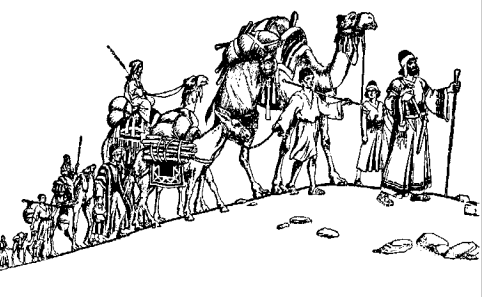
"And with great judgments" — These had been hinted at earlier to Moses (Ex. 3:20; 4:22), but had not been previously styled judgments. Nevertheless, such had been predicted to Abraham: "That nation whom they serve will \ judge" (Gen. 15:14). The plagues of Egypt were not merely "wonders," but punishments inflicted upon a proud and cruel nation by its righteous Judge.
VERSE 7
"And I will take you to Me for a people" — Yahweh will take Israel for His own people: a unique, exclusive privilege. Similar words are used for the ecclesia called out of Gentilism: "God did visit the Gentiles, to take out of them a people for His name" (Acts 15:14).
"And I will be to you a God" — The Hebrew text has: "I will be to you for Elo-him". This expresses a promise to develop Elohim out of the people that Yahweh had taken unto Himself.
Bro. Thomas comments in Phanerosis, p. 66: "There had been previous manifestations of spirit, and the then already-existent Elohim were its fruit. But now a new manifestation was predetermined — a manifestation of Elohim, or Sons of God, out of human flesh and spirit."
"And ye shall know that I am Yahweh your God" — Moses and Israel knew the name of God was Yahweh, because it had been proclaimed to them. But as yet they did not understand its implications. They were to "know" it experimentally by the deliverance to be effected.
"Which bringeth you out from under the burdens of the Egyptians" — The only way the Name of Yahweh could be revealed thus to Israel was by separation from Egypt, and by bringing them out from under its burden. Separation remains the keynote of a person's relationship to the Father to this day, for without such action, He will repudiate the claim of son-ship (see 2Cor. 6:17-18). Therefore, though the Name of Yahweh had been proclaimed to the people of Israel by Moses, and though they used it in addressing God, they did not experimentally "know" it, or experience it to its full significance, until they had left Egypt behind. Then they had seen openly demonstrated its real meaning, and acknowledged its power (Ex. 15:3, 6). Isaiah declared: "He led them by the right hand of Moses with His glorious arm, dividing the water before them, to make Himself an everlasting name" (Isa. 63:12).
VERSE 8
"And I will bring you in unto the land" — The purpose of Yahweh was not merely to separate the people from Egypt but also to bring them into the Promised Land. This is analogous to His present work among the Gentiles, in "taking out from the Gentiles a people for His name" (Acts 15:14). Mere separation does not complete the process. The people so influenced are drawn out of the world, that they may be constituted "in God the Father and the Lord Jesus Christ" (IThes. 1:1). There are both negative and positive aspects to the divine call.
"Concerning the which I did sware to give it to Abraham, to Isaac, and to Jacob" — See Gen. 26:3, and note Paul's comment in Heb. 6:13-18.
"And I will give it to you for an heritage" — The Hebrew morashah signifies "a possession." The same word is used of the Law in Deu. 33:4. Thus Israel was given two heritages: the Law and the Land. The obedience to the former was necessary to obtain the latter.
"I am Yahweh" - Rather: "I Yahweh." The emphasis is not intended to inform Moses of the divine Name, but to impress upon him, and upon Israel, that the guarantee of the fulfilment of the promises was to be found in the Name and nature of the One who had given them.
The name Yahweh signifies He who will be, and, therefore proclaims that the future will see the reality of that promised, or predicted in the Name. As the phrase "I am Pharaoh" (Gen. 41:44), is an assertion of royal authority and power, so the proclamation of the divine Name, in such a context, is a declaration of intent, together with an indication of the power and ability to perform it.
Moses And The People Discouraged By Opposition — vv. 9-13.
Moses carries Yahweh's message to the people, but the severe opposition of Egypt has so crushed their spirit that mere words of promise are not sufficient any more to rouse them. Even Moses is discouraged. When commanded to seek an audience with Pharaoh, he again raises an objection, claiming that he lacks ability to do so.
VERSE 9
"And Moses spake so unto the children of Israel, but they hearkened not unto Moses for anguish of spirit, and for cruel bondage" — The word "anguish" is better rendered "impatience" (see mg.). The people were utterly crushed by disappointment, and paid no heed to fresh promises of redemption. Their oppressions made them short-tempered, a contrast to their previous belief and excited anticipations (Ex. 4:31). "Hope deferred makes the heart sick" (Pro. 13:12). The severe opposition caused them to lose all faith, hope, heart and spirit. Their apathetic indifference to God's promises also discouraged Moses.
VERSE 10
"And Yahweh spake unto Moses saying" — Despite the despondent, faithless attitude of the people, Yahweh proceeded to fulfil His purpose.
VERSE 11
"Go in, speak unto Pharaoh king of Egypt, that he let the children of Israel go out of his land" — Previously the bidding had been limited to a period of three days (Ex. 5:3); but now it is absolute, without limitation of time. In the transaction, Pharaoh types the power of sin, redemption from which is no easy task. Significantly, Paul, in his chapter upon the principle of baptism, likens sin to a monarch that has dominion over flesh (Rom. 6:12-14), from whose reigning influence, believers must withdraw their allegiance and give it unto Christ. This way to redemption was foreshadowed by the Exodus from Egypt.
VERSE 12
"And Moses spake before Yahweh, saying, Behold, the children of Israel have not hearkened unto me; how then shall Pharaoh hear me?" —Moses claims that his failure to move the people of Israel by his message argued the failure of his mission before Pharaoh. If Israelites would not heed him, why should Pharaoh do so? His attitude reflected the despondency of the people.
"Who am of uncircumcised lips" — According to the Hebrew idiom, this denotes an imperfection of the lips which interferes with their efficiency. An uncircumcised ear is one that will not hear (Jer. 6:10); an uncircumcised heart is one that cannot comprehend (Lev. 26:41), and uncircumcised lips suggest hesitating or stammering speech (see Ex. 4:10).
VERSE 13
"And Yahweh spake unto Moses and unto Aaron, and gave them a charge unto the children of Israel, and unto Pharaoh king of Egypt, to bring the children of Israel out of the land of Egypt" — In answer to Moses' complaint, Yahweh drew Aaron into the scope of the charge (Ex. 4:14). "Charge" is from the Hebrew tsavah and signifies "to order, direct, or summon" a person to a task.
The transactions between Yahweh, Moses and the people, recorded in the early chapters of Exodus, reveal many serious challenges to faith:
[1] delays in God's promised action (ch. 5:22-23); [2] the crushed, despondent spirit of the people (ch. 6:9); [3] their lack of response to Moses' appeal (ch. 6:12); [41 the infirmities of the flesh (ch. 6:9).
Faith was weakened by dwelling too long on these problems. On the other hand, it could be strengthened by bringing into focus Yahweh's power (v. 1), name (v. 3), covenant (v. 4), response (v. 5), promise (v. 6), relationship (v. 7), and assurance (v. 8).
Genealogy Of Aaron And Moses — vv. 14-27.
This genealogy, recorded against the background of the charge given to Moses and Aaron, illustrates the important principles of Rom. 9:11-12, that the divine call is by election through Yahweh'sforeknowledge. Though Moses rose to such eminence as to become Israel's greatest son until the appearance of the Lord Jesus Christ (see Deu. 34:10-12), every point in the line of descent departs from that which would imply natural pre-eminence. Moses is not descended from Reuben, the eldest son of Jacob, nor from Joseph, his most beloved son, but from Levi, the younger son of the two united in a curse (Gen. 49:5-7). Yet not even from the eldest branch of the tribe, but from Kohath, the second son. Again, Moses was not the natural firstborn of Amram, his father, but the younger of his two sons.
All this stresses the principle, emphasized by the Lord Jesus Christ, that "the flesh profiteth nothing," and that divine selection is not according to natural advantage. These important principles are revealed in the seemingly dry details of genealogical descent.
VERSE 14
"These be the heads of their fathers' houses" — Thus what follows is not a complete genealogy; only heads of families, or leaders of the people, are given, and not lists of entire families.
"The sons of Reuben, the firstborn of Israel" — But see 1 Chr. 5:1, and notes on Gen. 49:3.
"Hanoch, and Pallu, Hezron, and Carmi; these be the families of Reuben" — See notes on Gen. 46:9.
VERSE 15
"And the sons of Simeon: Jemuel, and Jamin, and Ohad, and Jachin, and Zohar, and Shaul the son of a Canaani-tish woman: these are the families of Simeon" — See notes Gen. 46:10.
VERSE 16
"And these are the names of the sons of Levi according to their generations: Gershon, and Kohath, and Merari" — See notes Gen. 46:11.
"And the years of the life of Levi were an hundred and thirty and seven years" — This indicates the longevity of the Israelites at this time, accounting in part for their remarkable increase in numbers.
Levi was 43 years old at the migration, when he had already three sons, Gershon, Kohath, and Merari (Gen. 46:11) but no daughter. From his birth to that of Moses are 178 years, which must be shared between Levi's age at the birth of Jochebed, and that of Jochebed at the birth of Moses. If Jochebed was 65 years old at the birth of Moses, Levi would have been 113,and she would have been born 70 years after the migration, and just before the death of Joseph.
Is it, then, at all probable that Levi had three sons and no daughter at 43, no son or daughter for 70 years, and one daughter at the close of that long interval? And this at a time of population explosion? All probability points to the other way: that both sons and daughters were born to him during the earlier part of those seventy years which are not recorded in the genealogy because it is confined to the "heads of houses" (v. 14). Their absence in the list is no objection, because the words of Jacob furnish a key to genealogical reckoning: "Thine issue, which thou begettest after them... shall be called after the name of their brethren in their inheritance" (Gen. 48:6).
Thus any later-born sons of Levi, and any sons-in-law from the household, who might marry elder sisters of Jochebed, would be ranked under one of the three "heads of the fathers of Levi" — Gershon, Kohath, and Merari — without being specifically named, and therefore would anonymously contribute to the numerous progeny attributed to a particular house in Israel.
We shall see that this answers a problem and a criticism that some have advanced against the records of Exodus, and the genealogy of Moses in particular.
VERSE 17
"The sons of Gershon" — The line of Gershon, as the eldest, is taken first. Moses and Aaron are descended from the second son. Again we emphasize that the genealogical record is concerned only with "heads of father's houses," not in recording all the descendants of such.
"Libni"- Sig. White.
"And Shimi, according to their families"— Similar to Shimei, signifying Renowned.
VERSE 18
"And the sons of Kohath" — See note Gen. 46:1 1.
"Amram"— Sig. High People.
"And Izhar"— Sig. Anointing.
"And Hebron" — Sig. Uniting, or Fellowship.
"And Uzziel" — Sig. Mv Strength is God (El).
"And the years of the life of Kohath were an hundred thirty and three years." — See note, v. 16.
VERSE 19
"And the sons of Merari" — See Gen. 46:11.
"Mahali" — Sig. Weak, Sicklv.
"And Mushi" — Sig. Sensitive.
"These are the families of Levi according to their generations" — See Gen.46:11.
VERSE 20
"And Amram" — This Amram appears to be the unnamed "man of the house of Levi" of Ex. 2:1 who married Jochebed the "daughter of Levi," but it is claimed that he could not have been the Amram of v. 18, because at the time of the Exodus, the Kohathites (of which the Amramites were a prominent branch) numbered 8,600 people (Num. 3:27-28), and presumably, a quarter of these would have been descendants of Amram. Yet, as far as we know, Amram only had three children: Aaron, Moses, and Miriam. In Moses and the Gods Of Egypt, the problem is stated in the following terms: "If Amram, the son of Kohath and the tribe father of the Amramites, was the same person as Amram the father of Moses, Moses must have had 2,147 brothers and brothers' sons. This is deduced from the fact that in Moses' time the Kohathites were divided into four branches (Amramites, Izharites, Hebronites and Uzzielites) who consisted together of 8,600 men and boys (Num. 3:27-28). If divided equally, a fourth, or 2,150 men, would belong to the Amramites."
Is here a mistake in the genealogy? Or do we have to assume that the Amram of this verse is a different identity to the Amram of v. 18, and so do violence to the context? Either explanation is far from satisfactory, as casting doubts upon the narrative.
Are there any alternatives? There are two. The first is, that though we have the total of Kohathites, we have not the number of individual houses, and that of Amram could have been but few in number at the Exodus. However, such great disparity would surely be noted in the narrative which implies that each division among the Kohathites contributed fairly generally to the overall total of 8,600 men.
The second is, that Amram had other wives before Jochebed whom he married late in life, and from these other marriages there came a progeny which laid the foundation of the House of Amram at the Exodus. The implications of Scripture strongly favor this explanation. Consider the evidence. Kohath lived 133 years (v. 18), and probably from 120 to 130 of these were after the descent of Jacob into Egypt. It is a likely inference, from IChr. 6:22, that he had a daughter, the mother of Ammi-nadab, when about 70 years old — for Amminadab is not given as a son of Kohath in Ex. 6:18, and the term son, in Hebrew includes a descendant such as a grandson. That being the case, there would be a probable space of 30 or 40 years between the birth of this earliest and latest child. Four sons and one daughter, in so long a space, do not correspond to a promise of unusual fertility. Hence it is almost certain that he had several daughters, and might have had several younger sons, who are not expressly named. These also would be included in one of the four sub-families, and probably, on the principle of the law of inheritances to daughters (Num. 27:1-7), and of 1 Chr. 23:11, would be added to the less numerous family, so as to lessen the inequality. In other words, the Amramites of Num. 3:27-28 could have included the descendants of Kohath from sons and daughters other than Amram, not specifically noted in the genealogies, and who were not accorded the honor of being heads of recognised houses in the family of Kohath.
Consider also the facts with regard to Amram in the light of our suggestion that he could have been married to wives other than Jochebed. It is usual to assume that Moses and Aaron were his only sons, the offspring of a first and only marriage. But when the various statements of the text are compared, they lead naturally to a very different view.
From the order in which he is named, Amram seems to have been the firstborn of Kohath, and therefore would probably be born not more than 35 years after the descent into Egypt, perhaps earlier. This would be just 100 years before the birth of Moses, and 35 years before the birth of Jochebed. Is it likely, in a time of great fertility, that the eldest son of Kohath would abstain from marriage till the age of 55 years, and then 42 years more elapse, before a son is born to him? If the Amramites were numerous at the time of the Exodus this would be impossible, and the strong implication is that he had children from other marriages long before he married Jochebed. The first mention of the birth of Moses has none of the marks of a complete family history (Ex. 2:1-2). No allusion occurs in it to the previous birth of Aaron, and even the fact that a sister was already born comes out quite incidentally in the narrative.
Therefore, we do not have the full marital circumstances of Amram. If he had contracted one or two previous marriages, it is plain that they would also be passed by in silence. Neither in Ex. 6:20, nor in Num. 26:59, have we a direct statement of the sons of Amram; but we are informed that he took Jochebed to wife, and she bare him "Aaron and Moses, and Miriam their sister."
However, since it results from the whole account that Amram was probably just a century old at Moses' birth, we have the strongest historical presumption that he had one, if not two wives, before Jochebed, by whom he might have had a number of children. None of these, and probably none of their children, would have been living at the Exodus, so that the prominence in the genealogy, of Moses, Aaron and Miriam, who were two descendants nearer to Amram and Levi than all the other Amramites, is quite explicable, even apart from the supernatural commission, on the ground of this real precedence alone.
These facts and implications, taken from The Exodus Of Egypt (T. R. Birks), dispose of the problems advanced by J. Davis above, and which are suggested by most commentators. They show that the record can be accepted as it stands in The Book of Exodus.
"Took him Jochebed" — Jochebed signifies The Glory of Yah. Since Yah is an abbreviation of Yahweh, Jochebed is the first name in the Bible to incorporate the divine Name, a practice that afterwards became common.
From this it has been argued that the divine Name must have been known before the revelation at the bush, because it forms part of the name of Moses' mother (cp. Gen. 4:1). But that does not necessarily follow, and, indeed, there are reasons to suggest otherwise. Firstly, if the Name were known previously, why was it not incorporated in names of people before this, as it is from this point onwards? Secondly, as we have noted previously, the Name is built up from a Hebrew verb in common, everyday use among the people, and Jochebed's original name may have been only slightly different from the form in which it now appears without use of the Name itself, and subsequently changed through the influence of Moses, after the theophany at Horeb. In support of this hypothesis, it is significant that the name of Amram's wife is not given when first she appears in the narrative (Ex. 2:1-2), and only now is she introduced as Jochebed.
"His father's sister to wife" — This description indicates that Jochebed was Amram's aunt and the daughter of Kohath. However, the explicit meaning of the Heb. dodatho, rendered "father's sister," is uncertain. It is the feminine of dod, a word frequently denoting an "uncle," but also used for an "uncle's son" (Jer. 32:8, 12), and therefore denoting a cousin. Accordingly, Jochebed, could have been the cousin of Amram and not his aunt. The Septuagint renders it "the daughter of the brother of his father"; the Syriac has "the daughter of his uncle"; the Vulgate, "his paternal cousin." Marriages between a man and his aunt were prohibited by the Law (Lev. 18:12), suggesting that Jochebed was the cousin of Amram.
"She bare him Aaron and Moses" — She also had a daughter, Miriam, but emphasis is given to the two brothers because of their pre-eminence in the redemption of Israel from Egypt.
"And the years of the life of Amram were an hundred and thirty and seven years" — From this statement, the following approximate chronology (dated from creation) emerges:
Kohath born in Canaan............ approx. ac2298 (Gen. 46:11)
Married at age of 16 (?)............................ 2314
Amram born 1yr later.............................. 2315
Amram marries Jochebed ......................... (?)
Miriam born ................................................. (?)
Aaron born (Ex. 7:7) 115yrs later ........... 2430
Moses born 3yrs later.............................. 2433
Amram dies 19yrs later............................ 2452
•Moses 80 at the Exodus....................... 2513
VERSE 21
"And the sons of Izhar" — See note v. 18.
"Korah" — Sig. Baldness or Icy. The rebellious cousin of Moses (Num. 16:1).
"And Nepheg" — Sig. A Sprout or Offshoot.
"And Zichri" — Sig. Famous.
VERSE 22
"And the sons of Uzziel" — See note v. 18.
"Mishael" - Sig. Who is El?
"And Elzaphan" — Sig. El hath concealed.
"And Zithri" — Heb. Zickri, sig. Mindful, Famous.
VERSE 23
"And Aaron" — Sig. Enlightened.
"Took him Elisheba" - Sig. The Oath of El.
Thus these two names combined signify: The Enlightened seeks the Oath or Covenant of El.
"Daughter of Amminadab" — Sig. The People are Generous. A prince of Judah through whom came Christ (IChr. 2:10).
"Sister of Naashon, to wife" — A prominent prince of Judah (Num. 1:7). His name signifies An Oracle.
"And she bare him Nadab" — Sig. Of his Freewill or Liberal. He died in tragic circumstances brought about by rebellion (Lev. 10:1).
"And Abihu" — Sig. He (God) is Father. He died with his brother in the contest for leadership (Lev. 10:1).
"Eleazar" — Sig. El hath Helped.
"And Ithamar" — Sig. Palm-coast.
VERSE 24
"And the sons of Korah" — See note v.21.
"Assir" — Sig. Captive.
"And Elkanah" - El hath Created.
"And Abiasaph" — Sig. Father of Gathering (perhaps in the sense of removing reproach), thus Remover of Reproach.
"These are the families of the Korhites" — The sons of Korah escaped the judgment that was poured out upon their rebellious father, and established renowned families in Israel (Num. 26:11). Their names spell out their experience.
VERSE 25
"And Eleazar, Aaron's son, took him one of the daughters of Putiel to wife" — His name signifies Afflicted of El. Nothing more is known of him, but the meaning of his name, together with those of the sons of Koran, indicate the adverse circumstances experienced by the Israelites in Egypt.
"And she bare him Phinehas" — The courageous and faithful grandson of Aaron. His name is Egyptian for The Nubian.
"These are the heads of the fathers of the Levites according to their families" — The purpose of this brief genealogy is to provide the tribal setting of Moses and Aaron.
VERSE 26
"These are that Aaron and Moses" — Stated to emphasize the main purpose of the genealogy.
"To whom Yahweh said, Bring out the children of Israel from the land of Egypt according to their armies" — They were to be organised from a rabble of slaves into companies of marching armies. The word "armies" in Hebrew (tsaba) denotes battalions of orderly arranged troops under the direction of Yahweh Sabaoth, the "Lord of hosts" (see ch.7:4).
VERSE 27
"These are they which spake to Pharaoh king of Egypt, to bring out the children of Israel from Egypt: these are that Moses and Aaron" — The genealogical record of vv. 13-27 is arranged as a separate document that may be used independently of the rest of the narrative.
Yahweh Confers His Authority Upon Moses — vv. 28 to ch. 7:9.
Moses is now commissioned to go in unto Pharaoh, monarch of Egypt. He is warned of the difficulties that will face him, but is instructed as to how to proceed.
VERSE 28
"And it came to pass on the day when Yahweh spake unto Moses in the land of Egypt" — Exodus ch. 7 should commence here, for the phrase introduces a new order of events.
Moses is reminded that "the day" had come for Yahweh to act. Previously it seemed to him that God would never fulfil His covenant and promises to Abraham, Isaac and Jacob, or even those to Moses and his generation. He and all Israel had become completely discouraged (Ex. 5:19-23; 6:9-13, 28-30). But now Yahweh, on His appointed day (ch. 6:1, 28) began to work, and in but a short period of time had brought Egypt and all its power into complete subjection. He has likewise "appointed a day" in these latter times, when He will move to vindicate His Name and promise through the one leader He has provided for that purpose (Acts 17:31). In the meantime, patience must be exercised.
VERSE 29
"That Yahweh spake unto Moses, saying, I am Yahweh: speak thou unto Pharaoh king of Egypt all that I say unto thee" — The proclamation of the divine Name promised success in the mission set Moses. See notes ch. 6:2.
VERSE 30
"And Moses said before Yahweh, Behold I am of uncircumcised lips, and how shall Pharaoh hearken unto me?"
— The repetition of these words (cp. v. 12) is provided as a background to the authority conferred on Moses (ch. 7:1). They contrast the reluctance of Moses with the work Yahweh accomplished in him (see Ex. 4:11), and therefore illustrate God's remarkable power.
Moses' "uncircumcised lips" were given a charge and a power that constituted him as "God" to both Aaron and Pharaoh (see Ex. 4:17; 7:1).
For explanation of the reference to "uncircumcised lips" see note on v. 12.
Comments