CHAPTER ELEVEN
Exodus: A Pattern Of Redemption
SECTION THREE
INVITATION Chapters 11:1 to 12:28
This section of Exodus has presented a problem for commentators, inasmuch as the conclusion of chapter 10 seems to terminate the interview of Moses with Pharaoh, and yet, in the next chapter, the conversation between the two men continues.
Why such an arrangement? Because the divine plan of Exodus requires it. This is epitomised in Acts 15:14 as we have outlined in the Introduction (pp. 5-6), an epitome that is divisible into six parts as shown on pp. 23-24. In accordance with that plan, Exodus 10:29 completes the section we have headed "Visitation," and chapter 11 commences with that which is headed "Invitation" (seep. 25).
Notice that each section of the book is divided into three stages of development: Proposed, Resisted, Accomplished. Therefore in the section now before us, Yahwehs gracious invitation was first proposed, when He called upon the people to make preparation to leave (ch. 11:2-3); it was resisted by Pharaoh in spite of the warning of Moses concerning the severity of the last terrible plague (ch. 11:8-9); it was accomplished when the people accepted the provision of the Passover Lamb (ch. 12:1-28).
This section of Exodus records the circumstances in which the first Passover lamb was offered, and therefore is extremely significant, typifying the purpose of redemption in Christ Jesus, the Lamb of God provided for the sin of the world.
CHAPTER ELEVEN THE FINAL WARNING
A revelation is given to Moses that the time for the last plague is come, and that, following it, Pharaoh's resistance will be broken. It is the first intimation he has received of the duration of the contest, and he is instructed to prepare the people of Israel for their impending departure, as well as to warn Pharaoh of the consequences of his continued resistance. Many of the gods of Egypt having been humbled, this final punishment was to strike at the worship of Pharaoh himself, in that it would be directed against the god-elect: his firstborn son, and so his representative in each Egyptian family. Nevertheless, Moses is told that Pharaoh would continue to resist the appeal: Let My people go! In spite of that, however, the children of Israel should make preparation to depart.
(1) INVITATION PROPOSED Chapter 11:1-8
Portion of this section of the narrative is parenthetic, and reveals why Moses had been able to previously warn Pharaoh that he would not again appear in the court of the king (ch. 10:29). The information now recorded had been expressly revealed to Moses before he made his way to the palace; and he, doubtless, had already passed on the information to the people of Israel in Goshen.
Israel Borrows Of The Egyptians - vv. 1-3.
Moses is advised that the time to leave Egypt is impending and that the people should make preparations accordingly by obtaining that which is due to them from the Egyptians.
VERSE 1
"And Yahweh said unto Moses" — This is a parenthetic statement of a revelation that had been earlier made to Moses, probably during the three days of darkness when Israel had light in their dwellings. (Ex. 10:21-23). His conversation with Pharaoh continues from ch. 11:4. It is treated in this way because a new section commences at this point. See Introduction.
"Yet will I bring one plague more upon Pharaoh, and upon Egypt" — This was the first intimation that Moses received as to the time period occupied by the plagues. Armed with this information, he was able to answer Pharaoh that he would see his face no more (ch. 10:29).
"Afterwards he will let you go hence" — Pharaoh's resistance would ultimately break.
"When he shall let you go, he shall surely thrust you out hence altogether" — Rotherham renders this: "He will alto
gether drive you out from hence." Moses was warned that once the time arrived, the people of Israel would have to leave immediately; they would be forcibly driven out. Therefore, there would be no time for last-minute preparations; the people must be ready well beforehand in anticipation of the coming deliverance. The pre-warning allowed them to make necessary preparations both with regard to their families and flocks.
In similar manner, those who are awaiting the Lord's return and deliverance from antitypical Egypt, comprising the modern-day environment, should be making preparation now. There will be no time once the Lord leaves his mediatorial position in heaven (Rev. 22:11-12).
VERSE 2
"Speak now in the ears of the people" — The information had to be passed to the people immediately, so that they would understand the urgency of the situation, and the preparation they needed to make.
"And let every man borrow of his neighbour, and every woman of her neighbour" — The word "borrow" is an unfortunate translation (see note Ex. 3:22). The Hebrew shaal should be translated "ask" as it is in the RV, Rotherham, etc. See further comment at ch. 12:35-36.
"Jewels of silver, and jewels of gold" — Rotherham renders "jewels" as "articles." It was not merely jewels, as we understand the term, for which they asked. The gold and silver thus acquired later found its place in the tabernacle, as the gold and silver of the Gentiles will be used by the Lord in beautifying the temple of the Age to come (Hag. 2:8-9; Isa. 60:5, 9, mg.).
VERSE 3
"And Yahweh gave the people favour in the sight of the Egyptians" — The Egyptians responded favourably to the request that they deliver up their articles of gold and silver to the Hebrews. Why should they do so? Because they feared the God of Israel, and recognised the justice of such a request. The Israelites had served as slaves in Egypt for a considerable time, and what they now asked for constituted only fair wages for the service they had rendered. See comment ch. 12:35-36.
"Moreover, the man Moses was very great in the land of Egypt, in the sight of Pharaoh's servants, and in the sight of the people" — The reputation of Moses was deservedly very high. The people of Egypt recognised that divine power was manifested through him, and therefore feared to oppose either him or the Israelites on whose behalf he acted.
The Firstborn Threatened With Death — vv. 4-8.
These verses continue Moses' conversation with the king. Pharaoh is warned of the consequences of remaining stubborn: the firstborn male in every home would die, plunging every family in Egypt into mourning; and the spirit of revolt, already simmering throughout the land, would erupt into complete defiance. Pharaoh's own servants would plead with Moses to lead his people away; and, moreover, he would surely depart. As Moses is stirred up by the senseless opposition he perceives in the king, so his own anger matches that of Pharaoh's. Therefore, having bluntly issued his ultimatum, he turns and abruptly leaves the palace. The last, and worst, of the plagues, again struck at the worship of Egypt, for the firstborn of Egypt was considered as the son of Ra, and therefore the object of worship. Once again, and in the most terrible of ways, the gods of Egypt were humbled.
VERSE 4
"And Moses said, Thus saith Yahweh, About midnight will I go out into the midst of Egypt" — Moses does not indicate on what day this would occur, only the hour. The time indicated is significant, and is taken up by the Lord in his parable of the virgins awaiting the approach of the bridegroom: "At midnight there was a cry made..." (Matt. 25:6). The expression, / will go out is also significant, for it is that used of the captain of an army (2Sam. 5:24; Psa. 60:10; Isa. 42:13). Yah-weh's Elohistic host would move in belligerent manifestation against the enemy. See also Isa. 55:4.
The time lapse between the first plague and the last is not revealed in Scripture, there being no indication as to the season when the first plague began, nor the interval between each. The seventh plague, consisting of violent storms and hail, occurred between the end of January to early February, as shown by the information concerning the state of the harvest supplied in Ex. 9:31-32. This final plague took place in the seventh month of the civil year, which afterwards was given the name Abib, and established as the beginning of the Jewish sacred year (Ex. 12:2). It may have been that all the plagues occurred within the period of one year, but of this we are not sure.
VERSE 5
"And all the firstborn in the land of Egypt shall die" — By "firstborn" is meant, males. At the beginning of negotiations, Yahweh had claimed Israel as His firstborn among the nations and had warned Pharaoh that if he refused to release Israel, He would retaliate by moving against Egypt's firstborn (Ex. 4:22-23). As the law of primogeniture prevailed in Egypt, the monarchy was hereditary, and the eldest son was the Pharaoh-elect.
The crown prince, therefore, represented the Egypt of the future. Let Pharaoh dare hold back Yahweh's firstborn son, and vengeance would be taken on Egypt's future! Moreover, as Pharaoh's firstborn was considered a son of the supreme Egyptian deity, Ra, his death would be most humiliating to the worship of Egypt.
"From the firstborn of Pharaoh that sitteth upon his throne, even unto the firstborn of the maidservant that is behind the mill" — From the highest in the land to the humblest servant. The Berkeley Version renders the latter phrase as "the slave girl behind the mill." The grinding of corn was work commonly assigned to captives (Jud. 16:21; Isa. 47:1-2). By smiting the firstborn throughout the land, Yahweh is represented as smiting at Egypt's strength. See Psa. 78:51; 135:8, 14; 136:10. His action, in so doing, illustrated that He expected obedience, and later became an object of warning to Israel themselves (Heb. 1 1:28; Amos 4:10; 5:18).
"And all the firstborn of beasts" — These beasts were objects of veneration by the Egyptians, being considered as under the special protection of the gods.
VERSE 6
"And there shall be a great cry throughout all the land of Egypt, such as there was none like it, nor shall be like it any more" — The demonstrations of Eastern people at the incidence of death are much more emotional and conspicuous than is usually the case in Western civilisation, so that literally the cry of mourning would echo from house to house throughout the land. It anticipated the mourning into which the whole world will be plunged at the time of the end, through its own folly in rejecting the mercy of Yahweh (see Rev. 1:7; Mat. 24:30). In Moses' day, the mourning was limited to Egypt, and for that country exceeded all other expressions of grief, both before and since; but that of the future will sweep all nations, plunging them into a "time of trouble such as never was" (Dan. 12:1). Jeremiah declares that the "slain of Yahweh shall be at that day from one end of the earth even unto the other end of the earth" (Jer. 25:33). The tragedy of such incidents is that they could be avoided by accepting the wisdom of God.
VERSE 7
"But against any of the children of Israel shall not a dog move his tongue, against man or beast" — The howling of dogs normally accompanies death. Whilst it would be heard throughout Egypt, strangely, the land of Goshen would be exempt.
"That ye may know how that Yahweh doth put a difference between the Egyptians and Israel" — This had already been manifested in the exemption from the plagues found in the land of Goshen (Ex. 8:22; 10:23; see note on ch. 8:23). The same fact is to be dramatically brought home to nations everywhere as a consequence of Armageddon and its aftermath (see Eze. 37:28; 39:23-29).
VERSE 8
"And all these thy servants shall come down unto me, and bow themselves unto me, saying" — The word "come" is yarad, and literally signifies "to descend." The idea is that they would come humbly unto Moses, being thoroughly emptied of all pride and arrogance. This types the humble submission that the nations shall yet render to the Lord Jesus Christ, the antitype of Moses (Rev. 15:3-4) in the Age to come. See Zech. 8:22-23; Isa. 45:14-17; 49:23,26.
"Get thee out, and all the people that follow thee" — The Hebrew is as the margin: "that is at thy feet." The Egyptian lords looked upon Moses as the leader and shepherd of his people. In this, again, he typed the Lord Jesus. The leaders of Egypt would have to descend from their positions of eminence, get off their high horses, and humble themselves before Moses, and in so doing, they would defy the will of Pharaoh if necessary.
"And after that I will go out" — Moses issued this ultimatum to Pharaoh, declaring that nothing would prevent him leaving, and implying that the king would be wise to submit. Despite this, however, Moses could observe continued defiance in the sullen, angry countenance of the foolish monarch.
"And he went out from Pharaoh in a great anger" — The margin renders it as "heat of anger." Moses' anger was a righteous anger. Anger is sometimes justifiable, but in such cases, one must be on guard lest it lead to sin (see Eph. 4:26; Tit. 1:7). Actually, Moses was a very meek man (Num. 12:3), as was also the Lord Jesus (Mat. 11:29), but the hypocritical folly of Pharaoh moved him to anger, as also a similar action on the part of the Pharisees caused the Lord to view them in anger (Mark 3:5).
(2) INVITATION RESISTED Chapter 11:9-10
Moses is warned by Yahweh that Pharaoh would remain stubborn, and continue to resist the appeal to let His people go. Moses was thus to recognise the obstinate nature of flesh, manifested in this monarch.
Pharaoh Remains Stubborn — vv. 9-10.
In the face of the grave warning issued by Moses, Pharaoh remains stubborn, and so the crisis moves on to its climax.
VERSE 9
"And Yahweh said unto Moses, Pharaoh shall not hearken unto you; that My wonders may be multiplied in the land of Egypt" — This statement expresses the reason why Yahweh tolerated the stupid actions of the stubborn, foolish king. It helped to emphasise the divine power exercised by Moses in delivering the people, and revealed that God was with him.
There was mercy in this, for it impressed those who had the humility and wisdom to think and act according to the Truth manifested to them (cp. ch. 12:38).
This, also, will be the result of the supernatural judgments of Armageddon. They will demonstrate the fact of divine power, and reveal the divine authority that will rest upon the Lord Jesus Christ as king of the Jews.
An appeal shall be made to the nations to submit (Rev. 14:7; Psa. 2), and some, in wisdom, will do so (Isa. 60: 9). However, Babylon the Great will continue to resist (Rev. 14:9-12; 17:12-14) and face the outpouring of the final plague (Rev. 15:1). It is significant, that in The Apocalypse, Babylon the Great is spiritually aligned with Egypt (Rev. 11:8).
VERSE 10
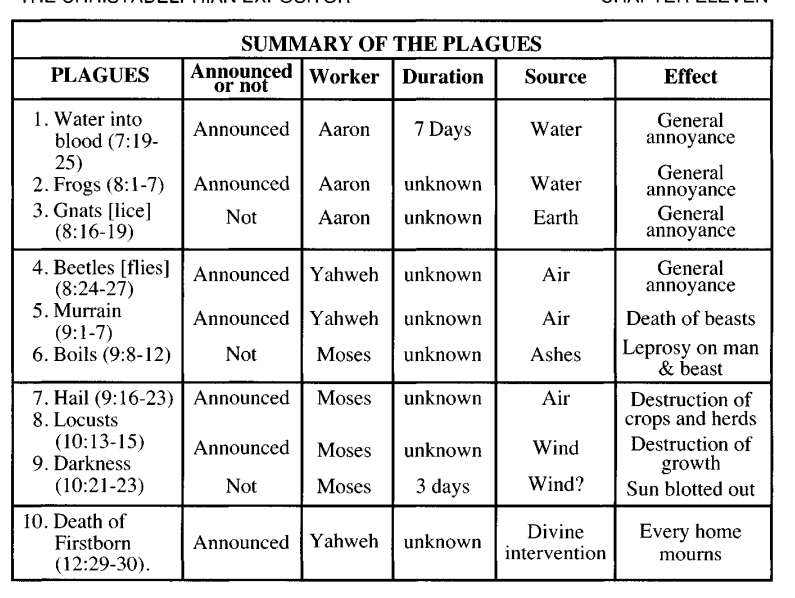
uAnd Moses and Aaron did all these wonders before Pharaoh: and Yahweh hardened Pharaoh's heart, so that he would not let the children of Israel go out of his land" — This is a general statement summarising the work of all the plagues.
Comments