CHAPTER TWELVE A NIGHT TO BE MUCH OBSERVED
No chapter of the Old Testament is of greater significance to Israelites than this one. Describing in detail the ordinances of the Passover, it lays the foundation, and provides a pattern for the scheme of redemption devised by Yahweh, through the offering of the Lord Jesus Christ, uthe Lamb of God for the sin of the world." In the delay that ensued between Moses' ultimatum to Pharaoh, and the death of the firstborn at midnight on the fourteenth day of Abib, careful instructions are given to Israel's leaders concerning the impending plague and what Hebrews must do to avoid it. The spiritual lessons involved are beneficial for God's people of all time.
Impressed with the solemnity of the occasion, the Israelites carry out the instructions delivered them by Moses, and at midnight the plague strikes throughout Egypt. Every family is plunged into mourning as the chill, dread hand of Death is extended toward it. A frightful cry of horror is heard throughout the land, as the worst of the plagues is felt. The whole nation, including Pharaoh, is brought to the breaking point. An urgent message is sent to Moses and Aaron urging them to instantly arrange for the departure of the Children of Israel with their possessions, but, at the same time, making a plea for help in the form of some blessing. The people leave, burdened with possessions heaped upon them by the Egyptians who fear any further judgment. A mixed multitude throws in its lot with Israel, and also leaves Egypt; and the whole company marches out in triumph as the army of Yahweh on route to the Promised Land.
(3) INVITATION ACCOMPLISHED Chapter 12:1-28
Yahweh outlines the terms of His invitation to the people to separate themselves as a people unto Himself. The year}s beginning is changed to indicate a new commencement for Israel, and detailed instructions are given concerning the observance of the Passover by which the people will escape the death that threatens the Egyptians.
The Beginning Of The Year Changed — vv. 1-2.
As the deliverance from Egypt marks a new beginning for Israel, the time of the year's commencement is changed.
VERSE 1
"And Yahweh spake unto Moses and Aaron in the land of Egypt, saying" — During the delay that ensued between the ultimatum delivered to Pharaoh, and the "set time" determined for the outpouring of the tenth plague, Moses is instructed as to what the people should do in preparation.
VERSE 2
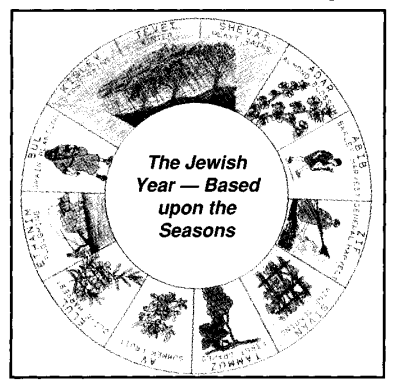
"This month" — The month is styled Ahib (Ex. 13:4), a word that signifies Green Ears of Corn, and denotes the advent of spring, or the appearance of new life. As such, the month is appropriate to mark a new beginning for Israel. The word abib is rendered "in the ear" (Ex. 9:31), and "green ears of corn" (Lev. 2:14). See also Ex. 23:15; 34:18; Deu. 16:1.
"Shall be unto you the beginning of months" — The religious year thus was instituted for the Hebrews, denoting a new beginning. The Jewish civil year commences with the seventh month of the religious year, appropriately (for seven is the number of the covenant) marking a new political beginning. The festivals of Atonement, and of Tabernacles were appointed for celebration that month, and type the coming of Christ in judgment and the Millennium as a time of rejoicing — the commencement of a new civil beginning for humanity. The month of Abib, and the celebration of the Passover began the religious year for Israelites, appropriately typifying the foundation principle upon which baptism is based: the new life in Christ.
"It shall be the first month of the year to you" — Abib (March/April) is the time of the spring equinox when nature springs forth in new growth. This suggests the resurrection, thus, a new beginning (see Rom. 6:4; ICor. 15:35-38, 42). The Hebrew civil year commences at the time of the autumnal equinox, approximately October (Ex. 23:16).
The Passover Instituted — vv. 3-10.
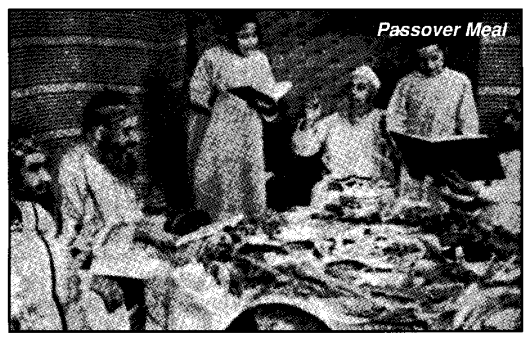
Moses instructs the people of Israel in the keeping of the Passover, the festival of deliverance. The spiritual lessons of this festival are applicable to all true Israelites. It foreshadows the redemption effected by the Lord "our Passover" (I Cor. 5:7).
VERSE 3
"Speak ye unto all the congregation of Israel" — At least four different Hebrew words have been rendered "congregation," and as each of them is of great significance to the context, it is valuable to indicate the particular Hebrew word used in each passage. Here it is edah, the feminine form of ed signifying "witness" or "testimony," and therefore appropriate to Israel as the Bride of Yahweh (Isa. 54:5). In Eze. 16:6-14 the prophet describes Israel as the foundling girl in Egypt whom Yahweh took for His bride. As such she was called upon to witness or testify to His truth, and to honour His name.
"Saying, in the tenth day of this month" — In The Hebrew Passover (p. 143) J.B. Segal suggests that the Hebrews "regarded the first nine days of the spring and autumn months as days of uncertainty.
If the heliacal rising of a fixed star had not taken place before the tenth day, then it was necessary to intercalate a month. It was only on the tenth day of the spring month — and not sooner — that it was known whether it was permissible to begin preparations for the Passover."
This adjustment was necessary because the Jewish year was based upon lunar months of thirty days each making a total of 360 days for a year instead of 365 days. Hence to bring this method of yearly computation into line with the sun, an additional month was occasionally included, and before the time of a fixed calendar, this adjustment was made at Passover, and determined by the position of a fixed star in the heavens.
How significant this is! In the beginning, Yahweh appointed the heavenly bodies for "signs and for seasons" (Gen. 1:14-16). He compelled Balaam to prophesy that "there shall come a Star out of Jacob" (Num. 24:17), and the appearance of that heliacal, being the manifestation of that star's light, heralded the approach of the antitypical Passover (Luke 1:78). All the time factors of Yahweh's appointed festivals are highly significant. Consider the following:
"The beginning of months" — The spring equinox, pointing to a new life or resurrection, a new beginning (Rom. 6:4).
"The tenth day of the first month" — Two fives (five being the number of grace): thus it is a time of grace for Jew and Gentile as the Passover Lamb is selected.
"The fourteenth day of the first month" — Two sevens: acceptance of the covenant (Heb. sheva, "seven") as the Passover Lamb is slain.
"The fifteenth day of the first month" — Three fives: grace completed through
resurrection to newness of life (three being the number of such: Gen. 1:9-13). The
Passover Lamb is eaten, and Israel leaves Egypt.
Compare the time factor of Passover when the harvest ripened, with the festival appointed when the harvest was gathered in the seventh month (Leviticus 23).
"The seventh month" — The autumn equinox. It commenced with the memorial blowing of trumpets to call the people together (Lev. 23:24), and marked the beginning of the political year.
"The tenth day of the seventh month" — The Day of Atonement, answering to
the examination of the passover lamb on the Day of Passover in the first month.
"The fifteenth day of the seventh month" — The harvest is brought in and the Festival of Tabernacles commences. The deliverance commemorated by Passover is thus brought to consummation in the complete in-gathering.
"They shall take to them every man a lamb" — By "man" is meant the head of the house. "Lamb" is seh, a kid old enough to "push out to graze." Thus the lamb suggests an independent member of the flock, and could be either from the sheep or goats. Its age is limited to a year (v. 5), and though both sheep and goats are specified, only lambs are recorded as being used.
"According to the house of their fathers, a lamb for an house" — Typically each household represented an individual ecclesia (John 14:1-2; Heb. 3:6), whilst the nation as a whole prefigured the "great number" of the redeemed (Rev. 7:9). Thus Psalm 22 compares "the congregation" of the apostles with the "great congregation" of all the saved (Psa. 22:22,25).

VERSE 4
"And if the household be too little for the lamb" — Too small in number to eat the lamb in one sitting. Subsequently, for convenience, the minimum number for a "household" was set at ten persons.
"Let him and his neighbour next unto his house take it according to the number of the souls — This emphasises the value of co-operation in the work of the Truth. It is not good to reduce the size of ecclesias to the point where they become inefficient. There is great value in the harmonious companionship and activity in ecclesial activities for the good of each other.
"Every man according to his eating shall make your count for the lamb" — Rotherham includes a footnote at this place, rendering "eating" as "mouth." Individual appetites were not to be taken into consideration, only individual persons.
VERSE 5
"Your lamb shall be without blemish" — It had to be physically sound (Lev. 22:19-20), or "perfect," as the word tamiym can be rendered (see The Interlinear Hebrew Greek English Bible). This physical perfection of the selected lamb foreshadowed the perfection of character revealed in Christ the antitype (IPet. 1:19; Heb. 9:14). To offer a lamb that was physically blemished was an affront to Yahweh (Lev. 22:20), and earned the rebuke of the prophet (Mai. 1:8,14). Christ's perfection of character, assured his resurrection to life eternal, for "it was not possible that he should be holden of the bonds of death" (Acts 2:24). Divine justice demanded that a perfectly righteous character be brought again from the dead.
"A male" — As such the lamb represented the firstborn males of Israel who, if not identified with it, would have died like their Egyptian counterparts. The lamb, therefore, foreshadowed the Lord Jesus as the "firstborn of every creature" (Col. 1:15).
"Of the first year" — The animal passes the lamb stage at the age of twelve months. Until that time, the age denotes the state of innocence, or perfect obedience. The literal Hebrew is "a son of a year" (The Interlinear Hebrew Greek English Bible), pointing forward to Yah-weh's obedient Son. For the purpose of Passover, the Israelites selected lambs up to a year old.
"Ye shall take it from the sheep, or from the goats" — The word for "sheep" is kebesim and signifies "to dominate," denoting rams old enough to butt; thus to be aggressive. The Passover lamb was separated from such.
The word for "goats" is azim, and signifies "strength," which, in goats, manifests itself in waywardness. The Passover kid, if taken from the goats, was separated from such before its natural stubbornness was fully developed. It represents the Lord Jesus who did not allow the influences of the flesh to be revealed in his life.
However, it should be carefully noted that it was not the animal, or the blood of the sacrifice, that saved the firstborn of Israel, but faith in the principles exhibited by them (Heb. 11:28). The rituals were external symbols designed to develop understanding and faith. Similarly, there is no real redemptive power in baptismal water; it is in the personal identification with the sacrifice of Christ that makes the ritual of value.
VERSE 6
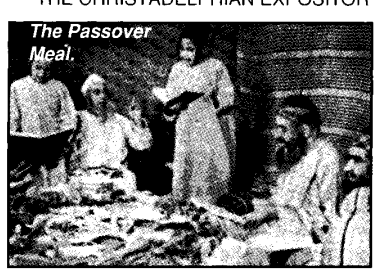
"And ye shall keep it until the fourteenth day of the same month" — Every detail of the original Passover was fulfilled to the letter by the antitypical Lamb of God. The animal was selected on the tenth day of the first month, and penned up until the fourteenth day when it was slain. This provided ample time for it to be carefully inspected in order to ensure that it was free from blemish. Significantly, in accord with this requirement, the Lord Jesus entered Jerusalem on the tenth day of Abib for his final public witness to the people. Six days before Passover the Lord arrived at Bethany (John 12:1), and on the following day, he entered Jerusalem. The Passover lamb was slain on the fourteenth day of Abib, which is called the Day of Preparation (John 19:14), and the festival was commemorated on the fifteenth which was celebrated as sabbathon, a holy convocation, when no servile work was to be done (Lev. 23:3; John 19:31). Hence the tenth day of Abib was five days (days of grace) before Passover proper. On that day, the Lord made his way from Bethany to Jerusalem for his last public appearance before the leaders of the nation, providing them with opportunity to carefully inspect him and to justify their repudiation of his claim to be the Messiah by convicting him of sin (John 8:46). They were unable to do so, and were silenced of their criticism. When, finally, they brought him before the high priest and Pilate, they were unable to vindicate the charges they laid against him, even though they employed false witnesses to do so. After closely and critically examining the Lamb of God for the very length of time provided in the original Passover, they could find no blemish in him. The Lord, therefore, fulfilled the type to the letter as far as the time periods of the Passover were concerned. It is also extremely significant, that he did so on the very days of the week upon which the first Passover fell — for though the dates of the feast remain the same, the actual days on which they fall differ from year to year.
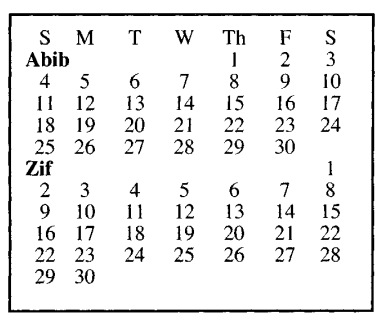
The basis of computation provided in ch. 16:1 establishes that the first Passover lamb was offered on a Wednesday. The Israelites arrived at the wilderness of Sin on the fifteenth day of the second month, and the context of that chapter (cp. v.5) reveals that this was on a seventh day, for following the demands of the people for bread, they were given manna for six days (vv. 4-5). As Abib was a month of thirty days, the calendar is computed as shown in the panel on page 155.
The Lord declared that he would be in the grave "three days and three nights" (Mat. 12:40). This time period is completed only if he were crucified on a Wednesday, and rose at the dawning of the first day (being the conclusion of the Sabbath, at sunset on the Saturday). The "days" then are Thursday, Friday and Saturday, and the "nights" Wednesday, Thursday and Friday.
The Wednesday crucifixion also reconciles other anomalies. For example, Mark 16:1 claims that "after (according to the Greek text) the sabbath," the women bought spices to anoint the body of the Lord, whereas Luke 23:56 records that this was done "before" the sabbath. This would constitute an irreconcilable contradiction if the Lord were crucified on a Friday; but John adds his testimony, that following the crucifixion there was a "high day" sabbath (Jn. 19:31). Thus, Passover was followed by a special sabbath in addition to the weekly sabbath. Between the death and resurrection of the Lord, we must account for two sabbaths with a day between in which the women purchased and prepared the spices. Only a Wednesday crucifixion followed by a Thursday sabbath, provides this. It is not only most appropriate that the antitype should be offered on the same day of the week as the type, but it also fulfils the allusion of Daniel's prophecy that "in the midst of the week," the Lord's offering would cause the sacrifices of the Law to cease (Dan. 9:27). The phrase "in the midst" was fulfilled at the end of the three and a half years of the Lord's ministry. Thus prophecy, type and antitype conform to the very letter.
"And the whole assembly of the congregation of Israel" — The term "assembly" is from the Hebrew qahal, the equivalent of the Greek word ecclesia, denoting those "called out" for a special purpose; while "congregation" is edah, the feminine form of of ed signifying "witness." Those who were to be identified with the Passover, therefore, constituted those "called out to witness" to this teaching, and not necessarily every Israelitish male and female. The feminine form of "witness" is used, because the ecclesia thus described constituted Yahweh's Bride (Isa. 54:5), and the association of Israel with the Passover, witnessed to that fact. The Ecclesia of Witness (see Acts 7:38) comprised particularly the male adult members of the nation (Ex 12:43-45,48). The "whole assembly," kol qahal, was divided into families or households, as the Ecclesia of Christ today is separated into groups.
While females participated in the Passover celebrations, it was obligatory for adult males, as constituting the qahal, to keep the festival (Ex. 23:17).
It will be found that the qahal was summoned for both military and religious duties, and that these duties were very closely intertwined. For military duties, see Num. 22:4 (rend, "company"), Jud. 20:2; 21:5-8; 1Sam. 17:47. For religious duties see Deu. 5:22; 9:10; 2Chr. 20:5; 30:25. The qahal ("assembly") was organised as a fighting unit, so that those recruited for war are said to comprise "the sum of all the congregation of the children of Israel" (Num. 1:2).
Israel marched out of Egypt as an army in the month Abib (spring — Ex. 12:51), and springtime (Passover or deliverance ) became the recognised "time of war" (2Sam. 11:1; lKgs. 20:22; IChr. 20:8). Thus all adult males had to keep the Passover, and also to register for war (Num. 1:2).
Similarly, like Israel of old, the ecclesia today has both religious and military responsibilities. It must "keep the Passover," and "fight the good fight of faith". Today, however, its obligations are not limited to adult males but involve all members (see Gal. 3:28).
"Shall kill it" — At the first Passover, the lamb was slain by the head of each house on behalf of its individual members. In doing so, he acted as priest on behalf of the household. Later, however, as the result of the faithful action of Levites in a time of crisis recorded in Ex 32:26, the priesthood was limited to the tribe of Levi (Num. 3:6-13). Now in Christ, there has been revealed "a change of priesthood" (Heb. 7:11-15). The Aaronic has given place to the Melchizedec, under which order all believers are accounted as priests, able to officiate on behalf of the individual families through the high priest. Christ, therefore, has restored the conditions that appertained before priestly ministrations in Israel were limited to the tribe of Levi.
"In the evening" — The margin provides the literal Hebrew (see also Interlinear Bible): "between the evenings." This denotes late afternoon, and is usually identified as between 3pm and 6pm, at which time the day ended and the next day commenced. However, there is doubt as to the actual time thus indicated. Some claim that the Hebrew implies the decline of the sun, and therefore, the afternoon. Josephus claims that it was between the 9th and 11th hours (3pm and 5pm — see Wars of the Jews, 6:9:3). The chronology of the N.T. shows that the Lord died on the stake at the time appointed for the Passover lamb to die.
VERSE 7
"And they shall take of the blood" — Sacrificial blood represents a life dedicated unto Yahweh (Lev. 17:11). The use of the blood in the way described indicated that the household understood its responsibilities to Yahweh.
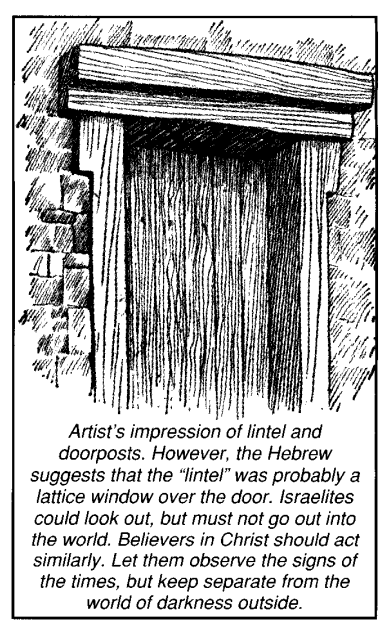
"And strike it on the two side posts and on the upper door post of the houses, wherein they shall eat it" — The RV renders "upper doorpost" as "lintel." The Hebrew is mashqowph from shaqaph, "to look out." It probably refers to the latticed window commonly placed over a doorway in Egyptian houses. It was possible to look out from such, but not to go out. The entrance of the dwellings where Israelites sheltered all that night (v. 22) were identified with the Passover lamb by the blood on the doorposts and lintel. Blood was not poured out on the ground, for sacrificial blood was not used in that way (see Lev. 17:13). The reason for this is explained in Heb. 10:29 which warns of the consequence of "treading underfoot the Son of God, and counting the blood of the covenant an unholy thing."
VERSE 8
"And they shall eat the flesh in that night, roast with fire" — Normally sacrificial meals were boiled (ISam. 2:14-15; Lev. 8:31). Roasting is a quicker process of cooking, and emphasised the urgency of the circumstances. It is also suggestive of a burnt offering, coming in direct contact with fire. This was done by impaling the victim on a spit, so that in a sense the lamb was crucified. The Jews say that this was done with a piece of pomegranate tree, which is significant, for its fruit is typical of Christ.
The lamb was slain during the late afternoon of the 14th day, and eaten after sundown. According to the Jewish calendar, the next day commenced at that time (cp. Gen. 1:5), so that whilst the Passover was slain on the fourteenth day of Abib, it was celebrated on the fifteenth day.
"And unleavened bread" — Leaven is a symbol of sin. In I Cor. 5:8, in association with Christ our Passover, Paul aligns it with the "leaven of malice and wickedness," which, he declares, must be purged out. It was the custom of Israelites to carefully search their homes for any trace of leaven which was removed therefrom before the Passover was celebrated. Because of this, and because leaven was excluded for the following week, the Passover is often styled the Feast of Unleavened Bread (Heb. matstsah). It taught the need of striving for sinlessness.
"And with bitter herbs they shall eat it" — This taught that the striving for sinlessness and association with the Lamb would be accomplished by trial. Actually "herbs" is not in the original (see Interlinear Bible). The Hebrew text has merorim, "bitternesses," the plural of maror. Already Israel had tasted of the bitterness of Egyptian slavery. Now the people learned that their deliverance from such would be accompanied by further painful experiences. So it is also with those who feed upon Christ as the Passover Lamb. We need to remember that the bread and wine represents the crucifixion of the Lord, and whilst providing a way of redemption, also commemorate the hatred manifested by the world toward him, a bitterness which his disciples must also experience (John 15:18). The apostles taught that it is "through much tribulation" that believers will "enter the kingdom of God" (Acts 14:22). They, too, must eat their "bitter herbs."
VERSE 9
"Eat not of it raw" — The Egyptians ate raw flesh in honour of the god Osiris. By this command, Yahweh sought to free His people in every conceivable way from all idolatrous practices. Moreover, whereas raw meat is indigestible and difficult to assimilate, the lamb was to be made easy to absorb.
"Nor sodden at all with water" — It was not to be boiled or stewed, requiring dismembership of its parts. Nothing extraneous was to enter into it.
"But roast with fire; his head with his legs" — It was to be roasted whole, including the head, heart, liver and kidneys, a symbol of the unity of the true Israel, of which the Lord was the ideal (Isa. 49:3). The antitype was fulfilled in accordance with this requirement (John 19:36).
"And with the purtenance thereof — The word qereb signifies the centre and therefore is better rendered as "inwards" (see Interlinear Bible). They included the heart, liver, kidneys, etc, which in other offerings were consumed on the altar (Exo. 29:13, 22; Lev. 1:9, 13). The same Hebrew word here rendered "purtenance thereof" is elsewhere rendered as "inwards" (see Ex. 29:13, 17, 22, etc.).
VERSE 10
"And ye shall let nothing of it remain until the morning" — The flesh was to be entirely consumed in the way specified, so that none remained the next day. That day was a day of significance, for on it the Israelites left Egypt. Therefore it typically points forward to the coming "day of Yahweh" when the flesh of the redeemed will be changed to Spirit nature (Mal. 4:1-2; ICor. 15:45-50).
"And that which remaineth of it until the morning" — Any flesh adhering to the bones.
"Ye shall burn it with fire" — By these means all the flesh was consumed, and none was left to corrupt. In fulfilment of the type "neither did Christ's flesh see corruption" (Acts 2:31).
VERSE 11
"And thus shall ye eat it; with your loins girded" — Loins girded signify a comprehension of the Truth (Eph. 6:14), as well as a readiness for action (Luke 12:35).
"Your shoes on your feet" — As a pilgrim, ready to instantly leave (cp. Eph. 6:15).
"And your staff in your hand" — Prepared for a long journey.
"And ye shall eat it in haste" — With a sense of urgency, as not knowing when the call to leave would come. See the antitype in Luke 12:34-40.
Later, the method of celebrating the Passover was changed. The rabbis mark four things required in the first Passover that were not practised later: (1) The selection of the lamb on the tenth day; (2) The eating of the lamb in the houses of the people; (3) The striking of blood on the door-posts and lintels; (4) The eating of it in haste {Jewish Targum, 6th century ad). In fact, there were seven items of the first Passover not observed in subsequent times:
- Congregational killing of their own lamb (this was later performed by
the priests). - Splashing blood on door-posts and
lintels. - Having loins girded.
- With shoes on feet.
- Staff in hand for travel.
- Eating in haste.
- Refraining from going out of the door until morning.
At the time of the Lord, the Jews reclined at the table to eat the Passover, instead of standing and eating it in haste as enjoined originally. The reason for this, as explained in the Jewish Haggadah, is to show that they celebrated it as free men, and not as those under bondage. It declares: "All Israel are equal, all Israel are free men, and all Israel should recline at the table as free men do." This statement is significant in view of the claim of the Jews to the Lord that they were "free" (John 8:32-33). They did not understand that they were still in bondage to sin, and needed deliverance from such, and that redemption could only be obtained through the true Lamb of God, and the Passover he would institute.
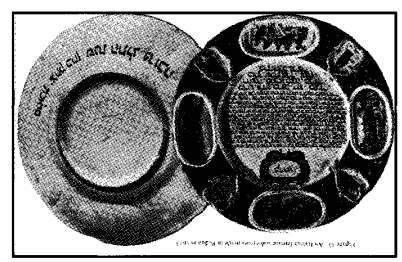
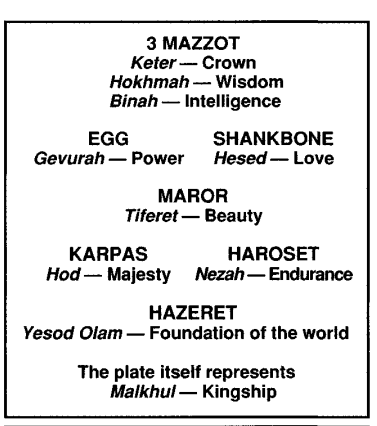
The Passover Plate as traditionally set out. The "3 Mazzot" relate to the three pieces of unleavened bread, each of which has a symbolic meaning to the participant. Note the provision for the shankbone, and compare the extract from Elpis Israel quoted in the text of our commentary.
Since the dispersion, Jews no longer slay a lamb, but, instead, place a bone on the Passover tray. In the Haggadah the following explanation is given for this: "On the right-hand of the tray is placed a portion of the shankbone of a lamb, roasted. This is intended to commemorate the actual Paschal lamb which was sacrificed in the temple at the Passover: originally the essential feature of the observance, but now no more than a symbolical relic."
On this custom, Brother Thomas comments in Elpis Israel: "I am informed by a Jew that when they eat the passover they eat no lamb, but have a dry bone of one on a dish; and that all who celebrate take hold of the lip of the dish, and unitedly offer a petition. This is remarkable. They have slain the true Lamb, which believers of the gospel feed upon: while only a dry bone remains to them, strikingly illustrative of themselves. Faith in the Lamb of God supplies the absence of the lamb in the Lord's Supper" (p. 297-298).
"It is Yahweh's passover" — The Hebrew is pesach. It occurs in the Old Testament 56 times, forty-nine of which relate to the festival or offering of Passover, and therefore provides no indication of the proper significance of the word. It is generally thought that it relates to the action of the angel of death in passing over the houses of the Israelites with their blood-spattered door-posts and lintels. Therefore, it is usually related to verse 12, where Yahweh states: "for I will pass through the land of Egypt this night, and will smite all the firstborn."
But the Hebrew verb of that verse bears no relationship to the noun before us. Its root is derived from the verb pasach rendered "pass over" in v. 13, but actually having the meaning of "to spare." It is rendered in the Septuagint as "protect," in the sense of overshadowing. The use of the word elsewhere in Scripture indicates that its true meaning is to "hover over, stay over, protect, abide over." Therefore, instead of "pass over," it would be more correct to render the words as "remain over."
In 1 Kings 18:21 the word is rendered "halt" and in v. 26 as "leaped." The references are to the people of Israel who halted, wavered, or hovered between two opinions, and to the priests of Baal who hovered anxiously over their altar, not "leaped upon it," as rendered in the A.V. The word occurs again in 2Sam. 4:4 which records that Mephibosheth fell, "and became lame." In fact, he began to limp, and the swaying motion that followed his fall suggested the wavering of a bird over its young. Hence the use of pasach in this place.
In Isaiah 31:5 the word occurs in a most interesting and significant way. The prophet declared: "As birds flying, so will Yahweh of hosts defend Jerusalem; defending also He will deliver it; and passing over He will preserve it." But, in fact, Yahweh did not pass over Jerusalem; He hovered over it and so protected it, thus justifying the use of the word protect by the Septuagint in Ex. 12:13.
The use of the term by Isaiah is significant in view of the statement of the Lord on the eve of Passover, as recorded in Mat. 23:37-39: "O Jerusalem, Jerusalem... how often would I have gathered thy children together, even as a hen gathereth her chickens under her wings, and ye would not. Behold, your house is left unto you desolate. For I say unto you, Ye shall not see me henceforth, till ye shall say, Blessed is he that cometh in the name of the Lord." The anxious hovering of the mother bird over her chickens is illustrative of the protection afforded by the first Passover.
If we use the term hover over to protect in place of "pass over," the real meaning to becomes apparent. Thus: "When I see the blood, I will hover over the door to protect you, and will not suffer the destroyer to come in unto your houses" (Ex. 12:23). "Yahweh hovered over to protect the houses of the children of Israel" (v. 27).
The angel did not pass over the houses of the Israelites when he saw the blood, but hovered over to protect them. He remained there with them, whilst the angel of death passed over to destroy the firstborn of Egypt. A.H. Broughton describes it as the Feast of the Hover-over, or Abiding Presence, and writes: "That is a true translation: the 'Feast of the Passover' is not. When God saw the blood on the door posts, He did not, as the English Bibles say, pass over the door, He hovered over it. The Feast itself is not that of a Passover, but that of a Hover-over."
The Passover as a festival, therefore, celebrated the invisible but real presence of Yahweh, hovering over His people at a time of extreme peril. It witnessed to the Abiding Presence of Yahweh as provided in the lamb and all that it signified. It does so also in the provision of our Passover Lamb around which we gather in memorial (ICor. 11:24-25). The Abiding Presence of Yahweh and His Son hovers over the celebration of the Memorials, and though unseen their presence is nevertheless real and powerful to save.
VERSE 12
"For I will pass through the land of Egypt this night" — The verb is from the Hebrew abar, signifying "to go through," and is so rendered in the R.V. He bears no relation to pesach ("passover").
"And will smite all the firstborn in the land of Egypt, both man and beast" — None were to be exempted, for Egypt had refused to accept the appeal of Yahweh, and so was about to reap His judgment. The world today repeats the spirit of Egypt, and shall reap the judgment of Armageddon. As in Egypt, Yahweh's power induced fear and terror, and His justice produced awe and veneration, so shall be the effect throughout the world in the future.
"And against all the gods of Egypt I will execute judgment" — In smiting the firstborn of all living beings, man and beast, Yahweh executed judgment upon objects of Egyptian worship. Every deity of Egypt was represented by some beast. Even Pharaoh himself was worshipped as a god, so that the death of his firstborn son constituted the death of the god-elect. This statement sums up the purpose of all the plagues: to illustrate how ineffectual was the pagan worship of Egypt. See Num. 33:4.
"I am Yahweh" — This statement declares Yahweh's power to perform His intentions, in contrast with the inability of Egypt's gods. The God of the Hebrews is the One whose purpose will be fulfilled, as indicated in His Name which signifies: He Who Will Be (manifested).
VERSE 13
"And the blood shall be to you for a token upon the houses where ye are" —
The literal Hebrew is "for you," not "to you" (See The Hebrew Greek English Bible and Rotherham). The blood would serve as a token or a sign in the mercy of Yahweh toward them. Thus it would be for them and not to them. It would be for them a sign of mercy to strengthen them at a time of judgment, when death impended.
"And when I see the blood, I will pass over you, and the plague shall not be upon you to destroy you, when I smite the land of Egypt" — The words "pass over" here is from pasach, the root of pesach. It denotes "to spare," and is rendered by the Septuagint as kai skepazo umas, "and I will protect you." But the Greek skepazo signifies "to cover, shelter, clothe or screen" (see Vine). At the time when the judgment of death would sweep Egypt, Yahweh promised to protect, cover, and clothe His people. Antitypi-cally, believers are "covered" with Christ at baptism, but in the complete sense, they will be protected and covered at the day of Judgment when death shall sweep the earth (Isa. 26:20).
VERSE 14
"And this day shall be unto you for a memorial" — As a memorial the Passover was not designed merely to recall to mind the great deliverance effected in the exodus from Egypt, but to awaken the mind to the significance of what was done, and to its application to the generations following. That is true also of the celebration of the Lord's death and resurrection. The statement "This do in remembrance of me" (ICor. 1 1:24) is from the Greek anamnesis, a noun signifying "a calling against to mind," thus to recall. However, Yahweh's memorial is not designed merely to recall to mind, but to mentally reaffirm the principles of the atonement as expressed in the death and resurrection of the Lord.
Israel was called upon to observe a number of memorials "throughout all generations" (Psa. 135:13). Among them were the following: the Name of Yahweh (Ex. 3:15; Hos. 12:5); the Passover (Ex. 12:14); the deliverance from Egypt (Ex. 13:9); the destruction of Amalek (Ex. 17:14); Yahweh's covenant (Ex. 34:27); the ephod stones (Ex. 28:12); the breastplate of judgment (Ex. 28:29); the redemption money (Ex. 30:16); the blowing of trumpets (Lev. 23:24); the frankincense (Lev. 24:7); the offering of jealousy (Num. 5:15,18); the sounding of the silver trumpets (Num. 10:10); the brazen censers of the altar (Num. 16:40); the booty of war from the Midianites (Num. 31:54); the stones from Jordan (Josh. 4:7); the crowns of the righteous in the temple (Zech. 6:14). Each item, or incident selected as a memorial is most significant, especially in its antitypi-cal application to the Lord Jesus Christ.
"And ye shall keep it a feast to Yahweh throughout your generations" — It is obligatory upon true Israelites to keep the Passover. Today Jews do so with a bone upon the plate instead of a lamb; whereas the "Israel of God" (Gal. 6:16) do so with true spiritual significance in the light of the Lamb of God offered for the sin of the world (1Cor. 5:7; Jn. 1:29).
The term "feast" is better rendered "festival." It is from a Hebrew root signifying "to move in a circle," and suggests rejoicing together, as well as indicating the circle or cycle of the year, implying a set time for its annual observance.
"Ye shall keep it a feast by an ordinance for ever" — The word "ordinance" is from the Hebrew chuzzah, and denotes an appointment. Persons of integrity will keep the appointments they make, and will allow nothing to interfere with such arrangements. Thus, the feast, whether in ancient times or in relation to Christ our Passover, is designed to be kept as an appointment which must not be broken.
The Feast Of Unleavened Bread - vv. 15-17.
Associated with the Passover and instituted at the same time, is the Feast of Unleavened Bread, instructions for its keeping are now given to Moses.
VERSE 15
"Seven days shall ye eat unleavened bread" — This is the first mention of the feast of unleavened bread. It began with the Passover on the 15th day of the month (Lev. 23:6), and continued seven days, the first and seventh being holy convocations, or sabbathons (vv. 6-8).
"Even the first day ye shall put away leaven out of your houses" — This is the first occurrence of leaven in the Bible. Out of all homes, every piece of leavened or fermented bread was to be removed during the feast (vv. 15-20; 13:3-7). Leaven is a general term for that which generates fermentation in dough, or that which corrupts morally and spiritually. Today, yeast is used for fermenting, but in ancient times various substances were known to possess this property. According to Pliny, the leaven then used was a piece of fully fermented dough retained for the purpose from the previous day's baking. Such a piece might either be broken down in water in a basin before the fresh flour was added, or it might be "hid" in flour (Mat. 13:33), and kneaded along with it. Bible leaven, then, is exclusively a piece of sour dough. This was especially used by the Jews, as the warm climate of the Middle East induces fermentation. It is said, that if flour is mixed with water, spontaneous fermentation will set in and be completed within twenty-four hours.
Leaven, therefore, is itself the offspring of corruption, and corrupts the mass of dough with which it has been mixed. It works silently but effectively. The Lord likened the imperceptible, yet progressive development of the kingdom in the Age to come, to the hidden but pervasive action of leaven in the midst of the dough (Mat. 13:33).
But, generally, leaven is used to denote moral corruption (ICor. 5:6-8; Gal. 5:9), and false doctrine (Matt. 16:6-12; Mark 8:15; Luke 12:1). By forgiveness of their sins, true followers of Christ are already "unleavened" (ICor. 5:7), and must therefore "keep the feast" by living the Christlike life "in the unleavened bread of sincerity and truth" (v. 8). This was the lesson emphasised to the Israelites in Egypt. The deliverance effected by the Passover, and the protection it afforded, was not enough. The festival indicated a new beginning, one that must be kept as free from the moral and doctrinal corruption of Egypt as possible. Hence the importance of the feast of unleavened bread.
Bread itself, was the main article of food in ancient times, and symbolised a life of activity. The Feast of Unleavened Bread reminded Israelites that they must strive to be free of the corrupting influence of Gentilism.
There was also a historical basis for the introduction of this feast. The Israelites had to leave the cultivated land of Egypt for the desolate desert, and because of the circumstances, haste was imperative. Food had to be made ready quickly, without previous preparation (see Ex. 12:33-34), and had to be of such a nature as to last much longer than usual. Hence the baking of unleavened bread (Hebrew, mazzah; plural, mazzoth).
The verse before us commands the Israelites not merely to prepare unleavened bread, but also to "put away leaven out of your houses." Accordingly, in celebrating the Passover and the Feast of Unleavened Bread, during later times, every corner of the house, however remote and difficult of access, was completely cleansed before the feast. The kitchen was scoured out, and the house thoroughly searched for any trace of leaven. The Jewish Haggadah, explaining the customs of Jews at such a time, states: "Spring cleaning acquired, in a word, a religious significance: so much so that the Jews may, perhaps, claim the credit of having introduced that hygienic practice."
As a spiritual practice, the followers of the Lord do well to carefully scrutinise their lives before partaking of their Passover feast, in order to exclude any corruption of "malice and wickedness" as enjoined by Paul (ICor. 5:8). The Lord, himself, commanded that due preparation of a like kind should precede formal worship before God (Mat. 5:23-24).
Jewish instruction concerning unleavened bread, distinguishes between the Feast of Unleavened Bread, and Pesach or Passover which, strictly, is applied only to the first night. It points out that the first principle taught by the bread is that of the need for haste:
"Fearing lest worse still might befall them, the Egyptians hurried the children of Israel away by night, so that they had to snatch up the bread which they were baking before it was leavened. At the same time, on account of its hardness and unpalatability, the masssah was regarded as 'bread of affliction', serving as a reminder of the harshness of Egyptian bondage. In the Orient, moreover, bread made without leaven was a less expensive preparation, which it took a shorter time to prepare (it is repeatedly mentioned in the Bible as being given to an unexpected visitor). Hence it remained the poor man's fare, and was, therefore, considered 'bread of poverty,' a fitting token of the slavery which it commemorated. A symbolical value was also attached to the massah. Leaven was regarded as typifying the 'leaven of sinfulness,' the evil impulse in man's heart which turns him aside from the higher intent. Hence unleavened bread became the token of purity of the higher freedom which comes from obedience: 'heavenly bread,' as it is called in Jewish mystical literature" (from Haggadah).
In current celebrations of the Pesach it is the occasion when the Unleavened Bread is displayed upon the table, and for the youngest member of the family present, to commence asking the four formal questions based on Deu. 6:20.
"For whosoever eateth leavened bread from the first day until the seventh day, that soul shall be cut off from Israel" — To be "cut off does not neces-sarily mean put to death, but to be expelled, or excommunicated from the congregation, and so separated. The same discipline should be exercised by the ecclesia in the case of any who wilfully flout the specific instructions of God whether in doctrine or practice.
VERSE 16
"And in the first day there shall be an holy convocation" — The first day of the feast was the fifteenth of Abib, for the previous day, when the Passover was killed, was "the day of preparation" (John 19:14). "Holy convocation" (Heb. quodesh migra, "a sacred, sanctified call out") signifies a separation and calling together of the people. This "holy convocation" was commemorative of the calling together of the people, in order to leave Egypt. It emphasised their separateness from Gentilism, and their dedication unto Yahweh.
"And in the seventh day there shall be an holy convocation to you" — Both the first and seventh days were days of rest when holy convocations were held. This arrangement epitomises the purpose of Yahweh. At the beginning of creation sin was evident (Gen. 1:1), and God's purpose is that during the seventh millennium there shall be another such "day of rest" for believers (Heb. 4:9-10). Meanwhile, God has been calling men and women unto Himself (Acts 15:14). In the seventh "day," which prophetically points to the millennium (2Pet. 3:8), there shall be a "holy convocation," or gathering together of the Redeemed. They will constitute "a great number, which no man can number, out of all nations" (Rev. 7:9), as was Israel when they came "out of" Egypt. The redeemed are described as having "come out of great tribulation, and having washed their robes, and made them white in the blood of the Lamb" (v. 14) — expressions suggestive of Israel's experiences in Egypt and association with the Passover Lamb.
"No manner of work shall be done in them" — They were days entirely devoted to Yahweh.
"Save that which every man must eat, that only may be done of you" — The people were to provide only for the absolute necessities of life. The spiritual lesson is that pronounced by the Lord: "Seek ye first the kingdom of God, and His righteousness; and all these things shall be added unto you. Take no [anxious — RV] thought for the morrow: for the morrow shall take thought for the things of itself. Sufficient unto the day is the evil thereof (Mat. 6:33-34).
VERSE 17
"And ye shall observe the feast of unleavened bread" — By "observing" it, Israelites were exhorted to consider the spiritual lessons implied in the keeping of it.The Hebrew shamar, signifies "to observe," and denotes to guard from being broken, to protect, to carefully scrutinise.
"For in this selfsame day have I brought your armies out of the land of Egypt" — This establishes the beginning of the festival as being on the fifteenth day of Abib, the day that the Israelites left Egypt. The Israelitish day commenced at sundown the night before, following the description of Gen. 1: "The evening and the morning were the first day." This enumeration is important in establishing the events of the last week of Christ's ministry (cp. John 12:1). The reference to the people as "armies" indicates their changed status. Previously they were an unorganised rabble of slaves in Egypt; but they left marshalled in armies, ready for the fight of faith.
"Therefore shall ye observe this day in your generations by an ordinance for ever" — The observance of the Passover is still maintained by the "Israel of God" (Gal. 6:16) in the partaking of the bread and wine as memorials of the true Lamb.
When The Feast Was To Be Kept - vv. 18-20.
Specific instructions are now given as to when and how the Festival is to be kept.
VERSE 18
"In the first month, on the fourteenth day of the month at even" — The Hebrew day commences with the evening (Gen. 1:5) at sundown, and as the evening here defined was that at the close of the 14th Abib, the celebration actually commenced at the beginning of the 15th day, the day of Passover.
"Ye shall eat unleavened bread, until the one and twentieth day of the month at even" — Since the evening of the 21st was actually the commencement of 22nd Abib, the festival continued until then. The words "unleavened bread" are from the Hebrew matstsah.
VERSE 19
"Seven days shall there be no leaven found in your houses" — Leaven (Heb. seor, "yeast cake") was excluded for the full period of seven days. As this represents the seven millennia of the divine plan of the ages, the prohibition points to the need of true Israelites to strive for perfection throughout their lives, and to anticipate the day of immortality, when the "leaven" of sin will be entirely removed.
On the fifteenth day, no leaven was to be found in the homes of Israelites, therefore, the fourteenth day was called the Day of Preparation, and all leaven was removed. It is significant that on that day Judas was excluded from the band of the apostles (John 13:30).
References to the Day of Preparation are found in Mat. 27:62; Mark 15:42; Luke 23:54; John 19:14, 31, 42, and all refer it to the 14th Abib.
"For whosoever eateth that which is leavened" — Here the Hebrew is chametz, "to ferment."
"Even that soul shall be cut off from the congregation of Israel" — This is an important addition to the statement of v.15, for "the congregation of Israel" included proselytes who normally would not be included among Israelites. Moses was instructed, that, although Israel was to be separated from Egypt and was about to become a nation, entering upon its inheritance of exclusive privilege. There was also the opportunity for Gentiles to share in it by becoming incorporated into the nation. In fact, a "mixed multitude" left Egypt with the Israelites, becoming proselytes of the faith, and considered as amongst the chosen nation, and subject to this law.
"Whether he be a stranger" — This word is ger, and signifies an alien, therefore a proselyte. This shows that Gentiles have never been entirely excluded from the covenants of promise. They have had opportunity to become incorporated therein by completely identifying themselves with the Israelitish hope, and submitting to circumcision. Throughout the law, provision is made for Gentiles to be included (Ex. 20:10; 23:12; Lev. 16:29; 17:10; 18:26; 20:2; 24:16; Num. 35:15; Deu. 5:14; 16:11-14; 24:17, 19; 27:19; 29:11 etc).
"Or born in the land" — The term denotes an Israelite by birth.
VERSE 20
"Ye shall eat nothing leavened" — This is not a mere repetition of v. 15, but an extension of the command there given, showing that the prohibition is not merely concerning bread, but includes all forms of food.
"In all your habitations shall ye eat unleavened bread" — This, again, is an extension of that expressed before. Even though not resident in the land, or if absent therefrom, a person was to uphold the same ordinance.
The Elders Instructed to Keep the Passover — vv. 21-28.
Having received specific instructions from Yahweh, Moses calls the elders together, to explain to them how to keep the festival. They agree to observe it and return to make preparations for it.
VERSE 21
"Then Moses called for all the elders of Israel, and said unto them, Draw out and take you a lamb according to your families, and kill the passover" — They were instructed to draw out from the flock an animal for the purpose of the passover. The word "lamb" is tsone in Hebrew, and denotes a flock generally, without specifying whether it be sheep or goats (See Interlinear Bible).
VERSE 22
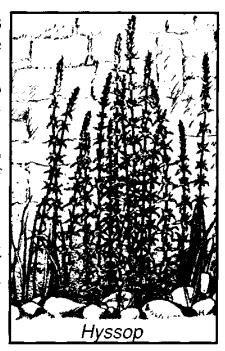
"And ye shall take a bunch of hyssop, and dip it in the blood that is in the bason" — The hyssop is a small bushy plant growing about 45 cms (1 1/2 ft) high. The leaves have an aromatic smell and a pungent flavour. It was used for medicinal qualities; and in the sacrificial provisions for cleansing a leper (Lev. 14:4,6,49,52). It was also used in conjunction with the red heifer in cleansing the defilement of death (Num. 19:6,18). See also Psa. 51:7; John 19:29; Heb. 9:19.
The hyssop has been identified as a species of marjoram (see All The Plants of the Bible - W. Walker) of the mint family, a plant that is native to Egypt and is found also in Syria. Others identify it with the caper plant (See Sinai & Palestine — Stanley, p. 21) which abounds especially in the desert or in difficult circumstances, and is generally low and insignificant. The hyssop is also known for its tenacity and is described as "springing out of the wall" (1 Kings 4:33). Accordingly, it suggests humility and faith in action. In so doing, it symbolised that quality of worship that gave significance to the keeping of the Passover, and was effective in cleansing from sin (Psa. 51:7). Humility, tenacity of purpose, and faith in action, are still necessary for acceptable worship.
Dipping the hyssop in the blood, helped to keep it from congealing. Apparently some of it was caught in a basin, as the verse before us implies and as is generally thought. However, the Hebrew saph translated "bason," may also be rendered threshold as in Judges 19:27. It is so rendered in the Septuagint, in the passage before us. But evidently some receptacle is meant, which probably was placed on the threshold for the purpose of holding the blood for sprinkling.
"And strike the lintel and the two side posts with the blood that is in the bason" — See note v. 7
"And none of you shall go out at the door of his house until the morning" —
They were not to leave the house unless divinely instructed to do so. This part of the command evidently related to subsequent celebrations of the Passover, for on the first keeping of it, the people actually left at night (see vv. 29-31; Deu. 16:1). The command is most significant to the "Israel of God" today; for the ecclesia constitutes the "house of God" (1Tim. 3:15), and after entering it, enjoying the protection it affords, to then leave it before the morning of the coming day (Mai. 4:1-2) is to risk the death that afflicts those outside.
VERSE 23
"For Yahweh will pass through to smite the Egyptians" — See note v. 12. The word here is abar.
"And when He seeth the blood upon the lintel, and on the two side posts" — Indicative of the obedient faith of those dwelling therein.
"Yahweh will pass over the door" — Here the word is pasach, and signifies not to pass over (AV), but to hover over, or to protect as the following words reveal.
"And will not suffer the destroyer to come in unto your houses to smite you" — The Destroyer denotes the angel who had been appointed to administer judgment upon Egypt. Later, Israel was warned against acting in such a way as to incite the wrath of this angel (Ex. 23:20-23).
VERSE 24
"And ye shall observe this thing for an ordinance to thee and to thy sons for ever" — In this verse, Moses changes from the plural, "you" (v. 21) to the singular, "thee." In doing so, he emphasised the individual and personal responsibility attached to keeping the Passover.
VERSE 25
"And it shall come to pass, when ye be come to the land which Yahweh will give you, according as He hath promised, that ye shall keep this service" — Significantly, and beautifully, the same principle was expressed by the Lord in introducing his Passover, declaring that he would no more eat thereof until the kingdom of God shall come (Luke 22:15-16; Eze. 45:21-22).
VERSE 26
"And it shall come to pass, when your children shall say unto you, What mean ye by this service?" — Instead of "children" read "sons" (See Interlinear Bible). It is still the custom, that in opening the Passover service, the unleavened bread is uncovered, and the youngest "son of the commandment" present asks the question posed in the next verse. Moses taught that it was the responsibility of fathers to instruct their children in divine principles and precepts. A Jewish commentator has stated: "Education in the home is thus as old as the Hebrew people: see Gen. 18:19." This same responsibility of personally educating their children in the things of God rests heavily upon the parents of the "Israel of God" today.
VERSE 27
"That ye shall say, It is the sacrifice of Yahweh's passover" — The lamb was treated as a sacrifice, the altar being represented by the house itself upon which the blood was splashed.
"Who passed over the houses of the children of Israel in Egypt, when He smote the Egyptians, and delivered our houses" — Here the verb is pasach as in v. 13, and again it is seen that the AV is inadequate. Yahweh did not "pass over" the children of Israel when He smote the Egyptians; He stayed over their houses to protect them.
"And the people bowed the head and worshipped" — They did so with greater fervency in view of the redemption and the future inheritance promised them.
VERSE 28
"And the children of Israel went away, and did as Yahweh had commanded Moses and Aaron, so did they"
— They went to select their lambs, and to make preparation for the Passover celebration.
Exodus: A Pattern Of Redemption
SECTION FOUR
SEPARATION Chapter 12:29 to 15:21
Yahweh intended that the tremendous miracle of Israel's deliverance from Egypt should be remembered by them for all time. It was not accomplished without trouble and anguish to all concerned, for these happenings constituted the birth-pangs by which the nation was brought into existence.
Consider what the exodus meant for Israel. It marked the beginning of a new Life, a new Liberty, a new Fellowship, a new Service. In Egypt, Israel was under bondage to Pharaoh; the people wore themselves out by slave-labour that promised them nothing; they partook of a life that was limited to sin and death. On the other side of the Red Sea everything was changed. They were brought into a relationship to things that promised eternal life. They changed masters: from Pharaoh to Yahweh. They entered into a state that promised them freedom from Egyptian slavery, and set before them the hope of the Promised Land. Between the one state and the other was a barrier of water, called the Red Sea. It became the means of life to Israel, but of death to Pharaoh — even as earlier the Flood saved Noah, but destroyed the world of wickedness with which he was familiar.
All this has its counterpart in the Gospel of Christ. Luke records that when Moses and Elijah appeared with Christ on the Mount of Transfiguration they "spake of his decease [lit. 'his exodus'] which he should accomplish at Jerusalem/' The Lord is the Leader of an Exodus far greater than that under Moses. Baptism into him provides a new Life, a new Liberty, a new Fellowship, and a new Service for his followers, greater than that to which Moses led Israel of old.
In this section now before us, this separation was first Proposed as the people were urged to leave Egypt; it was Resisted when Pharaoh endeavoured to prevent them crossing the Red Sea; it was Accomplished by the passage itself, culminating in the people singing the Song of Deliverance on the other side.
(1)-SEPARATION PROPOSED Chapter 12:29 to 14:4
The frightful effect of the tenth plague which plunges all Egypt into mourning, results in Pharaoh granting approval to Israel to leave, and in the Egyptians doing all in their power to assist them to that end. As the Hebrews leave for Succoth, the spiritual significance of the Passover, its eternal importance as a religious ceremony, is impressed upon them. At the same time, Moses does not forget the message and request of Joseph, and arranges for his remains to be conveyed with them. Under the protection of Yahweh, the people move slowly, but steadily, towards Pihahiroth and the Red Sea.
Tenth Plague: The Firstborn Slain - vv. 29-30.
Egypt is plunged into bitter mourning as the consequence of Pharaoh's folly is felt by every household, in the death of the firstborn, it is obvious that the gods of the land have been unable to protect their worshippers from the wrath of Yahweh.
VERSE 29
"And it came to pass, that at midnight" — It had been prophesied by Moses that the time of deliverance would be at midnight (ch. 11:4), though the day had not been fixed. Midnight is the time when most people are asleep, and therefore off guard for any crisis. So it will be at the coming of the Lord. The constant exhortation is that believers "should not sleep as do others" (IThes. 5:6). "Behold, I come as a thief," declared Christ, "Blessed is he that watcheth, and keepeth his garments, lest he walk naked and they [the overshadowing angels] see his shame" (Rev. 16:15). The word "watch," frequently used throughout the N.T. in a similar context, signifies to keep awake, and is an allusion to the night of Passover. For, whilst Egypt slept, the Hebrews were awake in their nouses "watching;" so that Passover is given the title of The Night Of Watching. The Lord warned that he could come at midnight (Mark 13:35), and in his parable of the ten virgins, represented the approach of the bridegroom at such a time (Mat. 25:6).
"Yahweh smote all the firstborn in the land of Egypt, from the firstborn of Pharaoh that sat on his throne unto the firstborn of the captive that was in the dungeon; and all the firstborn of cattle" — See note v. 12. The judgment of this, the most terrible of the plagues, is aligned with the final defeat of the gods of Egypt (Num. 33:4), and is described as judgment against "the chief of Egypt's strength" (Psa. 78:51). Every element of Egypt is included, from the highest to the lowest in the land, and the beasts of the field. Its counterpart in the future will be the judgment of Armageddon and its aftermath, when "the slain of Yahweh shall be at that day from one end of the earth even unto the other end of the earth" (Jer. 25:33).
Whilst death claimed all the firstborn of Egypt, those of Israel were protected by the hovering presence of Yahweh. Later, the tribe of Levi was constituted as the priestly tribe in Israel and was claimed of Yahweh as instead of the firstborn (Num. 8:16; 3:45). In Christ, the redeemed constitute "the firstfruits unto God and to the Lamb" (Rev. 14:4), and are thereby separated unto Him for His great purpose.
The word "cattle" in this verse is from the Hebrew behemah and denotes animals generally. There was no limitation of the plague to domestic animals: it affected all beasts, and as these were worshipped in Egypt, the death of such constituted judgment against the gods of the land.
VERSE 30
"And Pharaoh rose up in the night, he, and all his servants, and all the Egyptians" — Pharaoh had been warned of the impending disaster, but had not heeded the warning. Now he learnt that God's Word cannot be treated with contempt, and that his neglect involved all his people in the trouble.
"And there was a great cry in Egypt; for there was not a house where there was not one dead" — A frantic wail of agony was heard throughout the land. It is said that no people of antiquity were more emotional in mourning than the Egyptians. They whipped, beat, tore themselves, and howled and screamed in excessive grief!
The People are Urged To Leave - vv. 31-36.
This final plague is the breaking point: The hardness of Pharaoh's heart is revealed as Gentile folly. The king has brought his nation to the brink of destruction, and even his own position is insecure. That very night an urgent command is sent to Moses and Aaron to leave instantly with their people and possessions. No restrictions of any kind are imposed. Indeed, every assistance is offered them to go. Egypt has had enough.
VERSE 31
"And he called for Moses and Aaron by night" — The night was the 15th Abib, a Thursday according to our time, but which actually commenced on the evening of Wednesday, for the Jewish day begins at 6pm (thus: "the evening and the morning were the first day," Gen. 1:5). Pharaoh evidently sent a royal messenger to Moses, instructing him to leave, and did not call for him to attend at the palace, as implied in the AV. From Ex 10:28-29; 11:8 it appears that the king had no further personal interviews with Moses after the latter had left the palace in anger. The Interlinear Bible reads: "And he called Moses and Aaron by night." He instructed them by the hand of an emissary.
"And said, Rise up, and get you forth from among my people, both ye and the children of Israel; and go, serve Yahweh, as ye have said" — Pharaoh's resistance was at an end.
VERSE 32
"Also take your flocks and your herds, as ye have said, and be gone" — This was a retraction of Pharaoh's former prohibition (Ex. 10:24-26), and a complete capitulation to the requests of Moses.
"And bless me also" — An astonishing addition to the message, and one which indicates the complete humiliation of Pharaoh induced by his personal sorrow. His request for a blessing from Moses and Aaron was an acknowledgment that he now recognised the power and status of Yahweh. This was similarly the case with Nebuchadnezzar, following his experience of madness (Dan. 4:33-37). In the antitype the nations will be compelled to acknowledge that "God is in" those whom they previously opposed (Isa. 45:14).
VERSE 33
"And the Egyptians were urgent upon the people, that they might send them out of the land in haste" — The people had suffered much and feared more. Without concern for Pharaoh or what he might have determined, the Egyptians, on their own account, urged the Israelites to leave the land.
"For they said, We be all dead men" — They feared that if there was any further hindrance to the Israelites in leaving Egypt, the incidence of death already experienced would become more widespread, and the whole nation might be wiped out.
VERSE 34
"And the people took their dough before it was leavened" — Hence the origin of the festival of unleavened bread was based on the separation of the people from the darkness of Egypt, and the urgency of their deliverance.
"Their kneadingtroughs being bound up in their clothes upon their shoulders" — It was customary for nomads, in travelling, to bind their kneading troughs in their clothing so as to have them ready for use in travel. The troughs were small wooden bowls, or leather pouches, used for mixing flour and water to make bread or cakes. In taking these utensils, the Hebrews showed that they were leaving on a journey from which they would never return.
VERSE 35
"And the children of Israel did according to the word of Moses" — He had instructed them to "borrow" of the Egyptians (Ex. 3:22; 11:2).
"And they borrowed of the Egyptians jewels of silver, and jewels of gold, and raiment" — The word "borrowed" should be rendered "asked," not "borrowed" (see notes on Ex. 3:22; 11:2). In asking these things of the Egyptians, the Hebrews requested that they give them that which was their right to have, and which they did not intend to return. They had been unlawfully condemned to slavery, and had worked hard without adequate pay; now they requested payment for that which they had done. The jewels and raiment they received as a result were later used to provide what was necessary for the tabernacle.
VERSE 36
"And Yahweh gave the people favour in the sight of the Egyptians, so that they lent unto them such things as they required" — Yahweh's judgments caused a change of heart in the Egyptians, and made them more amenable to the requests of the Israelites. The latter part of the verse is better rendered by the RV, "They let them have what they asked."
"And they spoiled the Egyptians" — The Hebrew natsal signifies "to snatch away," and is better rendered "saved" rather than "spoiled." The Soncino Edition of The Pentateuch states "spoiled" is an impossible rendering of the Hebrew text, and comments: "The root natsal occurs 212 times in Scripture, and in 210 instances its meaning is admitted by all to be to snatch (from danger), to rescue (from a wild beast), to recover (property)... Its direct object is never the person or thing from whom the saving, or the rescuing, or the snatching has taken place, but always the person or thing rescued. The usual translation, both here and in Ex. 3:22... is unwarranted, for two reasons. It takes the persons from whom the things are snatched as the direct object; and furthermore, it necessitates an entire reversal of the meaning of natsal from 'save' into 'despoil'." The same word is rendered "deliver" in Isaiah 19:20, and applied to modern Egypt. Thus, in the days of Moses the people recovered from the Egyptians what had been taken from them during their servitude, and by so responding, the Egyptians purchased themselves back into favour. The law therefore commanded: "Thou shalt not abhor an Egyptian" (Deu. 23:7).
In willingly acknowledging the right of the Hebrews to the jewels and raiment they heaped upon them, the Egyptians were spared from any further divine judgment. Indeed, the readiness with which they responded, illustrated that they did not now endorse the policy of Pharaoh and his courtiers, and this kept them from a disaster similar to that which overcame his army subsequently. If the people had continued to resist the Exodus, they would have suffered the punishment that they apprehended (v. 33).
The Hebrews Journey To Succoth - vv. 37-39.
Together with a mixed multitude of Gentiles who identified with the saving work of God with His people, the children of Israel leave the land of Goshen and move on to Succoth.
VERSE 37
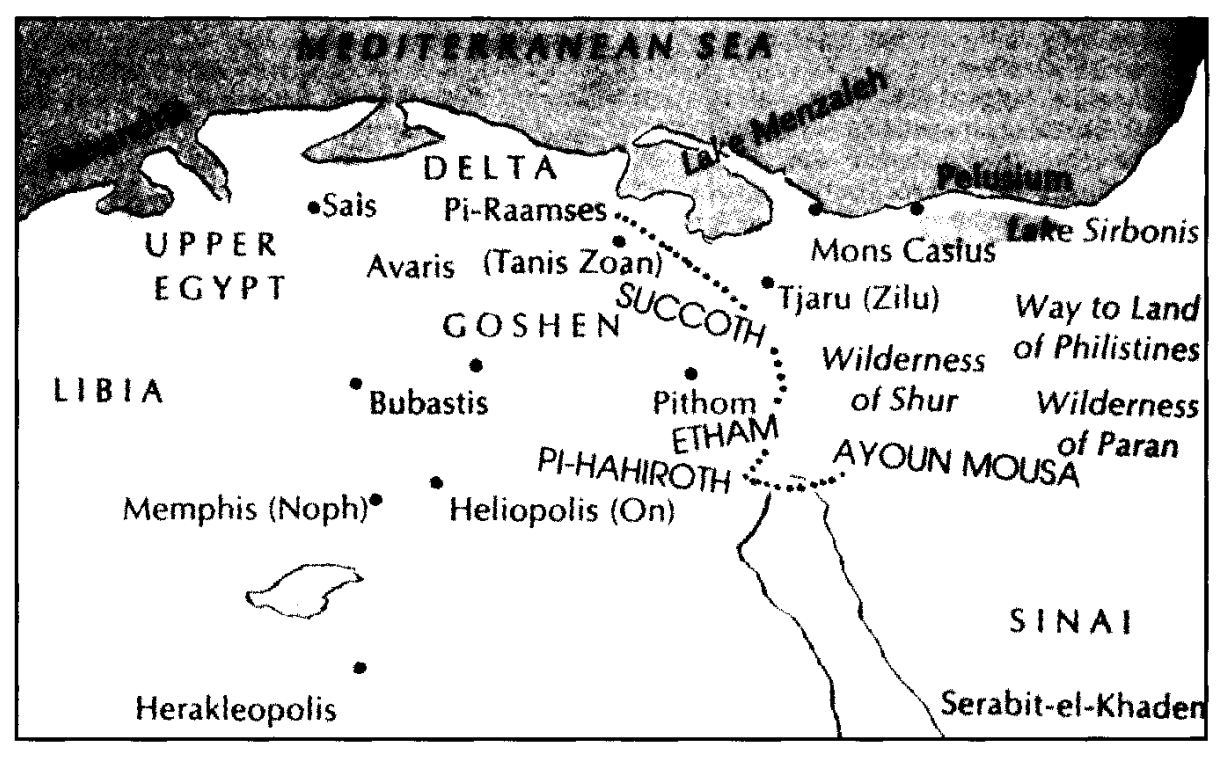
"And the children of Israel journeyed from Rameses to Succoth" — For Rameses, or Raamses as it is spelt in Ex. 1:11, see notes at that place.
"Succoth" signifies booths or tabernacles, and is so called becaustTthe Hebrews dwelt in temporary abiding places during the short time they remained there. This gave rise later to the Festival of Tabernacles (Lev. 23:43).
Succoth has been identified by some with Tell el-Maskhutah, on the eastern part of the Wadi Tumilat (see Unger's Dictionary), and is a little over 25 kilometres (15 miles) distance from Goshen. The Hebrews arrived there late Thursday and encamped under whatever temporary shelter was available.
"About six hundred thousand on foot that were men, beside children" — The total number of those who left has been assessed as over two million. The word for "children" is taph, and signifies "families." This would include all the women, and those under twenty. Objections have been raised as to the difficulty of such a large company of people leaving Egypt. These have been considered at length in The Exodus Of Israel by T.R. Βirks, and shown to be without real foundation.
VERSE 38
"And a mixed multitude went up also with them and flocks and herds, even very much cattle" — Pharaoh's stubbornness caused discerning Gentiles to acknowledge the might of Israel's God, ■ and so, at this time of crisis, to throw in their lot with them. Pharaoh's folly, and Yahweh's longsuffering, resulted in Gentiles embracing the way of life, as Paul observes (Rom. 9:22-24). Though Israel is the exclusive channel of divine grace and mercy, the opportunity has ever been for Gentiles to identify themselves therewith.
VERSE 39
"And they baked unleavened cakes of the dough which they brought forth out of Egypt, for it was not leavened" — Hence the significance of the Festival of Unleavened Bread, being celebrated after Passover. It is here repeated (see v. 34) to emphasise the urgency of their action, and the importance of preparing for their departure.
"Because they were thrust out of Egypt, and could not tarry, neither had they prepared for themselves any victual" — The Festival of Unleavened Bread celebrates the separation from Egypt, and the urgency with which it took place. They were to place no dependence upon Egypt, and to make all haste to distance themselves from its association. Even the food of Egypt was to be abhorred — although later the people turned again in faithlessness, remembering the pleasures of that land (Num. 11:5). The importance of separation from the ways and "foods" of the world cannot be overemphasized to those who today seek deliverance from spiritual Egypt.
The Night Of Observations — vv. 40-42.
The narrative of the departure from Egypt is followed by a statement of the length of the sojourn, and the importance of the night that preceded the journey from the land of sin and death.
VERSE 40
"Now the sojourning of the children of Israel, who dwelt in Egypt, was four hundred and thirty years" — The statement does not claim that the Hebrews were in Egypt for 430 years, but that the sojourning of the children of Israel who then dwelt in Egypt was for that period of time. In Gal. 3:16-17, Paul states that the figure given reaches back to the call of Abram, the progenitor of the Hebrews. That was thirty years longer than the 400 years given in Gen. 15:13, because it included the sojourning of Abram himself. Abram entered the land in the year 2083 after creation. Add to this the 430 years' sojourn, and the Exodus took place in the year 2513. According to our chronology (see outline at the conclusion of Gen. 50 in Expositor: Genesis), Joseph died in the year 2369, and from this the following periods are established:
Death of Joseph........................... 2369
Birth of Moses................................... 64
2433
Flight of Moses................................. 40
2473
Exodus from Egypt........................... 40
ac 2513
According to our chronology at Gen. 50, Jacob entered the land of Egypt in the year AC2298 at the age of 130. This was exactly half the time period indicated, for 215 years later, in the year AC2513, Israel departed out of Egypt.
VERSE 41
"And it came to pass at the end of the four hundred and thirty years" — This suggests that Abram began his sojourn on the 15th day of Abib, 430 years before the Exodus (cp. Gen. 12:6; Num. 33:3; Gal. 3:17). Thirty years later, according to Genesis 15:13, where it is stated that 400 years would elapse before the Exodus, the covenant was typically confirmed with Abraham.
"Even the selfsame day" — This statement significantly begins and concludes the wilderness wanderings (Deu. 27:9, 11; 32:48).
"It came to pass that all the hosts of Yahweh went out from the land of Egypt" — The word for "hosts" in the Hebrew is the same as that rendered "armies" in vv. 17, 51. The Hebrew tsabaoth is a feminine noun, and here has reference to Israel as the "Bride" of Yahweh (Isa. 54:5).
VERSE 42
"It is a night to be much observed unto Yahweh for bringing them out from the land of Egypt" — The margin renders this as a night of observations, or a night of watchings. Alternative ideas are those of celebrations and vigilances. The Hebrews were to be vigilant all that night, suggesting the words of Paul: "Ye are all the children of light, and the children of the day: we are not of the night, nor of darkness. Therefore let us not sleep, as do others; but let us watch and be sober" (IThes. 5:4-6). The Gentile night must become a time of watching, of vigilance and of preparation, for true believers (Rev. 16:15). The watching should be "unto Yahweh," with the mind concentrated on the things of faith.
"This is that night of Yahweh to be observed of all the children of Israel in their generations" — The Hebrew for "observed" is shimmur, from the root shamar and denotes observance but with the object of performance. The root is used in Deu. 6:25, " If we observe to do." See also ch. 12:17,24.
Who Shall Eat The Passover? - vv. 43-51.
Specific instructions are further given as to the observance of the Passover on future occasions.
VERSE 43
"And Yahweh said unto Moses and Aaron, This is the ordinance of the passover" — It was necessary to repeat the general principles of the Passover because of the presence of the mixed multitude (v. 38).
"There shall no stranger eat thereof — In this verse, two different Hebrew words are used: ben neker, "the son of a foreigner" (see Interlinear Bible), in contrast to vv. 19, 48-49. This denotes an alien who remains as such, and does not endorse the Israelitish covenant (ct. v. 48).
VERSE 44
"But every man's servant that is bought for money, when thou hast circumcised him" — Endorsing the instructions given unto Abraham when the rite of circumcision was first introduced (See Gen. 17:12, 13, 23, 27). However, it is implied, though not directly expressed, that the slave should of his own freewill accept the faith, and not be forced to embrace it. The rabbis interpreted the ordinance this way.
"Then shall he eat thereof — A foreigner who, as a bought servant, accepts the Israelitish faith and submits to circumcision, permanently enters the family circle, and becomes a full member of the nation. As such he must partake of the Passover. This principle is revealed in the case of Onesimus the slave, who, upon embracing the Truth, became a "brother beloved" (Phil. 10-16), partaker of the memorials of Christ, though remaining a slave. The ordinance before us urges the responsibility of the Israelitish master to instruct his slaves in the principles of the faith, acknowledging his own former state of servitude in Egypt (Deu. 5:15).
VERSE 45
"A foreigner and an hired servant shall not eat thereof — The word "foreigner" is towshab from yashab signifying "to sit down, to dwell," and thus denotes a resident alien. The RV renders it, "a sojourner." The "hired servant" is treated differently to the "slave," who, as a proselyte to the faith, becomes a member of an Israelitish household.
VERSE 46
"In one house shall it be eaten; thou shalt not carry forth ought of the flesh abroad out of the house" — See comments on vv. 3-10.
"Neither shall ye break a bone thereof — Representing the unity of those partaking of the Passover victim. These words were cited in regard to the Lord's manner of death (see John 19:33-36). To interfere with this important provision by destroying the harmony of the Christ-body with devious doctrines and wrong practices is strictly forbidden.
VERSE 47
"All the congregation of Israel shall keep it " — For "congregation" see notes vv. 3, 6. The word "keep" is from the Hebrew asah, and signifies to keep or make, in the broadest sense. The margin has "do it," the Interlinear Bible has "prepare it." All three words can have application. There was a sharing in both the preparation and the participation of the Passover.
VERSE 48
"And when a stranger shall sojourn with thee, and will keep the passover to Yahweh, let all his males be circumcised, and then let him come near and keep if — The word for "stranger" is ger, as in v. 19. Circumcision is required of all, whether Israelite by birth or Gentile proselyte, as a condition for eating the Passover. Symbolically, circumcision represents the denial of flesh, as a basis for the proper partaking of the Christ-Passover (see Rom. 2:29).
"And he shall be as one that is born in the land" — The foreigner, on becoming circumcised, was considered as a citizen of Israel, and to participate in its activities and worship.
It is significant that the same words are applied to a class of mortals in the midst of Israel in the Age to come (Eze. 47:22). The "strangers" referred to in this place are permitted to dwell in the midst of Israel, and possess portion of the land as an inheritance, at a time when the nation is restored in its fulness. To whom does the reference apply? It appears strongly to relate to the children of believers who have not reached the age of responsibility for accepting Christ before he returns. They will have the great benefit of guidance from immortal parents, and of being incorporated into Israel as though "born in the country."
"For no uncircumcised person shall eat thereof' — Upon this ordinance, in regard to its application in Christ, Bro. Thomas comments in Elpis Israel, p. 250: "None but circumcised persons can inherit the promises. This may startle; but it is strictly true. It will, however, be remembered that true circumcision is of the heart. Circumcision of the flesh is but an outward sign of Abraham's circumcision of heart; and every one who would inherit with faithful Abraham must be circumcised of heart likewise. When he was circumcised of heart his faith in God was imputed to him for remission of sins that were past. His former idolatry, etc., was forgiven, and the body of the sins of his flesh put off. Now, a man believing what Abraham believed, with the same effect on his disposition and life, is also circumcised of heart, when, in putting on Christ, he is 'circumcised with the circumcision made without hands by the circumcision of Christ," performed on the eighth day according to the law. In putting on Christ, his faith is counted to him for righteousness as Abraham's was. The "body of the sins of his flesh," is cut off. The foreskin of his heart is circumcised, and he is the subject of "circumcision in the spirit;" and his praise, though not of men, is pronounced of God (Rom. 2:29; Col. 2:1 1-12)."
VERSE 49
"One law shall be to him that is homeborn, and unto the stranger that sojourneth among you" — The word "law" is torah, derived from yarah, and signifies, "to aim at, teach, point out, direct, lead, guide," denoting instruction in righteousness (see also Lev. 24:22). This is the first mention of the word Torah, "law," in the Bible, and it is a word, extremely important and prominent to the mind of a Jew. The Law provided a guide to right conduct, illustrated the reality of sin (Rom. 7:13), made manifest the weakness of flesh (Rom. 8:3), and demonstrated the need of a Redeemer, so leading the way to Christ (Gal. 3:24). The understanding of the Law, and all that it brought home to the Israelite, provides an important foundation to the manifestation of grace in Christ. Thus Paul describes it as holy, just and good.
The word "stranger" is ger, and from this, the true proselyte was given the title of ger tzedek, the "righteous proselyte."
VERSE 50
"Thus did all children of Israel; as Yahweh commanded Moses and Aaron, so did they" — At their first Passover, the Israelites scrupulously observed all the ordinances of Yahweh. This response of the people is mentioned twice for emphasis, as the critical circumstances of the time caused them to seek Yahweh with the greatest fervency.
VERSE 51
"And it came to pass the selfsame day, that Yahweh did bring the children of Israel out of the land of Egypt" —
This statement reveals that the day the Israelites left Egypt was the Passover proper, the fifteenth of Abib, and not the 14th when the animal was slain.
"By their armies" — The word tseba'ah is in the feminine gender and signifies "to mass together." From this comes the word tsabaoth, "troops." The people massed together in armies, in order to leave. Passover, therefore, had both a religious and a military significance: a fusion of divine principles prominent throughout Scripture. For example, Paul exhorted: "Fight the good fight of faith, lay hold on eternal life, whereunto thou art also called" (ITim. 6:12). He combined military and religious duties.
Comments