Genesis is not merely the first book of the Bible in order. It is the book that establishes the setting of all biblical thought: God before all things, creation by His power, man within His purpose, and history moving under His Word toward promise and fulfilment. Genesis is presented on In the Bible as a foundational book of beginnings, deeply concerned with the relationship between God, creation, and mankind; that is an excellent starting point, because the opening of Genesis does indeed set the stage for everything that follows in Scripture.
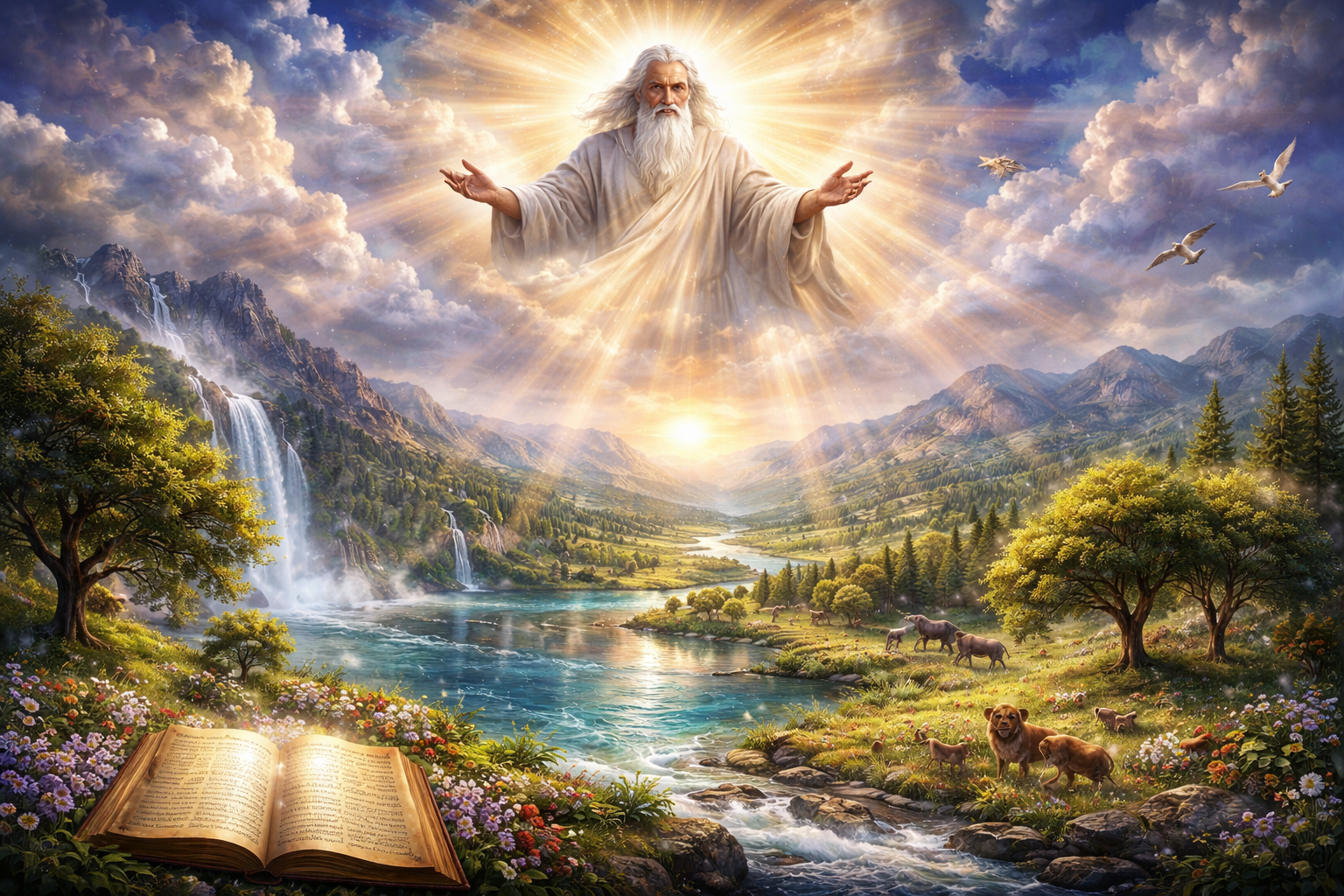
Bereshit: more than an English opening line
The King James Bible opens with the majestic words, “In the beginning God created the heaven and the earth” (Genesis 1:1). Those words are unforgettable, and rightly so. Yet the Hebrew title of the book, Bereshit, invites us to linger more carefully over the opening than an English reader may at first realise. Jewish commentators, and Rashi above all, have long noted that the Hebrew construction is capable of a subtler sense than a simple bare chronological statement; it can be read in the sense of “when God began to create” or “at the beginning of God’s creating.” That does not overthrow the truth of the King James rendering. Rather, it reminds us that even the first words of Genesis open into depth. The Bible begins with language that is both simple enough for a child to hear and profound enough to occupy the most patient student for a lifetime.
This matters because Genesis is not merely telling us when things started. It is telling us what kind of reality we inhabit. The opening point is not the date of creation, nor the mechanism of creation, but the primacy of God. Before the earth was, God was. Before the heavens were stretched out, God was. Before light shone, before the deep was bounded, before Adam drew breath, God already was. Scripture speaks elsewhere with the same solemn emphasis: “Before the mountains were brought forth, or ever thou hadst formed the earth and the world, even from everlasting to everlasting, thou art God” (Psalm 90:2). Genesis does not begin by proving God. It begins by presupposing Him.
That in itself is humbling. Human thought is bounded by sequence. We think in terms of “before” and “after,” of cause and effect, of beginning and ending. But the God of Genesis does not belong to that chain. Isaiah says that He “inhabiteth eternity” (Isaiah 57:15). The mind can repeat that sentence, but it cannot easily contain it. We can understand endless extension of time more readily than true eternity; yet even endless time is not eternity. Time rolls forward in succession. God is not merely ancient. He is not merely older than creation. He is before all succession, beyond all decay, untouched by all process. That is why the opening of Genesis should be read with reverence as well as interest. We are not simply at the beginning of the world; we are standing at the edge of a mystery the human mind cannot fully traverse.
The setting of Genesis is God Himself
It is therefore a mistake to think that the setting of Genesis is first geographical. Eden comes later. Canaan comes later. Egypt comes later. Even the “heaven and the earth” of Genesis 1:1 are not the deepest setting. The deepest setting is God Himself. The world is not self-originating. It is not self-explaining. It is not a machine that simply is. It is the work of One who speaks, orders, names, blesses, separates, judges, and sustains.
Again and again Genesis 1 repeats the same rhythm: “And God said … and it was so … and God saw that it was good.” The chapter does not portray a struggle between rival deities, nor a cosmos born from divine violence, nor a blind material process stumbling toward temporary order. The atmosphere is one of sovereign speech. Being answers to God. Light appears because He wills it. The firmament stands because He appoints it. Living things bring forth because He commands it. The world begins as ordered response to divine utterance.
This is why the chapter is so calm. It is majestic without being frantic. It is elevated without being speculative. The text does not indulge curiosity for its own sake. It teaches dependence. The world depends on God because it comes from God. “By the word of the LORD were the heavens made; and all the host of them by the breath of his mouth” (Psalm 33:6). “He hath made the earth by his power” (Jeremiah 51:15). “I have made the earth, the man and the beast that are upon the ground, by my great power” (Jeremiah 27:5). Those later passages are invaluable because they interpret Genesis 1 for us. They tell us that the act of creation is properly understood as the expression of God’s own power, word, and spirit.
The Spirit of God in creation
That observation leads directly to one of the most important themes in the setting of Genesis: “the Spirit of God moved upon the face of the waters” (Genesis 1:2). From a Christadelphian standpoint, this should be understood not as the action of a second or third divine person operating alongside God, but as the active power of God Himself. The Scriptures regularly use such language. Luke 1:35 places “the Holy Spirit” in parallel with “the power of the Highest”: “The Holy Spirit shall come upon thee, and the power of the Highest shall overshadow thee.” The parallel is striking, and it is difficult to miss its force. The Holy Spirit is not presented there as another being besides God, but as God’s own operative power.
The same pattern appears elsewhere. Isaiah 11:2 says, “The spirit of the LORD shall rest upon him”; Acts 10:38 interprets that in the language, “God anointed Jesus of Nazareth with the Holy Spirit and with power.” The linkage is plain. So too in creation itself: Genesis 1:2 speaks of the Spirit of God moving upon the waters, while Jeremiah and the Psalms describe creation as the work of God’s “great power,” His “word,” and the “breath” or ruach of His mouth. The Hebrew word ruach can bear the sense of spirit, wind, or breath; in Psalm 33:6 that richness is especially suggestive. God creates by what proceeds from Him. His creative energy is not external to Him. It is His own power in action.
In that sense, one may say that creation comes forth out of God, not out of any pre-existent independent reality standing over against Him. That phrase must be handled carefully. Scripture does not teach that the created order is simply identical with God in the crude sense of pantheism, as though stone and sea and dust and flesh were themselves the divine essence. But it does teach that all things proceed from Him, depend upon Him, and are sustained by Him. Paul says, “Of him, and through him, and to him, are all things” (Romans 11:36). Again, “In him we live, and move, and have our being” (Acts 17:28). There is therefore a profound truth in saying that the universe is not alien to God, not independent of God, not detached from God. It exists because His power called it forth and upholds it still.
That understanding also helps with passages that trinitarian readers often press into service to prove that the Holy Spirit is a separate co-equal person. John 14–16 speaks of the Comforter teaching, guiding, bringing to remembrance, and testifying. Acts speaks of the Spirit forbidding, sending, witnessing, and speaking. Yet Scripture often personifies that which is not literally a separate personal being. Wisdom cries in the streets. The blood of Abel cries from the ground. Sin reigns. Death reigns. The Scripture “saith” unto Pharaoh (Romans 9:17), though literally it is God speaking through the written word. So too the Spirit may be said to speak, testify, or comfort when in truth it is God Himself speaking, testifying, and comforting by His Spirit-power.
Indeed, much of the Bible’s language about the Holy Spirit sits more naturally with power than with an independent person. Jesus received the Spirit “without measure” (John 3:34). The Spirit was “poured out” (Acts 2:17). It “fell” upon hearers (Acts 10:44). The disciples received it when Jesus breathed on them (John 20:22), and others received it by the laying on of hands (Acts 8:17–19). Such language is entirely fitting if the Spirit is God’s operative power. It becomes strained if one insists that a co-equal divine person is being measured out, poured out, breathed out, or transmitted. In the setting of Genesis, then, “the Spirit of God” is best read as the creative and life-imparting energy of the One God, not as a second deity moving beside Him.
This is especially important at the beginning of the Bible. Genesis is not opening with a council of equal divine persons. It is opening with one sovereign God, creating by His word and by His Spirit. The simplicity of that monotheism should not be surrendered. “Hear, O Israel: The LORD our God is one LORD” (Deuteronomy 6:4). The setting of Genesis is therefore not trinitarian complexity, but divine unity in action.
Midrash and the Jewish meditation on beginnings
Jewish tradition has long recognised that Genesis opens onto mysteries larger than straightforward narrative. In Bereshit Rabbah, one of the classic collections of rabbinic exposition on Genesis, there appears the memorable thought that God “looked in the Torah and created the world,” likening the Torah to the plan by which a builder makes a palace. That is not inspired Scripture, and it should not be handled as though it were. Yet it is deeply revealing of how ancient Jewish readers approached Genesis: not as a simple primitive tale, but as the unveiling of ordered wisdom. The world is built according to divine thought. It is not random. It is not accidental. It is not godless.
Rashi also preserves another important line of reflection: Genesis begins with creation in order to establish that the earth belongs to God and may be given by Him according to His purpose. That insight fits beautifully with the rest of Scripture. Promise, land, inheritance, covenant, and kingdom all depend on the prior truth that the world is God’s before it is anyone else’s. No nation owns the earth absolutely. No ruler holds it inherently. All is under the sovereignty of the Creator. In that sense Genesis is not merely a beginning in time; it is a declaration of ownership.
Kabbalah and the language of emanation
Later Jewish mysticism, especially Kabbalah, took these questions into another register. Kabbalistic thought speaks of En Sof, the Infinite, the unknowable God beyond all finite comprehension. From En Sof proceed the sefirot, the ten emanations or powers by which God the Creator becomes manifest, discernible, and active in relation to the world. Britannica describes the sefirot precisely in those terms: as the ten emanations or powers by which God the Creator was said to become manifest, and as stages of emanation from En Sof, “the Infinite; the unknowable God.”
Lurianic Kabbalah then adds the idea of tzimtzum, a “contraction” or “withdrawal,” in which God as the Infinite withdraws, as it were, in order to make room for creation; then creation occurs by a beam of light from the Infinite into that newly provided space. Again, this is not the language of Moses, and it must not be confused with the plain sense of Genesis 1. Yet it is one of the most serious attempts within Jewish tradition to wrestle with the relation between the eternal God and the dependent world.
A careful Christadelphian reader will profit from this material only if it is used soberly. Kabbalah is not our authority. Scripture is. But mystical traditions sometimes help us see the scale of the question. How can the infinite God be related to finite creation? How can all things be from Him without collapsing Creator into creature? How can God be wholly beyond the world and yet wholly active in it? Kabbalah answered with the language of emanation, manifestation, and contraction. Scripture more commonly answers with the language of word, breath, spirit, glory, and power. The two are not the same. Still, they circle a common conviction: creation does not stand independently over against God. It depends wholly upon Him.
That is why mystical readers sometimes speak so strongly that the universe seems almost to be God extended into manifestation. Such language must be chastened by Scripture, which keeps the distinction between Creator and creation intact. Yet there is a profound truth nearby. The universe is not a rival realm, not an autonomous machine, not a closed material system sealed off from its Maker. It is God’s world, proceeding from His power, upheld by His will, and expressive of His glory. “The heavens declare the glory of God; and the firmament sheweth his handywork” (Psalm 19:1). If one wishes to say that the universe is “of God,” that is undeniably biblical. If one wishes to say that it is “through God,” that too is biblical. The safer theological course is to say that creation is the manifestation of divine wisdom and power, while God Himself still transcends all that He has made.
The difficulty of eternity
At this point the human mind begins to fail again, and perhaps that is where it should. The doctrine of creation is difficult not only because it asks how the world began, but because it asks what it means for God to be. We can imagine an old world more easily than a created world. We can imagine long duration more easily than true eternity. We can imagine immense energy more easily than self-existent being. Genesis quietly sweeps us beyond all our comfortable categories. It tells us that before all beginnings, God is.
This is one reason Genesis should never be reduced to a battleground over mechanisms alone. Questions of chronology and process may have their place, but the first thing Genesis demands is worship. It places us before a God whom we cannot domesticate by philosophy, contain by science, or exhaust by language. He speaks, and worlds exist. He withdraws His breath, and life returns to dust. He promises, and history bends toward fulfilment.
A faint modern echo
There is an unexpected modern resonance here, though it must be treated with care. A 2025 theoretical model publicised by Uppsala University proposed that consciousness is fundamental, and that time, space, and matter arise afterwards rather than the other way round. The model is speculative, controversial, and far from settled science. It does not prove the teaching of Genesis, nor does it establish any biblical doctrine. Still, it is striking that even within some contemporary theoretical work there is a willingness to ask whether consciousness, rather than matter, may be the more basic reality.
That does not entitle us to say that science has proved that space itself is conscious. It has not. But it does show that crude materialism no longer feels as secure to some thinkers as it once did. Genesis begins with mind, word, order, and intention. Some modern speculative models, however differently framed, are at least willing to wonder whether reality is more deeply inward and unified than mechanistic accounts allow. For the reader of Scripture, that is not proof; it is only an echo. Yet it is an interesting echo.
Why this matters for the whole Bible
The setting of Genesis, then, is extraordinarily rich. It is the setting of God before the world. It is the setting of creation by divine word and Spirit-power. It is the setting of a universe that depends wholly upon its Maker. It is the setting of a human race placed within ordered creation under command. It is the setting in which later truths—sin, death, promise, covenant, seed, blessing, land, kingdom, and redemption—will all unfold.
Everything in the Bible rests here. Eden matters because creation matters. The fall matters because divine order was first good. Promise matters because the Creator has not abandoned His world. Abraham matters because the God who called light out of darkness also calls a family out of idolatry and promises blessing for all nations. Christ matters because the work of redemption belongs to the same God who made heaven and earth by His power.
So Genesis is not merely a first chapter in the sequence of books. It is the threshold of biblical reality. It teaches that God was before all things, that all things come from Him, that His Spirit is His active power in creation, and that the world is neither self-made nor self-sustaining. Midrash sensed the mystery of that beginning. Kabbalah tried to describe its depth in the language of emanation. Modern speculative thought sometimes circles toward similar questions from another direction. But Scripture itself remains clear and sufficient: “In the beginning God created the heaven and the earth.”
That is the true setting of Genesis. And it is the setting of everything.