___________________
407. GENESIS CHAPTER THIRTY-TWO
JACOB RENAMED ISRAEL
The divine transaction marks this chapter as one of the most significant in the Book of Genesis. Through distress, fear and darkness, Jacob wrestled his way to a new dawn, a new status, and a new revelation. The chapter highlights tremendous contrasts: the messengers of God (v. 1) are contrasted with the messengers of Jacob (v. 3); the encouragement of the angels is contrasted with the ominous report from Jacob's spies (v. 6); the hoped for appeasement of Esau at the cost of an expensive gift, is contrasted with the freely bestowed blessing of the angel (vv. 20, 28); the anxiety that Esau might accept "his face" in peace (v. 20) is matched with seeing the "faces of ΕΓ in peace (v. 30); the prevailing over Esau is foreshadowed by the prevailing with the angel; and the darkness of the night of wrestling, ends in the blaze of a new dawn, and the revelation of a new name for the Supplanter.
Jacob's Vision At Mahanaim—Vv. 1-2
The hostility that Jacob experienced from Laban made him more sensitive to the help extended him of God. Now, with the crisis passed, a new fear develops. What of Esau? Will forty years' absence have succeeded in wiping out the anger he once felt for Jacob? In fear of his profane brother, Jacob's timidity again asserts itself, but the assurance of divine protection is again granted him at Mahanaim.
VERSE 1
"And Jacob went on his way" — He descended south-east of the river Jordan, towards Jabbok.
"And the angels of God met him" —Literally messengers of Elohim. They appeared unto him to encourage him.
VERSE 2
"And when Jacob saw them, he said, This is God's host" — The Hebrew Elo-him Makhaneh signifies camp of Elohim. It is a military term, a cognate word to that rendered encampeth: "The angel of Yah-weh encampeth round about them that fear him, and delivereth them" (Psa. 34:7). The presence of this divine army provided encouragement for Jacob, as the realisation that the angels "as ministering spirits," still "minister for them who shall be heirs of salvation" (Heb. 1:14), provides comfort and help for the oppressed today. Jacob's "bands" (vv. 7,10), are likewise called Mahanoth, bands or camps.
"He called the name of that place Mahanaim" — Mahanaim signifies two bands or camps. The two camps comprised the heavenly host, and Jacob's bands. In this way, the God of Bethel revealed Himself to Jacob in his hour of need. It reminds us, that the army of Yah-weh on earth, in its fight of faith, and under pressure, can rely upon the help of the heavenly army. Mahanaim is situated north of the Jabbok. The name was afterward given to the town established in the neighbourhood. It was on the boundary of Gad and Manasseh, and was a city of the Levites. Here Ishbosheth reigned and was assassinated (2 Sam. 2:8,12; 4:5-8). Some years after, David repaired to Mahanaim, and was entertained by Barzillai (2 Sam. 17:24, 27; 1 Kings 2:8). It has not been positively identified.
Jacob's Message To Esau — Vv. 3-5.
Jacob realised that he must now deal with Esau, whom he had so grievously deceived previously, and who, as far as he knew, still harbored hatred against him. His fear is goaded by his sense of guilt. He is willing to seek peace by establishing a new basis for it. To that end he sends messengers towards the country of Esau, with a message designed to placate Esau.
VERSE 3
"And Jacob sent messengers before him to Esau his brother" — These messengers (or angels, same word in Hebrew: malak) are set in contrast to those whom Yahweh sent to Jacob (v. 1).
"Unto the land of Seir, the country of Edom" — Seir signifies rough, bristling or hairy (Gesenius). Evidently Esau had recently conquered this tract of territory, deep to the south of where Jacob then was, though it afterwards became the headquarters of the Edomites (Deut.2:4). For the time being, however, Esau had not completely withdrawn from Canaan (Gen. 36:5-8).
VERSE 4
"And he commanded them, saying, Thus shall ye speak unto my lord Esau; Thy servant Jacob saith thus, I have sojourned with Laban, and stayed there until now" — Jacob's natural timidity asserted itself in the composition of the message that he dictated to be sent to Esau. He describes Esau as his lord whilst calling himself Esau's servant. Perhaps Jacob desired to intimate to Esau that he did not intend to assert that precedency which the blessing conferred upon him; though these are expressions of common courtesy in the East under such conditions.
VERSE 5
"And I have oxen, and asses, flocks, and menservants and, womenservants" — This was perhaps a tactful way of advising Esau that he stood in no further need of wealth from either Isaac or Esau.
"And I have sent to tell my lord, that I may find grace in thy sight" — Jacob realised that he did wrong previously in deceiving Isaac, and now desired to make amends. He desired grace from his brother: the forgiveness of anything that he had done amiss.
Jacob's Fear Of Esau — Vv. 6-8.
The messengers return with the ominous news that they had met Esau but were not entrusted with any definite reply. All that they report is that Esau is on his way to meet Jacob with a body of four hundred followers. This adds to Jacob's fear and distress.
VERSE 6
"And the messengers returned to Jacob saying, We came to thy brother Esau, and also he cometh to meet thee, and four hundred men with him" — It must have been towards the end of the day that the messengers returned, for it was not until the morrow that Esau met up with Jacob (Ch. 33:1).
VERSE 7
"Then Jacob was greatly afraid and distressed" — The Hebrew word translated distressed signifies to be narrow or confined. He could see no way to turn, no way of escape. Despite the reassurance he had received from the manifestation of the heavenly army some time previously (for it would take him some time to move his flocks from Gilead to Mahanaim), his natural timidity got the best of him, and he began to fear greatly.
"And he divided the people that was with him, and the flocks, and herds, and the camels, into two bands" — He acted judiciously and in faith. He divided his company and possessions into two bands or camps (Mahanoth: cp. v. 2), so that in the event of an hostile attack, some might escape. Then he gave himself to prayer.
VERSE 8
"And said, If Esau come to the one company, and smite it, then the other company which is left shall escape" —
There is no want of faith in Jacob's action, but a careful assessment of the situation, and application of his own intelligence to it. He did not put trust in his own ingenuity merely, but also had recourse to prayer. Like Nehemiah, he was a man of prayer and action (Neh. 4:9).
Jacob's Prayer For Help — Vv. 9-12
Recognising that his real help was in God, Jacob gives himself to prayer. It is a prayer of great beauty, and when compared with that which was offered at Bethel (Gen 28:20-22), demonstrates the extent to which his spiritual perceptions had advanced. He offers a prayer of humility, simplicity, frankness, and forthrightness based upon the covenants of promise. It consists of an invocation (v. 9), thanksgiving (v. 10), petition (v. 11), and an appeal based upon Divine faithfulness (v. 12).
VERSE 9
"And Jacob said" — He was afraid, but he prayed. It is human to be afraid, it is spiritual to pray. In that, he was like the Psalmist who declared: "What time I am afraid, I will trust in Thee" (Psa. 56:3). Let us remember these words in time of fear.
"O God of my father Abraham, and God of my father Isaac" — Jacob begins his prayer by placing his faith in the God Who made promises to Abraham and Isaac, and Who had blessed him for their sake.
"Yahweh" — The covenant name of God. Jacob did not know the name of God, as he revealed later to the angel (v. 29); therefore he did not use it on this occasion. But he doubtless made reference to God as He Whose purpose is yet to be manifested — the basic meaning of Yahweh. Jacob's reference to the covenant principle was doubtless to remind God that if Esau prevailed, the covenant could not be fulfilled. Of course, it is not necessary to remind God of that, except to show one's identification with and hope in the promise. It therefore was an expression of Jacob's confidence in God.
"Which saidst unto me, Return, unto thy country, and to thy kindred, and I will deal well with thee" — Jacob's prayer recalls that it was obedience to the Divine will that had brought him into the present predicament. He reminds God of the promise made to him.
VERSE 10
"I am not worthy of the least of all the mercies," — This is an expression of great humility and thanksgiving. The very timidity of Jacob, which had led him into error, also caused him to humble himself before God, and to express his appreciation of the great benefits he had received from His hand. As he prayed unto God in that moment of great need, his mind could revert to the amazing circumstances of his life, and recall how that God had directed the issues of it in spite of his own weakness. The profound humility of his words demonstrate the extent to which he had developed in spiritual acumen. The word "mercies" chesedim signifies God's lov-ingkindnesses to man, rather than His forgiveness; it relates to acts of Divine favour, including the privileged position of being able to commune with God in prayer.
"And of all the truth, which thou hast shewed unto thy servant" — The word emeth signifies faithfulness rather than truth as a mere doctrine. All that God had promised He had accomplished, and Jacob knew that he could rely upon Him with every confidence. See note at Gen. 24:27 for the significance of both mercies and truth. One of the titles of Yahweh is The God of truth (or Amen, a related word to the emeth of the verse before us: Isa. 65:16). The Lord Jesus is the manifestation of this quality of the Father, and of him it is written: "He abideth faithful; he cannot deny himself (2 Tim. 2:13).
"For with my staff I passed over this Jordan; and now I am become two bands" — "I had nothing, but am now wealthy". Jacob saw in his great increase a token of God's favour and faithfulness.
VERSE 11
"Deliver me, I pray Thee, from the hand of my brother, from the hand of Esau" — Jacob knew that God must deliver him in order to accomplish His promise and fulfil His covenant. However, to pray for something that he knew it was the purpose of God to grant, did not evince lack of faith, any more than it does when we, today, pray for the peace of Jerusalem. Such a prayer is expressive of our dependence upon God to bring it about, and illustrates that we view the problem from His standpoint. At the same time, Jacob did not know whether it was in the purpose of God that he should be taken captive by Esau, and endure further restraint such as he had experienced under Laban for forty years. He feared for those in his care and sought the Divine guidance and help in his need. Jacob's request in regard to Esau is very descriptive. He asked protection from "the hand of my brother, from the hand of Esau." First he was Esau's brother; there was an affinity between them. But that brother was Esau, the man of flesh, the profane man unmoved by spiritual virtues or hopes, nor governed by Godly principles. The flesh affinity of Jacob to Esau did not blind him to his spiritual shortcomings. We need to recognise the flesh in that light, and seek the Divine help to escape its influence: "Walk in the spirit, and ye shall not fulfil the lust of the flesh" (Gal. 5:16).
"For I fear him" — This was a healthy fear; we need always to be on our guard against the flesh, particularly when it is closely related to us, and natural affection would tend to blind our eyes to its real state.
"Lest he come and smite me" — Sin's flesh can gain dominion over us unless we seek the help of God (Rom. 6:14).
"And the mother with the children" — And so destroy the fruit of a faithful man's life. The Hebrew is very expressive. It is literally the mother upon the children. It pictures the mother crouching over the children in an endeavour to protect them from the hand of the killer.
VERSE 12
"And Thou saidst, I will surely do thee good, and make thy seed as the sand of the sea, which cannot be numbered for multitude"— See Gen. 28:13-15. Jacob recalled the covenant as the basis of his prayer. He pleaded deliverance from Esau on the grounds that the fulfilment of the covenant would be impossible if his brother succeeded against him.
Jacob's Precautions — Vv. 13-23.
Jacob's precautions were twofold. Firstly, he divided his followers and his flocks and herds into two separate bodies, placing a certain distance between them, so that they could only be attacked one at a time, calculating that while one was attacked in this way the other might retreat and make its escape. Secondly, he selected from the animals in his possession a goodly number, 580 in all, and sent them in a long procession of drove after drove on the line of route by which Esau was expected to come, as a present to Esau. Those in charge were carefully instructed in how to present their portion of the gift to him. Finally, he conducted all his family over the brook Jabbok.
VERSE 13
"And he lodged there that same night; and took of that which came to his hand a present for Esau his brother" — Jacob not only prayed, but also did what he could on his own account. It is necessary that we do so on all occasions. God will not do for us what we can do for ourselves, but He will bless our activities if we give ourselves faithfully to them. Nehemiah gave a good example in that regard. He was active, vigilant and prayerful in his labour towards God: "We made our prayer unto our God, and set a watch against them day and night, because of them" (Neh. 4:9). Yahweh listened to his faithful prayer, and blessed his faithful actions. Jacob, also, having made his prayer to God, having placed his confidence in He Who keepeth covenant and mercy with His servants, now did what he could to extricate himself from his trial. He selected a present. The word is min-chah, and is frequently used in Scripture for a sacrificial offering (Gen. 4:4,5), as well as for a gift to conciliate (Judges 3:15, 17,18; 2 Kings 8:8).
VERSE 14
"Two hundred she goats, and twenty he goats, two hundred ewes, and twenty rams" — There were 580 animals in all, an indication of the great affluence of Jacob gained at the expense of Laban. No wonder the latter became jealous and envious of his son-in-law. Now, in the face of Esau's possible attack, Jacob changed his strategy. Instead of merely dividing his family and possessions into two groups, and leaving it with the foremost one to take the brunt of any attack (v. 8), three groups were selected as emissaries of peace (v. 19) before Esau came upon the first of the main groups. Such a munificent gift would prove the truth of his claim that he had ample material possessions and would not encroach upon those of Esau, and at the same time this would delay Esau, in the hope that his anger would wane.
The gift also had a spiritual value. It demonstrated how that the blessing of God had rested upon Jacob in practical matters, and in that way, exhorted his profane brother to "taste and see that Yahweh is good" for "blessed is the man that trusteth in Him" (Psa. 34:8).
THE HOUSEHOLD AT HARAN
LABAN: THE CUNNING BARGAIN HUNTER
Any accusation of deceit that may be urged against Jacob, can be levelled with greater force against his uncle Laban. But whereas, in the case of Jacob it was motivated by a desire to obtain the Divine blessing, in that of Laban it was motivated by covetousness. Nevertheless, Laban was religiously inclined, as is shown by his reception of Abraham's servant when he came seeking a bride for Isaac, though even then, the record implies that he was impressed with external evidence of gain rather than inward qualities of worth (Gen. 24:29-30). He did show respect for God in his negotiations with Jacob (Gen. 31:29).
Laban was grasping and unreliable, constantly changing the wages of Jacob if he thought it would be to his advantage to do so (Gen. 31:7-8); cunningly removing the sheep and goats he had agreed to pay Jacob as his reward before the latter had opportunity of inspecting the flock (Gen. 30:35).
In his transactions, Laban gave an external appearance of kindliness, but it was often the cloke to his hidden feelings (Gen. 31:24). He shrewdly took advantage of Jacob's ignorance of local laws and customs in order to marry off Leah; and did his best to exploit his daughter and Jacob to his own advantage. Ironically, he finally lost his daughters, his best shepherd, his grandchildren, and most of his flocks.
Ultimately, Laban entered into a covenant of peace with Jacob, after which he faded off the scene. He had an external piety, but no inward conviction. He seems typical of apostate Christianity. His name signifies white, but it is a whiteness that is used in Scripture both for purity or for the sign of leprosy. In Laban's case, though men may view him as righteous, it was but a cover for his real character.
LEAH AND RACHEL AS TYPES
The narrative concerning Leah and Rachel obviously is both literal and typical. As types, they seem to represent Israel after the flesh and after the spirit.
Leah seems to represent Israel under the law. She was "tender-eyed" (Gen. 29:17), suggesting that she lacked the vision of faith. The names of her seven children in their various meanings spell out the national hope of Israel, upon which the Law was based.
Rachel seems to represent Israel of the spirit. Her two sons are both types of Christ, the seed of promise, and in their births seem to foreshadow the two advents of the Lord. Rachel earnestly desired their coming, and prayed constantly for them to be born. At the appearance of her first son, who turned aside her reproach, she instantly predicted the coming of the second son (Gen. 30:22-24).
Her name signifies Ewe lamb, a name of endearment; the feminine counterpart of the Lamb of God — the Bride of Christ.
VERSE 16
"And he delivered them into the hand of his servants, every drove by themselves; and said unto his servants" — His servants were carefully instructed in their duties.
"Pass over before me" — He carefully inspected all that was done, leaving nothing to chance. So should we act in the things of the Truth.
"And put a space betwixt drove and drove" — The word "space" is revach similar to ruach, and signifies to breathe freely. He put a "breathing space" between each group; that is, space to revive if one is attacked.
VERSE 17
"And he commanded the foremost, saying, When Esau my brother meeteth thee, and asketh thee, saying, Whose art thou? and whither goest thou? and whose are these before thee?" — Jacob anticipated the curiosity of Esau, and the many questions he would be disposed to ask. This is indicative of the careful preparations that he made on this occasion. He left nothing to chance. He gave himself to prayer, but also diligently thought out what was best to be done and did what he could as a basis upon which the Divine blessing could rest.
VERSE 18
"Then thou shalt say, They be thy servant Jacob's; it is a present unto my lord Esau: and, behold, also he is behind us" — This would not merely delay Esau in his approach to Jacob, but would suggest that Jacob was moving forward in confidence to meet him.
VERSE 19
"And so commanded he the second, and the third, and all that followed the droves, saying, On this manner shall ye speak unto Esau, when ye find him" — The repetition of three large droves of animals to be given as a present, would surely impress Esau with the affluence of Jacob, and demonstrate that he had no need to fear that his brother might require him to share the wealth of Isaac, or acquire that obtained already by himself. In short, it demonstrated that Jacob genuinely wanted peace, and was prepared to pay handsomely for it.
VERSE 20
"And say ye moreover, Behold, thy servant Jacob is behind us" — Carefully Jacob went over the whole matter again, so that there would be no slip-up. Cp. v. 18.
"For he said" — This comment is added by Moses as historian in disclosing the motive behind Jacob's action: "He said to himself...."
"I will appease him with the present that goeth before me" — The Hebrew is kaphar paneh, "I will cover his face" or change his appearance. I will blot out past failings on my part, so that he will not see them, and the anger expressed on his face will disappear (Prov. 16:14).
"And afterward I will see his face"— He will look upon me in friendliness.
"Peradventure he will accept of me" — "Accept" is nacah, to lift in Hebrew. The phrase is literally rendered, "he will lift up my face". With such a princely present, and in view of the fact that Jacob had been driven from home, Esau could well conclude that he had gained the greatest benefit from the contest over the birthright, for, unlike Jacob, the future meant nothing to him. The reference to the face of Esau should be contrasted with those of the angels later in the chapter.
VERSE 21
"So went the present over before him: and himself lodged that night in the company" — The present was despatched over the brook Jabbok, whilst Jacob with his family remained for most of the night on its northern side. It was toward evening when the attendants left with the present.
VERSE 22
"And he rose up that night" —Some time before daybreak (cp. v. 24).
"And took his two wives, and his two women servants, and his eleven sons, and passed over the ford Jabbok"
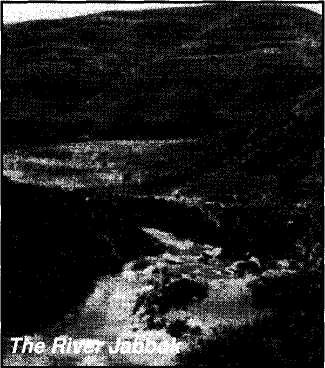
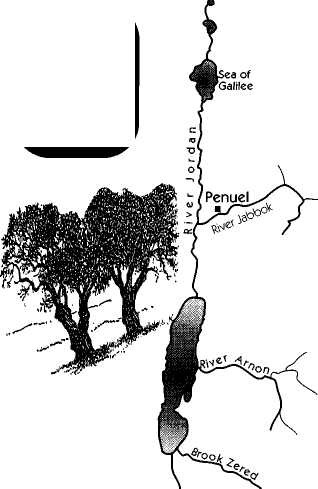
— He conducted them over the ford of Jabbok. Jabbok, according to some, is derived from bakak, to pour forth or empty, but by others, it is derived from abak, to wrestle or struggle, the verb of v. 24. It is identified with the Wady Zerka, or Blue River, situated about halfway between the Sea of Galilee and the Sea of Salt. Thus, like the altar erected between Bethel and Ai (Gen. 13:3), this significant place of prayer and wrestling, where Jacob received a new revelation and a new name indicative of his status before Yahweh, is strategically placed halfway between the Sea of Life and the Sea of Death. On the other side of this wady, Jacob met Esau and reconciliation was effected; then Jacob turned west, to pass over the river Jordan, to make his way in peace to Shechem (the Burden Bearer) where he worshipped at the altar he built and named El-elohe-Israel.
The typical significance of the wrestling of Jacob, and the site where it took place, is of the highest importance. We see foreshadowed therein the striving of every true son of God to attain unto the blessing; as well as the striving of the natural seed of Jacob in its wrestling with God.
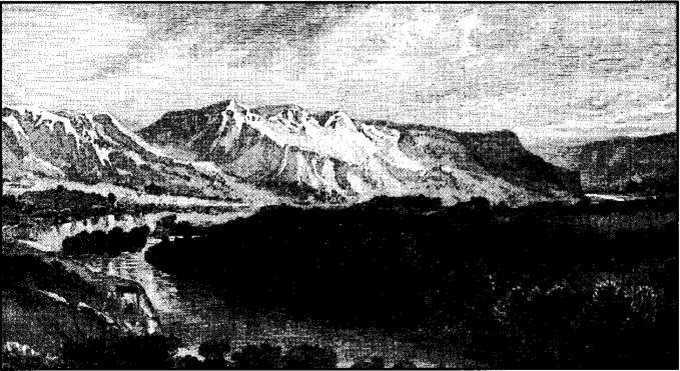
Artist's impression of the River Jordan
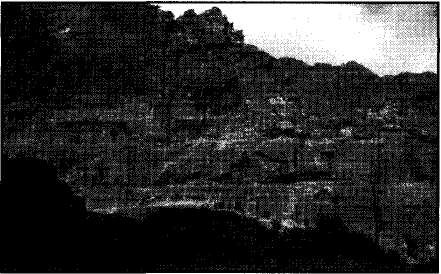
The wadi Jabbok cuts its tortuous way from the hills of Moab to the river Jordan. The scenery is wild, barren, arid, and centuries of erosion have cut a deep and harsh wadi which winds in and out of the valleys, wrestling its way to the Jordan below. Though its headwaters rise on the edge of Moab, only about eighteen miles (29kms) east of the Jordan, it so twists about, that its whole course measures some sixty miles (96.5kms).
VERSE 23
"He took them, and sent them over the brook, and sent over that he had"— He conducted them over, but returned himself to the northern bank. The word "brook" is nachal, signifying to inherit, to divide. It is translated the stream in the R.V. and describes a valley along which a brook runs, or a winter torrent.
Jacob's Contest With The Angel — Vv. 24-32.
Very early in the morning, a great while before day, Jacob conducts his wives and children over the brook Jabbok, but desiring to be in private, that he might commune with God and spread his cares and fears before Him, he remains behind. At that moment, when he is on his own, beset with fears and forebodings, and encompassed with darkness, he is accosted by a man who is identified with God. Jacob lays hold upon him, seeking help, but the man endeavours to break his hold. Together they wrestle until the breaking of the dawn. In desperation, as he realises that he is wrestling with an angel, Jacob refuses to desist until he receives a blessing. His request is granted; his name is changed to Israel. But he still suffers the result of the contest: a dislocated hip which causes him to limp. A thousand years later, Hosea made reference to this incident, and gave it a typical application to Israel after the flesh.
VERSE 24
"And Jacob was left alone" — Hedoubtless remained on the other side of Jabbok alone for the purpose of private meditation and prayer, to spread his cares and his forebodings of the coming day before God, and to again beseech His help. In citing this incident (Hos. 12:2-4), Hosea exhorts Judah to show similar initiative and determination. Jacob aimed by very force to extract a blessing from the angel, and Christ taught that only by force, determination and zeal will one gain the Kingdom of God (Matt. 11:13).
"And there wrestled a man with him" — The word for man is ish. In general, it implies a higher form of man than the usual word adam, which inevitably defines a descendant of Adam. But this was no descendant of Adam; he was a representative of the Elohim, and therefore is given the title of God (v. 30). Hosea calls him an angel: "He (Jacob) had power over the angel, and prevailed" (Hos. 12:4). Jacob wrestled with this "man." The verb "wrestled" is abak. As a root it means dust, and implies that in the great night of prayer and conflict, the two wrestled so hard that a cloud of dust arose around them as the struggle went on. By some, the word Jabbok is derived from the same root, and. therefore, signifies "to wrestle".
"Until the breaking of the day" — Or, literally, the appearing of the morning. Typically it points forward to the millennial dawn (MaL. 4:2), that "morning without clouds" to which David made reference (2 Sam. 23:4).
Every saint who attains the kingdom must wrestle at the brook Jabbok before he will receive the blessing; the nation of Israel is in the process of doing so. See how this incident foreshadows the future of Israel (whether according to the spirit or the flesh). The following principles emerge: (1) After wrestling a blessing is received; (2) The antagonism between the brothers is solved; (3) Jacob finds peace at Shechem (the Burden Bearer) which he reaches through Succoth.
VERSE 25
"And when he saw that he prevailed not against him" — If "the man" were "an angel" why could he not prevail against Jacob? Is flesh stronger than spirit? Remember, too, Jacob was an old man of ninety-seven years of age! Hosea describes how Jacob wrestled (Hos. 12:4). He did not merely grapple with the angel, refusing to release his hold, but "he wept and made supplication." Prayers and tears were part of his weapons. It was not only a physical, but a spiritual wrestling, by the vigorous action of faith and of strong desire. Jacob succeeded because he refused to give ground. The discouragement of the wrestling did not shake his faith nor silence his prayer. Hosea declares: "By his strength" he had power with God (Hos. 12:3). But the R.V. changes this to: "in his manhood," and the change is significant. His manhood suggests growth to maturity. In full maturity of mind and faith, in the face of personal danger, Jacob sought the divine blessing. Physically the angel was more than a match for a dozen Jacob's, and he could have destroyed the elderly patriarch instantly, but to do so would have defeated the covenant that Yahweh had entered into with Jacob. He had promised: "I am with thee, and will keep thee in all places whither thou goest, and will bring thee again into this land; for I will not leave thee, until I have done that which I have spoken to thee of" (Gen. 28:15). In full confidence of that promise, Jacob held on to the angel, and refused to relax his grip; and because of the promise and the covenant, the angel was powerless to harm him. So it is with all such wrestlings with God. In spite of personal weakness, in spite of many failings, if we still cling to God, we will struggle through to the ultimate blessing. The wrestling was difficult and tiring, much dust was cast up as the patriarch struggled to maintain his hold upon the angel, but the very contest assisted in developing his spiritual maturity. The experience of life well testifies to the saying: "There are those who wouldlike to think that the crisis of a spiritual life is reached at a very early stage of development, and that once passed there are no more grounds for apprehension or fear or care or caution. The story of the wrestling of Jacob teaches a very different lesson. First comes the vision of the ladder
- the dream of glory, the sense of divine protection and security. And then, long afterwards — after many years of service and prayer and worship and endeavour, when Jacob is getting on in years, at the end of much experience and patient trust
- there comes the struggle, all alone in the darkness, the struggle that wastes and draws the strength of Jacob, the struggle in which the nature and character of the man are finally declared, and proved and sealed
for ever."
So long as Jacob's mind was centred upon the covenant and the hope, the angel found it impossible to break his hold. So it is with the trials of life, many of which are God-induced. In all the striving and struggling and wrestling with God which they entail, let us never relax our hold upon Yahweh, let us keep ever in mind the covenant that binds us to God, and the hope of our calling that reveals that these experiences are but the means to an end. Then in the long run, all the weary wrestling will reveal its fruits of blessing.
Meanwhile, as far as Jacob was concerned, the wrestling with the angel dramatised and illustrated the lesson of his life. In all its tortuous circumstances, God was wrestling with Jacob, in order to change him to Israel. That, also, comprises the significance of our trials in life.
"He touched the hollow of his thigh; and the hollow of Jacob's thigh was out of joint, as he wrestled with him" — Literally the socket of his hip. The action of the angel demonstrated that physically Jacob was no match for him, and he could easily have broken his hold. However, bound by the terms of the covenant, this would be impossible so long as Jacob maintained his hold on the angel. Jacob maintained his hold, and continued wrestling, even though the dislocated joint made it much more painful, and he had to limp.
VERSE 26
"And he said, Let me go, for the day breaketh" — The time for wrestling was at an end; Jacob would have to rejoin his family on the other side of Jabbok. Weakened and in pain through his dislocated thigh he still clung hold of the angel, thus demonstrating his determination and his faith.
"And he said, I will not let thee go, except thou bless me" — Jacob looked beyond the pain and discomfort of the wrestling. He recognised its purpose and refused to relax his hold upon the angel until he had secured the blessing. We are reminded of Paul's words: "We glory in tribulations also: knowing that tribulation worketh..." (Rom. 5:3). Paul had attained unto a state of spiritual maturity that enabled him to see the purpose of God in the tribulations he endured: he recognised them as an essential means of character-building for the kingdom. Though his trials entailed much wrestling, much pain and discomfort, they were lessened by his understanding of the result so that he could say: "I glory in tribulations."
VERSE 27
"And he said unto him, What is thy name?" — The two aspects of the wrestling now combine to effect the blessing. The angel wrestled with Jacob to change his character; Jacob wrestled with the angel to secure the blessing. When the angel requested: "Let me go, for the day breaketh," he recognised that a great change had been effected in the character of Jacob, and that the patriarch could look forward to the coming day with confidence. But Jacob desired more than that: he wanted a blessing. As a basis for that, the angel asked the question now before us. The name of a person was indicative of his personality, character and purpose.
"And he said, Jacob" — Jacob signifies Supplanter. It was a fitting caption for Jacob to that point of time. He had contended with Esau in the womb, he had contended with him for the blessing, he had contended with Laban for his wives and his possessions. Later he was to contend with the inhabitants of the land of promise, and again with his own sons because of their jealousy of Joseph. Yet in all this wrestling he prevailed, though it was through much anxiety and pain such as would cause him to limp. Throughout his life, El Shaddai had been with him to protect him: the angel of Yahweh's presence was always there to help him; yet it was only through much trial, and hard wrestling, that he succeeded. Does it not illustrate the exhortation "It is through much tribulation that we shall enter the Kingdom of God?"
VERSE 28
"And he said, Thy name shall be called no more Jacob, but Israel" — Inspite of this angelic statement, the patriarch is still "called Jacob" (Ch. 33:1,10,17,18 etc.). Perhaps we should supply the ellipsis: "Thy name shall be called no more exclusively Jacob." The subsequent chapters reveal that the two names were interchanged. Evidently the name was now bestowed provisionally. Confirmation of it was given later at Bethel (Gen. 35:10), but the full manifestation of it awaits the resurrection, and the establishment of the Kingdom of God. After the declaration at Bethel, Jacob is more frequently described as Israel, indicating a further progression in his character.
The name "Jacob" is hereafter used of his times of suffering and affliction; whereas "Israel" is more usually associated with his great destiny.
"Israel" — This is the first occurrence of this important and significant name. The most common meaning given to it is that which appears in the margin: A prince of God. However, it is not the only meaning, and it is obvious that the angel saw more in it than such a simple title.
The name is actually Yisrael, and the marginal meaning is derived from sar "a prince," and el, "God" or "Power." Hence, A Prince with El.
Some, however, derive it from sarar, to prevail in striving and El, and thus see in it, A striver with God, and for God against man. It is significant that the angel gave it this meaning in his explanation of the name.
Others again, find it compounded of Ish (the aleph in this word being dropped), raah, "he saw," and El, "God," and hence The man who saw God. This, it appears, was Jacob's definition. See v. 30.
The angel's definition anticipates "the time of Jacob's trouble," from which the nation will emerge to serve Yahweh in truth (Jer. 30:4-24), and attain to its destined greatness as a royal nation under the authority of the coming Prince (Jer. 30:21).
Jacob's definition anticipates the future when the manifestation of El in the Lord Jesus Christ will be seen and recognised by the nation (Zech. 12:10), and through his saving grace, it will be redeemed (Rom. 11:26).
Gather the various meanings together, and the name Yisrael is seen to signify: The man (Ish) who is a victorious Striver with God, and a conqueror of man (enosh), will see God and reign as Prince with El.
"For as a prince hast thou power with God" — The phrase "as a prince hast thou power," is but one word in Hebrew, sarah, signifying to prevail with power as a prince. The R.V. alters to: "Thou hast striven with God..." Rother-ham's rendition is similar.
"And with men" — Here the word "men" is enoshim. It defines man as physically or morally weak or depraved, as exemplified in the profane man, Esau. For all his display of physical strength, he was but enosh, weak and mortal. The Psalmist uses this word in his statement: "Put them in fear, Ο Yahweh, that the nations may know themselves to be but men" (enoshim). This has been rendered: "Give them a teacher, Ο Yahweh, that they may know themselves to be but men" (Psa. 9:20). The Psalm is Messianic and points forward to what the future will reveal. In that day it will be clearly seen that Yisrael has prevailed over Enosh, the man of flesh.
"And hast prevailed" — The sense of the passage seems to signify: "He who strives with God and prevails will certainly prevail with men." Seeing that the angel, with all his power, could not prevail against Jacob, why should he fear Esau?
The R.V. margin gives it this emphasis by quoting from the Septuagint and Vulgate versions: "Thou hast had power with God, and thou shalt prevail against men." This is the heritage of Jacob.
Consider the state of the nation as a whole. It has wrestled with God in refuting His teaching and rejecting His Son; yet man has not prevailed against it, because of the covenant made with Abraham (Ezek. 36:21). If Jewry can successfully contest the issue with God without being destroyed as a nation, will flesh prevail over it? By no means.
VERSE 29
"And Jacob asked him, and said, Tell me. I pray Thee, Thy name" — The name of a person captions his character and purpose. Jacob desired to know more of both, as they relate to God, and therefore asked this question. Yahweh has pleasure in those who "speak to one another" and "think upon His Name" (Mai. 3:16), but He views with abhorrence those "who think to cause My people to forget My Name" (Jer. 23:27). The Name of God is the name of the family of God (Acts 15:14), the Name into which we are baptised.
"And he said, Wherefore is it that thou dost ask after My name?" — The time had not come for the proclamation of the Name, and therefore, at that stage, it was not disclosed. The circumstances for its revelation and meaning occurred in Egypt later on. If he had been at all in doubt, this answer of the angel would have shown Jacob that the "man" with whom he wrestled was an angelic manifestation of God.
"And he blessed him there" — This blessing would endorse the divine purpose in Jacob. He need not fear the future, for El Shaddai would be with him. The blessing gave Jacob new heart and outlook. He went forward with renewed conviction, with his mind stirred through the encounter with the angel and his encouraging words, and rejoicing in the new status that the name "Israel" gave him. All this would have the effect of driving fear of Esau from his thoughts.
VERSE 30
"And Jacob called the name of the place Peniel" — This word is given in the margin as The face of God. However, it is compounded of panah, to turn, and, by implication, to face. Literally Peniel signifies My turning to El, or face to face with El (God). The wrestling at Jabbok, and the subsequent revelation and new name, marked a turning point, a great change in the attitude of Jacob. He found it possible to turn and look into the face of God, represented by the angel.
"For I have seen God face to face, and my life is preserved" — In the Hebrew this is in the plural: "faces to faces", whilst God is Elohim. How can the plural apply when there was only one angel wrestling with one man? Because both angel and man were representative. The angel represented the Elohim as a whole; those angels Jacob had seen in the vision of Bethel ascending and descending the stairway linking heaven and earth. In them Jacob saw the multitudinous "faces of El" or power, whilst in Jacob the angel saw the nation that would develop from him. In the future, national Israel will see the multitudinous Christ as faces of power, whilst the redeemed (the'One man" of Dan. 10) will look upon a plurality of faces in the restored nation of Israel over which it shall rule. In Eureka (Logos Edition) vol. 1, p. 94, appears this comment:
"And Jacob called the name of the place (where he wrestled) Peni-ail, 'Faces of Power,' 'for,' said he, Ί have seen Elohim faces to faces, and my life is preserved...' 'Here was the most high Ail in multitudinous manifestation..."
Normally, to look upon the face of an angel was fraught with danger (Exod. 24:11; 33:20; Jud. 6:22,13:22), but Jacob had done so unharmed. "My life is preserved," he exclaimed. The word signifies saved, and is used in Isaiah 49:6 in conjunction with the work of redemption for Israel, to be effected by Christ in the age to come. Hence, the narrative before us, is to be interpreted typically as well as historically. Jacob was enacting what will take place in the future. The faces of the Elohim again will be openly manifested in the earth at the time of judgment. Chief among the Elohim will be the Lord Jesus, and joyful will those people be who will be able to look at him face to face and find their lives preserved. John wrote: "We know that, when he shall appear, we shall be like him; for we shall see him as he is" (1 John 3:2).
VERSE 31
"And as he passed over Penuel" —There is a slight difference in the spelling of the word here: a vav replaces the yod in Peniel. It introduces a change in the meaning of the word: a contrast yet; thus: face to face yet God (did not consume). It seems that Jacob called the place Peniel, but his descendants used Penuel (cp. Jud. 8:8,9, 17).
"The sun rose upon him" — Indicative of a new beginning, a new relationship, a new confidence; and typically pointing to the new day yet to dawn (Mal. 4:2).
"And he halted upon his thigh" — The struggle had left its mark on Jacob, yet he emerged from it redeemed and transformed. So it has ever been with those who have successfully gone through such wrestling with God. Jacob "halted" or limped. Under normal circumstances a limping man would be no match for a marching warrior like Esau, but Jacob put no confidence in himself, but in God. He had come to realise that God's strength is made perfect in weakness; and he would renew that lesson time and again.
To halt or limp figuratively is to be conscious of personal weakness and of sin. Israel after the flesh is in that state, and is so described in the Word. "In that day, saith Yahweh, will I assemble her that hal-teth, and I will gather her that is driven out, and her that I have afflicted; and I will make her that halted a remnant, and her that was cast off a strong nation; and Yahweh shall reign over them in mount Zion from henceforth, even for ever" (Mic. 4:6-7). "Behold, at that time I will undo all that afflict thee; and I will save her that halteth, and gather her that was driven out, and I will get them praise and fame in every land where they have been put to shame" (Zeph. 3:19). The experiences of Jacob at the brook Jabbok typify those that natural Israel will yet experience.
VERSE 32
"Therefore the children of Israel eat not of the sinew which shrank, which is upon the hollow of the thigh" — The R.V. renders this: "the sinew of the hip." The Jewish version: "The sinew of the thigh-vein." This relates to the sciatic nerve. With other arteries and tendons, this sinew must be removed from slaughtered animals, before that portion can be ritually prepared for Jewish consumption.
"Unto this day" — Unto the day of Moses, the historian. It still remains the case with Jews in the preparation of Kosher meat.
"Because he touched the hollow of Jacob's thigh in the sinew that shrank" — The Jews claim that "this precept is a constant reminder of the Divine Providence to Israel as exemplified in the experience of the Patriarch."
Comments