___________________
418. CHAPTER FORTY-THREE
This chapter continues to record the incidents that led to Joseph's brethren being humbled before him. It describes the second visit of Joseph's brethren to Egypt in their necessity. They return in fear, and are treated by the strange lord of the country in a manner that arouses their wonderment. But, for the moment, all goes well, and in the assurance that it will continue that way, they relax with Joseph.
Judah Offers To Be Security For Benjamin—Vv. 1-14
It is significant that Judah who was foremost in betrayal (Ch. 37:26) now becomes foremost in restitution. It foreshadows the attitude of the nation of Judah at both advents of the Lord. The tribe was foremost in crucifying him and will be foremost in the reestablishing of the nation (Lech. 12:7). Meanwhile, Judah himself only persuades Jacob to allow Benjamin to go down to Egypt with extreme difficulty, and only through extreme need.
VERSE 1
"And the famine was sore in the land" — See Amos 8:11-13. The famine continued because the divine purpose required it, in order to bring a blessing on Jacob (See Ruth 1:6). But Jacob was ignorant of that; and perhaps praying for relief, wondered why it did not come. God knows what is best in granting or withholding the requests of prayer.
VERSE 2
"And it came to pass, when they had eaten up the corn which they had brought out of Egypt, their father said unto them, Go again, buy us a little food" — Jacob's emphasis upon a little food suggests that the greatest economy was being exercised in regard to that which they obtained which was in short supply. Jacob was desperately hoping for the famine to break, so as to avoid sending Benjamin to Egypt.
VERSE 3
"And Judah spake unto him, saying" — Judah assumes the leadership among the sons.
"The man did solemnly protest unto us" — The language of Joseph in Egypt was similar to that of the Lord towards Jewry. Consider his oft-repeated saying: "Verily, verily, I say unto you..."
"Ye shall not see my face, except your brother be with you" — As we have observed previously, Benjamin was also a type of Christ. Now consider Judah's statement in the light of that of the Lord: "Behold, your house is left unto you desolate. For I say unto you, Ye shall not see me henceforth, till ye shall say, Blessed is he that cometh in the name of the Lord" (Matt. 23:38-39).
VERSE 4
"If thou wilt send our brother with us, we will go down and buy thee food" — Literally this is: If thou art sending our brother with us; that is, if you are agreeable to sending our brother.
VERSE 5
"But if thou wilt not send him, we will not go down" — It would be useless to do so: the governor was quite specific in his requirements.
"For the man said unto us, Ye shall not see my face, except your brother be with you" — The Egyptian governor (as Judah viewed Joseph) had left no doubt as to what was required. The binding of Simeon before the eyes of the others had demonstrated his determination to carry out his threat.
VERSE 6
"And Israel said" — The change of name is possibly to emphasise the importance of these events in the furtherance of the plan of redemption (cp. Vv. 8,11). Cp. note Gen. 37:3.
"Wherefore dealt ye so ill with me, as to tell the man whether ye had yet a brother" — Jacob's petulant rebuke was an attempt to conceal an issue he was afraid to face. This is frequently the case with us all: we refuse to face up to issues in faith and courage; we prefer to act as though they do not exist.
VERSE 7
"And they said" — The other brothers joined in to support Judah in his statement to Jacob.
"The man asked us straitly of our state, and of our kindred, saying, Is your father yet alive? have ye another brother? and we told him according to the tenor of these words: could we certainly know that he would say, Bring your brother down?" — They had not tried to conceal anything, but had answered Joseph's questions truthfully, not knowing that he had knowledge of their circumstances. This was a step in the way of their finding ultimate blessing. Assuming they had tried to hide the facts, Joseph would have known, and would have treated them more harshly. How often, in life, we attempt to hide things, even from God, which it would be better if we frankly confessed. So it was with the brethren of Joseph. Evidently Joseph has asked these specific questions, though not recorded in the preceding narrative (cp. Gen. 42:13, 32), for Judah mentions them again afterwards (Gen. 44:19).
VERSE 8
"And Judah said unto Israel his father" — Once again Judah took the lead, as the nation will in the last days (Mic. 4:8). Adversity had worked on him to his betterment, as it will the Jews in the land at the return of the Lord.
"Send the lad with me and we will arise and go" — The Hebrew na'ar, here rendered "lad" signifies an "adolescent," and also, by implication, a dependant, such as a servant. Benjamin was over twenty years of age at the time, already married, and with a large family of ten children when he came into Egypt with Jacob (Gen. 46:21). Jacob was ninety-seven when he left Laban, and one hundred and thirty when he came into Egypt (Gen. 45:6). This allows for a thirty-three year interval, during which he dwelt for a time at Shechem, and then moved south towards Bethlehem where Benjamin was born. Benjamin thus married when he was extremely young, and proved to be most prolific. Perhaps Jacob urged an early marriage in view of the assumed tragic death of Joseph. Such terms as "child" (Gen. 42:22) and "lad" are used in Scripture of responsible young people, and the context must determine their actual age.
"That we may live, and not die" — It was a matter of life and death to make reconciliation with Joseph; as it will be with Jewry in regard to his antitype (Jer. 30:7).
"Both we, and thou, and also our little ones" — The future of the whole tribe was at stake.
VERSE 9
"I will be surety for him" — The word arab rendered "surety," signifies to traffic as by barter. Judah was about to make a proposition. The verb thus conveys the idea of changing places.
"Of my hand shalt thou require him" — Judah was prepared to barter his life on the outcome. He would guarantee Benjamin's return, even though he was imprisoned as a consequence. Why did he so openly take the lead on this occasion? Perhaps he recalled his infamous influence in disposing of Joseph, and desired to make restitution. That certainly will be the case with the nation of Judah in the last days (Zech. 12:5-7). The people will look upon him whom their forefathers crucified, and shall mourn their past blindness (Zech. 12: 10-14).
"If I bring him not unto thee, and set him before thee, then let me bear the blame for ever" — In this very solemn statement, Judah bartered his eternal salvation on the issue. The word "blame" is chata, "sinner", and "for ever" is kolhay-omim, "all the days." Judah therefore stated that his failure to restore Benjamin would constitute unforgiven sin, to be recalled day after day for the term of his life. His words can be literally rendered: and I shall be accounted a sinner all my days. This is a far more realistic, mature, and solemn asseveration than Reuben's foolish offer of substitution: the putting to death of his two sons. It would mean that if, on this second occasion, he failed his father (for unknown to Jacob he had been foremost in the betrayal of Joseph previously) he, as an unforgiven sinner, would be without hope, with the blame of it resting upon him throughout his life.
How significant this statement is when compared with the antitype. Judah, as a nation, took the lead in putting the Lord to death; but, in the mercy of the Father, and in view of the Abrahamic covenant, the nation will be given opportunity to rehabilitate itself at the second coming of the Lord. If it fails again, it will be branded a sinner without hope, bearing the guilt forever.
Who does Benjamin represent in the typical foreshadowing of this incident? It is obvious that Benjamin (as the Son of the right hand — Ps. 110:1) represents Christ in some way. But in what way? Obviously as the multitudinous Christ (Heb. 2:11). As Joseph refused to receive the brethren before he had honoured his closer brother, so Christ will honour first the saints before extending help to Israel after the flesh.
VERSE 10
"For except we had lingered, surely now we had returned this second time" — As rendered by the margin, this is literally returned twice by this: we could have been to Egypt and back again twice by now. Judah urged upon his father that it was foolish to linger in a matter of life or death. How true; yet we also tend to do so, when a firm decisive action would bring us closer to Christ.
VERSE 11
"And their father Israel said unto them, If it must be so now, do this; take of the best fruits in the land in your vessels" — The "best fruits of the land" were designed to please the governor and make him well-disposed towards the sons of Israel in their request for relief and sustenance. What are the "best fruits of the land" that will dispose Christ towards us, or towards Israel? Obviously the fruit of the Spirit as outlined in Gal. 5:22. Both saints and Israel after the flesh must have "gifts to offer unto the king," and foremost among these is a humble, contrite heart (Isa. 66:2). The sufferings of the last days will induce this in Israel.
"And carry down the man a present" — That Jacob should send such a gift appears inconsistent with the record of the famine. But the failure of cereal crops does not necessarily mean a failure of fruit, or of the things listed here which might well have been preserved from previous seasons, but which did not constitute a staple diet. Notice, also, that Jacob specifies a little balm, a little honey etc.
"A little balm" — See Gen. 37:25. It was noted for its healing qualities.
"And a little honey" — Honey is used figuratively of the strengthening and soothing qualities of the Word (Ps. 19:9-10; 119:103).
"Spices" — See note Gen. 37:25. Spices symbolised prayer (Exod. 30:34).
"And Myrrh"—This is not the usual word for myrrh (see note Gen. 37:23). The Hebrew word is lot, and according to Dr. Strong, is derived from a root signifying to wrap up, and so to cover.
"Nuts" — Hebrew: botenim identified as pistachio nuts. The word is from a root signifying the body, the womb, and thus associated with birth.
"And Almonds" — The Hebrew shaqedim is from a root signifying to be awake, alert. The almond tree is a symbol of resurrection, being the first tree to blossom in the spring. Known as the Awakening Tree it is used as a symbol of divine selection and approval (Num. 17: 8-13).
The "best fruits of the land" of promise, therefore, symbolised in order: healing, soothing and strengthening, communion (prayer), covering, resurrection and approval — the process of divine manifestation leading from a position of need (through sin) to final glorification and acceptance.
VERSE 12
"And take double money in your hand" — The word mishneh signifies repetition, and the phrase can be rendered money of a second, suggesting the same amount as was returned. The brethren evidently took twice as much money, returning that which they found in their sacks. The A.V. would suggest that they took three times as much: double money in their hands, as well as the money found in the sacks.
"And the money that was brought again in the mouth of your sacks, carry it again in your hand; peradventure it was an oversight" — Thus they returned to Joseph with a double payment of money, as was appropriate to the type. Israel after the flesh will likewise pay double for its sins (Isa. 40:2). Under the Law of Moses, the appointed firstborn received a "double portion" of the inheritance (Deut. 21:15-17), and in the light of that legislation, the "double money" in the hands of Joseph's brethren became an acknowledgement of Israel's status among the nations seeking food (see Jer. 31:9).
VERSE 13
"Take also your brother, and arise, go again unto the man" — So Jacob capitulated to the will of God; commending his sons to Yahweh's care.
VERSE 14
"And God Almighty give you mercy before the man, that he may send away your other brother, and Benjamin" — Jacob sought the mercy of El Shaddai. This title is discussed in our comments upon Gen. 17:1. It can signify either The Strength of the Destroyers, or The Strength of the Nourishers. Jacob relied upon the providential care of El Shaddai. Trouble had driven him to the state of utter dependence upon Him. That is the value of trial and difficulty. Yahweh is always present, and deeply interested in our welfare (see Rom. 8:31-32), but He knows what is best for us, and in order to develop our characters according to His will, permits us to be tried, though never beyond our measure (1 Cor. 10:13). As we read of Jacob's concern, the drama of the situation is lessened because we know the outcome of that journey to Egypt. But Jacob and his sons did not. To the patriarch, the future looked gloomy indeed. To him, one son was dead — he had no reason to believe otherwise; another son was imprisoned by a despotic tyrant — he had no reason to believe otherwise; a third, beloved son was entering an arena of danger — he had no reason to believe otherwise.
But we see the mercy and goodness of Yahweh in the situation; and that which was like a hideous nightmare to Jacob, was actually a necessary prelude to his final triumph. That being so, let us learn to view our own troubles in faith. It is difficult to do so always. But we must follow the example of Jacob, who when forced to concede to the demands of the Egyptian governor (as he considered Joseph), and the urgent pleas of his own sons, did so with a prayer on his lips for divine help. Isaiah exhorted: "Who is among you that feareth Yahweh, that obeyeth the voice of His servant, that walketh in darkness, and hath no light? Let him trust in the name of Yahweh, and stay upon his God" (Isa. 50:10). That was the attitude of Jacob at this time of crisis.
"If I am bereaved of my children, I am bereaved" — An expression indicating that having placed his problem in the hands of El Shaddai, it was beyond his control, and he would acquiesce with the divine will in the matter.
The Brethren's Fear Of Joseph In Egypt — Vv. 15-25
Making their way to Egypt, the brethren again encounter unexpected and inexplicable experiences. First of all, the imperious "governor" orders them to present themselves at his house; next, they are told by his steward that he received payment for their corn on their previous visit; finally, they fearfully await their interview with Joseph.
VERSE 15
"And the men took that present, and they took double money in their hand, and Benjamin; and rose up, and went down to Egypt" — What were the feelings of Jacob as he watched his sons, with Benjamin, disappear into the distance, not knowing what would befall them there? He might well have experienced similar feelings to those of Paul (Acts 21:13), but was forced along the road of circumstance.
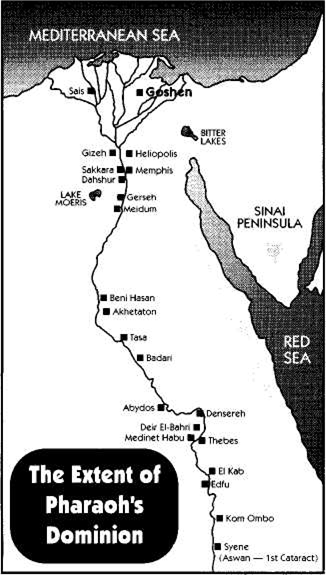
The sons probably followed the well known route along the low coastal region, which led by way of Gaza and Gerar, to Pelusium and Tanis, traversing country parallel with the Mediterranean. This included some 120 miles (193kms) of waterless desert, during which they would be scorched by the blazing sun in the day, and chilled by the keen desert air at night, to finally enter a mourning land devastated by years of famine. It was not a pleasant journey.
"And stood before Joseph" — In Egypt, they made their way to the corn market over which Joseph presided.
VERSE 16
"And when Joseph saw Benjamin with them" — The presence of Benjamin moved Joseph emotionally, whilst, at the same time, demonstrated that the others had carried out his conditions of re-entry into the land. If he had fears concerning the welfare of his brother, they were unfounded.
"He said to the ruler of his house" — This official is later described as his "steward" (Gen. 43:19; 44:1).
"Bring these men home, and slay, and make ready" — In spite of the worship of all manner of animals in Egypt, flesh was eaten daily by priests, kings and people of the upper strata of society, though priests had to abstain from certain kinds of animal food (see Herod 2:37,77). Joseph called upon his steward to slay an animal on the behalf of his brethren, so that they might eat with him within the house. A similar provision is made on the behalf of all those who enter Christ's "house" (cp. 1 Tim. 3:15) for the same purpose.
"For these men shall dine with me at noon" — This unusual treatment was received by the brethren with the greatest
fear as they pondered its reason (v. 18). "Noon" in Hebrew is tsoharim, a plural word signifying double lights, and signifying midday, the time of greatest light, when the day is divided into two.
VERSE 17
"And the man did as Joseph bade; and the man brought the men into Joseph's house" — If this was at On (cp. Gen. 41:45), they would have been taken to a city adjacent to modern Cairo. In any case, they saw the elegance in which Joseph lived, and perhaps caught a glimpse of Asenath, Joseph's wife.
VERSE 18
"And the men were afraid, because they were brought into Joseph's house" — This would be the natural reaction of shepherds unused to the elegant sophistication of city life, when taken to the palace of a high official in a foreign land. They were mystified at the arrangements, and fearful that they were about to be charged with thieving.
"And they said, Because of the money that was returned in our sacks at the first time are we brought in; that he may seek occasion against us" — The literal rendition of the latter phrase is roll himself upon us. This was another way of saying that he intended to crush them (see Job 30:14).
"And fall upon us, and take us for bondmen" — They were apprehensive of a charge being levelled against them to deprive them of their liberty.
"And our asses" — If they were deprived of their means of transport, they would find it extremely difficult to escape from the land.
VERSE 19
"And they came near to the steward of Joseph's house" — Their mounting problems and fears drew them to him, as life's problems draw us to Christ's stewards (see 1 Cor. 4:1).
"And they communed with him at the door of the house" — The brethren communed with the steward, setting before him their problem, as a precautioncagainst a charge of theft being laid against them. There is need for similar communion before conducting anybody into Christ's house that they might understand what is required "in the house" of such a high and influential representative of Heaven (cp. Acts 10:6; Heb. 3:6).
VERSE 20
"And said, Ο sir" — Literally, Ο my lord. They treated him with the greatest respect.
"We came indeed down at the first time to buy food" — Though bewildered by his demands they were certain of the reality of their need; though they only knew how to satisfy it temporarily by buying. They had no idea that Joseph was anxious and waiting to satisfy it permanently without payment on their part.
VERSE 21
"And it came to pass, when we came to the inn, that we opened our sacks, and, behold, every man's money was in the mouth of his sack, our money in full weight: and we have brought it again in our hand" — See the circumstances in Ch. 42:27. They could not understand that their money was not adequate compensation for food in a time of famine, any more than Judaism can appreciate that salvation is by grace. Their money was returned to them to impress that fact upon them. They had to learn that the means of salvation is by grace not by works. Like the Jews of another age, "being ignorant of God's righteousness, and going about to establish their own righteousness, they did not submit to the righteousness of God" (Rom. 10:3). The money had been returned to their sacks to reveal that the governor required something apart from their money: even a self-sacrificing love and affection. But his true identity was hidden from them, so that all they could offer was more money, as they tried to buy their way by personal works into his good grace. But what is the real value of even a double portion of money in time of acute famine!
In like manner, how can works give adequate compensation for salvation? Salvation is dependent upon the grace of God. That fact will be brought home to Jewry ultimately, and their salvation will be dependent upon their acceptance of it (Zech. 13:1). Meanwhile, the lesson was being typically impressed upon the brethren of Joseph.
VERSE 22
"And other money have we brought down in our hands to buy food" — Typically they acted as though they could buy salvation on the basis of personal merit.
"We cannot tell who put our money in our sacks" — They did not comprehend that the grace and love of Joseph had arranged this; and that these were adequate for all their needs. They had to learn the lesson of 1 Pet. 1:18, "Ye are not redeemed with corruptible things, as silver and gold..." That basic fact will ultimately be brought home to Jewry.
VERSE 23
"And he said, Peace be to you, fear not: your God, and the God of your father hath given you treasure in your sacks" — This remarkable statement by the steward of Joseph's house suggests that he had been taught to fear and trust the God of the Hebrews, and implies that Joseph had expounded the Truth to him, which he now, in turn, passed on to the brethren. The Apostles as "stewards" of Christ (1 Cor. 4:1), did likewise (John 17:20). In the Age to come, Elijah, as the "steward" of Christ will bring this same message home to the tribes of Israel (Mai. 4:5-6). The statement is not a subterfuge but one of fact. It was God who influenced Joseph to act as he did, and, therefore, God who had given "hidden treasure" in their sacks.
"I had your money" — The literal Hebrew is your money came to me. Again, that would have been a statement of fact, for most likely Joseph had paid it, as the Lord has paid the cost of redemption in his blood. However, such a remarkable statement by the steward of Joseph's house, would have completely bewildered the brethren — as the revelation of Christ, in the Age to come, at first will mystify the Jewish people. See the wonderment of thecJews predicted in Isaiah 49:21-22.
"And he brought Simeon out unto them" — The grace of God brings freedom out of bondage.
VERSE 24
"And the man brought the men into Joseph's house, and gave them water, and they washed their feet; and he gave their asses provender" — In the natural sense, every care and attention of hospitality was lavished upon them. They were made warmly welcome, and their needs were met. They were given water to wash their feet, representative of a partial cleansing (John 13:10; Zech. 13:1). Their complete education, cleansing and acceptance had yet to wait.
VERSE 25
"And they made ready the present against Joseph came at noon" — What Joseph wanted was themselves and their love, not their gift as such, unless it was an outward expression of their inward feelings.
"For they heard that they should eat bread there" — To eat bread together is an act of friendship and communion. But for the moment they were not quite ready for the full act of fellowship.
Joseph Entertains His Brethren — Vv. 26-34
At last Joseph arrives home, and his brothers pay their respects to him delivering to him their present, and answering his questions regarding Jacob. He meets Benjamin and treats him with the greatest kindness and consideration. In fact, he is so overcome by emotion, that he withdraws from them lest his secret be discovered before the time he had determined (cp. Song 5:6). The meal follows in typical Egyptian fashion, with each group segregated the one from the other. However, the brethren are forced to marvel at the prescience of the governor, for he sets them in order exactly according to their ages. Also notable is his preference for Benjamin. Nevertheless in the general atmosphere of wellbeing and hospitality, they relax for the first time.
VERSE 26
"And when Joseph came home, they brought him the present which was in their hand into the house" — "The present which was in their hand" speaks of personal effort and labour. Yahweh desires that of us, not as adequate payment for salvation, but as a token of our loving obedience to His will. The brethren did not have that feeling towards Joseph as yet, so that the "present" was more in the nature of a bribe. It suggests justification through works. The Hebrew word minehah is frequently used to denote a bloodless sacrificial offering. The same word is rendered offering in Genesis 4:3, and there descriptive of that which Cain presented to Yahweh. The antitype suggests Jewry's rejection of the blood of Christ, and their insistence upon the bloodless works of Judaism, as a means of justification.
"And bowed themselves to him to the earth" — Once again Joseph had evidence of the fulfilment of his dreams (Gen. 37:7,9-10). The brethren paid their respects in ignorance of the true identity of the one before them, as will the Jews to Christ at his appearing (Zech. 13:6).
VERSE 27
"And he asked them of their welfare, and said" — The word "welfare" is shalom, peace; but true peace can only come through acknowledgement of the Prince of Peace (Isa. 9:6; John 14:27).
"Is your father well, the old man of whom ye spake? Is he yet alive?" — Again, the word "well" is shalom, peace. Thus, literally, Is there peace to your father? This is one of the most moving moments in this drama of family affection. The very eagerness of Joseph's questions suggests the emotion he must have felt as he thought of his aged parent. It illustrates the close bonds of affection that united true family life in patriarchal days. The eager questions draw out our sympathy, and cause us to feel for Joseph in his separation. Let us remember that the incident is recorded by inspiration of Yahweh Who created the family, and seeks to gather His Redeemed into the most loving and intimately holy family in existence. Paul wrote (according to an alternative rendition): "I bow my knees unto the Father from whom all fatherhood in heaven and on earth derives its name" (Έρη. 3:14, Twentieth Century Translation). Emotions of love, affection, consideration, family relationships are not despised of God. Indeed, Edom was condemned and punished because it "remembered not the brotherly covenant" (Amos 1:9). The Law attached a promise to the fifth command (the command of grace): "honour thy father and thy mother that thy days may be long upon the land" (Deu. 20:12). Joseph's concern for his father is in sharp contrast to the disrespect of age and responsibility towards parents which characterises this age. As Paul warned, this is an epoch of juvenile delinquency, shown in widespread "disobedience to parents" (2 Tim. 3:2). We must avoid such an influence by following the example of faithful Joseph.
VERSE 28
"And they answered, Thy servant our father is in good health, he is yet alive"— In describing Jacob as Joseph's servant, the brethren fulfilled that portion of the dream that involved their father (Gen. 37:9), for the term describes him as subservient to the elevated Joseph (cp. Ps. 110:1; Matt. 22:44). Thus Joseph received tangible evidence of the manner in which all that God had revealed unto him would be fulfilled.
One item remained to be fulfilled. His mother, the "moon" of the dream, was dead. How could she bow down before him? Only through the resurrection (Job 19:25; Psa. 16:9). Therefore, to a discerning man of faith like Joseph, the present was but a typical fulfilment of the dream, with the reality awaiting the future.
"And they bowed down their heads, and made obeisance" — In doing so, they confirmed their use of the title thy servant by which they had described Jacob, and once again fulfilled the prophetic dreams.
VERSE 29
"And he lifted up his eyes, and saw his brother Benjamin, his mother's son, and said" — Again the narrative emphasises the "natural affection" which was characteristic of Joseph, as it was of Christ, and the absence of which is listed by Paul as a latter-day evil (2 Tim. 3:3). In the antitype, Christ has a closer "brother" for whom he has a greater affection than Israel after the flesh: namely, "the Israel of God," styled by Paul as the son of Jerusalem above, "the mother of us all" (Gal. 4:26). Benjamin represents the Ecclesia.
"Is this your younger brother, of whom ye spake unto me?" — Benjamin must have been surprised at the great gentleness and kindness of the governor of whom he would have heard so much from his brothers, and for whom they had a great fear. In the type, the "younger brother" points to the Redeemed, brought into being after the Israel of the flesh.
"And he said" — Without waiting for an answer.
"God be gracious unto thee, my son" — This is an unexpected prayer from one so high in the land. It confessed that favour stemmed from God, and not from Egypt. This blessing on Benjamin must have greatly encouraged the brethren as illustrating the ruler's mercy and favour towards them. Joseph singled out this prayer for Benjamin, and thus acted as advocate on his behalf, commending him to the grace of God. In like manner, the antitype, the Lord Jesus Christ acts as Advocate on the behalf of his brethren (1 John 2:1).
VERSE 30
"And Joseph made haste; for his bowels did yearn upon his brother" — This statement is expressive of the intensity of Joseph's feelings for his brother; he could scarce restrain himself, so great was his love. And what of Christ's love for his "closer brother?" Does not he have an ardent desire to reveal himself to such? We read that "Yahweh waits" that He may be gracious unto Israel (Isa. 30:18), and we may be sure that the Lord, likewise, awaits that time of reunion with those he loves so much that he died on their behalf. As Bridegroom he has an ardent longing to take his Bride to himself, as the love songs of the Song of Solomon testify.
"And he sought where to weep; and he entered into his chamber, and wept there" — Overcome with emotion, Joseph withdrew himself for a moment, and wept tears of joy. They witnessed to the intensity of his feelings for his brother (See note Gen. 42:24). Yet they were unseen by Benjamin who, though conscious of the graciousness of the governor towards him as expressed in the blessing pronounced upon him, yet remained in ignorance of the intensity of his feelings and the tears shed on his behalf. Does not that reflect the attitude of Christ's "closer brother" whilst he remains in heaven? Read of the lovingkindness of Yahweh towards Israel, as expressed in Isaiah 63:7-10. "In all their affliction He was afflicted, and the angel of His presence saved them: in His love and in His pity He redeemed them; and he bare them, and carried them all the days of old." The Lord wept over Jerusalem, and expressed his desire to have extended his covering-wings over the city and people. "How often would I have gathered thy children together... and ye would not" (Matt. 23:37). Again to his disciples: "With desire I have desired to eat this passover with you..." (Luke 22:15). As we ponder the drama in the palace of Joseph, and consider the weeping Joseph hidden in the chamber, let us see in it a drama of Christ's great love and desire for his brethren, and try to respond with a measure of warmth and love towards him.
Paul declared that there is laid up a crown of righteousness for them that "love his appearing" (2 Tim. 4:8). Are we anxiously desiring his coming? Do we look upon it as we would the coming of a beloved friend or relation? Are not we touched with emotion as we consider Joseph weeping tears of joy in the inner chamber? Let us also remember that those whom the Lord loves "he rebukes and chastens" (Heb. 12:6). There was chastening awaiting Benjamin before the complete revelation would come, and he would come to appreciate the significance of the prayer of grace that had been pronounced on his behalf by the governor of the land.
VERSE 31
"And he washed his face, and went out, and refrained himself" — So Joseph's emotion was hidden from the sight of his brothers, as Christ's feelings on behalf of his own are presently hidden from them. One who died on our behalf is not indifferent to our trials and sufferings. That is the lesson revealed by this incident.
"And said, Set on bread" — He provided for their needs, as his antitype does today.
VERSE 32
"And they set on for him by himself, and for them by themselves, and for the Egyptians, which did eat with him, by themselves" — There was a careful segregation of each group: Joseph on his own as befitted his status; Egyptians, as Gentiles; Hebrews as a privileged company. Historically, the caste system was prominent in ancient Egypt, so that the separation of the three groups would have appeared quite normal. Remarkably, the same distinction is preserved in human affairs: Gentiles segregated from Israel after the flesh and spirit, with the Lord Jesus presiding over all and dispensing gifts of grace to the latter.
"Because the Egyptians might not eat bread with the Hebrews; for that is an abomination unto the Egyptians" — According to Herodotus (Book 2:41), Egyptian exclusiveness towards foreigners generally was a feature of their way of life. They considered themselves as the master race. They particularly hated the Hyksos, the so-called "shepherd kings" who invaded Egypt and seized power; and when, in turn, they were expelled, they destroyed all their monuments. It is significant, that the anti-semitism manifested in Egypt in the days of Joseph, is still in evidence throughout the Gentile world.
VERSE 33
"And they sat before him" — Whereas the Romans reclined at meals, the Egyptians sat. The statement is in accord with archaeological evidence.
"The firstborn according to his birthright, and the youngest according to his youth" — The purpose of this arrangement was to demonstrate that Joseph knew all about them; even as "all things are open unto the eyes of Him with whom we have to do."
"And the men marvelled one at another" — They were mystified at the amazing knowledge of Joseph, and probably looked upon it as the result of some supernatural power that he possessed. It certainly gave point to the steward's comment as recorded in Gen. 44:5. Later, however, when Joseph declared himself, the incident helped to demonstrate the truth of his claim.
VERSE 34
"And he took and sent messes unto them from before him" — He gave them preferential treatment, as Israel both natural and spiritual, have received at the hands of Christ (cp. 1 Pet. 3:22) during Gentile times. This, indeed, has been done in the sight of the Gentiles, is witnessed in the establishment of the Jewish nation. The word "messes" is masouth in Hebrew, from nasa, to lift, or take, and hence signifies portions or gifts.
"But Benjamin's mess was five times so much as any of their's" — Five is the number of grace, and, therefore, represented a visible token of Joseph's prayer.
In the narrative of Joseph, the number of five frequently occurs (Gen. 41:34; 45:22; 47:2,24). It speaks of grace or redemption. Grace was shown towards Egypt in famine because it had sheltered Joseph; and a special grace was manifested towards Benjamin in the food and clothing granted him because of his closer relationship to Joseph. It foreshadows the greater gifts of grace extended to the Ecclesia of Christ.
"And they drank and were merry with him" — This is a Hebraism expressing that they were relaxed and at ease (1 Kings 4:20). As the brethren observed the kindness of Joseph, and the care manifested towards each one of them and Benjamin in particular, their previous fears were assuaged, and they became relaxed and at ease. This, however, was soon to give way to a final test and fear before the revelation would be given them.
What of the antitype? Is it not evident in Israel both natural and spiritual? The final test on the nation of Israel will find it relaxed and at peace (Ezek. 38:11; 39:25-26), but this will give way to a terrible fear (Jer. 30:6-8) before ultimate relief will come. And ecclesially, Christ comes at a time of Laodicean relaxation, before the Judgment. All this seems foreshadowed in the experience of Joseph with his brethren.
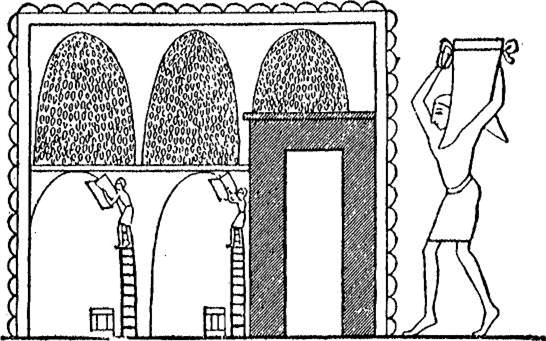
Portrayal of Harvesting and Storage of grain in Egypt.
Note the labourers filling the silos.
Comments