___________________
421. CHAPTER FORTY-SIX MIGRATION INTO EGYPT
Having declared his intention of moving down into Egypt to make acquaintance with Joseph again, Jacob makes it a matter of prayer, and is encouraged by God to carry on with his mission. A register of the family is then made, and as a community, it makes its way down to Egypt and to Joseph. The various members of the tribe are warmly greeted by Joseph, who instructs them in what they should say to Pharaoh. The joy of this meeting between the patriarch and his son anticipates that glorious meeting day that is coming after the trials and mistakes of the present have been corrected.
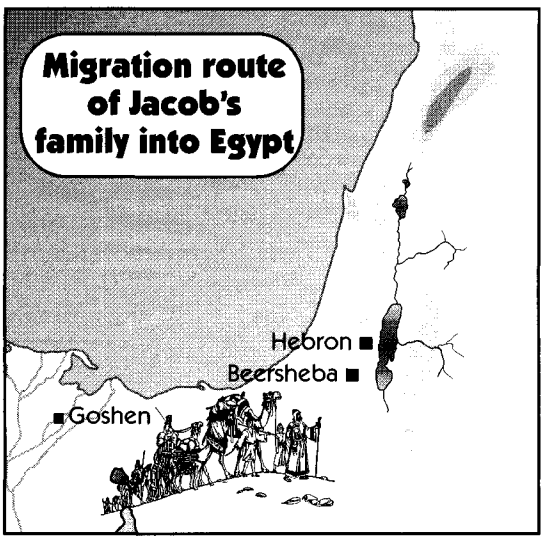
The Migration to Egypt — Vv. 1-7
In spite of the news that Joseph was in Egypt, it was not easy for Jacob to leave Canaan, for it was the Promised Land, and his whole life was based on the covenant made to him in relation to it. He therefore seeks divine guidance and is given permission to take the journey to Egypt to meet with his son.
VERSE 1
"And Israel took his journey with all that he had, and came to Beersheba" — Beer-sheba is about twenty-five miles from Mamre or Hebron (Gen. 35:27). It was a place of great significance to the patriarchs, as its name indicates, for Beersheba signifies The Well of the Oath, and points to the covenant with Abraham which God confirmed with an oath.
"And offered sacrifices unto the God of his father Isaac" — It was at Beersheba that Jacob had received the blessing and promise (Gen. 28:10), and at this significant site he now turns to God to receive guidance as to his future movements. His worship probably comprised a mixture of thanksgiving and petition. He could thank God for the wonderful tidings concerning Joseph, seek guidance for his future movements, and beseech His blessing upon his offspring, in view of the prophecy of oppression in Egypt delivered unto Abraham (Gen. 15:13).
VERSE 2
"And God spake unto Israel in the visions of the night" — The phrase, visions of the night, suggests more than an allusion to night time, and seems to imply a relationship to Gentile times. Daniel, certainly, used the term in that way (cp. Dan. 7:7,13 with John 9:4), and it is appropriate for the sojourning of the children of Israel in Egypt, through which they reached nationhood.
"And said, Jacob, Jacob" — God speaks to the old Jacob, reminding him of what he had been, and so implying that His love and care had been with him in his weakness.
"And he said, Here am I" — The response of Jacob suggests compliance with what God required, as though he said: "Take me." It suggests that Jacob was ready to obey God in whatsoever He bade him to do.
VERSE 3
"And He said, I am God, the God of thy father" — Two different words for "God" are used in this statement. The first is El and signifies Might, Power; the second is Elohim, and signifies Mighty Ones. The latter word is translated angels in Psalm 8:5, and represents the medium through which the Divine power is manifested to men. When the two words are used in conjunction, they signify The strength of the mighty ones, elsewhere described as El Shaddai, rendered "God Almighty" (Gen. 17:1). Jacob and his descendants could rely upon that Strength during their sojourn in Egypt, and therefore need not fear what man might do unto them.
"Fear not to go down into Egypt" — Jacob had received divine guidance throughout his life. He had done so when he left Beersheba for Padan-aram (Gen. 28:15); and again when he was directed to leave Padan-aram for home (Gen. 31:13). God overshadows the lives of all His servants, and will provide them with guidance during crises that may come upon them. Let such be pliable to His moulding influence, and constantly seek His help. From the exhortation to "Fear not," we can conclude that fears were disturbing the mind of Jacob. Probably he recalled how disastrous had been the experience of Abraham (Gen. 12:10-20) when he had entered Egypt, and now feared for the future of his family.
"For I will there make of thee a great nation" — This statement explained to Jacob why his children would be permitted to enter Egypt, whereas others had been prohibited from so doing. The experiences there would develop them into nationhood. Their waywardness had revealed that they were not ready for that as yet. Their characters needed purifying for the Kingdom. Jacob may have feared that his sons' treachery towards Joseph, and the evidence of waywardness that they had subsequently manifested (cp. Gen. 35:22; Gen. 38) would hinder the development of the nation that God had promised. He was told to fear not, for it would be established. See the antitype in Isa 43:1-2.
VERSE 4
"I will go down with thee into Egypt" — With this assurance, Jacob could enter Egypt with full confidence. Similar words are used in relation to the nation in later times: "When thou passest through the waters, I will be with thee" (Isa. 43:2). Yahweh is with Israel even today (cp. Zech. 1:15-16; Ezek. 38:16). Notice the fourfold promise of vv. 3-4.
- Jacob would develop into a great
nation, in Egypt. - God would protect him and his
descendants. - His descendants would return as a
nation. - Joseph would perform the last rites
for his father.
"And I will also surely bring thee up again" — Jacob, himself, was brought up again in his coffin (Gen. 50:4-13), but in this verse, as is often the case elsewhere in Scripture, he is referred to nationally, and identified with his descendants. God here repeats in different terms what he previously told Abraham (Gen. 15:13-16). It was with this assurance, also, that Joseph comforted his associates before his death (Gen. 50:24). Meanwhile, the trials the children of Israel would experience in Egypt would help bring them to nationhood.
In Elpis Israel, Bro. Thomas writes: "In this promise Jacob was re-assured of a resurrection to life. The action of putting the hand upon the eyes represents death; for this was one of the last offices of the nearest relations. Hence, to tell Jacob he should die, and yet that he should be brought up again, was telling him in effect that he should rise from the dead again to possess the land" (p. 278).
"And Joseph shall put his hand upon thine eyes" — God thus gave assurance to the old man that he would again see his beloved son, and that finally he would die in peace with Joseph ministering to him to the very end, finally closing his eyes in death.
VERSE 5
"And Jacob rose up from Beer-sheba" — Reassured by the voice of God, he arose spiritually refreshed and with greater confidence.
"And the sons of Israel carried Jacob their father, and their little ones, and their wives, in the wagons which Pharaoh had sent to carry him" — Pharaoh had instructed Jacob's sons not to regard their possessions because all the good of Egypt was before them, but they desired to maintain their independence as a separate people in the midst of Egypt.
VERSE 6
"And they took their cattle, and their goods, which they had gotten in the land of Canaan, and came into Egypt, Jacob, and all his seed with him" — Jacob was then 130 years of age (Ch. 47:9), so that 215 years had elapsed since Abram entered the land. See Expositor: Exodus on Exod. 12:40.
VERSE 7
"His sons, and his sons' sons with him, his daughters, and his sons' daughters, and all his seed brought he with him into Egypt"—This need not imply that Jacob had more daughters than Dinah, but may include his sons' wives who are not otherwise mentioned in this enumeration.
Jacob's Descendants — Vv. 8-27
The migration into Egypt comprised "the souls" of Jacob (he thus being included) summarised as follows:
Leah — v. 75 (33 souls). With Er and Onan there are 34 mentioned, but excluding them, and including Jacob, there are thirty-three.
Zilpah — v. 18, sixteen in all.
Rachel — v. 22, fourteen in all, but excluding Joseph, Ephraim and Manasseh who were already in Egypt, there were eleven.
Bilhah — v. 25, comprised seven.
These figures (33+16+11 + 7) total sixty-seven; but add Joseph, Ephraim and Manasseh, they make seventy in all.
VERSE 8
"And these are the names of the children of Israel which came into Egypt, Jacob and his sons" — Thus Jacob is included in the enumeration.
"Reuben" — Sig. See a Son.
"Jacob's firstborn" — He was firstborn to Jacob according to the flesh, but was supplanted by Joseph (1 Chron. 5:1).
VERSE 9
"And the sons of Reuben; Hanoch" — Sig. Initiated or Dedicated. Significantly, this also was the name of Cain's firstborn (Gen. 4:17).
"And Phallu" — Sig. Distinguished.
"And Hezron" — Sig. Enclosed.
"And Carmi" — Sig. Vine-dresser.
The names of Reuben's sons set forth the ideal of the firstborn. To be Dedicated, Distinguished, Separated in order to labour in the Vineyard.
VERSE 10
"And the sons of Simeon" — Simeon signifies Hearing.
"Jemuel"—Sig. Day of El.
"And Jamin"—Sig. Right Hand.
"And Ohad"—Sig. Joined together.
"And Jachin"—Sig. Whom God establishes.
"Zohar" — Sig. Whiteness.
"Shaul" — Sig. Asked for.
The names of Simeon's sons express the result of a thorough hearing of the Word. There is set before such the Day of God when, with He of the right hand, they will be joined together, established of God, in the whiteness, which they have asked for.
"The son of a Canaanitish woman" — Simeon's marriage to such must have been a "grief of mind" to Jacob (Gen. 26:35). Nevertheless, by hearing the Word, evil can be redeemed.
VERSE 11
"And the sons of Levi" — Levi signifies Joining; i.e. Fellowship.
"Gershon" — Sig. Expulsion.
"Kohath" — Sig. Assembly.
"And Merari" — Sig. Bitter, Sad.
Fellowship with God requires the expulsion of the things of the flesh, and joining with the Assembly or Ecclesia. This invariably brings its bitter trials.
VERSE 12
"And the sons of Judah" — Judah signifies Praise.
"Er" — Sig. Watchful.
"And Onan" — Sig. Strong.
"And Shelah" — Sig. Request, or Petition.
"And Pharez" — Sig. A Breach.
"And Zarah" — Sig. Sunrise Λ Chron. 2:6 reveals that Zarah had five sons, but evidently they were born after the descent into Egypt.
"But Er and Onan died in the land of Canaan" — The effect of sin thus dimmed the praise and joy of Judah. See notes Chapter 38.
"And the sons of Pharez were Hezron and Hamul" — These names sig. Enclosed and One who has experienced mercy or spared.
The names of Judah's sons are also significant. The first two speak of watchfulness and strength, but this was in regard to the things of the flesh, so that in their death there was no praise but regret and sorrow. The names of the sons who follow, speak of Petition or Prayer, the breaking forth or breaching of praise, and the promise of the sunrise (Mai. 4:1-2) for the separated and spared.
VERSE 13
"And the sons of Issachar" — Issachar signifies Reward.
"Tola" — Sig. Worm or Scarlet.
"And Phuvah" — Sig. Mouth.
"And Job" — This name is given as Jashub in the Septuagint as it is in Num. 26:24. Jashub signifies Turning oneself.
"And Shimron" — Sig. Watch.
The names of Issachar's sons spell out how to obtain the reward: by seeking the cover provided through the scarlet of Christ's blood; by witnessing to his truth; turning in true repentance; and watching for the coming of the Lord.
VERSE 14
"And the sons of Zebulun" — Zebu-lun signifies Dwelling.
"Sered"—Sig. Fear.
"And Elon" — Sig. Oak, from a word indicating Strength.
"And Jahleel" — Sig. Wait for God.
The names of Zebulun's sons also proclaim vital truth. For, fear of Yahweh is the beginning of knowledge, and, therefore, of true strength. It leads to one waiting for God, and for the dwelling that He will provide.
VERSE 15
"These be the sons of Leah, which she bare unto Jacob in Padan-aram, with his daughter Dinah" — Dinah sig. Judgment.
"All the souls of his sons and his daughters were thirty and three" — With Dinah, there are thirty-four mentioned; but if Er and Onan are excluded, and Jacob is added, the total becomes thirty-three. From v. 8 it is obvious that Jacob should be included.
VERSE 16
"And the sons of Gad" — Gad signifies Company.
"Ziphion" — Sig. Expectation.
"And Haggi" — Sig. Festive.
"Shuni" — Sig. Quiet.
"And Ezbon" — This name is given in the margin as Ozni. It signifies Toiling.
"Eri" — Sig. Guarding.
"And Arodi" — Sig. Wild Ass.
"And Areli" — Sig. Lion of God.
The names of Gad's sons set forth the characteristics of those who will make up the company of the redeemed. They are found in a state of expectancy; feasting in quiet with their Lord (Rev. 3:20); toiling and guarding the Truth, in the assurance of a transformation from the status of a wild ass (the symbol of Israel after the flesh) to that of a Lion of God.
VERSE 17
"And the sons of Asher" — Asher signifies Blessed.
"Jimnah" — Sig. Prosperity.
"And Ishuah" — Sig. Even, Level, or Peaceful.
"And Isui" — Sig. Even, Level, Peaceful, the same as Ishuah. Perhaps these two sons of Asher were twins.
"And Beriah"— Sig. Gift.
"And Serah their sister" — Sig. Abundance.
"And the sons of Beriah" — Asher was a grandfather when he went down into Egypt.
"Heber" — Sig. Fellowship.
"And Malchiel" — Sig. King of God (El).
The names of Asher's children illustrate the condition of blessedness or happiness which his name signifies. Prosperity, true peace (indicated by the twins, or peace doubled), the gift of abundance, expressed in true fellowship, and leading to royalty with God, are expressive of the blessedness and happiness of the future age, suggested by the name of Asher.
VERSE 18
"These are the sons of Zilpah" —
See Gen. 30:10-13.
"Whom Laban gave to Leah his daughter" — See Gen. 29:24.
"And these she bare unto Jacob, even sixteen souls" — Sixteen children are mentioned in these verses.
VERSE 19
"The sons of Rachel Jacob's wife; Joseph and Benjamin" — Jointly sig. He shall increase the son of his right hand. This comprises the basic fact of Yahweh's
purpose in the earth (Isa 53:10-12).
VERSE 20
"And unto Joseph in the land of Egypt were born Manasseh and Ephraim" — These names signify Forgetting and Double Fruit. They suggest the means whereby the son of Yahweh's right hand shall increase; it is by those of the two great families of humanity: Jew and Gentile, "forgetting their father's house" (Ps. 45), and producing fruit to the glory of the Lord.
"Which Asenath the daughter of Potipherah priest of On bare unto him"— See Gen. 41:50 for details.
VERSE 21
"And the sons of Benjamin" — Benjamin signifies Son of the Right Hand, a title of Christ (Ps. 110).
"Were Belah" — Sig. Devouring.
"And Becher" — Sig. Young Camel.
"And Ashbel" — Sig. Opinion of God, or Flowing.
"Gera" — Sig. Grain.
"And Naaman" — Sig. Pleasantness.
"Ehi" — Sig. My brother. In Num. 26:28 his name is given as Ahiram.
"And Rosh" — Sig. Head.
"Muppim" — Sig. Adorned ones. In Num. 26:39, his name is given as Shup-pim. The initial letters of both names are similar in Hebrew. Shuppim signifies serpents.
"And Huppim" — Sig. Coverings. The name is given as Hupham in Num. 26:39.
"And Ard" — Sig. Fugitive.
Again, these names provide the foundation of a significant paraphrase relating to Christ, the Son of the right hand. Those associated with the Lord are expected to devour the unclean (camel), and through divine teaching, provide grain and pleasantness to the elder brother, as the chief of the adorned ones.
From a literal viewpoint, it will be noted that "little" Benjamin had more children than any other of the brethren. Moreover, in Numbers 26:40, Ard and Naaman are given as the sons of Bela, and the grandsons of Benjamin. In the same list, Becher, Gera and Rosh are omitted. Perhaps they died without issue For other references to Benjamin's descendants, see notes at Numbers 26 (Expositor: Numbers). Thus Benjamin was a young grandfather when he was taken down into Egypt to meet his brother Joseph.
VERSE 22
"These are the sons of Rachel, which were born to Jacob: all the souls were fourteen" — The fourteen include Joseph, Manasseh and Ephraim who were already in Egypt.
VERSE 23
"And the sons of Dan" — Dan signifies Judgment.
"Hushim" — Sig. Those who make haste. In the face of Judgment there is need to make haste for a proper covering.
VERSE 24
"And the sons of Naphtali" —
Naphtali signifies wrestling.
"Jahzeel" — Sig. Allotted by God.
"And Guni" — Sig. Painted with colours.
"And Jezer" — Sig. Image, form.
"And Shillem" — Sig. Retribution.
The names suggest the result of successful wrestling with sin. God allots an inheritance, incorruptible and undefiled, one glorified with the colours of the rainbow (Gen. 9:13), reserved for those who conform to the image and form of Christ, to be received in the day of retribution.
VERSE 25
"These are the sons of Bilhah, which Laban gave unto Rachel his daughter, and she bare these unto Jacob: all the souls were seven" — See Gen. 29:29.
VERSE 26
"All the souls that came with Jacob into Egypt, which came out of his loins, besides Jacob's sons' wives, all the souls were threescore and six" — The descendants of Jacob recorded in Vv. 8-25 total seventy in all. However, they include Er and Onan, Ephraim and Manasseh which being excluded make a total of sixty-six.
This is the number that went from Canaan to Egypt.
VERSE 27
"And the sons of Joseph which were born him in Egypt, were two souls: all the souls of the house of Jacob, which came into Egypt, were threescore and ten" — This computation includes Jacob (as one of the souls of his house), Joseph, Ephraim and Manasseh. See note preceding v. 8 above. However, in Acts 7:14, Stephen states that seventy-five came from Canaan into Egypt. This can be computed in various ways. As a Hellenistic Jew, Stephen could have used the Septuagint which, at Gen 46:20 adds: "There were sons born to Manasses, whom the Syrian concubine bore to him, even Machir. And Machir begat Galaad. And the sons of Ephraim the brother of Manasses, Suta-laam and Taam. And the sons of Sutalaam, Edom." This addition in the Septuagint is probably taken from Num. 26:28-31; 1 Chron. 7:14-20, and the additional names make seventy-five in all, answering to the number cited by Stephen. On the other hand, Stephen may have obtained his number by taking account of the wives of Jacob's sons. Judah's wife, Shuah, was dead (Gen. 38:12). Rachel and Leah were dead (Gen 35:20; 49:31), Joseph was already in Egypt, making 65 who went into Egypt "besides Jacob's sons' wives" (v. 26). This allows for ten wives, excluding those of Judah and Joseph. Whatever computation is accepted, the fact is that Stephen did not make a mistake, and the various totals of sixty-six (Gen 46:26), seventy (v.27), and seventy-five (Acts 7:14) can all be accounted for. As Israel's family numbered seventy persons when he went into Egypt, so there is a seventy-fold division of Gentile "families" (or nations) listed in Genesis 10. Concerning this enumeration, Moses later recorded: "He (God) set the bounds of the people according to the number of the children of Israel" (Deut. 32:8). Thus there is a compensating balance of seventy in the two great families of the human race: the Gentiles and Israel. Seventy is a combination of seven (the covenant number) multiplied by ten (the number of completeness). The redeemed are those drawn out of these two great families (Rev. 5:9-10). See the Introduction to Genesis 10.
Jacob Meets Joseph — Vv. 28-34.
Nearing Egypt, Jacob sends Judah as the new leader of the brethren ahead of the others in order to work out the details of the settlement in the new land, so that all will be in readiness on their arrival. But Joseph, as a high official, has access to Egypt's swiftest means of transportation, and excited at the prospect of welcoming his beloved father, goes forth to meet him. A dramatic, emotional and affectionate reunion takes place. Conducting the family into Egypt, Joseph next turns his attention to obtaining formal approval of Goshen as a place of settlement for his family. Because of the delicate conditions then existing between Egyptians and shepherds he carefully instructs his brethren as to the correct procedures to be adopted under the circumstances.
VERSE 28
"And he sent Judah before him unto Joseph" — Reverses and trials had brought out the good qualities of Judah, so that Jacob came to rely upon him more and more (Ch. 43:3). Antitypically, Christ will reveal himself first to the Jews in the land, thus described as Judah (Zech. 12:7).
"To direct his face unto Goshen" — Judah went ahead in order to ascertain what procedures should be adopted in order to enter the land as sojourners.
"And they came into the land of Goshen" — See note Gen. 45:10.
VERSE 29
"And Joseph made ready his chariot, and went up to meet Israel his father, to Goshen" — As a high official, Joseph had access to the state chariot, and therefore made his way to his father by that means. It represented the authority he wielded in the land.
"And presented himself unto him"— Rotherham renders this as "appeared" unto him, and in a footnote or umanifested himself— an interesting word". This is an interesting word, because the niphal form of the verb is commonly used of the manifestation of God and angels. The antitype points to the manifestation of the Lord in the future age.
"And he fell on his neck, and wept on his neck a good while" — A very dramatic and emotional reunion took place between the aged patriarch and his beloved son. For the emotion of Joseph, see note on Gen. 42:24. See also Luke 15:20.
VERSE 30
"And Israel said unto Joseph, Now let me die, since I have seen thy face, because thou art yet alive" — By these expressions, Jacob meant that he could die happy having thus attained more than his dearest wish, and mortal life could hold nothing better for him. All he could look for to exceed his present joy was a resurrection to life eternal. Actually, Jacob lived a further seventeen years before his death.
VERSE 31
"And Joseph said unto his brethren, and unto his father's house, I will go up, and shew Pharaoh, and say unto him, My brethren, and my father's house, which were in the land of Canaan, are come unto me" — Joseph proposes to act as mediator between the supreme authority and his people, as the Lord will between Yahweh and Israel after the flesh in the Age to come (see Zech. 13:1 ).
VERSE 32
"And the men are shepherds, for their trade hath been to feed cattle; and they have brought their flocks, and their herds, and all that they have" — In a spiritual sense, this really describes the pastoral work of Yahweh's shepherds, to which all Israelites have been called (1 Pet. 5:4).
VERSE 33
"And it shall come to pass, when Pharaoh shall call you, and shall say, What is your occupation?" — Such a question was bound to be asked, for Egyptian life was regulated by such considerations. Herodotus claims that under the monarch Amasis a law was established "that every Egyptian should declare to the governor of his district by what means he maintained himself; and if he failed to do this, or did not show that he lived by honest means, he should be punished by death" (Book 2.177). Enquiry will be made into spiritual occupation in the Age to come (Zech. 13:5), and that of shepherding will be accounted honourable (v. 7).
VERSE 34
"That ye shall say, Thy servants' trade hath been about cattle from our youth even until now, both we, and also our fathers" — This answer would set the children of Israel aside as a special people in Egypt, intent upon caring for the flocks, and not unduly interested in city life or the administration of the nation. For the antitype see comments on the previous verse.
"That ye may dwell in the land of Goshen" — See note Gen. 45:10. Joseph probably desired his brethren to dwell in Goshen for three reasons: (1) It was admirably suited to the grazing of flocks and herds; (2) It would keep them as a separated, isolated community from the rest of Egypt; (3) It was on the outskirts of Egypt, closest to the land of promise, so that their eyes would be always centred on the hope of their calling.
"For every shepherd is an abomination unto the Egyptians" — These are obviously not the words of Joseph, but the explanatory words of Moses. In his day, a change had occurred in the attitude of the Egyptian monarchy towards the people of Israel (Exod. 1:8). This is in accordance with the historical records of Egypt. Prior to 1700 B.C., the Hyksos (shepherd: sos, King: hyk) or rulers of foreign lands established themselves in Egypt, and evidently, in the time of Joseph, were in authority over the nation, so that to a true Egyptian "every shepherd was an abomination." This particularly would have been so when the Hyksos were overthrown, as subsequently, was the case. The Hyksos were a Semitic race, a rural people who invaded Egypt. The centre of their power was in the eastern Delta, their capital being established in the Plain of Tanis, called the field ofloan (Ps. 78:12). They were ejected about 1550 B.C., according to Unger (see Bible Dictionary). They were the first to introduce the swift war chariot to Egypt (Gen. 41:43; 46:29; Exod. 14:6).
Comments