___________________
424. CHAPTER FORTY-NINE JACOB'S BLESSINGS ON HIS SONS
As old age claims Jacob, and he realises that he is about to die, he gathers his sons together that through divine inspiration, he might reveal their destinies unto them. His words provide guidelines for future generations, visions of hope and glory upon which the thoughtful among his descendants could build their faith. There is frequently revealed in the several blessings, a primary and ultimate application of prophecy. In regard to the latter, it involves the ulast days of JudaKs Commonwealth" at the first advent of the Lord, as well as the ulast days" of the Gentiles, when the Lord will return to bring to fulfilment the rest of the prophetic vision. Except for the first verse, this portion of Scripture is poetic inform, comprising the oldest piece of Hebrew poetry in existence. In a series of oracles, it describes the characters and future of the twelve tribes of Israel. It is rich in parallelism of thought, word-play, and metaphor.
Jacob's Blessing Of The Last Days — Vv. 1-28
Jacob's sons gather around the deathbed of the patriarch to hear his final message of warning and hope. One by one, commencing from the eldest, and moving down to the youngest, they are brought into review by him. Apart from v. 1, this section of Genesis is in poetic form. In our verse by verse notes, from v. 2, we cite Genesis according to the lines of poetry.
VERSE 1
"And Jacob called unto his sons, and said, Gather yourselves together" — The naming of Jacob's sons had a special significance as the record clearly shows (Gen. 29, 30). Wherever they are listed as in this chapter (and various varieties of listings are provided throughout Scripture), they can be paraphrased into a sentence expressing divine truth. In this chapter they are given in the order of descent, thus: Reuben: See a son; Simeon: Hearing; Levi: Joining; Judah: Praise; Zebulun: Dwelling; Issachar: Reward; Dan: Judgment; Gad: Troop or Company; Asher: Blessed or Happy; Naphtali: Wrestling; Joseph: Adding; Benjamin: Son of My Right Hand. The sentence thus formed is: See a Son! Hear, join, praise and dwell with him. He will bestow a reward at the judgment upon a company of blessed or happy ones who, after wrestling, will add further to the Son of Thy right hand.
"That I may tell you that which shall befall you in the last days" — The phrase has been rendered both the last days and the latter days throughout Scripture, and has been applied to both advents of Christ. The first advent of the Lord is described as "a time of the end," or "the last days" because it came at the end of Judah's Commonwealth and saw the termination of the Mosaic age (see Heb. 1:2; 1Cor. 10:11; Heb. 9:26).
VERSE 2
"Gather yourselves together, and hear, ye sons of Jacob" — This is the first line in the poetic construction of Jacob's speech.
"And hearken unto Israel your father" — The repetition underlines the importance of the impending revelation.
VERSE 3
"Reuben, thou art my firstborn, my might, and the beginning of my strength" — These clauses emphasise the status of Reuben as firstborn of the flesh. In type, he represented natural Israel being superceded by spiritual Israel, as exhibited in the pre-eminence given to Joseph over Reuben, the natural firstborn (see 1 Chron. 5:1; Ps: 89:24; Col. 1:15). The birthright conferred a double portion of the inheritance upon the holder of it (Deut. 21:15-17). This was forfeited by Reuben in favour of Joseph who was represented by two tribes in Israel: Ephraim and Manasseh.
"The excellency of dignity, and the excellency of power" — In addition to a double portion of inheritance, the firstborn acted as priest within the family and therefore was consecrated to God (Num. 3:45; 8:16; Luke 2:23). This is described by Jacob as the excellency of dignity. Reuben was deposed from his position as firstborn, and subsequently the priestly pre-eminence was conferred on Levi. The "excellency of power" expressed the right of the firstborn to rule (see 2 Chron. 21:3). This was taken from Reuben and given to Judah. This verse, therefore, refers to the threefold blessing conferred upon the legal firstborn: Birthright, Priesthood, Ruler-ship. They were taken from Reuben and given to Joseph, Levi and Judah.
VERSE 4
"Unstable as water, thou shalt not excel" — The Hebrew pachaz, here rendered "unstable," signifies to froth, and figuratively to lust. It comes from a root signifying to bubble over, or froth, as boiling water, and therefore can be rendered: boiling over like water (see A New Old Testament). It suggests the boiling over of unrestrained lust driven on by flesh-weakness. Strong gives the meaning as ebullition, suggesting the impetuosity of water when driven swiftly along. Under such circumstances water will break every barrier of restraint. "Thou shalt not excel" is rendered by some as "thou shalt not have the pre-eminence," or "Thou shalt not have the excellency" (R.V.). The reference is to the status of the firstborn, which was withdrawn from Reuben because of his misconduct. The subsequent history of the tribe of Reuben justified the judgment of Jacob. It did not have the pre-eminence. The tribe was numerically inferior at the beginning of the wilderness wandering (cp. Num. 1:21); and at the conclusion of it, the camp of Reuben, comprising the tribes of Reuben, Simeon and Gad, had actually decreased by 45,020 (cp. Num. 2:16 with Num. 26:7). Reuben was among the first of the tribes to be taken into captivity by the Assyrians (1 Chron. 5:26).
"Because thou wentest up to thy father's bed" — See Gen. 35:22; 1 Chron. 5:1.
"Then defiledst thou it; he went up to my couch" — Reuben had desecrated what ought to have been regarded as sacred and untouchable (Deut. 27:20). The change from the second to the third person in the grammatical construction of the final clause, expressed Jacob's indignation, even after so long a time. He appealed to all present to consider the justness of his decision and action in deposing Reuben from his position of pre-eminence. Typically, Reuben the firstborn according to the flesh, represents natural Israel. It has been deposed from its previous lofty position, in favour of the "Israel of God" (Gal. 6:16). All who consider the reason for this can agree that the decision is just.
But in what way was the deposition of Reuben related to "the last days?" Only in its typical application. It was at the first advent of the Lord, during "the last days of Judah's commonwealth," that Israel after the flesh lost its previous honored position of privilege, in favour of the Israel of God drawn from both Jew and Gentile (see Rom. 11:11 -22).
VERSE 5
"Simeon and Levi are brethren"— These two brothers were closely associated from birth (Gen. 29:33-34), and became brethren in crime (Gen. 34:25-29). Jacob now reveals that the crime then committed, foreshadowed an even greater one in the future.
"Instruments of cruelty are in their habitations" — The word "habitations" is from the Hebrew mekerah, from a root signifying to dig, or pierce through, and therefore to stab (see Gesenius). Accordingly, the R.V. renders: "Weapons of violence are their swords." Once again Jacob is harking back to the past as a base for his predictions of the future. He recalls the violent ruthlessness of their attack on Shechem (Gen. 34:26), and sees that as a foreshadowing of the future.
VERSE 6
"O my soul, come not thou into their secret" — In this burst of indignation, Jacob expressed his horror and repudiation of their action. The word "secret" is sode, a session, suggesting a company in secret and close deliberation. The R.V. has "council". Evidently the two brothers formed themselves into a council of two, and plotted the attack on Shechem, drawing others in with them. For the antitype see Matt. 27:1; Luke 22:3; John 11:53.
"Unto their assembly, mine honour, be not thou united" — The Hebrew is qahal, and, like the word "ecclesia", signifies those called out by special invitation. Simeon and Levi did not bring the whole family together to discuss the problem facing it in the matter of Shechem and Dinah, but only called together those whom they knew would support their action of violence and treachery. For the antitype see Ps. 22:16; Matt. 26:14.
"For in their anger they slew a man" — The word is ish, denoting a man of higher status than adam; it is a word that is used for a prince, in this case, the prince of Shechem, the Burden-bearer! The history of the past becomes typical of the future murder of the Lord Jesus.
"And in their selfwill they digged down a wall" — The R.V. alters this to houghed an ox; the Concordant Version has felled a chief (i.e. a bull). In Hebrew, the only difference between wall and ox are the vowel points. "Wall" is shuwr, and "ox" is showr. They are from a common root, shuwr signifying to travel about. The Hebrew word for "ox" signifies traveller — and a wall "travels" about a city. See AV. margin. "Ox" or "bull" is appropriate to the antitype, for it anticipates the treacherous murder of the Lord Jesus by the priests of his day. He died a sacrificial death as "the bullock for the sin offering" (Heb. 13:11-13), so that the expression here is appropriate to the divine purpose.
In this remarkable statement, therefore, Jacob anticipated that the prince to be slain would die a sacrificial death. His horror at the treachery by which this would be brought about, is matched by that of Peter when he expounded the circumstances on the Day of Pentecost (Acts 2:22-24). In Elpis Israel, Brother Thomas comments: "The verification of these things will easily be recognised in the history of the tribe of Levi at the era of the crucifixion. It was the priests who sought and at last accomplished the death of Jesus, to whom Jacob refers; and to mark his sense of their conduct, he said, Ί will divide them in Jacob, and scatter them in Israel.' This was fulfilled in giving Levi no cantonal inheritance in the land, and in including Simeon's portion within the limits of the canton of Judah (Josh. 19:1,9). From this arrangement Levi, Simeon, and Judah became the tribes principally concerned in the transactions of the last days" (p. 280).
VERSE 7
"Cursed be their anger, for it was fierce" — In consequence upon the fierce anger of Jewry in putting the Lord to death, the curse of God has rested upon the nation, and will continue to do so until provision is made for its cleansing on a national basis as predicted in Zech. 13:1. The Jews demanded the death of the Lord, proclaiming: "His blood be upon us and upon our children." Until the children of those who murdered the Lord completely repudiate such action, and turn to him as their Saviour they will continue to experience the curse proclaimed by Jacob in the beginning.
"And their wrath, for it was cruel" — Three words in Jacob's statement deserve additional attention: "anger," "wrath," and "cruel." The first is from the Hebrew aph, signifying the nose. In the present context it denotes the emotion of "anger" such as may cause rapid breathing through deep feeling. "Wrath" is from ebrahim, the plural form of the word, denoting outbursts or outpourings of passion suggesting the fulness and intensity of the tide of fury manifested by Levi and Simeon, which foreshadowed the unreasoning and ungovernable madness excited in the priests and leaders of Jewry at the crucifixion of the Lord. "Cruel" is qashah, and signifies to be dense or obstinate, tough or severe.
"I will divide them in Jacob" — Simeon was settled within Judah's territory (Josh. 19:1,9), providing the type for the future. Simeon's part in the tragedy of Shechem was fulfilled by the leaders of Jewry, the Pharisees etc., in the days of the Lord. Levi was represented by the priests.
"And scatter them in Israel" — Levi was given no inheritance, but was scattered up and down throughout the land (Josh. 21).
VERSE 8
"Judah, thou art he whom thy brethren shall praise" — There is a play on words here, for Judah means praise. But when have the brethren of Judah praised him? Only for a very brief period in the past, under David and Solomon, when it is recorded that "Judah prevailed above his brethren" (1 Chron. 5:2). That brief moment was the period of the united Kingdom, which foreshadowed Messiah's reign (Amos 9:11). So this prophecy sweeps on to the "last days" of Gentile
ascendancy: the time when Messiah shall appear to "restore the kingdom to Israel" (Acts 1:6), and as "the Lion of the tribe of Judah" (Rev. 5:5), to receive the praise of all the tribes (Ps. 65:1 ).
"Thy hand shall be in the neck of thine enemies" — The expression denotes the subjugation of the enemies of the Lord. It is found again in David's Messianic Psalm (Ps. 18:40). The "brethren" shall praise Messiah, for he shall appear before them as their Deliverer (Rom. 11:26).
"Thy father's children shall bow down before thee" — As Judah types Christ who shall be praised, this statement reveals that Jewry shall submit to him. See Rom. 11:25-26.
VERSE 9
"Judah is a lion's whelp" — In this verse, the Lion of Judah is variously described as a whelp, as a full grown lion, and as a lioness. These expressions combine youth, experience and productivity. The young lion is pictured as (1) developing into full strength and ferocity, (2) roaming the land in search of prey, (3) repairing to its lair to consume it and to protect its offspring. The representation of "he whom his brethren shall praise" (the Lion of Judah, Rev. 5:5) as a lioness is significant, for it suggests the reproduction of seed. It is written of the Lord that he "travailed" to bring forth seed (Isa. 53:10-11), so that the feminine gender is appropriate to the Lord as the multitudinous Christ.
It is significant that elsewhere the King of Israel, the City of Jerusalem, and the Altar of the House of Prayer of the future age, are all given the title of Lion (Rev. 5:5; Isa. 29:1; Ezek. 43:16 mg.), for "Ariel" in the latter references signifies Lion of God. Christ, as the Lion of Judah, will be king, ruling from Jerusalem; priest, presiding over the millennial temple (Isa. 56:7); and altar to receive the offerings. He represents the ruling authority (Rev. 5:5), the antitypical New Jerusalem (Rev. 21:23), and the altar (Heb. 13:10). See also references to the Lion of Judah in Joel 3:16; Num. 23:24; 24:9; Deut. 33:20-21.
"From the prey, my son, thou art gone up" — An expression denoting that the prey has been caught and consumed and that the king of beasts has returned in peace. It indicates that the one referred to will not always be tearing down and consuming, but rather, once his objective has been satisfied, he will return in peace from the prey. That one is represented as being so strong and courageous that when he seizes his prey none can resist him; when he goes up from it, none dare pursue him to avenge it. It is significant that Jacob refers to one in particular, styled "my son" who would accomplish the prophecy. It was never done so by Judah personally, so obviously the patriarch must have looked beyond his immediate son to the promised Messiah.
"He stooped down, he couched as a lion" — In these terms the lion is represented as couchant, at peace. This suggests that Messiah will not make war for the sake of war, but to establish peace. "In righteousness, he doth judge and make war" (Rev. 19:11). The prophecy thus describes the Lion of Judah as stalking the prey, consuming the prey, and returning in peace. This is a remarkable allusion to the work of Messiah in subduing the nations in order to establish peace (Isa. 9:6-7).
"And as an old lion; who shall rouse him up?" — Here the word is in the feminine gender, and has so been translated by the R.V.: "As a lioness.1' The lioness is particularly fierce in defending her cubs, and will exceed the male beast in so doing. The figure therefore suggests that Messiah will not only overthrow his enemies and return in peace, but will successfully protect his own against molestation. Messiah, appropriately, is described as both lion and lioness, for the prophecy does not apply to him merely, but also to the multitudinous Christ, who as one with him, is described as his bride. This vision of Jacob should be aligned with the revelation of John: "The Lion of the tribe of Judah... hath prevailed" (Rev. 5:5). The final clause: "Who shall rouse him up," can read: "Who dare rouse him up !" What man is hardy enough to dare antagonise a ferocious and virile lion, ready to defend its own?
VERSE 10
"The sceptre shall not depart from Judah" — The exercise of authorityand rulership, was one of the privileges of the firstborn, and therefore, under normal circumstances, would have been enjoyed by Reuben. But Jacob's natural firstborn, Reuben was ultimately replaced by Judah in that regard.
"Nor a lawgiver from between his feet" — Messiah is to be both Prince and Lawgiver. In regard to the latter, he is described as being "like unto Moses" (Deut. 18:18-19), whilst references to the Law he will establish throughout the earth at his coming, are found in Isaiah 2:2-4; 42:4; Mai. 4:4, and elsewhere. In anticipation of this, Yahweh declared: "Judah is My lawgiver" (Ps. 60:7; 108:8). This was never the case until the Lord set forth the principles of his "new commandments" as set forth in his policy speech for kingdom citizenship (see Matthew 5,6,7). Though based upon the Law of Moses, it went so far above and beyond it as to constitute a new Law (John 13:34).
This will form the basis of the Law that shall emanate from Zion when the Kingdom is established. As Brother Thomas remarks: "Moses was a lawgiver, not of Judah, but of Levi; but when Shiloh comes as the lawgiver of Judah, then 'the law shall go forth from Zion, and the word of the Lord from Jerusalem' (Isa. 2:3)" (Elpis Israel p. 281).
The lawgiver is described as being "between the feet" of the one whom his brethren shall praise. This is a reference to the staff of office held upright in front of the dispenser of the law. The R.V. gives "lawgiver" as ruler's staff, whilst The New Old Testament has leader's staff. According to Strong, however, the Hebrew relates to a dispenser of law, the staff of which, as the insignia of his office, is described as being "between the knees" of Shiloh, the Messiah.
"Until Shiloh come" — The Hebrew has tsad ki, "for that" which is equivalent to "because." Brother Thomas comments: "The passage is easy enough, and teaches that the reason why the staff or sceptre shall not depart from Judah is 'because Shiloh shall come'" (Herald Of The Kingdom And Age To Come, vol. 8, p. 103). This translation makes the verse consistent with the facts. It shows that the coming of Shiloh was necessary for the continuance of the sceptre in the hand of Judah, and the issuing of a Law from the same source. Jacob saw not the limiting of these matters, but the perpetuity of them "for that Shiloh shall come." His presence alone would make the prophecy possible. The prophecy is taken up by Ezekiel, who told Zedekiah, the last king to sit on David's throne: "I will overturn, overturn, overturn, it; and it shall be no more, until he comes whose right it is, and I will give it him" (Ezek. 21:27; cp. the expressions concerning Jehoichin in Jer. 22:2,30).
But who is Shiloh? The word comes from a Hebrew root signifying peace, rest, tranquility. As a proper noun it can signify The Bringer of Peace or Tranquility. This title will be appropriate to the Lord at his second advent. When he appeared among men 1900 years ago, he declared: "Think not that I am come to send peace on earth; I came not to sent peace but a sword" (Mat. 10:34). He extended peace to his followers (Jn. 14:27), but not to the world either Jewish or Gentile. At his second advent, however, he will be revealed as the Prince of Peace (Isa. 9:6). He will be manifested as Shiloh whose lionlike roar (Joel 3:16) will put fear into the hearts of his enemies, and establish peace in the earth (Psa. 72:3,7; 85: 8). Jerusalem will then be established in peace, and for this the Lord's people continually pray (Psa. 122:6-7). Meanwhile, as Shiloh, the Lord offers "rest" to his people (Mat. 11:28-30).
"And unto him shall the gathering of the people be" — The word "people" is in the plural amim, and therefore relates to the peoples of the earth. Having established his authority in the earth, and laid the foundation of peace in Jerusalem, Shiloh will extend the Kingdom of God into an empire embracing all nations (Ps. 72:11). Moreover, they will ascend up to Jerusalem to worship before the King (Zech. 14:16; Isaiah 2:2-4; Jer. 3:17).
The Hebrew is even more expressive of what shall be accomplished by the Lord
as Shiloh. It is yiggarah amim, "obedience of the nations" as rendered by The New Old Testament. The R.V. has "unto him shall the obedience of the peoples be." He shall command and receive the respect and obedience of all peoples (Isa. 60:12).
VERSE 11
"Binding his foal unto the vine" — There was a typical fulfilment of this prophecy when the Lord rode into Jerusalem upon the "foal of an ass" (Zech. 9:9; Matt. 21:2-5). Why was Christ so particular in selecting such an animal for such a purpose? The ass so excellent a worker in the field, so patient a beast of burden, is used in Scripture as a symbol of Israel. The use of this animal became so common in Israel that the nation was identified with it, and it was rumoured that Israelites even worshipped an ass's head (ancient testimony cited by Josephus concerning an Alexandrian ambassador who falsely reported that the Jews worshipped an ass' head. See Against Apion, II, Sect. 7). The ass, if a high bred animal, conferred a status on its owner. Abraham and Moses both used this animal (Gen. 22:3-5; Exo. 4:20), judges and kings adopted it as the symbol of their rank (Judges 5:10; 10:4-14; 2Sam. 16:1,2). When David wanted to confirm Solomon as king, he commanded that he should ride upon the special ass reserved for such use (IKings 1:38). When the Lord rode into Jerusalem upon the ass's colt, the people recognised the symbol of royal dignity, and responded with the words of the Passover Psalm: "Blessed be the King that cometh in the name of Yahweh," "Blessed be the kingdom of our father David" (Luke 19:38; Mark 11:9-11). Jacob's reference to Shiloh's animal as "his foal", therefore relates to his symbol of royalty. The word "foal" is ayir which comes from a root signifying to raise, and thus the bearer of a burden: the burden, in this context, being the authority wielded by the rider thereon.
The prophecy describes the foal as being bound to the vine. The vine is used as a symbol of Israel (Ps. 80:8-11). But the symbology is used in such a way as to bring home to the people that they did not produce fruit such as the husbandman desired; therefore it was destroyed (Isa. 5; Ezek. 15; Hosea 10:1). A vine is only good for fruit-bearing. When it does not produce fruit, it is given over to destruction. Its wood is useless for any other purpose. What of its fruit? Wine is the product "which cheereth God and man" (Jud. 9:13). How can wine be described as cheering God? Because fermented wine is the symbol of a new life, such as is produced by sacrifice. To make wine, men trod the ripened grapes underfoot to crush out the juice, which was permitted to mature and so produce wine. It is a wonderful lesson of new life through sacrifice.
Israel, however, failed to reveal that new life, and so the privilege of being Yahweh's vine, was taken from the nation, and given to a people who would bring forth the fruits thereof (Matt. 21:43). The Lord's disciples now constitute the new vine (John 15:1-3), and to them the warning of the symbol must apply.
Shiloh, however, is described as binding his foal (the symbol of authority) to the vine. What is meant by this? Surely the restoration of the Israel vine, and the identification of Shiloh with it in assuming his rightful status as King of the Jews (see Matt. 2:2-6; 27:37; Ezek. 37:21-22). When the Lord is accepted as King in Israel (Hos. 3:5), "his foal", the symbol of kingly authority, will be found bound to the vine.
"And his ass's colt unto the choice vine"— The reference to the "choice vine" is not mere repetition. In fact, Scripture speaks of two vineyards: that of Israel after the flesh, and that of Israel after the spirit. The "choice vine" is the one referred to by the Lord in John 15:1-3, and in the age to come, will represent the Lord's immortal associates who shall reign with him (Rev. 5:9-10; 20:4). The Hebrew is soreqah suggesting the redness of the grapes. The reference is to the richest variety of vines, such as yielded purple grapes. Purple is the colour of God-manifestation and royalty (Luke 16:19; John 19:5), appropriate to the true Israel of God (Gal. 6:16).
In Hebrew, "ass' colt" is son of an ass.
The word for "ass" is athown, which Strong gives as being derived from a root signifying patience. Son of Patience certainly is an appropriate title for Shiloh.
"He washed his garments in wine" — A similar figure is taken up by the Revelator (Rev. 14:18). He describes how the sharp sickle will be used on the harvest of the earth, so that the fully-ripe clusters of grapes will be reaped. They will be reaped to be trodden underfoot in the winepress
"without the city" (v. 20) as a result of which the Victor's clothes are described as being "dipped in blood" (Rev. 19:13).
This apocalyptic language describes the conquest of the nations by the Lord Jesus in company with his immortalised saints (Psa. 149). Commencing at Armageddon, it will continue until all nations are brought within the scope of his rule. But the Lord's objective will not be merely conquest, but also the manifestation of a new way of life in the earth. Therefore, the conquest of the nations is described as a vine-harvest, and the wine so produced is expressive of a "new life" dedicated to Yahweh (Zech. 14:16). Similar language is found in Isaiah 63:1-3.
"His clothes in the blood of grapes" — The "blood of grapes" describes the ripened juice. Unless it is ripened it will not produce wine. Therefore the warmth of the sun is necessary to bring the fruit to maturity. For the symbol see Mal. 4:1 -2.
VERSE 12
"His eyes shall be red with wine" — Wine is used in Scripture for the doctrine of Truth that stimulates to newness of life (see Isa. 55:1). The symbol represents one who has drunk so continuously of the wine, that the effect is seen in his appearance. Like so many other symbols, wine is used in Scripture for both good and bad doctrine. There is wisdom's wine (Prov. 9:5) that gladdens the hearts of those receiving it (Ps. 104:15), as well as the wine of Babylon that will induce stupefying drunkenness (Rev. 17:4).
"And his teeth white with milk" — Milk is used figuratively in Scripture for teaching (cp. Isa. 55:1). But whereas wine is for adults, milk is for children and relates to the basic principles of truth (1 Pet. 2:2; Heb. 5:13-14). Shiloh's eyes are described as "red with wine," and his teeth "white with milk," to illustrate that he is equipped to dispense both the deep things of Truth as well as its elementary principles. After subduing the nations as implied in the previous verse, he will educate them in righteousness: "He will teach us of his ways, and we will walk in his paths" (Isa. 2:3).
VERSE 13
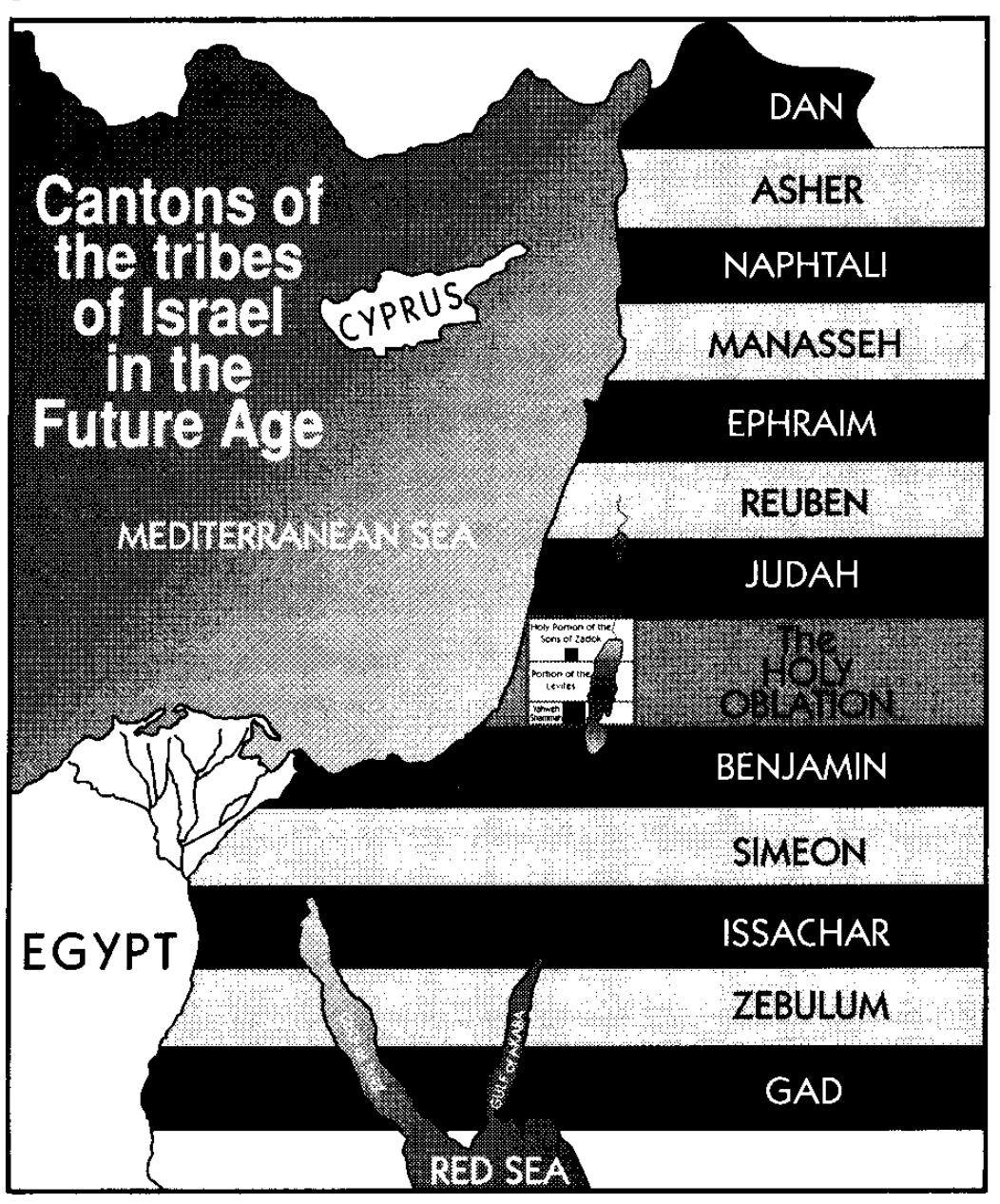
"Zebulun shall dwell at the haven of the sea" — Zebulun signifies dwelling, so that, again, there is a play upon words. According to Josephus (Ant. 19:10,16), Zebulun was never bounded by the sea, being cut off by the tribe of Asher. It is obvious, therefore, that, as with the prophecy of Shiloh, we must look to the future for the fulfilment of this prophecy. When the Kingdom is set up, there will be a re-allotment of tribal inheritance, and Zebulun will be placed in the deep south (Ezek. 48:26). According to the map drawn by the late Bro. H. Sulley (see The Temple of Ezekiels Prophecy), Zebulun then will "dwell at the haven of the sea." This will provide the means whereby the prophecy of Deut. 33:18-19 will be fulfilled. It is significant, that in this place, Moses places Zebulun and Issachar in conjunction one with the other, as Ezekiel does also in the reallotment of the tribes in his 48th chapter.
"And he shall be for an haven of ships" — In Moses' blessing upon the tribes, he declares of Zebulun and Issachar, "They shall call the people unto the mountain; there they shall offer sacrifices of righteousness" (Deut. 33:18-19). These are remarkable words, for at that time, Zion had not been selected as the mountain of worship, and Zebulun has never provided "an haven of ships." The future will see changes in that regard. Isaiah predicts "I (Yahweh) will bring them (the nations) to My holy mountain and make them joyful in My house of prayer; their burnt offerings and their sacrifices shall be accepted upon Mine altar; for Mine house shall be called an house of prayer for all people" (Isa. 56: 7). See also Isa. 2:3; Zech. 14:16; Isa. 60:11. These worshippers, and the wealth they will bring with them (Isa. 60:5 mg.) apparently will enter the land through the haven for ships that will be provided in the territory of Zebulun and Issachar. These tribes, by that means, will "suck of the abundance of the seas," as they "call the people unto the mountain" as the blessing of Moses requires.
"And his border shall be unto Zidon" — Here, again, commentators are in a quandary, inasmuch as the border of Zebulun was never "unto Zidon." Some have observed that the Hebrew word can be rendered towards Zidon, and suggest that the ancient territory of Zebulun was like a dagger pointing at Zidon. However, this is the only place in Scripture where yerekah has been translated "border." The word signifies the side or rear of a person, so that the picture of Zebulun that Jacob presented to his sons was that of the tribe with its side or back turned to Zidon, whilst offering a welcome and refuge to others. This would suggest that Zebulun, or the dwellers in the land will have no welcome to extend to Zidon. Why? The word Zidon is from the Hebrew Tsuwd signifying to lie in wait, and from the idea of catching, or ensnaring, came to mean a fishery. The Zidonians were among the original inhabitants of Canaan whom the Israelites failed to drive out (Jud. 1:32), in consequence of which they became a snare to Israel (Jud. 10:12). Instead of turning the back to them, as the dwellers (Zebulun) in the land should have done, they eagerly embraced them. Indeed, Ahab married Jezebel, the daughter of Ethbaal, King of Zidon (IKings 16:31), and this became a snare to Israel, so much so, that even Elijah had to flee to the refuge of Horeb. Unfortunately, the influence of Jezebel has ever remained with the dwellers with the Lord (see Rev. 2:20-21; 17:5), and the tendency of such has been to embrace her. There will be a change in the future, however, for the dwellers with the Lord will have their backs turned to antitypical Zidon, and their faces averted from her. Christ has decreed the destruction of Roman Catholicism (2 Thess. 2:8; Rev. 18), so that there will be no welcome for such as may be influenced by her. The backs of the dwellers in the land will be "turned unto Zidon."
VERSE 14
"Issachar is a strong ass" — Issachar is a combination of yis, "there will be," and sachar "a reward." He is likened to a "strong ass," or, more literally, an ass of bone. The word for "ass" in this verse, is different from that of v. 11. It is from the Hebrew chamor, signifying reddish, and therefore is suggestive of sin's flesh strengthened to bear the burden of humanity in order to provide for a reward (Ps. 80:17). Strong gives the meaning of Issachar's name as He will bring a reward. The reward and rest of the future is only possible through Israel (Eph. 2:11-13).
"Couching down between two burdens" — The Hebrew mishpathim has been the subject of considerable conjecture by Hebraists. Some give it as sheep-folds, others as boundaries, others again as burdens. The R.V. has sheepfolds. The figure suggested by Jacob, is that of Israel as a redeemed ass (cp. Exod. 13:13), at ease among the sheepfolds, or Christ's flock drawn from Jews and Gentiles (John 10:16). Other renditions provide a millennial significance to the passage. The Chaldee paraphrase provides the following: "He saw his portion that it was good, and the land that it was fruitful, and he shall subdue the provinces of the people, and drive out their inhabitants, and those who are left shall be his servants and his tributaries." The Septuagint Version has: "Issachar has desired that which is good; resting between the inheritance. And having seen the resting place that it was good, and the land that it was fertile, he subjected his shoulder to labour, and became a husbandman."
VERSE 15
"And he saw that rest was good" — The word "rest" is menuchah, and signifies a safe shelter. It is the word by which Hebrews describe a husband's house, which provides a refuge, a home, a place of rest and safety for the bride. The word was used by Naomi when to Ruth she declared: "My daughter, shall I not seek rest for thee, that it may be well with thee?" (Ruth 3:1). She was seeking a husband and a home for her daughter-in-law; and Boaz, as redeemer, provided such a menuchah for Ruth. Christ will act as a redeemer for Israel in the future age. He will call the tribes back home and they will see that the menuchah he offers "is good."
"And the land that it was pleasant" — In the future age, the promised land will provide the menuchah for Israel, for "thy land shall be married," declared Yahweh (Isa. 62:4).
"And bowed his shoulder to bear" — He submitted to the discipline of the yoke or bridle (Prov. 26:3), and in doing so found the promised rest (Matt. 11:28-30). The ass is a sure-footed animal, used to heavy burdens, and able to exist on a very meagre diet, pointing to the spiritual lessons implied. It is a symbol of Israel as a nation.
"And became a servant unto tribute" — The phrase suggests tribute rendered by labour (1 Kings 9:21; 2 Chron. 8:8). In a rural community this takes the form of agricultural pursuits, so that the Septuagint has rendered it: "became a husbandman." As such, Israel will be expected to render unto the king the fruits of its labour. See Matt. 21:33-46.
VERSE 16
"Dan shall judge his people" — Dan signifies judge, so that again there is a play upon words. The word "judge" diyn has the sense of avenging as well as judging. The great Judge of Israel will avenge his people from their enemies and adjudicate over their lives.
"As one of the tribes of Israel" — Dan, as a tribe, was situated north of the tabernacle. The Hebrew word for "north" suggests the place hidden from human eyes, the great unseen: Yahweh's throne of judgment. The Psalmist declares: "Promotion cometh neither from the east, nor from the west, nor from the south. But God is the judge: He putteth down one, and setteth up another" (Psa. 75:6-7). If promotion does not come from the east, west, or south, it must come from the north — the place where the tribe of Dan (the Judge) was situated in relation to the tabernacle and in the tribal allotments of the land. The Psalmist excluded the north from his comment, but declared: "God is the Judge." This seems to point to Dan on the north of the tabernacle emphasising the Judgment of Yahweh. In Isaiah 41:25,
Messiah is said to be "raised up from the north" that is, figuratively, from the place of Yahweh's throne of judgment. Dan will retain the northern position among the tribes even in the millennium, according to the allocation of the tribal inheritances outlined in Ezekiel 48.
VERSE 17
"Dan shall be a serpent by the way" — The word is nachash as is found in Gen. 3:1. It was noted for its subtlety (see also Mat. 10:16), suggesting that the Judge of Israel will act wisely and skilfully.
"An adder in the path" — The margin suggests arrow-snake. The Hebrew shephiphon occurs only here. Gesenius derives the word from a root signifying to slide, others, to sting. According to G.S. Cansdale in Animals of Bible Lands, "This description would fit one of the desert vipers that lie hidden in the surface and strike out when disturbed." As the serpent strikes suddenly, unexpectedly and swiftly, and as the "adder in the path" is overlooked by the rider on a horse because he is lifted high above it, so the Judge of all the earth, in the person of the Lord Jesus Christ, will suddenly, unexpectedly and swiftly avenge his people in the age to come, by striking at the "horse," and bringing its "rider" crashing to the ground.
"That biteth the horse heels" — In ancient times the horse was used almost exclusively for war and is used frequently in the symbology of the Bible for that purpose. To "bite the horse heels" would be to destroy the use of the horse in war. "He maketh war to cease unto the end of the earth" (Psa. 46:9). The Hebrew aqeb, "heel", is from the same root as "Jacob," the heel-catcher or supplanter.
"So that his rider shall fall backward" — In Bible symbology, riders on horses are those who sit in the seat of authority and guide the nations, particularly in their schemes of conquest. The blessing on Dan the Judge reveals that the nations will be unseated by a hidden menace that they will overlook in their ambitious plans. Zechariah prophesies how that Messiah will use Israel after the flesh to subdue the nations: "They shall be as mighty men, which tread down their enemies in the mire of the streets in the battle; and they shall fight, because Yahweh is with them, and the riders on horses shall be confounded" (Zech. 10:5). "Blood came... even unto the horse bridles" (Rev. 14:20), signifying that the destruction will reach to those who are seated in authority. The symbol of Christ at war, is The Word of God seated upon a horse (Rev. 19:21).
VERSE 18
"I have waited for Thy salvation, Ο Yahweh" — From this short, beautiful and fervent prayer, it is obvious that Jacob comprehended the Messianic application of the blessing on Dan. The patriarch's actions, through life, were motivated by the desire to participate in the Divine salvation. It was for that reason that he sought the birthright and the blessing from Esau early in life, the reason why he was prepared to dare the wrath of his more powerful brother in returning to the land with his wives and family. It was his ardent longing throughout the "evil days" of his life, even when separated from his beloved Joseph.
The verb is qavah signifying to twist, or bind together so as to give strength, then to_ expect, to await "perhaps from enduring, remaining, which differs but little from the notion of strength" (Gese-nius). Jacob's strength had been in his patient endurance and waiting for the coming of salvation.
This verse records the first occurrence in the Bible of the word salvation. The Hebrew is yeshuwah: a noun in the feminine gender, the passive participle of the root yasha from whence is derived the proper noun Joshua or Jesus, it being a combination of Yah-shua. Jacob, in using the term he did, proclaimed to his sons that God would effect his salvation, through means beyond his ability to accomplish, and that he would be but the passive recipient of the divine goodness manifested through the Saviour who would come.
The prayer of Jacob, as expressed in the Hebrew, includes the name of Yahweh. But Jacob did not know the memorial
Name of God! That information was denied him on the occasion that he wrestled with the angel and pleaded that the Name be revealed unto him (Gen. 32:29). Why then is the Name included in this personal prayer of the patriarch? Because, in common with all the faithful from the Fall onwards, he looked for the coming of the Redeemer promised in Genesis 3:15, in whom God would be revealed. He doubtless looked upon El Shaddai as He Who will be revealed in due time, and used the common Hebrew verb to express his belief and desire for the coming of the promised one. He would worship God as the One Who will be, without knowing the self-styled Name by which Yahweh later chose to be known (Exod. 3:14; 6:3). Moses, recording the incident after the proclamation of the Name, appropriately included it in the prayer, as to all intents and purposes, Jacob had used the words which express it.
VERSE 19
"Gad, a troop shall overcome him" — In the original this expresses a play on words that is lost in the A.V. The Hebrew is Gad geduwd yedudennu. Gad signifies a troop or company and the line can read:
Gad, a troop shall troop on him. This part of the blessing speaks of the domination of Israel by the Gentiles. This has been fulfilled in the long period of Gentile oppression since the days of a.d. 70 (Luke 21:24).
"But he shall overcome at the last" — The Hebrew is vehu yagud ageb — and he shall troop upon their heel completing a triple alliteration, or play on words in the two lines of poetry. The idea of "a troop"
of true Israelites trampling upon the heel of the once triumphant enemy speaks of the ultimate triumph of the nation as its forces press upon the heels of the retreating enemy. This is a promise of ultimate
victory to take place at "the latter end" such as is predicted in Deut. 32:29-30. The word "last" in Hebrew is ageb rendered "heels" in v. 17 and forms the base of the word "Jacob." As he supplanted his enemies, so his children will their's.
VERSE 20
"Out of Asher his bread shall be fat" — Asher signifies blessed or happy and the promise is of abundance and fruit-fulness.
"And he shall yield royal dainties" — The literal Hebrew is dainties of a king or dainties for a king. This remarkable statement anticipates the establishment of a monarchy in Israel a thousand years before Israel requested a king of Samuel. It anticipates the future restoration of the monarchy under Messiah (Ezek. 37:21-22). Ezekiel, in vision, saw the tribes bearing their oblation, or portion, to the Prince of Israel as a "royal dainty" or tribute (Ezek. 45:16). This oblation, or portion, will help provision the temple in the age to come, providing the means of supplying a "feast of fat things" to be enjoyed by the assembled worshippers from all nations in that day (Isa. 25:6).
VERSE 21
"Naphtali is a hind let loose" — Naphtali signifies wrestling. But what do the words a hind let loose signify in the form of blessing? The Septuagint has a tree trunk let loose reading perhaps ayloh for ayaloh (the same consonants in Hebrew). The trunk and branches of the mighty oaks, twisting and forcing their way upwards and outwards, symbolise the principle of wrestling and of strength. See comments on Gen. 12:6; 13:18. The territory of Naphtali was in Galilee, which witnessed much of the wrestling of the Lord at his first advent. Indeed, Isaiah specifically refers to Naphtali in that relationship (Isa. 9:1), in words that are cited in Matt.4:15. Bochart translates: "Naphtali is a spreading oak producing branches." The Concordant Version is similar: "Naphtali is an oak stretched out, the giver of products that are seemly."
On the other hand, the Peshito (Syriac) version has: "Naphtali is a swift messenger." The swift and graceful hind could symbolise the swift messengers of the gospel in the age to come (Isa. 52:7), successfully wrestling with the forces of darkness. Whether Naphtali is likened to an oak for its spreading strength, or the hind for the grace and swiftness of its message, the blessing anticipates the time when the Truth shall be common knowledge throughout the world.
"He giveth goodly words" — Isaiah selected the area of Naphtali as being particularly the place from whence the "goodly words" of the gospel sounded forth at the first advent of the Lord (Isa. 9:1), and the context of his prophecy moves on to reveal that what was heard then was but a foretaste of greater things to come (cp. Vv. 2-7).
VERSE 22
"Joseph is a fruitful bough" — As Jacob's eyes turn towards his favourite son, they must have kindled with joy. Joseph's name means Increaser, and his life typified that of the Lord Jesus who as "a fruitful bough" shall increase mightily in the earth (Rev. 7:9). The past has revealed a typical fulfilment of the future, for Joseph developed into two tribes in Israel: Ephraim and Manasseh. The words "fruitful bough" are ben paroth, son of a fruitful {tree or vine). Paroth is in the feminine gender, suggesting a reference to Rachel (see Isaiah 54:1). The term Λ Son of' Fruitf niness is a good title for the Lord Jesus (John 12:24; 14:12; 15:4).
"Even a fruitful bough by a well"— The R.V. alters "well" to fountain, and one is reminded of "the fountain of Jacob" (Deut. 33:28), symbolised by the well that the patriarch dug at Shechem (the burden-bearer). It was at that well that the Lord discoursed with a Samaritan woman upon the hope of the Gospel (John 4:6-7), and from the figurative well associated therewith that he drank deeply of the water of life (Psalm 1). Thus the Lord Jesus was truly A son of fruitfulness by a well, for he was a true son of the Abrahamic covenant, which is likened to "Jerusalem which is above is free, which is the mother of us all" (Gal. 4:26).
"Whose branches run over the wall" — In this line of poetry, "branches" is in the feminine gender, banoth, or daughters (see mg.). The figure is that of a vine so prolific, that its branches (or daughters) spread over the wall and beyond. It therefore is a remarkable prophecy of the spreading influence of Christ, typically expressed in the sons of Joseph. His two sons, Ephraim and Manasseh, developed into two tribes, in contrast to the single tribe developed from each of the other sons of Jacob, so that in that sense, it could be said that the "branches" of Joseph extended beyond the wall.
Again, those tribes were located east and west of the Jordan, with two portions given to Manasseh, the firstborn according to birth, also suggest the figure of a spreading vine. But the full force of the prophecy is discovered in the antitypical Joseph, the Lord Jesus Christ. He declared to the disciples: "I am the vine, ye are the branches" (John 15:5). In that relationship, the feminine gender for "branches" in the verse before us, is appropriate, for the Lord's disciples comprise both his offspring (Isa. 53:10; Heb. 2:13) and his bride. As the "first Adam" could describe his "bride" as his offspring "bone of his bones, and flesh of his flesh" (Gen. 2:23), so can the "second Adam" of his bride (Eph. 5:25; John 17:21). The branches of the Christ-vine have spread "over the wall," for they have extended beyond the limits of Israel unto the Gentiles. Christ has "broken down the middle wall of partition" and has "reconciled both (believing Jews and Gentiles) unto God in one body" (the vine, Eph. 2:14-16). In order to effect this purpose, Yahweh strengthened the Christ-branch, and planted it to form the vine of His choice (see Ps. 80:14-17). As a vine is susceptible to transplanting, so the Israel-vine will be transplanted into the Lord Jesus Christ (Rom. 11:24).
VERSE 23
"The archers have sorely grieved him" — The Hebrew baalai chitstsim signifies chief archers, or masters of arrows. In the case of Joseph, they comprised his brethren who became the "fathers of the children of Israel," and entitled to the term baalai or chiefs. But the experiences of Joseph foreshadowed those of Christ, who was hated and "shot at" by the leaders of Jewry as to cause him much grief. In Psalm 64, their attacks are likened to bowmen "shooting their arrows, even bitter words," "shooting in secret at the perfect" without fear (vv. 3-4). The Psalmist, however, predicted that "God shall shoot at them with an arrow; suddenly shall they be wounded" (v. 7). The "arrow" by which the enemy should be overthrown comprised the Lord Jesus Christ, represented by Isaiah as "a polished shaft" hidden in the quiver of Yahweh (Isa. 49:2). His opponents were no match for him. They felt the weight of his wisdom, and the strength of his mouth which "like a sharp sword" (Isa. 49:2), was "quick, powerful, and sharp, dividing asunder of soul and spirit, and a discerner of the thoughts and intents of the heart" (Heb. 4:12). The Lord revealed his opponents for what they were, openly rebuking them as hypocrites and perverters of truth.
"And shot at him, and hated him"— Joseph's brethren "shot at him" secretly, hiding their true motives from Jacob, allowing their hatred of their brother to dominate them, and blind their sense of proportion. They would have killed him, but were dissuaded from doing so on the grounds of expediency, and sold him into Egypt. The leaders of Jewry "shot at" the Lord, by maligning him in secret; they hated him so as to bring him to the cross.
The word for "hated" is satam, "to lurk for, to lay snares." The type finds its fulfilment in Luke 11:54, "Laying wait for him, and seeking to catch something out of his mouth, that they might accuse him."
VERSE 24
"But his bow abode in strength" — "Strength" here is ethan. Own is used for strength in Gen. 49:3. Though hated by his brethren, Joseph continued on his course before God, and refused to be diverted therefrom. When, in Egypt, his brethren appeared before him, he "shot at them" so effectively as to more than match the ability they had revealed in directing their arrows of malice against him, so that they were compelled by his very skill to submit to him. His "arrows" hurt them, but were directed in love for their own good, and to their ultimate benefit, and in this he typed the Lord. As Psalm 64:7 and Isa. 49:2 reveal, the Lord also was a master of the bow. He used his words with ability and skill, revealing the error and hypocrisy of his opponents — but for their own good, and to the ultimate benefit of the nation as a whole. In the cases of both Joseph and the Lord, Yahweh was really the bowman, and they His arrows directed skilfully against the enemy. In spite of all opposition, the "bow abode in strength," for it was used with ability and success.
"And the arms of his hands were made strong" — The word "strong" is pazaz, "to spring" or to be active. The R.V. has active in the margin. The Amplified Bible has "the arms of his hands were made strong and active." He derived from the God of Jacob the skill to match his enemies, and to wage war successfully with them, even though outnumbered. The ability and the activity which characterised the labours of the Lord, the antitype of Joseph, stemmed from his divine parentage. Whereas the type, Joseph, had natural potential for spirituality, the antitype, the Lord Jesus had supernatural potential. Both through God, conquered in their respective conquests with their enemies. Seelsa. 11:2; Psalm 80:17.
"By the hands of the mighty God of Jacob" — Notice that God is in italics which indicates that there is no comparable word in the Hebrew. "Mighty" is abiyr and is better rendered Mighty One as in the R.V. It is from the root abar, "to be strong, to soar," and is rendered fly in Job 39:26. The title of Abiyr of Jacob suggests the Lofty One whose strength is sufficient for every need, who is high above flesh, and therefore, is not bounded or limited by it. Like the soaring eagle, whose keen vision takes in the panoramic view beneath, Abiyr is able to see beyond the horizon of human vision to the beyond, and so provide for all man's needs. Let all who suffer, all who are oppressed by the opposition of their fellows, or who are depressed with the consciousness of their own failings, lift themselves up to seek the Abiyr (Lofty One) of Jacob (see Col. 3:1), for from His elevated position, He can see beyond present difficulties and can help accordingly.
"From thence is the shepherd, the stone of Israel" — These remarkable words reveal that Jacob saw the coming Redeemer, the antitype of his beloved son, Joseph, as both Son of Man and Son of God. As the former, he made mention of him as the Shiloh, the Lawgiver of Judah, the great Ruler of the tribe whom his brethren shall praise (Gen. 49:8-10); as the latter, he saw him as the great antitypical Joseph, the Son of God, who would conquer his enemies by the sword of the spirit, and the arrow of truth. The divine begettal of the Lord is expressed in the line before us: "From thence (from Abiyr or the Lofty One) is the shepherd, the stone of Israel".
Jacob thus described the antitypical Joseph as "God manifest in the flesh."
As far as the Lord's fleshly descent is concerned, the words of Paul are to the point, and illustrate the blessing upon Judah: "It is evident that our Lord sprang out of Judah" (Heb. 7:14). As far as the Lord's heavenly origin is concerned, and illustrative of this blessing upon Joseph, Gabriel told Mary: "The Holy Spirit shall come upon thee, and the power of the Highest shall overshadow thee; therefore also that holy thing which shall be born of thee shall be called the Son of God" (Luke 1:35).
This merging of spirit and flesh was necessary for the work Christ was to undertake. As Son of Man, he identified himself with the limitations and infirmities of the flesh; as Son of God, he represented and manifested Yahweh in such a way as to conquer the flesh. As both Son of Man and Son of God he represented both humanity and Deity, and was in a position to help and uplift those cast down by sin.
As such, he became the ideal shepherd of Israel. The shepherd characteristics of Christ are a manifestation of the shepherd characteristics of his Father (see Ps. 77:20; 78:52; 80:1; Jer. 31:10; Micah 7:14 etc.).
In the reference to The Stone of Israel the Hebrew word eben (stone) is from banah, the same root from which is derived the word ben, "son," signifying to build. Thus as sons and daughters build a family, stones build a house. The word eben occurs in Ps. 118:22; Isa. 8:14; 28:16, in prophecies relating to Christ. Reference also should be made to 1 Sam. 7:12 where Samuel set up a stone to commemorate the help received of Yahweh and called it Eben-ezer or The Stone of Help. The Lord Jesus has been set up as a Stone of Help to all who put their trust in him.
The reference to "the stone of Israel" seems to particularly relate to Jacob's experiences at Bethel. He selected one of the stones of the place to use as a pillow upon which to rest, and on the morrow, having received a wonderful blessing from God (Gen. 28:13-15), he set it up as a pillar to memorialise the spiritual temple that would be erected (vv. 17,22).
Christ is the foundation stone upon which the "house of God" is being erected (Zech. 4:8-10; 1 Pet. 2:4-6), "the chief corner-stone" into which the other "living stones" must be fitted (Eph. 2:22), and the "head stone" that provides the crowning beauty of the building (1 Pet. 2:7). He was also "a stone of stumbling, and a rock of offence" to those who failed to believe in him (1 Pet. 2:8), and therefore, "the stone that the builders rejected" (Matt. 21:42). In discoursing upon this theme, the Lord likened himself also to the stone that smote the image seen by Nebuchadnezzar, and destroyed it. He warned that that would be the lot of all those upon whom he should fall in judgment (Matt. 21:42-44).
As both "foundation stone" and headstone (cp. Zech. 3:9; 4:7), the Lord is "the author and finisher of faith," the "alpha and omega" of the purpose of God. Without him there is no permanent strength or beauty; with him there is both. Peter saw him as "a chief corner stone, elect, precious" and declared, "He that believeth on him shall not be confounded" (1 Pet. 2:6). He saw the ecclesia as living stones, built up together as a "spiritual house, an holy priesthood to offer up spiritual sacrifices, acceptable to God by Jesus Christ." As the indwelling divine glory gave significance to the tabernacle and temple, so the manifestation of divine glory by the saints reveals that He dwells with them. Peter emphasised the purpose of the divine call: "That ye should shew forth the praises (virtues) of Him who hath called you out of darkness into His marvellous light" (1 Pet. 2:9). A community manifesting such qualities "is none other than the house of God" — to use the words of Jacob when he set up the stone of Bethel as a pillar.
VERSE 25
"Blessings of the deep that lieth under" — In a natural sense, "blessings of the deep that lieth under" refer to the subterranean storages of water that provide the source of wells and springs, and to the rivers of water that irrigate the land. Spiritually, these refer to the hidden truths of revelation, the "deep things" of the Word that comprise part of the blessings of heaven above. Thus the Psalmist described the righteous as "trees planted by the rivers of water" (Psa. 1:3). They are replenished and strengthened by "the deep that lieth under," the figurative springs and wells of water that are hidden in the Word, and which provide nutriment in seasons of drought. Christ described the gospel as the thirst-quenching waters of a well that springs up into everlasting life (John 4:14). Therefore, whereas the "blessings of heaven" in the form of rain and dew, water and fructify the earth, the wells, springs and rivers store it for future use. The roots of trees and plants must dig into the soil to derive benefit from such "blessings of the deep that lieth under." The blessings of heaven above, and of the deep that lieth under, therefore, point to the influence of divine revelation as it is manifested in the Word, symbolised by life-sustaining water. Such blessings were conferred on Joseph who became the channel of them to others. As he typed the Lord, so they are revealed in the Christ. To him true Israelites must turn if they would participate in the benefits to be thus derived.
"Blessings of the breasts, and of the womb" — These blessings imply a numerous, healthy, well-fed progeny. This was typically fulfilled in the descendants of Joseph. In the first census of the tribes the numbers of Ephraim and Manasseh exceeded those of any of the other sons of working of Providence, he was now able to pronounce upon him the blessing of a greater progeny than that of any of his other sons. What of the Lord Jesus, Joseph's great antitype? Isaiah prophetically enquired: "Who shall declare his generation? for he was cut off out of the land of the living" (Isa. 53:8). But he adds, "When thou shalt make his soul an offering for sin, he shall see his seed, he shall prolong his days" (v. 10), The Lord spiritually begat a numerous progeny, for the blessing of Joseph reached down to him.
The God of Jacob
Wherever the term "God of Jacob" is used in Scripture, it is found in a context of trouble from whence deliverance is obtained, and therefore comprises a most significant and encouraging divine title. The Abiyr of Jacob is the Lofty One who had supervised his life from the beginning, who had brought him through all his troubles, who had moulded his character, and who had so revealed His purpose, that the aged patriarch could now pass on to his sons the revelation of the future. The Abiyr of Jacob was the God who had appeared to him at Bethel, to declare that He would be with Jacob the fugitive in all his wanderings. He is the God who, knowing the weakness of humanity, yet proclaims that He will be with those who put their trust in Him during the days of their trial. Though they may be the victims of the evil thoughts of their fellows as Jacob was of Laban, or may find themselves endangered by fierce and unscrupulous enemies such as the patriarch was when facing Esau, the God of Jacob will deliver them to establish in them His covenant of peace, and to grant them immortality.
It is a very profitable exercise to examine every occurrence of divine titles appended to the name of Jacob, for he was a man whom God remade, and his very weaknesses, timidity, failings, but ultimate conversion, provide a parable for those whom God will change for the kingdom. When considering men like Jacob, and even meditating their failures, we must never forget the comment of Paul: "God is not ashamed to be called (or surnamed) their God" (Heb. 11:16). If God is not ashamed to be known as the God of Jacob, we must never despise the patriarch, nor the association with him which our acceptance and identification with the Abrahamic covenant establishes with us.
As one writer has expressed it: "God revived the promise over which Jacob had brooded for nearly 60 years since he learned it in childhood from his mother. Angels conversed with him. Gradually he felt more and more the watchful care of an ever-present spiritual Father. Face to face he wrestled with a representative of the Almighty. And so, even though the moral consequences of his early transgressions hung about him, and saddened him with a deep knowledge of all the evil of treachery and domestic envy, and partial judgment, and filial disobedience, yet the increasing revelations of God enlightened the old age of the patriarch; and, at last, the timid 'supplanter,' the man of subtle devices, waiting for the salvation of Yahweh, dies as the 'soldier of God,' uttering the messages of God to his remote posterity."
In The Christadelphian for 1940, the late John Carter, wrote beautifully upon the theme of "the God of Jacob," expressing the great comfort that this divine title has for all who experience the problems and reverses that fell to the lot of the patriarch. He declared: "The God of Jacob, then, is One who has promised to be with His people in all their sojourn, never to leave them in all the days of trial during which they may be the victims of the evil thoughts of their fellows as Jacob was of Laban's. The God of Jacob is One who, fulfilling His Word, will bring the heirs of the promise to the land covenanted, with life preserved through unending days.
"The Psalms when read with this background, are found to have a fuller meaning. David says (20:1):
The Lord hear thee in the DAY OF TROUBLE; The name of the God of Jacob defend thee.
"In the troubled days of Hezekiah, when the Assyrian cloud covered the land, but when men of faith believed the message that God would deliver them, one could say (46:7):
The Lord God of hosts is with us
The God of Jacob is our refuge.
"There were faithless men at the time, as Shebna; but in the assurance of the victory of the righteous, Asaph sang (75:9-10):
/ will declare forever;
I will sing praises to the God of Jacob.
All the horns of the wicked also will I cut off:
But the horns of the righteous shall be exalted.
"The same writer uses the title when he bemoans Israel's failure to secure the blessing because they would not hearken to His voice (81:1). There was no failure with the God of Jacob.
"Human promises with the best of efforts are bounded by the limits of frail human life. What a magnificent contrast is that of Psalm 146, where the Lord's irresistible might to accomplish is put over against human weakness!
Put not your trust in princes.
Nor in the son of man,
In whom there is no help.
His breath goeth forth.
He returneth to his earth;
In that very day his thoughts perish.
"We quote these verses, and rightly quote them, to prove the mortality of man; but we miss the writer's object if we thus limit our meaning. We are not to put our trust in men; they are of small power and soon are dead. God knows no end to His years or failing of His powers. Therefore the Psalmist continues:
Happy is he that hath the God of Jacob for his help,
Whose hope is in the Lord his God:
Which made heaven, and earth.
The sea, and all that therein is:
Which keepeth truth for ever:
"The Creator is not a God afar off; He has come into close association with men; has revealed His truth which will not fail; and He has been proved in the experience of Jacob as a God who neither leaves nor forsakes. If ours is the God of Jacob, the beatitude of this Psalm is written of us."
The references above are to the Elohim of Jacob, except that of Psalm 146:5 where it is the El (Strength) of Jacob, whereas the title before us is the Abiyr of Jacob. But when the name of Jacob is connected with any of these titles they become expressive of One who has promised and will perform; One who had revealed His truth and will not fail; One who has power to redeem and will not leave nor forsake those who put their trust in Him. And will do so even in spite of human weakness.
Jacob himself expressed this in an earlier blessing on Joseph: "And he blessed Joseph, and said, God, before whom my fathers Abraham and Isaac did walk, the God which fed me all my life long unto this day, the Angel which redeemed me from all evil, bless the lads: and let my name be named on them..." (Gen. 48:15-16).
During much of his life, Jacob walked in darkness and could not see beyond the immediate future. Hemmed in by trouble, beset with fears, he placed his hand in Abiyr and ultimately walked out of darkness into light. For Abiyr, being the Lofty One, can see beyond the darkness (see Isa. 50:10).
The title occurs only a few times in Scripture. David was the next to use it after Jacob. He did so. in connection with the choice of Zion as the place of Yahweh's rest. He spake of how he "sware unto Yahweh." and "vowed unto the Abiyr of Jacob," that he would not rest until he found "a place for Yahweh, a habitation for the Abiyr of Jacob" (Psa. 132).
Both the Name of Yahweh and the title of Abiyr of Jacob are appropriate to the context of David's words. Yahweh is the covenant name of Deity the name that guarantees the perpetuity of the seed of Jacob (Exod. 3:14). The Abiyr of Jacob is appropriate to describe the One whose lofty eminence enables Him to see beyond their present humiliation to their future glory. Accordingly, it is appropriate that the temple of the age to come is described as "the house of the God of Jacob" (Isa. 2:3), for all who will appear there, both mortal and immortal, apart from the Lord Jesus, will be men and women who have been remade through the influence of the Lofty One who has elevated them. Thus, even in the future, the name of Jacob, and the example his life presents, will be perpetuated.
Isaiah uses the title Abiyr three times. In Ch. 1:24 he joins it with the name of Israel. In the spirit of prophecy he speaks of how the Lofty One will avenge Himself on His enemies, and will restore Israel: "Zion shall be redeemed with judgments and her converts with righteousness" (v. 27). Zion's converts comprise the true Israel of God (Gal. 6:16), the Jacobs of the flesh, whose names are changed to Israel to conform to their remade characters.
In Isa. 49:26, Deity is described as "I Yahweh thy Saviour, and thy Redeemer, the Mighty One {Abiyr) of Jacob." Here the title is associated with the work of saving and redeeming Israel. "I will feed them that oppress thee with their own flesh... and all flesh shall know that I Yahweh am the Abiyr of Jacob." The experiences of Jacob will be reflected in those of the redeemed, both individual and national.
The third occurrence is in Ch. 60:16, "Thou shalt suck the milk of the Gentiles, and shalt suck the breast of kings: and thou shalt know that I Yahweh am thy Saviour and thy Redeemer, the Mighty One (Abiyr) of Jacob."
Jacob successfully supplanted the flesh because the Lofty One was with him. For the same reason, the nation that came from him shall do likewise. Therefore, the title as used by Jacob in the blessing before us, can be paraphrased: The God whom I have found to be high above flesh, alike in His mercy and His faithfulness as also in His power to save and redeem, and whose overriding providence has caused me to successfully supplant my enemies, will enable the antitypical Joseph to likewise conquer his enemies and bring succour to his brethren in need.
Jacob. Antitypically, however, the fulfilment is seen in the progeny of the Lord Jesus. The ecclesia comprises "the children whom God has given him" (Heb. 2:11-14), and the possession of such a
family constitutes him the Father of eternity (Isa. 9:6), the Author of life (Acts 3:15 mg). From him will be developed that "great multitude which no man could number" (Rev. 7:9), being the aggregate of
his spiritual offspring. Ephraim and Manasseh, the two sons of Joseph, typically represent spiritual and natural Israel (Deut. 33:17). Isaiah likens such to the sons of Zion to "be brought forth" by a personal and a political resurrection at her travailing in the future (Isa. 66:8-10).
Earlier Jacob had imagined his son Joseph to have been destroyed, but by the working of Providence, he was now able to pronounce upon him the blessing of a greater progeny than that of any of his other sons. What of the Lord Jesus Joseph's great antitype? Isaiah prophetically enquired: "Who shall declare his generation? for he was cut off out of the land of the living" (Isa. 53:8). But he adds, "When thou shalt make his soul an offering for sin, he shall see his seed, he shall prolong his days" (v. 10), The Lord spiritually begat a numerous progeny, for the blessing of Joseph reached down to him.
VERSE 26
"The blessings of thy father" — To Jacob were confirmed the promises made to Abraham and Isaac, with the assurance that El Shaddai would be with him in all his wanderings, and would restore him back into the land (Gen. 28:13-15). The promise was irrevocable (Rom. 11: 29), as was dramatised to Jacob when he wrestled with the angel, and was told: "As a prince hast thou power with God and with men, and hast prevailed" (Gen. 32:28), or, as it has been rendered: "He who strives with God and prevails will certainly prevail with men."
The Shepherd of Israel
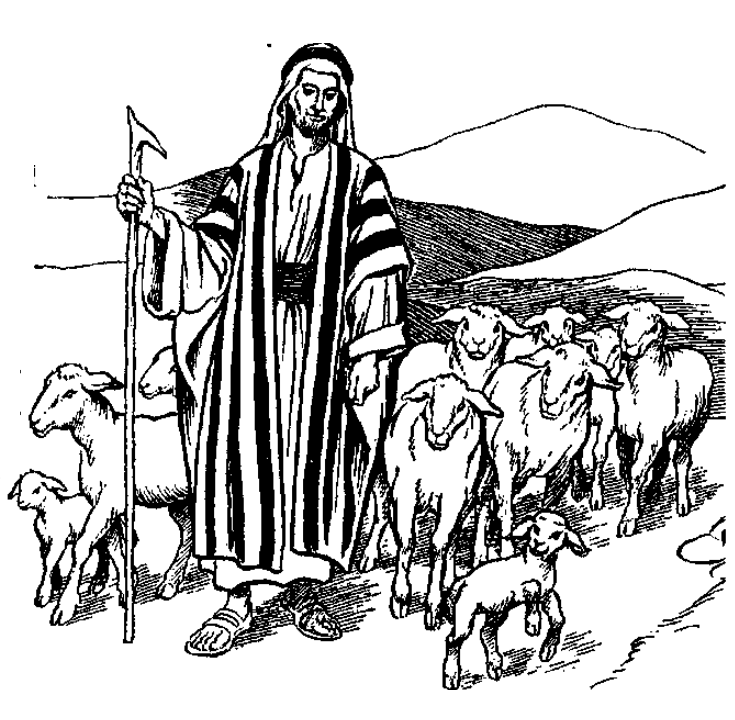
The tender solicitude of a shepherd for his flock aptly illustrates the care which Yahweh exercises in the affairs of His people, as shown by His dealings with the people of Israel. He guided them to pastures and fed them with His Word. He protected them against the wild beasts (Gentiles) which would devour them, whilst disciplining them in love when such was needed. He taught them to hearken to His voice, and provided under-shepherds who would teach them what was required.
One of those "under-shepherds" was David, the shepherd-boy that became shepherd-king. "He chose David also His servant, and took him from the sheepfolds; from following the ewes great with young He brought him to feed (Heb. shepherd) Jacob His people and Israel His inheritance. So He fed (shepherded) them according to the integrity of his heart; and guided them by the skilfulness of his hands" (Ps. 78:70-72).
David experienced the anxious care of a true shepherd for the sheep; he knew how the shepherd had to anticipate the needs of the flock, how he had to watch over its welfare, guard it from danger, deny himself for its sake, risk his life in its defence, encourage it with a gentle, caressing voice along the rough and dangerous paths it sometimes had to tread, and lead it to the green fields beyond.
He knew too, how the sheep trusted him, relied upon his guidance, recognised his voice and responded to it. The sheep lacks the ability to defend itself and is completely reliant upon the shepherd. It is meek and submissive to guidance but is also susceptible to following a wrong lead.
Frequently, in Scripture, the word shepherd has been translated fed ox feed. Thus "the lips of the righteous feed (shepherd) many" (Prov. 10:21). "I will give you pastors (shepherds) according to mine heart, which shall feed (shepherd) you with knowledge and understanding" (Jer. 3:15).
It was a high and responsible position. The king in Israel was the shepherd of the nation — its servant. He was expected to "walk before the people" in leadership and example (1 Sam. 12:2). David was praised for the manner in which he had accomplished this: "Thou wast he that leddest out and broughtest in Israel: and Yahweh said to thee, Thou shalt feed (shepherd) My people Israel..." (2 Sam. 5:2; 1 Chron. 11:2).
David was a type of the "good shepherd" whom Jacob foresaw in his blessing upon Joseph. In Psalm 23:1, Yahweh-Rohi, Yahweh My Shepherd, becomes a divine title, anticipating the manifestation of the Lord Jesus as "the good shepherd," and providing a contrast to the "hirelings" that camouflaged themselves as shepherds in Israel (cp. Isa 56 :11; Jer. 23:1; Ezek. 34:1-4). Yahweh declared that He was against such pseudo-shepherds, and proclaimed his intention to deliver the flock from such, and to set up "one shepherd" over them, even His servant David (the beloved — the Lord Jesus Christ), who would become "their shepherd" (Ezek. 34:23).
In the N.T. the Lord is set forth as "the good shepherd" (John 10:11), "the great shepherd" (Heb. 13:20), "the shepherd and overseer of your souls" (1 Pet. 2:25), the "chief shepherd" (1 Pet. 5:4). The responsibility of the sheep is to hearken to his voice, and follow in his path. If they do that, he will "lead them unto living fountains of waters" and wipe away "all tears" from their eyes, (Rev. 7:17).
"Have prevailed above the blessings of my progenitors" — This statement presents a difficulty. As it stands in the A.V., it would suggest that the blessings of Jacob were greater than those of Abraham. However, the interlinear New-Old Testament alters this to: "The blessings of thy father surpass (upon) the blessings of the mountains of everlastingness." This reading, which is supported by Gesenius, the Septuagint, and other authorities, reads horim "mountains" instead of hourim "progenitors." The lines can then read: "The blessings of thy father prevail over the blessings of the mountains of continuance (or the ancient mountains — Heb. od), the delight, glory or loveliness of the hills of eternity (olahm)." This rendition is supported by the R.V. mg. which cites ancient manuscripts as reading "the blessings of the ancient mountains" instead of "the blessings of my progenitors." The term mountains of continuance or ancient mountains, has a symbolic or political significance, in similar manner as Babylon is described as a "destroying mountain" (Jer. 51:25); or as "the Mighty One from Teman" is pictured "scattering the everlasting mountains" (empires of antiquity), and causing "the perpetual hills (nations) to bow" (Hab. 3:6). In that sense, "the blessings of the ancient mountains" over which the blessings of Jacob prevail, relate to the benefits derived from the glory, culture and political prestige of such mighty empires of antiquity as that of Egypt. Jacob's sons, and Joseph in particular, had evidence of the material advantages derived from such, but now they are assured that all such glory and wealth will be superseded by the blessings derived from Jacob in the future governing of the nations. Certainly, the blessings of Jacob to be revealed in the millennial reign of Christ, will surpass the benefits derived from fleshly power and prestige. Whatever glory Joseph enjoyed through his position in Egypt, that which he ultimately will receive through "the blessings of his father," will greatly surpass it.
"Unto the utmost bound of the everlasting hills" — The word "bound" is from the Hebrew taavah, and whilst it can signify the boundary or extent of a thing, it particularly expresses the idea of desire, delight or glory. "Everlasting" is from olahm, frequently used to express the millennial hidden period. Therefore, in the context of this verse, "hills of olahm" seem to relate to those nations which shall be incorporated in the empire, the Kingdom of God which Christ shall set up at his coming, and of which Israel shall comprise the "first dominion" (Mic. 4:6-8; Ps. 72:10-11; Isa. 60:12; Rev. 11:15). The blessing of Jacob will attain unto the full glory, the taavah, of such, for those associated therewith shall exercise "power over the nations" (cp. Luke 1:32-33; Matt. 19:28-30; Rev. 2:26).
The statement of this verse, therefore, can be rendered: "The blessings of thy father prevail over, are greater than, the blessings of the ancient mountains, the delight, glory, or loveliness of the hills of eternity." These terms should be interpreted symbolically and prophetically.
"They shall be on the head of Joseph" — The blessings of Joseph will be received through Christ, who is the "head" of the multitudinous body of the elect. Joseph foreshadowed the Lord, and the significance of his name, The Increas-er, will be manifested by the great company of the redeemed that will own the Lord's name (Acts 15:14) in the age to come. He will be chief over them, acknowledged as Lord of Lords and King of Kings (Rev. 17:14).
"And on the crown of the head of him that was separate from his brethren" — Primarily, this was Joseph, but ultimately is the Lord Jesus Christ, the antitypical Joseph. "Crown" is qodqod and relates to the top of the head, where the anointing oil was poured when a priest was consecrated to his holy office (Ps. 133). Priests, prophets and kings were all so consecrated to their high and holy office: three forms of service that are combined in the Lord Jesus Christ who is prophet, priest and king. In the symbolic description of the "one like unto the son of man" (Rev. 1:13-16), attention is drawn to "his head and his hairs" which are said to be "white like wool, as white as snow." This speaks of the righteousness of the one described, the antitype of the white mitre that was placed upon the head of the high priest (Exod. 39:28) with its caption in gold: Holiness to Yahweh (Exod. 28:36). The Lord needed no such artificial arrangement, for his "crown of glory" "grew out of his head." He was a true Nazarite, the vow of which made priests of laymen, the external badge of which was the hair, permitted to grow long as a token of submission to the divine requirements (Num 6:5; 1 Cor. 11:5,7). Therefore he was "separate from his brethren."
The verb "separate" is nazir, a word that is used to describe the separateness of a Nazarite, a priest, or a prince. It is the root of the noun Nazarite, as well as of Nezer, or royal diadem. Joseph was forcibly separated from his brethren, and elevated to his high position above them; the Lord Jesus was separated by the excellence of his mind and character, both of which stemmed from Yahweh. In nature, he was identical to others, but in mind and character he was divine.
VERSE 27
"Benjamin shall ravin as a wolf — To "ravin" is to tear the prey in pieces, a characteristic for which the wolf is noted (Ezek. 22:27). The prediction takes in the warlike characteristics of the tribe of Benjamin (Jud. 3:15,5:14, 20:16). But as Benjamin signifies the Son of the right hand, and typically represents the Lord Jesus Christ (Ps. 110:5; Matt. 22:44; Mark 12:36; Luke 20:42-43; Acts 2:34-35), it also provides a foreshadowing of the future when "the Lord at Thy right hand shall strike through kings in the day of his wrath," "shall judge among the nations, and shall fill the places with dead bodies" (Ps. 110:5-6). In that day the Lord Jesus Christ, as the Son of His right hand shall destroy all opposition to the divine theocracy to be set up, and will apportion the loot.
"In the morning he shall devour the prey" — The reference takes in the coming "day of Yahweh," the "morning" of which will witness the rising of the "sun of righteousness" (Mai. 4:1-2; Isa. 60:1). Concerning "the prey," Zephaniah declared: "Therefore wait ye upon Me, saith Yahweh, until the day that I rise up to the prey; for my determination is to gather the nations, that I may assemble the kingdoms, to pour upon them Mine indignation, even all My fierce anger: for all the earth shall be devoured with the fire of My jealousy" (Zeph. 3:8).
"And at night he shall divide the spoil" — The morning of Zion's day will comprise the night of Gentile power: At that time the Son of the right hand shall "spoil those that spoiled" Israel (Ezek. 39:10). Again, at the end of the millennial reign, there will be further national judgment and a final dividing of spoil (Rev. 20). Thus, at the beginning and at the ending of the millennial day, there will be an epoch of judgment and an apportionment of rewards.
VERSE 28
"All these are the twelve tribes of Israel" — This statement or summary by Moses emphasises that Jacob's "last words" to his sons were actually future predictions relating to the tribes.
"And this is it that their father spake unto them, and blessed them; every one according to his blessing he blessed them" — In each case there was a play upon the name of the son addressed. The blessings can be summarised thus:
Reuben — pride in the son of flesh misplaced.
Simeon and Levi — will be found hearing and joining in an ungodly conspiracy.
Judah — will receive praise for valour and rulership.
Zebulun — will dwell in peace with his back turned to his enemies.
Issachar — will receive the reward of a pleasant inheritance.
Dan — shall judge the people.
Gad — shall trample upon the enemy as a troop.
Asher — shall be blessed with royal luxuries.
Napthali — shall successfully wrestle the forces of darkness with words of truth.
Joseph — shall increase on all sides.
Benjamin — as the Son of the right hand shall apportion the spoil.
The blessings revealed that the natural seed of Jacob would be deposed through the wickedness of its leaders and priests rejecting the Messiah. However, as the lion of Judah he will reign over them at which time Israel after the flesh will attain unto the blessing of the land. Nevertheless, the greatest blessings will be reserved for the antitypical Joseph (singular and multitudinous) at a time when the Son of the right hand will apportion the spoil.
VERSE 31
"There they buried Abraham and Sarah his wife; there they buried Isaac and Rebecca his wife; and there I buried Leah" — From this it appears that Leah died before Jacob came into Egypt.
VERSE 32
"The purchase of the field and of the cave that is therein was from the children of Heth" — See notes Gen. 23:3-17.
The Death of Jacob — v. 33
Having delivered his final instructions to his sons, Jacob allows death to take hold upon him.
VERSE 33
"And when Jacob had made an end of commanding his sons" — The command was in relation to his burial (v. 29).
"He gathered up his feet into the bed" — On the arrival of his sons Jacob had strengthened himself and sat up upon the bed with his feet overhanging the edge in order to deliver his final oration.
"Yielded up the spirit, and was gathered unto his people" — The R.S.V. has breathed his last. See notes Gen. 25:8. Jacob allowed death to temporarily possess him.
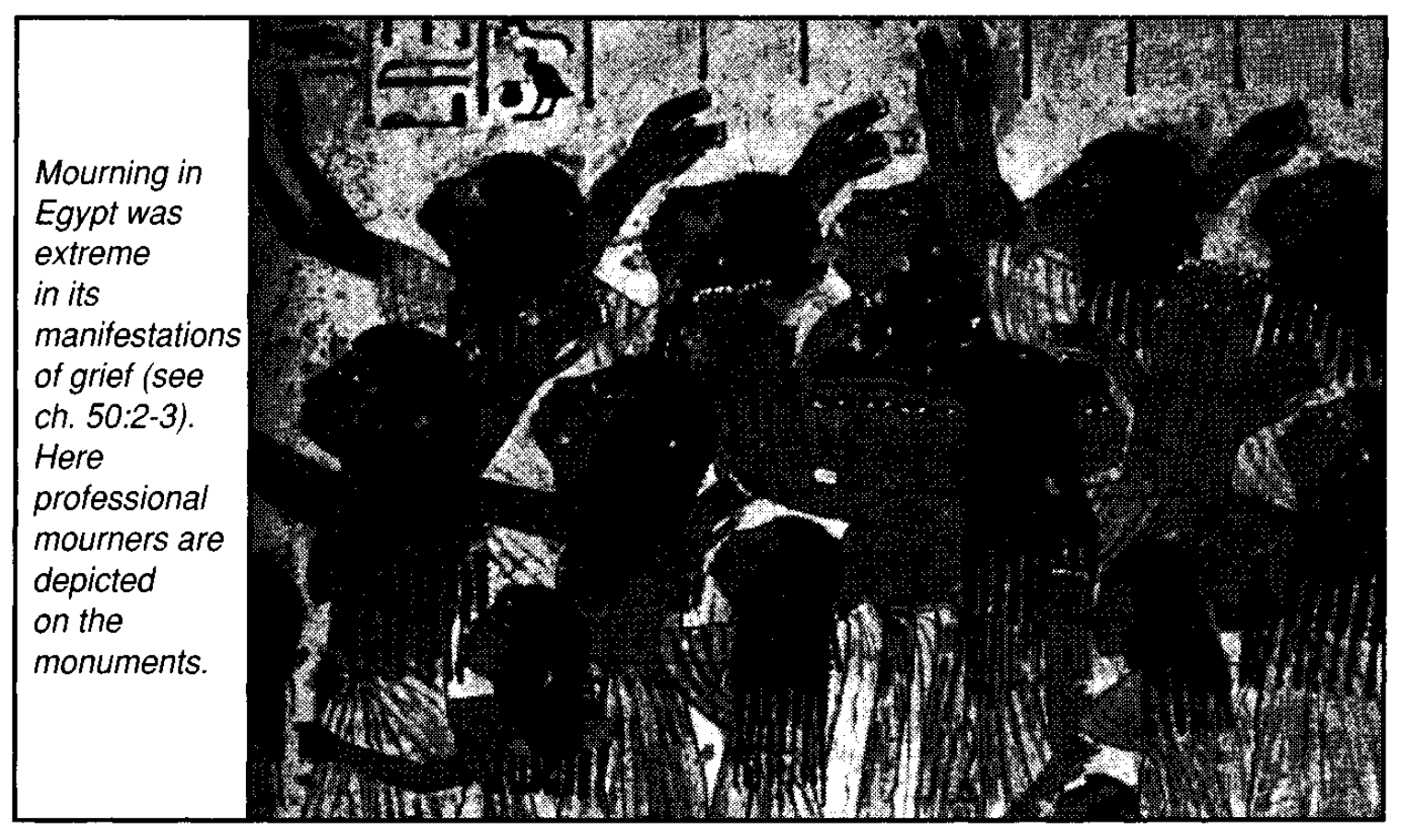
Comments