447. EXODUS - CHAPTER TWENTY
TEN COMMANDMENTS PROCLAIMED TO THE PEOPLE AT HOREB
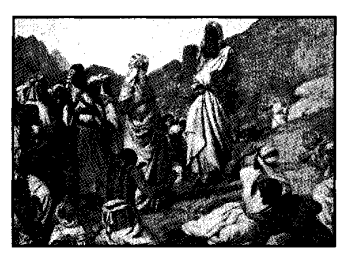
A holy and righteous God has holy and righteous standards. These are set before the people in the form often commandments that provide the basis of Yahweh's covenant through Moses. Meanwhile, the awful manifestation of divine majesty based upon Law causes the people in fear to withdraw themselves. They plead with Moses to intercede for them. Accordingly, on their behalf, he draws near to the mount and is instructed as to the basic requirements that worshippers should observe in approaching Yahweh.
The Ten Commandments — vv. 1-17.
The Ten Commandments form the basis of the Mosaic Covenant (Exo. 34:28), so that the tables of stone upon which they were subsequently inscribed were called "the tables of the covenant" (Heb. 9:4).
These commandments, which Yahweh was about to give to Israel were not the first issued, for divine laws have always existed (Gen. 26:5). In fact, they are necessary to proper human conduct. If moral law were an element in the nature of things like the law of gravitation, or of eating and drinking, it would assert itself naturally.
Mankind's universal lawlessness, however, demonstrates that this is not the case, and makes moral law a necessity. Moreover there are laws of varying importance.
Notice that in the ten commandments, the first four relate to Yahweh, the fifth to parents, and the last four to the individual's relations with his fellowmen. This establishes the relative importance in the affairs of life: God first, home obligations next, then toward fellow-man, self last.
VERSE 1
"And God spake all these words, saying" — Moses and Aaron had drawn "unto" the mount, and now stood in front of the priests and people, between them and the mount. They had not ascended into the mount itself (see Exo. 24:1). Meanwhile, the divine glory had moved from Sinai to Horeb (Exo. 19:18; Deu. 4:11), which mount was now enveloped in cloud, fire and lightning (Deu. 4:11). Yahweh then spake directly to the people (Deu. 4:10), proclaiming the Ten Commandments.
The people were evidently drawn up in a body before Horeb, with the priests in front (Exo. 19:22), and Moses and Aaron before them (Exo. 19:24; Deu. 5:4-5). The people heard the Voice out of the fire (Deu. 4:12), and understood what was spoken unto them (Deu. 4:12, 33, 36; 5:23; Exo. 20:22). This could hardly have been the case if the Voice had thundered from the hidden eminence of Sinai, five kilometres (8 miles) distant from where they were assembled. In that case, the Voice would have been broken up by echoes prominent around the mounts. Nor would there have been need to "gather the people together," for it would have thundered along the valleys where they had encamped. Later, however, when the people returned to their tents, they no longer heard the Voice, suggesting their need to come close to the mount to hear it (Exo. 20:21; Deu. 5:27-31). All this suggests that when the Voice was heard, it was similar to the "still, small voice" heard by Elijah when he was at Horeb, and witnessed a similar theophany in storm and thunder. The still, small Voice of God, penetrating beyond the roar of thunder, would have been singularly impressive as it solemnly enunciated the Ten Commandments.
The word for "God" is Elohim, a term frequently used for the angels, and which is translated "angels" in Psa. 8:5. The Law was given by angels (Acts 7:53; Gal. 3:19; Heb. 2:2) as "ministering spirits" (Heb. 1:14), speaking the words of Yahweh.
VERSE 2
"I am Yahweh thy God, which have brought thee out of the land of Egypt"— The prelude proclaims the benefits received by the people from Yahweh, and implies that such should be repaid by loving obedience.
The Hebrew form of "Egypt" is Mitzraim signifying Oppressors.
"Out of the house of bondage" — The people of Israel had been called out of a servitude that offered them nothing but toil, sadness and death. The same principle is observed by Paul when he outlines the privileges obtained in Christ (see Rom. 6:13). At the foot of Horeb, the people learned that, in spite of the awful manifestation of cloud, thunder, lightning, earthquake and fire that accompanied the divine theophany, the goodness of Yahweh also was in evidence: so that both "goodness and severity" were blended together (Rom. 11:22). God had delivered the people from a hopeless state of servitude and death, and the enunciation of what He had done for them taught them that He desired to be obeyed through love and not fear. Fear of Yahweh is the beginning of knowledge (Pro. 1:7), but love is its development (Col. 3:14).
VERSE 3
"Thou shalt have no other gods before Me" — To honour Yahweh is the first and greatest of all commandments, and was endorsed by the Lord as such (Mat. 22:31-38; Mark 12:30; Luke 10:27-28). The responsibility to do this is a personal one, hence the commandment is directed to individuals as such.
"Thou" is in the singular number, emphasising the need of each one, on his own account, to obey Yahweh. Man is so constituted that he must worship someone or something, and this first commandment directs the channel of such inherent desire towards Yahweh. However, a person does not have to be guilty of bowing down to a pagan deity in order to break this command. He can be found worshipping self, his family, home, or business instead of God. Paul rates covetousness as idolatry (Col. 3:5), and in this materialistic age there is, perhaps, more widespread worship of that god than any other.
The time is approaching, however, when the fallacy of this form of worship will be brought prominently before all, and men will seek to unload themselves of their burdens of gold and silver (Isa. 2:20). In the revelation of Truth at Christ's coming, mankind will be moved to confess: "Surely our fathers have inherited lies, vanity, and things wherein there is no profit. Shall a man make gods unto himself, and they are no gods? Therefore, behold, I will this once cause them to know Mine hand and My might; and they shall know that My name is Yahweh" (Jer. 16:19-21). Thus this first commandment advocates the inward worship of God in love, desire, joy, hope, and admiration, for only when He is thus approached do we offer Him the first place in our considerations.
"Before Me" is literally "before My faces." This can be rendered idiomatically as "in My sight," or, doctrinally, as relating to the Elohistic faces of Yahweh: the angels who supervise worshippers (Heb. 1:14; Mat. 18:10), and record their actions for the purpose of future judgment. Enoch "walked with God" (Gen. 5:22, 24), as did Noah (6:9). Abram was commanded to "walk before God" (17:1), that is, to walk in the continuing presence of God. Let us seek also so to walk.
VERSE 4
"Thou shalt not make unto thee any graven image, or any likeness of any thing that is in heaven above, or that is in the earth beneath, or that is in the water under the earth" — This second commandment forbids the worship of even the true God by images (cp. Isa. 40:18, 25). This was in contrast to the practice of the Egyptians who made "images of creation," and sought to worship the gods thereby. See the prohibition also enforced by the apostles (Acts 15:20, 29; 21:25; Rom. 1:18-32; 2:22; 1 Cor. 10:7, 14; Gal. 5:20; Col. 3:5), which related to the making of images for the purpose of worship.
Moses made the brazen serpent, and ordered the shaping of the cherubic figures without violating the command, for these were objects commanded by the Deity to reflect and present the principles of divine Truth. Our religious worship must be governed by the power of faith, and not by that of imagination, or the need to be stimulated by external objects to incite it.
This second commandment requires attendance on God's Word, supplemented by the practice of prayer and of praise.
VERSE 5
"Thou shalt not bow down thyself to them, nor serve them" — An Israelite might imagine that the prohibition regarding images was limited to making them, and that he could, under certain circumstances, offer worship or servitude to the gods made by others. This is now specifically prohibited. The use of images in Roman Catholic churches is plainly contrary to the letter of this command, and so also is the elevation of a building as an object of worship. Yahweh must be worshipped in faith.
"For I Yahweh thy God am a jealous God" — Yahweh demands our undivided allegiance. He will not share the glory and praise due to Him with others (Isa. 42:8; 48:11). He is so insistent upon this, that He has surnamed His name with the title of Jealous (see notes Exo. 34:14; Deu. 4:24; 5:9; 6:15; Jos. 24:19). Unfaithfulness in worship before Him is treated as spiritual adultery (James 4:4; Jer. 3:1-2; Eze. 16:20-26), punishable with death.
"Visiting the iniquity of the fathers upon the children unto the third and fourth generation of them that hate Me" — This warns that though Yahweh is ever just (cp. Num. 26:11; Deu. 24:16; Eze. 18:10-22), the punishment that parents might receive can also involve their offspring. They can bring distress upon those with whom they are responsible, just as a disease can be transmitted to those nearby. Therefore, parents who love their children, best help them by being circumspect in their worship of God. For example, the sin of idolatry in Israel was punished by the nation being taken to Babylon into captivity: a punishment that involved both the parents who were directly responsible for the sin, and the children who were brought up in its atmosphere.
Moreover such punishment could continue on until the third and fourth generation of those who hate Yahweh. Of course, if the children repudiated the actions of their parents, and sought to worship Yahweh in truth, they would be treated by God on that basis (Eze. 18:14-18). An example of this is seen in the case of the children of Korah, who evidently rejected the sin of their father, and were exonerated from the punishment meted out to him (see Num. 16:27, where the family of Dathan and Abiram are mentioned, but not that of Korah. Hence: l Chr.9:19).
VERSE 6
"And shewing mercy unto thousands of them that love Me, and keep My commandments" — The word "mercy" is chesed, and signifies "kindness, favour, and pity" rather than mercy in the sense of forgiving sins. Chesed is a divine characteristic (see Exo. 34:6), and manifests Yahweh's goodness toward those who reveal their love for Him in keeping His commandments; for, "this is love that we walk after His commandments" (2 John 6). The literal Hebrew is "to the thousandth generation of them that love Me" (Deu. 7:9; Ps. 105:8). Consequently, Yahweh's lovingkindness is boundless: a contrast to His action toward those who hate Him, which is limited to the "third or fourth generation." "He is slow to anger, and plenteous in mercy" (Psa. 103:8), and "His anger endureth but a moment" (Psa. 30:5).
VERSE 7
"Thou shalt not take the name of Yahweh thy God in vain" — This third commandment has relation to practical principles in regard to the worship required by God. His Name was named upon the people of Israel (Num. 6:27) as it is on those today who worship Him in truth (Acts 15:14).
Those who bear this relationship to the Name, being Name-bearers, can "take it in vain," by treating it lightly, not living up to what it requires. Thus Israel is said to have "profaned the holy Name" when the people acted so inconsistently with it as to bring it into disrepute (Eze. 36:20). And this even though they refused to mention the Name out of a superstitious regard for the very commandment before us! Proverbs describes breaking the commandments of God, as indicative of "taking His Name in vain" (Pro. 30:9), which can be done without any mention of it. On the other hand, the Lord taught his disciples to pray: "Hallowed be Thy Name" (Mat. 6:9).
We take God's name in vain by:
[1] Hypocrisy. Making a profession of God's Name, and setting a value on it, but not living up to that profession. "Let every one that nameth the name of Christ depart from iniquity" (2 Tim. 2:19).
[2] Covenant-breaking. If we make promises to God, yet do not perform our vows, we treat His Name lightly (Mat. 5:33). It is folly, and God has no pleasure in fools (Ecc. 5:4), nor will He be mocked (Gal. 6:7).
[3] Irresponsibility. By using it lightly or carelessly, and without regard to its significance, or our responsibility as Name-bearers to manifest the divine qualities associated with it (Exo. 34:6-7).
The statement in the verse before us has particular reference to the utterance of an oath. The word "take" is from nasa, "to lift up," and here refers to one taking the Name of Yahweh upon the tongue as in an oath. The term "in vain" can be rendered "for vanity" or "falsehood." Yahweh's Name is holy and must not be used to testify to anything that is untrue, insincere or trivial.
"For Yahweh will not hold him guiltless that taketh His name in vain" — Whatever a person may think, however he may plead his own cause, or confess to ignorance of what is required in relation to the Name, Yahweh will not hold him guiltless who treats it lightly (see Mat. 5:33-37).
VERSE 8
"Remember the sabbath day, to keep it holy" — In this fourth commandment Israelites were to "remember the sabbath day." Hence they had to bear in mind the circumstances in which it was first introduced. It is significant that the sabbath rest was first commanded at the giving of the manna from heaven (Exo. 16:23), for, at the appearance of the anti-typical "manna" from heaven (John 6), there was offered to the people a true rest from the works of sin (Mat. 11:28-30).
It is also significant that it was on the background of that statement, that the Lord proceeded to demonstrate the sense in which his disciples "keep the sabbath." He explained that even as the priests in the temple "profaned the sabbath and were blameless" (Mat. 12:5-8), so also were his disciples, who had been called to a higher form of priestly ministration in him (IPet. 2:9). The sabbath was not a day of rest for the priests ministering in the temple, but the very reverse: their labours were doubled, and their time was given to actively performing the will of Yahweh. So also with the followers of the Lord. They keep the sabbath as did the priests in the temple: by constantly striving to do the will of God every day, rather than limiting this to one day in seven. Thus they try to rest from the works of the flesh every day whilst striving to do the will of God (Heb. 4:4-11).
The sabbath was not a day of idleness, but of spiritual labour (cp. Heb. 4:11), of concentration of the mind on the things of Yahweh, and finding it a "delight" so to do (Isa. 58:13). This was only possible when the spiritual significance of the sabbath was brought to mind, and Israelites saw it as a foreshadowing of the millennial rest yet to come (Isa. 58:14). Unfortunately, most Israelites "polluted His sabbaths" (Eze. 20:13), impatiently awaiting their end (Amos 8:5), exclaiming, "What a weariness it is!" (Mal. 1:13).
The observance of the sabbath is not enjoined on believers today, because their status is that of priests in the temple (cp. Mat. 12:5; 2Cor. 6:16; IPet. 2:9). The sabbath was a shadow, the fulness of which is seen in Christ (Col. 2:14-16; Rom. 14:5; Gal. 4:9-10). Even the Law witnessed to that, for if it was necessary to circumcise a child on the sabbath, being the "eighth day" of the child's life, the sabbath rest was waived to perform it (John 7:22-23). Circumcision took precedence of sabbath keeping because it was the token of the Abrahamic covenant, whereas the latter was the token of the Mosaic covenant. The sabbath pointed forward to the millennial rest, whereas circumcision on the eighth day, pointed forward to the end of the millennium when sin and death will cease, and all living will inherit immortality. Meanwhile, it is significant to notice that sabbath keeping will be re-instituted in the kingdom (Eze. 44:24; 45:17; 46:3; Isa. 66:23), but then, apparently, on the first day of the week, and not on the seventh (Eze. 43:27).
Although sabbath keeping was first introduced at the giving of manna (Exo. 16:25), evidently the division of time into weeks and months was observed from the beginning. At the time of the exodus from Egypt, the months of the year were readjusted to provide for a religious new year for Israel as well as its civil year (Exo. 12:1). The sabbath rest was appointed shortly afterwards.
VERSE 9
"Six days shalt thou labour, and do all thy work" — Note that Israelites were commanded to labour on the six days, not to loiter! This command identifies the labourer in his field with the Creator, who continues in activity (Jn. 5:17), upholding all things by His power. So Paul exhorts that our daily experiences of labour are an expression of co-operation with God, who provides the food to "eat" (2Thes. 3:10).
VERSE 10
"But the seventh day is the sabbath of Yahweh thy God" - The R.V. has a significant change of this statement, altering of to unto. There is no rest for Yahweh at present. This was illustrated by the comment of the Lord when he was accused of breaking the sabbath. He answered his critics by stating: "My Father worketh hitherto, and I work" (John 5:17). God rested at the beginning, but sin intervened to prevent a continued rest. The sabbath rest was designed to intermit man's labour that he might give himself unto God.
"In it thou shalt not do any work, thou, nor thy son, nor thy daughter, thy manservant, nor thy maidservant, nor thy cattle" — A man's wife is not included in this prohibition because, normally what he would do she would endorse. In commenting upon the sabbath restrictions, Brother Thomas states (Elpis Israel, p. 16-17): "From these testimonies (Exo. 31:12-17; Deu. 5:15; Exo. 35:2-3; Num. 15:32-36; Jer. 17:21-27; Exo. 16:29-30) it is clear that it was unlawful for servants in the families of Israel to light fires, cook dinners, harness horses, drive out families to the synagogues, or priests to the temple to officiate in the service of the Lord. The visiting of families on the sabbath day, the taking of excursions for health or for preaching, and conversing about worldly, or family, or any kind of secular affairs, was also illegal... On this day, however, it was 'lawful to do good;' but then, this good was not arbitrary. Neither the priests nor the people were the judges of the good or evil, but the law only which defined it. 'On the sabbath days the priests in the temple profaned the sabbath, and were blameless' (Mat. 12:5), for the law enjoined them to offer 'two lambs of the first year, without spot, as the burnt offer-ring of every sabbath' (Num. 28:9-10). This was a profanation of the seventh-day law, which prohibited 'any work' from being done; and had not God commanded it, they would have been 'guilty of death.' It was upon this ground that Jesus was 'guiltless;' for he did the work of God on that day in healing the sick as the Father had commanded him."
"Nor thy stranger that is within thy gates" — The Hebrew ger denotes the resident alien, a proselyte of the gate, or, as the Talmud states: "The non-Israelite who agrees to keep the seven Noahic precepts." See also Exo. 12:48.
VERSE 11
"For in six days Yahweh made heaven and earth, the sea, and all that in them is" — The word "made" is asah, and signifies not merely to "make" but also to "appoint," and is so rendered in Job 14:5 and Psa. 104:19. It is also translated "dressed" (Gen. 18:7-8; 2Sam. 12:4; Lev. 7:9). Therefore, the statement does not necessarily mean that our heavens and the earth were created six thousand years ago, but rather that they were put in order, or appointed their positions in relation to the earth and man upon it.
"And rested the seventh day" — Six days of activity brought the work of creation to the apex of Yahweh's intention, and was followed by a day of rest, typifying His ultimate purpose to fill the earth with His glory (see Heb. 4:9).
"Wherefore Yahweh blessed the sabbath day and hallowed it" — The word "blessed" is from the Hebrew barak, "to kneel," and hence to submit to its requirements. The term in relation to Yahweh and the sabbath means that He condescended to provide a day for man's good (cp. Mark 2:27). To "hallow" (qadash) it is to set it apart for special observation.
Making reference to the resting of God on the seventh day, Moses declared: "God blessed the seventh day, and sanctified it!" But when did He do that? Not at creation, but at the time Moses recorded. Thus Moses, in noting the work of the first seven days, linked it up with the sabbath day ordinance given exclusively to Israel 2,500 years later.
VERSE 12
"Honour thy father and thy mother" — This is the fifth commandment, and because five is the number of grace, it is appropriate that Israelites should be reminded of their duty to parents. See this command endorsed in Mat. 15:4; Eph. 6:2. Col. 3:20. It cuts right across modern philosophy which encourages children to think independently of, and even in opposition to, the counsel of their parents. This commandment is not limited to minors however, but has application to parents as well. Paul makes the point, that the father of the household, in status and responsibility should reveal the "image and glory of God" (ICor. 11:7; see also Eph. 3:14-15), and elsewhere he likens the ecclesia to "the mother of us all" (Gal. 4:26). In similar typology, Yahweh is the Father of the nation, whilst Israel is likened to His Bride (Isa. 54:5). This fifth commandment, therefore, not only taught the need for filial affection in the home and among the family, but also the need for adult Israelites to manifest love, respect and loyalty towards their spiritual Father (Deu. 32:6), and the nation into which they were born. A similar love and loyalty should be manifested towards Yahweh and the Ecclesia by believers today.
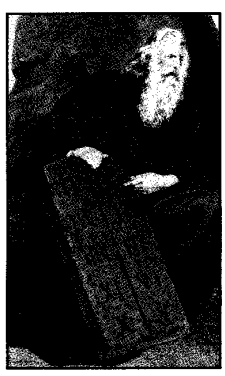
It is significant, that the ten commandments were inscribed on two slabs of stone, the first five on one; and the last five on the other. The first stone carried commandments that related to God and the family; the second stone those that relate to human relationships. God first, family next, then neighbours, is the divine order. "Thou shalt love the Lord thy God, and thy neighbour as thyself formed the basis of all the law and the prophets, taught the Lord (Mat. 22:38-40). In fact, the fifth commandment concerning family responsibilities, is associated with God as listed on the first stone, demonstrating the divine association in the family.
"That thy days may be long upon the land which Yahweh thy God giveth thee" — This addition to the fifth commandment elevates it into a special category, for Paul comments: it is "the first commandment with promise; that it may be well with thee, and thou mayest live long on the earth" (Eph. 6:2-3). This promise related to Israel both nationally and individually; for the home unit is the basis of the nation, as it is of the ecclesia. Let homes be regulated according to divine principles, and there will be no need to fear the future of either a nation or an ecclesia. See Pro. 23:22-25; Mal. 1:6; Col. 3:20, and contrast with Pro. 15:5; 30:11, 17.
Because Israel did not honour their heavenly Father, they were driven into exile (Mal. 1:6; Deu. 4:25-27,40; 25:15; 32:47). This punishment, inflicted because of the sins of parents, was experienced by children also, who thus learned to avoid the failings of adults. For example, the seventy years captivity in Babylon had a salutary effect upon the nation as a whole, for it cured it of idolatry. Never again did Israel turn to pagan idols. Therefore, although the effects of sin sometimes fall on innocent members of the family, the result is instruction for their ultimate benefit.
VERSE 13
"Thou shalt not kill" - This sixth commandment legislates against unauthorised killing, such as man-slaughter and murder, and not against judicial executions or the destruction of enemies in a holy war: a war commanded by Yahweh. Thus Noah was told that "at the hand of every man's brother will I require the life of man" (Gen. 9:5), but Joshua was commanded to completely destroy the Canaanites.
The command, "Thou shalt not kill," did not override these other requirements, but related to the taking of personal vengeance. The commandment was confirmed by the terms of the new covenant (Mat. 5:21-22; Rom. 13:9; Jas. 2:11). Indeed it went further, and forbad the very root and cause of such unauthorised killing. It prohibited a believer manifesting anger against his brother without due cause (Mat. 5:22), and described one who harboured hatred in his heart as a "murderer" without hope of eternal life (Uohn 3:15). What care we should exercise in our relationships one with the other! How important to observe Paul's exhortation of restraint in regard to anger: "Be ye angry and sin not; let not the sun go down upon your wrath" (Eph. 4:26). Whilst there is such a thing as righteous anger, and it is good to manifest such (Mark 3:5), there is also need to exercise patience and avoid being "soon angry" (Tit. 1:7).
VERSE 14
"Thou shalt not commit adultery" — Christ's instruction on this command is to avoid even looking at members of the opposite sex to incite such a lust (Mat. 5:28), thus revealing the spirit behind the law. Adultery is an act of unfaithfulness. In that regard there is such a thing as spiritual adultery. James admonishes: "Ye adulteresses [the word "adulterers" is not in the original], know ye not that the friendship of the world is enmity with God?" (James 4:4). The Redeemed are likened to virgins who have been faithful to their Lord, avoiding unscriptural associations with Babylon the Great and her harlot daughters (Rev. 14:4; 17:5). In the New Covenant, an unwarranted friendship with the world is accounted as adultery, which, under the Old Covenant, was punishable with death.
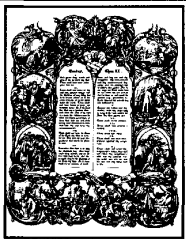
Summary of The Ten Commandments
The Ten Commandments, described as "the ten words' (Deu. 5:22) were inscribed on two tables of stone representative of the two great commandments upon which all the Law rested: Love to Yahweh; and love towards neighbour (Mat. 22:40).
The first five, inscribed on the first stone have each an explanatory addition; the last five, on the second stone, are brief and emphatic; a series of Thou shalt notsl This is appropriate. An explanation of our duty to Yahweh whom we cannot see is necessary; whereas personal experience should teach us how to act towards others. These duties have their root in the principle: "Thou shalt love thy neighbour as thyself (Lev. 19:18). The first five commandments all mention the divine Name; the last five do not — for the first stone had relation to God, whereas the second stone concerned behaviour towards men.
The Ten Commandments provided the basis of the Mosaic Covenant (Deu. 4:13; 1Kings 8:9,21; Heb. 9:4). They introduced a new social order in Israel based upon worship of God, and thoughtful consideration of others. This was further amplified in the statutes that were introduced to the people at the same time (Deu. 4:14).
VERSE 15
"Thou shalt not steal" — The New Covenant likewise warns against dishonesty to man or God. In relation to the first, Paul advocates that brethren should observe scrupulous integrity: "Let him that stole steal no more, but rather let him labour, working with his hands the thing which is good, that he may have to give to him that needeth" (Eph. 4:28). We live in an age of dishonesty. Petty thieving is increasing rapidly among young and old alike. Moreover there prevails a dishonest attitude in regard to labour. Sometimes employees "go slow," "take sick leave" when not ill, waste time which, in fact, they have sold to their employer. In measure this is stealing. In addition, there is such a thing as "robbing God." Israelites were guilty of that when they failed to return to God His due (Mal. 3:6-10).
A person also steals who robs God's Word of its true significance. Thus the Lord decried as "thieves and robbers" those shepherds who failed to minister to the flock as directed by God (John 10:1). In illustration of that, he declared that the religious leaders of Jewry had turned the temple of God into "a den of thieves" (Mark 11:17).
VERSE 16
"Thou shalt not bear false witness against thy neighbour" — To falsely slander the character of another is to bear false witness against him. We need to bear in mind that Christ "is the silent listener to every conversation" and will execute judgment on those who bear false witness, whilst he will also vindicate the righteous (Psa. 101:5-6; Pro. 10:18; 11:13; Rom. 13:9; Eph. 4:25). James wrote at length on the need to keep a guard on the tongue. He pointed out that the man who learns to tame the tongue is a perfect man, whereas on the contrary, "therewith bless we God, even the Father; and therewith curse we men, which are made after the similitude of God" (James 3:9). From the same source, he continues, there "proceedeth blessing and cursing," a thing which should not so be. He states that a person who speaks evil of his brother actually flouts the law, and therefore, himself, will come under the strictures of the law (James 4:11).
VERSE 17
"Thou shalt not covet thy neighbour's house, thou shalt not covet thy neighbour's wife, nor his manservant, nor his maidservant, nor his ox, nor his ass, nor any thing that is thy neighbour's" — As noted in an earlier comment, covetousness, against which this tenth commandment legislates, is a form of idolatry. Therefore, there is little use a person priding himself upon having no other God but Yahweh, if at the same time, he is given over to covetousness. The danger of the times in which we live, is that covetousness is encouraged on every hand. Modern advertising is designed to make a person discontented with what he has, and to incite him to covet what others possess. The great antidote is the study of the Word (see Psa. 119:36; Ecc. 4:8; 5:10-11; Mat. 6:24-34; Luke 12:15; Heb. 13:5). The Word will reveal how little we really need in order to discover true happiness, and it will also show us how great are those blessings that Yahweh has lavished upon us. It will teach us not to place undue importance upon this life and all that it presents, but to labour for that which is to come.
A covetous man is a discontented man: a man not satisfied with his lot in the life God has permitted him. Covetousness is the root of all sin: murder, adultery, thieving, slandering. It makes a child dissatisfied with his family heritage. It creates impatience with the restrictions of the Truth, and views them as an infringement of personal rights in self-seeking to personal advantage. It destroys faith, for it doubts Yahweh's ability to provide the necessities of life, whilst viewing luxuries as life's vital needs! It is significant that Paul cited this tenth command as a prelude to his discourse on indwelling sin (Rom. 7:7). Obviously he recognised that selfish desire comprised the root of every evil. However, he had learned to rise above it: "I have learned, in whatsoever state I am, therewith to be content" (Phil. 4:11), and summarised his experience by stating: "Godliness with contentment is great gain. For we brought nothing into this world, and it is certain we can carry nothing out. And having food and raiment let us be therewith content" (1 Tim. 6:6-8).
Moses The Mediator — vv. 18-21.
At the conclusion of the proclamation of the ten commandments, the people, moved by fear, plead that they may be permitted to withdraw, and that any further revelations should be made through Moses as mediator. See Deu. 5:23-31; Heb. 12:19.
VERSE 18
"And all the people saw the thun-derings, and the lightnings, and the noise of the trumpet, and the mountain smoking" — The roar of thunder, the flash of lightning, the ear-splitting, strident note of the shophar trumpet, together with the smoking mountain, caused the people to fear and tremble. The Sinaitic mountains are so constructed that the claps of thunder and the long drawn out trumpet notes would reverberate and echo throughout the valleys with terrifying effect. They would be bandied from crag to crag, to roar along the wadis and mountains, until lost in the distance.
"And when the people saw it, they removed, and stood afar off" — In fear and trembling they retired from the barrier at the foot of Horeb, to the shelter of their tents in the valleys leading to the plain (Deu. 5:30). There they did not hear the voice of the angel, which would not have been the case, if the divine voice had sounded as thunder (Deu. 5:27-31). We have given reasons for believing that amid the noise of thunder and the sounding of the trumpet, the Voice of Yahweh must have been as a "still, small voice," penetrating in its power. If it had sounded as thunder from Sinai which is some five kilometres (8 miles) distant from Horeb, it would have been unclear and unintelligible, distorted by echoes. A fuller account of this incident is given in Deu. 5:22-32.
VERSE 19
"And they said unto Moses" — Representatives of the tribes approached Moses with this request (Deu. 5:23).
"Speak thou with us, and we will hear: but let not God speak with us, lest we die" — A fuller account of their request is given in Deu. 5:24-27. Therein they acknowledge that they had witnessed the divine glory, and heard the voice of God out of the midst of the fire. They particularly express fear because of the consuming fire that flamed on the Mount (see Deu. 5:25; 4:24; 9:3). They request that Moses should act as their mediator, promising again to obey God in all that is required of them. Paul uses this experience as a means of demonstrating how much more accessible is God under the covenant of Grace, than under the covenant of Law (Heb. 12:18-21).
VERSE 20
"And Moses said unto the people" — Moses first held colloquy with the angel who authorised him to permit the withdrawal of the people. Indeed the angel, representing Yahweh, acknowledged that they "had spoken well" in making such a request: they recognised the tremendous responsibility of worshipping according to Law. He expressed the hope that the healthy, spiritually motivating fear they now manifested, would continue to activate them (Deu. 5:28-33); for "the fear of Yahweh is the beginning of knowledge" (Pro. 1:7).
"Fear not" — Moses attempted to pacify the people with the assurance that there was no cause for total, abject fear, if their hearts were right with Yahweh (see Deu. 5:29).
"For God is come to prove you, and that His fear may be before your faces, that ye sin not" — Yahweh's words to Moses on that score are recorded in Deu. 5:29. So long as the "fear of Yahweh" was before the people they were more likely to keep His commandments. Familiarity with the things of God can cause contempt. We must never allow the privilege of worship granted us to become a mere matter of routine.
VERSE 21
"And the people stood afar off" — The people retired to their tents (Deu. 5:30), fearfully watching the apocalypse of glory from afar, being at that distance unable to hear the Voice.
"And Moses drew near unto the thick darkness" — Moses remained at the foot of Mount Horeb from whence the angel spake with him (Deu. 5:31). The thick darkness was designed to veil the divine glory which the angel manifested, and which it is not possible for mortal man to view without harm (1 Tim. 6:16).
"Where God was" - The word Elo-him is frequently used for an angel as representing the host of heaven. It is clearly stated that Moses received the Law "by the disposition of angels" (Acts 7:53). This angel spake the words of Yahweh, for the divine name was named upon him (Exo. 20:22;23:20-21).
The Yahweh Altar: Sole Means of Approach — vv. 22-26.
As a basis for further revelation, Moses is told to instruct the people that they must not worship God through idols of silver or gold. Their approach is to be to an invisible God, symbolised by the "thick darkness" Moses had approached, and the only visible object in such worship is to be the altar, particulars of which are now disclosed to Moses.
VERSE 22
"And Yahweh said unto Moses, Thus thou shalt say unto the children of Israel" — Moses now assumed the position of mediator, so that Paul later wrote: "The Law... was ordained by angels in the hand of a mediator" (Gal. 3:19).
"Ye have seen that I have talked with you from heaven" — The words were spoken by the angels on earth, but they originated from heaven.
VERSE 23
"Ye shall not make with Me gods of silver, neither shall ye make unto you gods of gold" — Instead of "with Me," the Septuagint renders for yourselves, making it consistent with the rest of the statement. The Vulgate omits the statement altogether, whereas the Peshitto (Syriac) has both: for yourselves with Me. The Berkeley translation has: "Make yourselves no gods of silver or gold to rival Me," which seems to set forth the correct idea. The first thought of the Israelites, when they imagined that Moses had deserted them, was to make a golden calf for a god.
VERSE 24
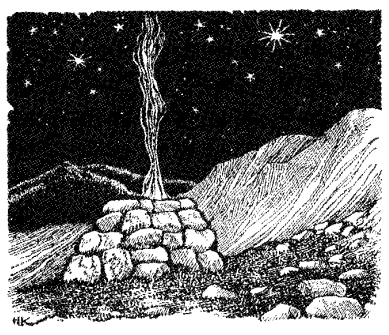
"An altar of earth thou shalt make unto Me" — The word "altar" is mizbeach from zabach signifying "slaughter." Such an altar could be made of earth or stone, but in either case it must not be shaped according to man's device. If it were an altar of earth, it must be heaped up in a simple manner. The elevation symbolised the lifting up of man toward Yahweh; its simplicity directed man's attention from himself and material things to the God of heaven. In Eureka vol. 2, p. 236, Brother Thomas observes: "In the building of altars the will of the Deity was that they should be of earth; or if of stone, that the stone should not be hewn... Now, all this was significant of the substance, Christ, who was 'the end of the law.' The Holy Spirit signified something that he regarded important in his system of wisdom, in commanding an altar to be made of earth, or of unhewn stone; and in forbidding a tool to be lifted upon it. The things commanded were 'a parable for the time then present' — a riddle, the meaning of which would be found in the realities developed in the Christ. He is declared by Paul to be the Christian altar. 'We have an altar,' says he in Heb. 12:10, which in being cleansed by the blood of Jesus is made identical with him. He was the altar of earth, or of unhewn stone; and in his making, or generation, he was begotten, 'not of blood, nor of the will of the flesh, nor of the will of man, but of the Deity.' To affirm that in his generation he was begotten of Joseph is to 'pollute him.' In admitting his altarship, and at the same time affirming his paternity to be of Joseph, and not of the Deity, as related in Luke, is to make Joseph the builder of an altar of hewn stone — a polluted altar, upon which a man's nakedness had been discovered." See also notes on Exo. 17:15.
"And shalt sacrifice thereon thy burnt offerings, and thy peace offerings, thy sheep, and thine oxen" — Such offerings were made even before the Law of Moses. They comprised the tokens of dedication of self to God, and of fellowship with Him. For further details see Lev. 1:1-17; 3:1-17.
"In all places where I record My name" — The building of altars was restricted to those places where special theophanies of God occurred. Ultimately Zion became chief among these places, for Yahweh chose it that it might be the main centre of worship. He instructed the people, through Moses, that once they were in the land, He would select a specific site at which to place His name, and to that centre they must turn for worship (see Deu. 12:5, 11, 14, 21, 26; 14:23; 16:5-6, 11; 26:2). Later that site was revealed as Zion (Psa. 132:13-14), and subsequently, the temple was built there (1 Kings 8:29, 43; 9:3; 2Chr. 6:6; 7:16; 12:13; Ezra 6:12; Neh. 1:9; Psa. 74:7; 76:2; 78:68; Jer. 7:10-12). Jerusalem shall be the centre of universal worship in the Age to come, the place where Yahweh's name will be recorded. Hence the prophet declared: "Surely the isles shall wait for Me... to bring thy sons from far... unto the name of Yahweh thy God" (Isa. 60:9). Meanwhile, during the epoch of Israel's dispersion, no specific centre is found for worship. The question was put to the Lord by the woman of Samaria, and he replied: "The hour cometh, when ye shall neither in this mountain (Gerizim), nor yet at Jerusalem, worship the Father... The true worshippers shall worship the Father in spirit and in truth: for the Father seeketh such to worship Him" (Acts 15:14), and as such constitute the spiritual temple of Yahweh (2 Cor. 6:16). See also Mat. 18:10; 1 Tim. 3:15; Heb. 12:22-23.
"I will come unto thee, and I will bless thee" — The word "bless" is the Hebrew barak, and comes from a root signifying to kneel as a servant. Yahweh did this to Israel by attending to their needs through angelic ministration (Heb. 1:14). But in a particular fashion He has served all the elect in that He sent His Son to minister to their needs, and to reveal unto them the great blessing of eternal life. In order to emphasise this, and to demonstrate the need of his followers to act as servants one to the other, the Lord, in the upper room, "laid aside his garments; and took a towel and girded himself," and so acted the part of a servant to the apostles, calling on them to do likewise. The one kneeling before them in that gracious act of humility was Yahweh manifested in flesh, tending to their needs that they might receive the blessing (see also Luke 22:27; John 13:12-13). The fulness of the blessing is yet to be revealed in Zion (Psa. 128:5; 133:3; 134:3).
VERSE 25
"And if thou wilt make Me an altar of stone" — An altar of earth would be erected at a temporary place of worship; but if something more permanent was deemed necessary, an altar of stone could be built.
"Thou shalt not build it of hewn stone: for if thou lift up thy tool upon it, thou hast polluted it" — The stone had to be unhewn stone as shaped by the Creator. Christ is our altar (Heb. 13:10), made in our physical likeness (earth or stone), but of divine parentage or character, unshaped by human devices. The type was fulfilled in the Lord. "We beheld his glory, the glory as of the only begotten of the Father" (John 1:14). "God was in Christ, reconciling the world unto Himself (2Cor. 5:19). "God was manifest in the flesh" (ITim. 3:16). The beautiful character of Christ was not derived by giving way to the desires of the flesh, but by strength obtained of the Father (Psa. 80:17). "He that hath seen me hath seen the Father," could only have been spoken by him, and that because of his divine parentage.
VERSE 26
"Neither shalt thou go up by steps unto Mine altar" — The altar must not be too high; it must be easily accessible, as is the Christ-altar to all those who seek it. That is the first principle presented by this prohibition; but there is a secondary and more important consideration, now presented by Moses.
"That thy nakedness be not discovered thereon" — The altar that Yahweh would provide (the Lord Jesus — Heb. 13:10) was to be "the seed of the woman," and not the "seed of man" (Gen. 3:15), as Brother Thomas states in the extract from Eureka cited on page 267. God, not man, was to be his Father, and to emphasise that principle this prohibition is introduced into the Law of the Altar. It was important to recognise that man's state in sin was so feeble, that he could only be rescued out of it by the divine provision of a saviour-altar. Concerning nakedness in worship, Bro. F. W. Barling writes in Law And Grace: "Those organs which enable man to procreate might be regarded as endowing him with the same creative power as God himself, a notion akin to the perverted one which formed the basis of the revolting fertility cults of those and later days. Such cults were abhorrent to the Creator, and no altar of His was to be, even in the most incidental way, profaned by those who ministered at it, as were the altars at which pagan priesthoods ministered (often naked) to the fiendish gods of their own devising" (p. 70).
The clothing of Aaron, with special garments down to the feet (Exo. 28:42-43) made this prohibition unnecessary, whilst the prohibition was allowed to stand, not merely as a protest against the Canaanitish forms of worship, but to emphasise the more important principle, that the antitypical Christ-altar would not owe its existence to a human father, for that would have polluted it. The Christ-altar was the specific interposition of God.
Comments