THE PLACE OF THE PSALMS IN ISRAEL'S WORSHIP
David "the sweet psalmist of Israel".
Some of earth's inhabitants have left an indelible impression upon the world. Over the brief span of their mortal years they have so risen above the behaviour or customs of the past as to provide a new standard for generations to come.
David the son of Jesse of Bethlehem-Judah was such a person. He was not born into wealth or fame, but the name of "David" is now synonymous with hope, joy and unity. The Jewish people looked back to the spirit of David when they strove to rekindle national aspirations and destiny. Upon their new flag they placed "the Star of David", awakening in the Jewish people around the world the awareness of what a blessed and united people they had been in the past, the deep past of 3,000 years before, when a young man of faith arose to seek the welfare of his people. "David the man of God" (Neh. 12:36), lifted the thinking of Israel towards their God as the nation had not known it before. He was "a man after God's own heart" and the nation was united and inspired by his brilliance upon the field of battle and by the integrity of his personal behaviour, alike to friend and foe.
One of the richest legacies that David left to Israel was the Psalms and their use in Israel's worship. From the earliest times of his life, David is presented as a lover of music, "a cunning player on an harp" who, in the court of the melancholy king "took an harp and played with his hand" with such skill and sensitivity that "Saul was refreshed, and was well, and the evil spirit departed from him" (1 Sam. 16:16, 18, 23). From this small beginning David learned in his life the power of music as a medium of inspiration and later conceived the idea of applying this to the nation's worship in a general and organized manner.
There are earlier examples of the use of instruments in worship. When Miriam led the women of Israel in joyous thanksgiving for the deliverance through the Red Sea, we read that "she took a timbrel in her hand; and all the women went out after her with timbrels and with dances" (Exod. 15:24). In a similar way Jephthah's daughter came out to welcome the return of her victorious father (Judges 11:34). In David's earlier years, when he returned with King Saul from the many encounters with the Philistines, we read that "the women came out of all cities of Israel, singing and dancing, to meet king Saul, with tabrets, with joy, and with instruments of musick" (1 Sam. 18:6). So the use of instruments in the company of women for the exercise of praise and worship was a fundamental practice in Israel long before David.
The significance of David's contribution is that he took the idea to the centre of the nation, in the very place of worship, established permanent companies of singers and players of instruments, composed and collected many psalms and spiritual songs and left behind an uplifting and important institution that prevailed throughout most of the period of the kingdom of Judah, and in fact to the period of the Second Temple until its destruction by Rome in A.D. 70.
So the private experiences and lessons of personal worship developed in the quiet valleys of Bethlehem brought a vitality and beauty to Israel's national worship for a thousand years duration.
There is another possible factor in the development of David's understanding of worship in song. When as son-in-law to king Saul, he desperately escaped from his own house through the help of Michal, "Saul's daughter", he found his way to Samuel's house in Naioth in Ramah (1 Samuel 19). Three times the foolish king sent a band of messengers to capture David within Samuel's dwelling, and three times the power of the Spirit of prophecy overpowered them. At length the king, who was incapable of being corrected, went himself to the dwelling of Samuel, his mind bent on the capture and destruction of David. Yet before he came to Naioth, the Spirit of God overtook him (as at the former occasion, 1 Sam. 10:9, 10) and he came to Samuel's house prophesying and lay down at the prophet's feet, only metres as it were from his quarry, but unable to touch the Lord's anointed! What an unforgettable experience for David. Samuel's prophetic ministration was accompanied by psaltery and tabret, pipe and harp (1 Sam. 10:5). It is hard to escape the thought that David visited Samuel's house before this call, but never could he have been so impressed with the power of the Word of God in music and song as when he witnessed his treacherous father-in-law restrained all day and night in the simple room of Samuel. Young men like David would not forget the lesson. If Samuel and David discussed other matters of the kingdom with its new dynasty— and we know they together chose the families for the keeping of the gates of the Temple (1 Chron. 9:22)—then it is very probable that they also gave combined thought to the matter of the singers and players of instruments. In fact Heman, one of the three principal singers was a grandson of Samuel. Faith often runs in a family.
The ark to Jerusalem.
The first occasion in which David employed large numbers of singers was on the joyous return of the Ark, for which he had prepared a new tabernacle (tent), in Jerusalem. There were a number of psalms written upon this subject (eg. 87, 96, 105, 106—see 1 Chron. 16), and it may be that some of these were employed in the songs of thanksgiving that characterized the triumphant return of the Ark:—
"And David and all Israel played before God with all their might and with singing, and with harps, and with psalteries, and with timbrels, and with cymbals, and with trumpets" (1 Chron. 13:8).
While this first attempt was abandoned, the second occasion was accompanied with even greater musical preparation and accompaniment. David instructed the Levites to appoint specific leaders in song, one from each of the three branches of this tribe. So from the Kohathites, Heman was appointed; from the Gershomites, Asaph; and from the sons of Merari, Ethan (1 Chron. 15:17). Let it be noted that these men were so important in the constitution of Israel that their complete genealogies are given in 1 Chronicles 6:33-48.
It is curious to note that there were then a second order described as "their brethren of the second degree", half of whom were to play with psalteries "on Alamoth" [or "for the maidens"] and the rest to employ harps "on the Sheminith" [or, perhaps, 'for the males'] (1 Chron. 15:20-21). So while Heman, Asaph and Ethan were to strike a sharp note upon cymbals (v. 19), these brethren of the second order provided harmony with psalteries and harps. So here we have the first description of part-singing, accompanied with various instruments. Even the principal instructor in their preparations, Chenaniah, is named, "because he was skilful" (v. 22). So a man of intelligence in the words, and the music was chosen for this historic occasion, to ensure that all was done with a sense of perfection. It is difficult to be sure of Chenaniah's relationship to Asaph, who, among the first three, was clearly the chief (1 Chron. 16:5). Perhaps Asaph was the one responsible for gathering them together (v. 5), the principal of the singers and their administration, so that when David had composed psalms for this joyous occasion we then read "he left there before the ark of the covenant of the LORD Asaph and his brethren, to minister before the ark continuously, as every day's work required" (1 Chron. 16:37). Chenaniah may have been more involved in the specific aspects of the music and preparation of the choirs and instrumentalists.
The statement "as every day's work required" suggests that what was prepared for the event of the Ark's return became a regular institution in Israel. In 1 Chronicles 6:31-32 it states:—
"And these are they whom David set over the service of song in the house of the LORD, after that the ark had rest. And they ministered before the dwelling place of the tabernacle of the congregation with singing, until Solomon had built the house of the LORD in Jerusalem...".
So throughout the remainder of David's reign there was permanent song about the tabernacle of the congregation. Now this was not where the ark was because David had prepared a special tabernacle in Jerusalem for the ark, whereas the "tabernacle of the congregation" was a little north at Gibeon (2 Sam. 6:17; 1 Chron. 16:1; 2Chron. 1:4; 1 Chron. 17:39; 2 Chron. 1:3). Both places were there for twenty years or so, until Solomon completed the new Temple, services with songs of praise and thanksgiving, with Heman and Jeduthun (the full name of Ethan) and the rest that were chosen with them, employing trumpets and cymbals and "musical instruments of God" as they co-operated in Gibeon with Zadok and the priests in the morning and evening continual burnt offerings (1 Chron. 16:39-42). All this continued until Solomon had completed the building of the house of Yahweh when it would all be united in Jerusalem.
Here we see, then, the practical foundations for this grand institution of the singers in Israel. David the Shepherd boy, skillful on the harp, has now greatly and beautifully elevated the worship of the people of God. How pleasant and exciting it would be for worshippers to draw near to the Tabernacles and be roused and elevated in their service by skillful and harmonious singers and musicians solemnly making their praises to Yahweh. A new level of worship had been developed: "O worship Yahweh in the beauty of holiness", indeed!
The Chief Musician.
But with this new found organization there emerged a need to preserve this spirit of glorious worship and hence David appointed Asaph to the office of Chief Musician. He was a prophet (1 Chron. 25:2), the Spirit of God aided him in the choice of the psalms for special events and particular themes, and in the setting of these psalms to suitable music. Through at least the earlier psalms came the influence of David the king, for Asaph worked "according to the order of the king" or, as the Hebrew signifies, "under the hands of the king". Thus the foundations of this wonderful combination of music and psalms was established in the early days of Judah's Kingdom and grew through several centuries with the same family of Asaph presiding over the program. What a wonderful duty he had in the worship of the God of Israel! How pleasant to be employed in this vital role of leading the nation's song and praise, or to provide the right "pieces" for the choral work for each occasion throughout the year.
"I have set my affection to the house of my God".
This caption is taken from king David's last speech to the great congregation of Israel (1 Chron. 28:3). He was of "a good old age" and had called this great assembly to confirm Solomon as his successor and to set before the nation the great responsibilities that rested upon them and the next young king in the preparing and construction of the House of Yahweh. It is clear that the last years of David had been spent with concentration upon this grand prospect; "so David prepared abundantly before his death" (1 Chron. 22:5). The instigation for this new direction in his life was the knowledge of the site of the House that became known to him when Yahweh accepted his offering on the threshing floor of Oman the Jebusite (1 Chron. 21:27-22:1). The chapters between this exciting revelation and the final congregation of chapters 28 and 29 are filled with the old king's reorganization of Levites and principal officers of the realm. Of special interest to us here are the details of the singers as given in 1 Chronicles 25. Among the Levites there were 4,000 singers and musicians!
"...and four thousand praised the LORD with the instruments which I made, said David, to praise therewith" (1 Chron. 23:5).
Clearly this vast number were far more than the limited circumstances of the tabernacles would have required. David's mind was in the future, catering for the grander scenes of the "exceeding magnificat" Temple to be built by Solomon his son.
The king saw these singers as performing a vital role in Israel. When the time came for the singers to be consecrated into office, David actually ordered the captains of the host to be present (1 Chron. 25:1). At first we can hardly find any relationship between tough, battle-hardened generals like Joab, Abishai, and Benaiah; and the principals of music and song. But obviously David saw relevance in this arrangement. Never mind how many the soldiers of Israel or how skillful and determined their generals, the power of fervent praise was a greater security than all the best weapons of war. The daily praise from sincere hearts in the house of the LORD meant more than whatever great generals could bring to the battle.
In this record of chapter 25 the three principals are again mentioned, Asaph, Heman and Jeduthun, but alongside their names are listed the number and names of their sons, four to Asaph, six for Jeduthun and fourteen for Heman (v. 2, 3). This gives a total of 24 sons, the same number as the courses of the priests which have just been listed in chapter 24. Of Eleazar, there were in the days of David sixteen principal priests and of Ithamar, eight; and each of these led a company of priests. The order is given in chapter 24. Having listed the 24 sons of the principal singers, chapter 25 goes on to mention that each of the 24 had twelve singers in his ward or lot, making a total of 288 (verses 8-31). The correlation of the two chapters makes it plain that each group of priests was accompanied by a ward of singers. This is a far more detailed and sophisticated arrangement than outlined for the ceremonies of the Tabernacle or the bringing in of the ark. King David despite his advanced years has, under the inspiration of the Spirit, provided for a beautiful and continuous arrangement to magnify the name of the God of Israel in offering and in song (1 Chron. 28:12-13, 19, 21).
The use of the psalter in the days of the monarchy.
The psalms of David and his contemporaries were the source of great comfort and joy throughout the checkered history of Judah's Kings. While they appear to have been disregarded by evil kings, they were constantly revived and brought back to the centre of the nation's conscience by men like Jehoshaphat, Hezekiah, and Josiah. This in itself proves how important a part these psalms played in elevating and motivating the people. Without the heart of the people responding to the strains of the temple music, the reforming work of Hezekiah would have been less effective in its far reaching consequences.
After David's death the psalms were used in both public and private worship. When a worshipper entered the temple courts by passing through the gates he was met by the sons of Korah who escorted him to the place of worship with singing and thanksgiving (Psa. 42:4; 100:2-4). As he offered his burnt offering, along with other people's burnt offerings, there was a public acclamation of song accompanied by the trumpets and the choir which lasted until the burnt offering was finished (2 Chron. 29:28-29).
The whole atmosphere of these courts and gates was one of single-minded gladness and praise. Who could fail to be moved by all of this as they came to pray and dedicate themselves to their God? Even those who came to confess their iniquity and offer their sin and trespass offerings would have left the mountain of holiness with renewed zeal after listening to the lofty strains of these psalms echoing throughout the thronged courtyards.
Psalms were sung at the time when a new king was proclaimed (2 Chron. 23:13, 18). Doubtless psalms like Psalm 21 and Psalm 72 were sung which spoke of the king's dependency upon his God and the prospect of a righteous and powerful reign.
The psalms which were sung when the ark was brought to rest in Jerusalem were used by Kings when they went forth to battle. Hence Jehoshaphat after consulting with the people appointed singers who led the nation into battle singing psalms which spoke of the Lord of all the earth treading down the enemy (cp. 2 Chron. 20:21-22 with 1 Chron. 16:29, 34, 41).
Not all the singing was connected with joy. When Josiah was killed in battle, Jeremiah led the choir in a lament which moved the nation greatly (2 Chron. 35:25; Zech. 12:11). While these lamentations were recorded as a separate part of the Word of God, they were nevertheless based on some of the psalms that Josiah had reintroduced into the nation's midst once more.
Perhaps the source of most public singing was connected with the feasts themselves, or with great events like the dedication of the temple (2 Chron. 5:12-13) or the dedication of the wall (Neh. 12:40-47). The singing of psalms played a great part at Passover time (2 Chron. 29:28-30), at the Feast of Unleavened Bread (2 Chron. 30:21) and at the Feast of Tabernacles (2 Chron. 8:12-13). How appropriate it was when families came together to remember deliverance, holiness and trust. They would be encouraged to feel these principles as they sang psalms which spoke so eloquently of these times.
The holy feasts commenced in the evening with a song and sometimes with a procession which wove its way from the outlying districts to the holy mount. At the head of the procession was the master singer playing the flute as he brought his flock into the courts of Yahweh with great gladness (Isa. 30:29-30, RSV). It is no wonder that one of the sons of Korah exclaimed, "How amiable are thy tabernacles O Yahweh of hosts; my soul longeth, yea fainteth for the courts of Yahweh,... for a day in thy courts is better than a thousand [elsewhere]" (Psa. 84).
The psalms in New Testament times.
The most important service in Herod's temple next to the sacrifices was the hymnody of the sanctuary. There was a great deal of emphasis placed upon the voices of the choir with instrumental music serving the lesser role of accompaniment. Yet for all the acclaim that Jewish writers afford this service there is very little mention in the New Testament of the temple choirs singing the psalms of David.
We have a brief mention of the children singing Hosanna in the streets of Jerusalem (Matt. 21:15), and of the Lord and the disciples singing a Passover psalm (Matt. 26:30). But beyond this there is almost a studied omission of any reference to psalms being sung in the temple. It was as though God refused to recognize these hypocritical services as He did in the days of old (cp. Amos 5:21-27 - quoted in Acts 7:42).
It was left to the Apostles to revive the simplicity and fervour of private singing. Thus James wrote, "Is any among you afflicted? let him pray. Is any merry? let him sing psalms" (5:13). Paul also exhorted us to speak to ourselves "in psalms and hymns and spiritual songs, singing and making melody in your heart to the Lord" (Eph. 5:19; Col. 3:16). It was not without significance therefore that we find both Paul and Silas singing psalms for all to hear despite the oppression of bonds and beatings (Acts 16:25). Their praise could never be bound by anything man could inflict upon them.
One of the most heartening scenes that the aged and afflicted John witnessed was that of the saints in glory singing new songs and harping with their harps (Rev. 5:8, 14:2-3, 15:2-3). He could enter into then- emotional responses, understanding how they felt, now they had been crowned with immortality and victory, offering their deepest praise to the one who had made it all possible. How he would have longed to witness that as a reality.
The psalms in our worship.
It is truly a phenomenon that these same psalms play a similar role—to that which they did in Israel—in private and collective worship wherever the brotherhood is found today, and have done so for over two thousand years.
Clearly the Hand of God was behind the Psalter and its use in Israel. Let us in our worship, therefore, not forget the gravity and dignity of the Psalms. They are full of lofty and grand principles expressed in holy and exalted terms. They represent a great contrast to the flippant, worldly trends that pass for worship in Christendom today. Too many items being sung in our community sound like and are evangelical "Pleasant love songs" or 'Gospel Songs'1 with a few words changed. The right way to praise God must include what He has caused to be left on record in Holy Writ, rather than follow the trends of a sacrilegious world that hastens to Armageddon.
The future age.
When all the sensual 'music' of this modern evil world has been swept into the abyss of Divine judgement, then probably at least some of this beautiful annual program of song and praise will emanate again from the House of the Lord, in the height of Mount Zion.
When our Lord is in the earth there will be once more the restoration of truth in the earth and with it will come the return of the temple services as in the days of old: Instead of the imperfect voices of mortality, struggling to appreciate the lofty principles of each psalm, there will be new voices singing the old psalms as new songs. Perfected by immortality the saints will sing as they have never sung before, each individual gloriously equipped to sing in absolute harmony with the thousands of voices besides them. What a glorious day that will be when their King ascends the throne, and the temple, resplendent in absolute perfection, will open to the strains of multitudes of immortals all lifting up their heart and voice in glory.
But the voices of praise in the house of prayer for all nations will be preceded by songs of rejoicing over Israel's deliverance. After the enemy has been swept aside and the nation of Israel turns to their Messiah it is written, "Yahweh thy God (in this context a reference to Christ and his brethren) in the midst of thee is mighty, he will save; he will rejoice over thee with joy; he will rest in his love, he will joy over thee with singing" (Zeph. 3:17). Our love for this despised nation will find expression in song as we respond to their salvation in absolute joy and wonder (Isa. 44:23; 49:13).
For those who return under the leadership of Elijah there too will be times of weeping and rejoicing. They shall return and "come with singing unto Zion, and everlasting joy shall be upon their head and they shall obtain gladness and joy; and sorrow and mourning shall flee away" (Isa. 35:10; 51:11).
The return wilt be fraught with dangers. They will be encouraged to trust in their God and to believe that the Son of God is once more in the earth and can save them. This message of deliverance will be proclaimed with great feeling, as it is written, "sing with gladness for Jacob and shout among the chief of the nations; publish and praise ye, and say, O Yahweh save thy people the remnant of Israel" (Jer. 31:7). They will come initially with weeping but as they reach the door of hope leading to Zion, "they shall come and sing in the height of Zion and shall flow together to the goodness of Yahweh... and they shall not sorrow any more at all" (Jer. 31:9, 12; Hos. 2:15).
When the house of Yahweh is established in the top of the mountains and all people have learned His laws, then at last the whole earth will burst forth into song and thanksgiving (Psa. 96:1-9). Everything that hath breath will respond in fervent praise to the Creator of all things and at last the earth will have rest (Psa. 145).
"Musical instruments of God"
What remarkable things will have developed from such small beginnings. Will the once Shepherd-boy of Bethlehem-ephratah be set over the glorious song and praise of these immortal choirs? Will he take those same psalms that by the Spirit of God he composed in the days of his obscurity and teach them to the new and everlasting singers in the House of Prayer for all nations? Will the companies of the earth hear and learn these ageless, beautiful songs, together with new songs composed to celebrate even greater triumphs, more universal achievements of David's greater Son?
Perhaps we could also ask if the same instruments of David's day will find a renewed role in the Temple of the future? There are many musical instruments mentioned in the Scriptures, and in a later article these are dealt with in detail. David was responsible for the construction of these instruments, but the more intriguing fact is that their design was given by God. Hence in 1 Chronicles 16:42 they are described as "the instruments of God" and in 2 Chronicles 7:6 as "the instruments of musick of the LORD, which David the king had made to praise the LORD". Apparently the pattern for these was given by the Spirit together with all the other details for the Temple and all its furniture, utensils, instruments, courses, and chambers (1 Chron. 28:11-21; 23:5).
What a remarkable consideration this is. There was a combination of melody and resonance that God Himself desired to hear in His house of worship. Other kings thought at times to copy David's example by making up their own set of musical instruments and having them played at their licentious feasts (e.g., Amos 6:5). More faithful kings like Hezekiah carefully organized the singing with exactly the same instruments that David had originally employed:—
"And he set the Levites in the house of the LORD with cymbals, with psalteries, and with harps, according to the commandment of David. And when the burnt offering began, the song of the LORD began also with the trumpets, and with the instruments ordainedby David" (2 Chron. 29:25, 27).
Even further on, in the reign of Josiah, at the time of the memorable passover, we read that "the singers the sons of Asaph were in their place, according to the commandment of David, and Asaph, and Heman, and Jeduthun the king's seer". The arrangements and instruments of king David were still preserved. Originally the directions seem to have come specifically from the personal instructions of the king; "the sons of Asaph under the hands of Asaph, which prophesied according to the order (Heb., the margin, "by the hands of the king"). So from the king to Asaph and then to his sons were the directions given. What a remarkable father must Asaph have been that all his family for twenty generations meticulously preserved these Divine instructions and arrangements. Even during the Babylonian exile they must have maintained them, for at the dedication of the Temple foundations, and again at the dedication of the wall in Nehemiah's days, the sons of Asaph were singing their psalms of praises in the correct apparel and with the same instruments "after the ordinance of David king of Israel" (Ezra 3:10-11; Neh. 12:45-47).
Surely the Temple of the age to come will see this beautiful institution, founded by David of old, restored and magnified to the praise of the God of heaven and the rejoicing of all mankind.
"Make a joyful noise unto the LORD, all ye lands. Serve the LORD with gladness: Come before His presence with singing. Know ye that the LORD He is God-Enter into His gates with thanksgiving, And into His courts with praise: Be thankful unto Him, and bless His name. For the LORD is good; His mercy is everlasting; And His truth endureth for all generations" (Psalm 100).
ARRANGEMENT AND COMPILATION OF THE PSALTER
The main idea behind the Hebrew title of the Psalter (Tehillum) is that of praise, or songs of praise. While some psalms appear at first reading to speak in the most solemn tones of deep anguish, nevertheless each psalm is, in its own way, an expression of heart-felt praise and thanks. To offer this praise to the Most High is to lift the mind above the natural circle of human society and focus the imagination upon the wonderful works of the Father. The very expression of thanks is in itself a recognition of someone greater than self and, as Asaph expressed it, "whosoever offereth praise glorifieth God" (Psa. 50:23).
In the Hebrew text, the psalms are divided into five books, each of which closes with a doxology (except the last book where the final psalm of praise brings the whole psalter to a glorious conclusion). Their arrangement can be summarized as follows:
Book I (Psalms 1-41) — all psalms are ascribed to David except 1 and 33.
Book II (Psalms 42-72)
Psalms 42 to 49 were written by the sons of Korah
Psalm 50 was written by Asaph
Psalms 51 to 65 were written by David
Psalms 66 & 67 are anonymous
Psalms 68 to 70 were written by David
Psalm 71 is anonymous
Psalm 72 was written by David for Solomon
At the close of this group there is a subscription "The prayers of David the son of Jesse are ended".
Book III (Psalms 73 to 89)
Psalm 73 to 83 were written by Asaph
Psalm 84 & 85 were written by the sons of Korah
Psalm 86 was written by David
Psalm 87 was written by the sons of Korah
Psalm 88 was written by Heman
Psalm 89 was written by Ethan.
Book IV (Psalms 90 to 106) — Psalm 90 was written by Moses
Psalms 91 to 100 are anonymous
Psalm 101 was written by David
Psalm 102 was written by "the afflicted one"
Psalm 103 was written by David
Psalm 104 to 106 are anonymous.
Book V (Psalms 107 to 150)
Psalm 107 is anonymous
Psalms 108 to 110 were written by David
Psalms 111 to 119 are anonymous
Psalms 120 to 134 were written or compiled by Hezekiah
Psalms 135 to 137 are anonymous
Psalms 138 to 145 were written by David
Psalms 146 to 150 are anonymous, each beginning with Halteluyah.
The arrangement of the Psalter analysed.
There are several features about this arrangement into five books which need to be considered. Firstly, why was this division made, secondly, who made it and lastly, how can the arrangement be classified into any rational order?
The Midrash, in its commentary on Psalm 1:1, states that Moses gave the Israelites the 5 books of the Torah and correspondingly David gave them the 5 books of the psalms. Although this old Jewish tradition lacks substance as far as David's involvement goes in arranging the five books, nevertheless there is a definite grouping of psalms that was recognized by the Jews from earliest times.
At the conclusion of Book IV (Psa. 106:47-48) there is an appeal by the people for salvation, followed by their hearty response, "Amen, Praise ye Yahweh!" We learn from 1 Chronicles 16:35-36 that these words were in fact used when the ark was brought to Zion, They are the final words recorded as the ark was brought to rest, implying that the very final act of bringing the ark into its habitation was a representation of salvation from the enemy and the ultimate blessing of God upon His people.
However, the point of interest is that the brief prayer in 1 Chronicles 16 was appended to the last psalm of Book IV to bring this particular series to a conclusion. It marks out the fact that someone, through inspiration, saw the need to draw this fourth book to a final crescendo by using these isolated words in this way.
Further evidence of deliberate rearrangement, under the guidance of the Spirit, can be gleaned from the fact that the earliest psalm of all, Psalm 90 by Moses, does not appear first, but is deliberately inserted at the beginning of Book IV, almost two thirds through the Psalter. Furthermore Hezekiah compiled fifteen psalms and arranged them in a series called The Songs of Degrees. To achieve this, he wrote ten himself and linked them with other works by David and Solomon in a special compilation.
Other Old Testament books that have undergone a providential arrangement of material can be seen in the prophecy of Isaiah—where the historical narrative of Sennacherib's invasion deliberately interrupts the flow of thought between chapters 35 and 40; and in the prophecy of Jeremiah—where whole groups of chapters have been presented by theme with little regard for chronological order.
It should also be noted that the formation of the Psalter would have been gradual. The earliest psalms [apart from the one by Moses] were soon gathered into a primary collection of psalms during the time of David, before its later division into five books. This is borne out by the fact that the first two books contain 57 out of 72 psalms ascribed to David and then concludes with the words, "the prayers of David the son of Jesse are ended" (Psa. 72:20). This implies that they were a set arrangement of Davidic prayers with a formal beginning and end. This primary collection of David's psalms was doubtless the basis for the hymns which soon became part of Israel's public worship once the ark had been brought to Zion. Most of this collection was in the custody of the Chief Musician, which also implies a formal gathering of psalms for a specific library or collection.
Keeping in mind the Jewish tradition of a correspondence between the Pentateuch and the five books of the psalms, there is a broad correlation between the themes of Moses' writings and the themes of each of the five books in the Psalter. For example:—
Genesis mentions many themes including the enmity between the two seeds and the introduction of sin, pain, suffering and death into the world. Book I of the Psalms depicts a similar enmity between David and his enemies as well as highlighting his suffering and affliction because of his transgression.
Exodus outlines the parable of national deliverance, the treading down of Egypt, and the construction of the tabernacle where people could find refuge in God. Book II contains psalms that talk of the same issues, particularly the righteous finding refuge in God and offering their sacrifices of contrition and praise, as well as seeing the treading down of their enemies.
Leviticus records the sacrificial requirements of the Law and the statutes of the priesthood and sanctuary. In every psalm in Book III, except Psalm 88, there is some reference to either the sanctuary, the congregation, the tabernacle, the temple, the cherubim, the feasts, the courts, the altars, and the saints. These are all terms dealing with the statutes mentioned in Leviticus.
Numbers speaks of the wilderness wanderings and the advance of the nation in victory through the lands east of Jordan, poised to conquer the promised land. The psalms in Book IV also speak of the saints in a desolate world seeking protection in their pilgrimage, Furthermore, there are many psalms that speak of Yahweh seizing power from the nations and reigning in absolute victory.
Deuteronomy highlights the spirit and intention of the Law. It presents such lofty thoughts as loving, fearing and praising God with all one's heart, soul and strength. It also delineates the blessings and cursings of the covenant, and ends with a song of witness against Israel. Book V contains psalms with the same themes. They are songs of praise, blessings, thanks and joyful response to God's overwhelming graciousness. Psalm 119 records the disposition of the righteous as he contemplates the spirit of God's law working in his heart. The Songs of Degrees were songs of appreciation following Hezekiah's miraculous deliverance from the Assyrian and from death. Finally there is the series of Hallel psalms that bring the whole of the psalter to a glorious finale with a crescendo of singing and praise.
While this overall pattern is a useful classification of psalms, it is by no means complete. Examples of psalms within each book that break this pattern can be found. Sometimes a psalm in one division seems more appropriate in another. Clearly the thematic links with the Pentateuch are there in broad outline, but what we seek is a more satisfactory explanation of the way in which the psalms are grouped and classified.
Thematic groupings.
There are a number of possible ways in which psalms could be grouped together. They could be arranged in historical progression, by calendar events (for example, special feasts), by author, by word connections, or by thematic groupings. Which arrangement best fits the facts?
Firstly, the historical progression. It is evident that this cannot be the correct grouping. In Book I alone the history of David's struggles as outlined by the psalms does not form any sort of chronological linking. Psalms 3 to 5 speak of the time when Absalom seized the throne at the end of David's life, whereas Psalm 8 is based on the slaying of Goliath early in David's youth. Furthermore we have David's psalms in Book V (138-145), which are placed after the Songs of Degrees written by Hezekiah.
Arrangement by calendar event is also unsupported by the structure Very few of the psalms have a musical notation that assigns the song to a particular feast. Those which do, are as follows:—
7, 80, 83 (for Gittith—winepresses—to commemorate Feast of Tabernacles).
46, 68 (for Shoshannim—lilies—to commemorate Passover)
59, 79 (for Shushan Eduth—lily of Testimony—to commemorate the Feast of Weeks)
92 (for the Sabbath)
Groupings by author seems to have some part in the arrangement of the Psalter, although not exclusively so. The first two books contain mostly Davidic and Korahite psalms interspersed with only 6 other psalms (5 anonymous, and I by Asaph). This suggests a deliberate design in keeping most of the psalms written in David's era together in the first two books.
Other groupings by author can be seen in Book III where the 17 psalms are mostly by Asaph and the sons of Korah. Book IV on the other hand has little evidence of such an arrangement, while Book V has mainly psalms by Hezekiah1 (i.e. Songs of Degrees) and David, interspersed with 18 anonymous psalms.
By viewing the Psalter in this light, some cohesion can be detected in blocks of psalms assigned to various authors. But this raises other questions. Why were these groups interspersed with anonymous psalms? Why are psalms written by David found in all books? Why are psalms written by the sons of Korah spread across two books? Why aren't all anonymous psalms put in one place?
All these issues force us to look at another possible type of grouping—that of thematic linking, in which one psalm gives rise to a theme that is taken up and continued in the following psalm. Evidence of this type of composition in Book I will be discussed later, but some examples of a number of lesser known psalms being linked by word themes or phrase connections can be seen in the following description.
Examples of theme links in Book II.
1. Psalms 42 to 49 are written by the sons of Korah—a group of people who were assigned the duties of gate keeping and overseeing the Levitical responsibilities in the Temple—and are all bound by a common thread. Each psalm is distinguished by either an intense joy because the psalmist is with God's anointed king in His courts, or by an intense longing to be with Anonymity does not necessarily imply that the author was someone other than David. For example, Psalm 2 has no author mentioned, yet we learn from Acts 4:25 that the psalm was written by David. Also, Psalm 95 is ascribed to David in Hebrews 4:7. The reason for excluding an author in the title is not fully known.
God's anointed in those courts. Psalms 42 to 44 repeat the same complaint: the righteous are "cast off (43:2; 44:9), and the psalmist seeks for God to "command deliverance" (42:8; 44:4). The appeal for help and redemption is answered in Psalm 45 where the king comes to destroy his enemies. These thoughts are then amplified in Psalms 46 to 48 where the city of the king is exalted for all to see. By way of contrast, Psalm 49 is, like Psalm 47, addressed to "all people", but seeks to explain the last verse of the previous psalm. For many, God is not "a guide unto death" (48:14). The majority are like the beasts that perish, but the righteous have this hope that "God will redeem [their] soul from the power of the grave" (49:15). 2. This grouping is abruptly followed by a psalm of Asaph (Psalm 50), and then a psalm dealing with David's repentance after sinning with Bathsheba. What is the connection?
The last Korahite psalm finished by describing a class of mankind who would die without ever seeing light. For the other class, the responsible and accountable, however, there is another phase of their life which can never be neglected. It is their gathering together for judgement and Psalm 50 eloquently describes the time when God will judge His people. One of the points at issue in that judgement scene is the motive by which sacrifices have been offered. Some will offer hollow and formal sacrifices. Others will offer the sacrifice of praise and thanksgiving, thereby glorifying God. This principle sets the scene for Psalm 51 where David, unable to offer for his transgression under the Mosaic code, writes:
"Thou desirest not sacrifice; else would I give it: thou delightest not in burnt offerings. The sacrifices of God are a broken spirit; a broken and a contrite heart, O God thou wilt not despise" (v. 16-17).
In this grouping of psalms, we have a remarkable series of links through the use of ideas commenced in one psalm and expanded or contrasted in the subsequent psalm.
Examples of theme links in Book III.
A similar pattern to the previous examples in Book II can be detected in
Book III. The series of psalms by Asaph are linked by a common idea of
service and refuge in the sanctuary of God. This was highlighted in the early
part of this article.
At the conclusion of these Asaph psalms we are introduced to two more Korahite psalms (84 and 85), a Davidic psalm and another Korahite psalm (87). Asaph finished his series with a description of "the tabernacles" (i.e., tents) of the enemy. They were full of hatred and evil, especially in the way they sought to destroy the people of God. Psalm 84 is introduced to contrast these tabernacles of wickedness with "the tabernacles" and "courts" of God.
This psalm concluded, "no good thing will he uphold from them who walk uprightly" (v. 11) and the next psalm explains how Yahweh gives that which "is good" (v. 12).
The themes of Psalms 83 to 85 are continued in Psalm 86. Here David speaks of the "assemblies of violent men" (v. 14). He speaks about how God hears prayer (84:8; 86:6), how He forgives (85:2; 86:5), how He is plenteous in mercy and truth (85:10; 86:15), and how He will turn to the righteous (85:4; 86:16).
These brief examples illustrate how thoughts from one psalm are taken and built upon or contrasted in succeeding psalms. This type of grouping can be repeatedly illustrated through the rest of the Psalter. The way in which this pattern binds together many psalms serves to explain why psalms with a different author are placed side by side.
While a detailed consideration of theme groupings in Books II to V will be deferred until later publications, the thoughts behind the structure of the first book need to be explored.
Arrangement of psalms in Book I.
The first psalm stands as an introduction to all the psalms in the first book. It is a summary of the main principles of the first 41 psalms. Each psalm in that first book is a description of how some issue raised in Psalm 1 is outworked in the life of the righteous. It contrasts the way of the godly and the way of sinners. It portrays the faithful as separate from the wicked and whose delight is seen in meditating on the Word. God has promised that in the end the ungodly will be swept away like chaff, while the godly are known by Him.
To illustrate how the psalms in Book I are thematically linked, that is, how the ideas in the first psalm are taken up in the succeeding psalms until they are all chained together in a growing crescendo of word-links, the following table— consisting of the first 22 psalms—has been compiled.
Psalm Connection with previous psalm(s).
2 The blessing of 1:1 is repeated in 2:12. The way of the ungodly perishes (1:6) is repeated in 2:12.
3,4,5 This group is based around Absalom's rebellion and illustrates the enemies of God defying Yahweh's anointed (2:1-6) as well as the wicked not standing in the way (1:5; 5:5) and the godly king blessed (1:1; 3:8; 5:12).
6 This psalm again describes God's anointed threatened with being overwhelmed by his enemies, as established in Psalm 2.
2:12 concluded with the exhortation, "Blessed are all they that put their trust in him", and this declaration of trust is echoed in 7:1. The appeal for God to 'arise' in 3:7 is repeated in 7:6 because of the "rage of his enemies".
God's declaration of 2:7, that the king was his son, is now given more substance in 8:4-5 when God crowns the son of man because of his dominion over all things. Note the occurrence of the Name in 7:17; 8:1, 9; 9:2.
The raging and judgement of the heathen (2:1-2) is repeated in 9:5, 15, 17, 19, 20. They perish (1:6; 9:3) while the godly put their trust in him (2:12; 7:10).
Once more the way of the wicked (1:6; 10:5), the exaltation of the King (2:6; 10:16), the perishing of the ungodly (1:6; 10:16), and the remembering of the poor (9:12, 18; 10:2, 9, 12, 17), are highlighted.
This psalm contains the same themes as Psalm 2—trust (2:12), the raging of the enemy (2:1-3, 11:2), and the king in his holy mountain (2:6; 11:4).
The oppression of the poor (see 10:2, 9, 10), and the arising of God to save him from the ungodly (10:12; 12:5) by cutting off the wicked (12:3), illustrate the themes of the first two psalms.
The psalmist is again threatened by extinction at the hand of his enemies and speaks of his trust in God. These are the themes of the second psalm once more reiterated (13:2, 5).
Here is the epitome of the ungodly introduced in Psalm 1 and repeated in Psalm 12.
The psalm stands in absolute contrast to the previous psalm. The former describes the fool, this one the righteous. For the faithful will dwell in God's holy hill (v. 1; Psa. 2:6).
The inheritance of the earth mentioned in Psalm 2:8 by the resurrected son is now outlined in this psalm (v. 5-6, 9-11). It illustrates the last clause of Psalm 15:5—the man who obeys God will never be moved, even though he is confronted by death.
The king is once more surrounded by his enemies who rise against him (v. 7, 9, 12). The last verse speaks of the resurrection of the king, a clear connection with Psalm 16:10-11.
Again the anointed king is delivered from his enemies (v. 50; Psa. 2:2, 6) as God answers from heaven (v. 6-16; Psa. 2:4-5)
The delight of the righteous is in the meditation of the law and this psalm explains the full significance of Psalm 1:2 in the words of v. 7-11.
Verse 6 is a direct allusion to Psalm 2:2-4.
This psalm speaks of the coronation of the king in Zion and the destruction of his enemies.
Before the crown must come the suffering. Psalm 21:7 stated that "the king trusteth in Yahweh". Psalm 22 demonstrates how great that trust was.
This thematic pattern continues through the rest of the first book and although it is not the intention of this article to detail every link, these examples supply a key in unlocking the progression and arrangement of the first 41 psalms. They are locked together either by an expansion of the themes in the first 2 psalms, or by building or contrasting a theme from the previous psalm.
The compilation of the psalter.
Most of the oldest psalms reside in the first two books of the psalter. As indicated earlier, this doubtless became the foundation for public worship in the tabernacle and temple during the early monarchy. In addition to this, those psalms written by Asaph would have been included, and this would have accounted for most of the psalms in the first three books.
There are a number of questions, however, which come to mind. When were the anonymous psalms written, who wrote them, why were they assigned without appropriate authorship and when were they placed amongst the early Davidic books? When did the final compilation and placement of each psalm take place and was this final editing the work of one or many hands?
Regrettably there is little information in Jewish history that helps us to answer these questions. It is only from inferences within the Word itself that tentative answers can be given.
There were only really three feasible times after the early monarchy when additional psalms could have been added. These were the times of Jehoshaphat, Hezekiah, and Ezra. The reason for saying this is that each of these time frames was characterized by a dramatic increase in the consciousness of the Word and by a return to prominence of the temple choir together with the psalms (cp. 2 Chron. 20:21-28; 29:25-30; Isa. 38:20; Ezra 7:6-10; Neh. 12:44-46).
J. W. Thirtle in his book, Old Testament Problems argues that Hezekiah alone arranged the psalms in their present order because he was the only king who had the capacity to do so. He also argues that Hezekiah inserted all the subscriptions and superscriptions, that the Asaph and Korah of the psalms were actual men contemporary with king Hezekiah [in addition to the Asaph and Korah of earlier times] and that all anonymous psalms were written by Hezekiah. Although all of this seems compelling after reading his arguments, Thirtle lacked the concrete evidence to substantiate most of these key points, and went too far by saying that many words in the Davidic psalms were changed by Hezekiah so as to bring them up to date with a relevance to his own time and circumstances. This idea suggests that the first utterances of David through the Spirit were inadequate and needed to be changed by the same power to bring them into line with Hezekiah's experiences; a philosophy which cuts right across the inspiration of Scripture as revealed in the Word1. Thirtle also writes that all 150 psalms were brought in for Temple use by Hezekiah because they all related to his life and experiences. This, too, tends to destroy the unique character of the non-Hezekiah psalms and gives a one-sided view of the whole psalter.
While Hezekiah's involvement in the psalms must have been reasonably substantial (the Songs of Degrees, psalms like Psalm 76—which the LXX assigns to the time of Sennacherib's invasion, and Psalm 102—which speaks of Hezekiah's cutting off, support this), it does not necessarily follow that he alone put the whole arrangement together. The reason for saying this is that there are a few psalms which appear to have been written during the Babylonian captivity or after the restoration of Zion's exiles back to the land. This was many years after Hezekiah's reign.
Two psalms that fall into this category are as follows:
107: (v. 3 describes the return of the exile from the north, south, east and west and v. 16 describes the breaking of Babylon's gates)
137: (this was written at Babylon soon after the calamity of Jerusalem's destruction had occurred).
There is no evidence to suggest that any psalm was written after the days of Ezra and Nehemiah. We therefore have two main possibilities. Either Hezekiah arranged the psalms and later authors inserted these new psalms within an existing format, or the final authors of the psalms were instrumental in putting the whole psalter in a particular order. It is possible, though not certain, that the hand which placed these psalms in the psalter would have been the hand which arranged the psalms in the order that we find them today. Such a man could have been Ezra to whom has been attributed, by the Jews2 themselves, the final compilation of the canon of the
1 It is evident from Hezekiah's use of David's psalms in the rededication of the
temple, that he adapted these psalms to his own circumstances. What he didn't
do, however, was to change the wording as argued by Thirtle.
2 In the article on Ezra in Smith's Bible Dictionary (1863, 3 vol. edition), it is
pointed out that to Ezra was attributed the institution of the Great Synagogue,
the settling of the canon of Scripture, the editing of the Scriptures into the
threefold arrangement of the Law, Prophets, and Hagiographa, the authorship of
Chronicles, Ezra, and Esther and the establishment of synagogue worship.
Old Testament. His wisdom in the Word was, without dispute (Ezra 7:6, 10-12, 21, 23), and well known in Babylon even at a time when men like Daniel were noted for their excellence. He, too, had a capacity equal to, if not greater, than Hezekiah. Being a priest, he was vitally interested in the restoration of the Word and the temple services so that the returning exiles would worship God from their hearts.
Summary.
We conclude that David commenced the psalter by writing and collecting together many of the psalms which now occur in the first two books. After this the Levitical psalms written by the sons of Korah and Asaph were added either during the time of the early monarchy or soon afterwards. Additional psalms were then added during the reign of Jehoshaphat and more particularly by Hezekiah1. Finally it was left to someone like Ezra to add the final psalms composed after the return from exile.
Whether the rearrangement of the psalter was done by Hezekiah or Ezra or both, we have little certain evidence, but it is clear that the careful rearrangement was done for a reason. Psalms from different epochs have deliberately been placed side by side to build themes and contrasts, until we come to the final Hallel psalms which bring the whole psalter to a wonderful and grand crescendo.
HEBREW POETRY AND TEMPLE MUSIC
The peculiar genius of Hebrew poetry is found within its rhythm of meaning rather than in its rhythm of sound. Western poetry is balanced by metre, by well established rules of composition and generally by rhyming words at the end of various lines. This all contributes to an effective symmetry and a harmonious rhythm. Free verse would be an exception to this type of poetic structure rather than the rule.
In Hebrew, however, the language is characterized by its brevity and so much is condensed within a few words that our English language has trouble conveying the same conciseness. The AV performs an admirable task in attempting to preserve this compression of ideas. Hebrew poetry, particularly in the Psalms, consists of two or three words per clause. We therefore, not only have a terseness of expression in a single word but also a very brief arrangement of clauses within a psalm. The overall effect of this arrangement is to produce a rhyming of thought and meaning instead of long elegant phrases with their alliteration and balanced metre.
Although each clause contains only a few words, the words themselves depend on the number of syllables to give it some form of expression. Delitzsch in his book on the Psalms, writes, 'widi this alternation of rise and fall, long and short syllables, harmonizing in lively passages with the subject, there is combined, in Hebrew poetry, an expressiveness of accent which is hardly to be found anywhere else to such an extent. Thus e.g., Psalm 2:5a sounds like the pealing thunder and 5b corresponds to it as the flashing lightning'. Kirkpatrick writes in similar vein, 'the lively animated rhythm of the opening stanza (v. 1-3) of Psalm 2 vividly suggests the tumultuous gathering of the nations; while the stately measure of v. 4 presents the contrast of the unmoved majesty...in heaven. Or again, the evening hymn, Psalm 4, sinks to rest in its concluding verse with a rhythm as reposeful as the assurance which it expresses'.
PARALLELISM
The general characteristic of Hebrew poetry is parallelism, that is, there is an equality or Telationship between two succeeding clauses, so much so that ideas answer to ideas, and words to words. In this way balance is preserved in theme and sense, and its structure lends itself to chanting. More importantly, this arrangement allows for the exposition of phrases by comparing its meaning with subsequent phrases. Frequently a series of parallel phrases unlocks the sense and significance of the verse.
The various forms of parallelism can be classified as follows:—
(1) Synonymous parallelism
This form of parallelism is the most frequent, in which the second clause expands or repeats the first clause. Different words are employed but the thought is generally the same.
For example,
For in death there is no remembrance of thee In the grave who shall give thee thanks? (6:5)
In this grouping, death answers to the grave and no remembrance answers to who shall give thee thanks.
Sometimes there is a gradation, or a strengthening of ideas. For example,
The King shall joy in thy strength, 0 LORD,
In thy salvation how greatly shall he rejoice!
Thou hast given him his heart's desire,
Thou hast not withholden the request of his lips (21:1 -2).
Here salvation is an advance upon strength, and 'how greatly shall he rejoice' is a more powerful thought than 'he shall joy'. Similarly the negative form, 'thou hast not withholden' is much stronger than the positive, 'thou hast granted'.
(2) Contrasting parallelism
This occurs when two or more lines correspond with one another, but their link is by way of contrast rather than agreement. While this type of relationship occurs less frequently in the 0. T., it is particularly pervasive in the Proverbs. The purpose of producing prominent contrasts is to sharpen the sense of the clause by allowing its meaning to stand in bold relief when considered against the opposite figure.
For example:—
Some trust in chariots, some in horses:
But we will remember the name of Yahweh our God.
They are brought down and fallen:
But we are risen, and upright (20:7-8).
Similarly,
Weeping may endure for a night, But joy cometh in the morning (30:5).
(3) Constructive parallelism
Under this heading are clauses which, although they do not answer word for word, are nevertheless linked either by cause and effect, question and answer, or by logical theme. This kind of parallelism allows for great variety of expression and yet by combining clauses in this way the psalms are at the same time beautifully balanced and yet distinct and precise in their train of thought.
The following examples serve to highlight these structures.
a) Parallelisms in two lines with question and answer:—
What man is he that feareth the LORD?
Him shall he teach in the way that he shall choose (25:12).
b) Parallelisms in three lines where the first two lines are synonymous and the
third is supplementary or expansive:—
The kings of the earth set themselves,
And the rulers take counsel together,
Against the LORD and against his anointed (2:2).
c) Parallelisms in four lines where,
—they are all synonymous:—
I will praise thee O LORD, with my whole heart;
I will shew forth all thy marvellous works;
I will be glad and rejoice in thee:
I will sing praise to thy name, O thou most High (9:1-2)
—the first answers to the third, and the second to the fourth—
As the heaven is high above the earth, . So great is his mercy toward them that fear him; As far as the east is from the west, So far hath he removed our transgressions from us (103:11-12).
d) There is even aparallelism of 8 clauses in Psalm 19:8-11.
(4) Introverted parallelism
These refer to stanzas, which are so constructed, that whatever the number of lines, the first line is always paralleled to the last, the second line to the second last, and so forth.
An example of this type can be seen from Psalm 135:15-18:—
The idols of the heathen are silver and gold The work of men's hands They have mouths but they speak not They have eyes but they see not They have ears but they hear not Neither is there any breath in their mouths They that make them are like unto them So is everyone that trusteth in them'.
Here the first line contains a reference to the idolatrous heathen, while the eighth to those who trust them. In the second we have the fabrication, in the seventh, the fabricators. In the third we have mouths with no voice, in the sixth mouths without breath. And finally in the fourth and fifth lines we have organs of sense devoid of perception.
In addition to this type of parallel structuring, there is sometimes also a grouping of verses into a stanza or strophe. Often these divisions are clearly marked by a refrain or by alphabetical construction. Sometimes the word, 'Selah' occurs which permits an interlude designed to allow time for reflection.
ACROSTIC OR ALPHABETICAL PSALMS
An acrostic is a Hebrew poem of which the initial letters of the lines or stanzas formed the alphabet in order. Nine of the psalms have this alphabetical arrangement— 9, 10, 25, 34, 37, 111, 112, 119 and 145, of which 119 is the most famous. Some of these are irregular and each commentator has made comments on this in the exposition of these psalms. [There are eleven other acrostic scriptures in the Old Testament: 5 in the book of Esther; each giving the Divine names in the form of an acrostic; one other of the Divine name in Psalm 96:11; a perfect acrostic in Proverbs 31:10-31; and in the Book of Lamentations, each of the first four chapters.] Their obvious purpose was to assist memorization.
SUMMARY
While all of this may seem somewhat technical as an explanation of the structure of Hebrew poetry, nevertheless this form of parallel expression was designed to fully convey the mind of the Spirit. Its power lies in its brevity and intensity. Its beauty lies in the harmony of its spiritual ideas. Its relevance lies in its expression of the feelings and emotions of the worthies of old. It is indeed the Word of God.
TEMPLE MUSIC
It is significant that the Law contained no directions in the use of songs or music in connection with Divine worship. It was unable to affect the conscience in its diverse ordinances, and the omission of any connection between singing and worshipping serves to underline this fact.
Although there were a number of songs in existence before David's time, for example the Song of Moses in Exodus 15:1-19, the Song of Witness in Deuteronomy 32:1-43, and the song of Deborah in Judges 5:12-31, it was left to Samuel and particularly David to arrange the details of temple music and worship. In fact, whenever the temple services were resumed after prolonged decay it was reestablished 'according to the commandment of David' (2 Chron. 29:25, Ezra 3:10).
A chief feature of the music was the appointment of the temple choir under the three choir-masters: Heman, Asaph, and Jeduthun. They were appointed by the chief Levites to be both singers and musicians, "sounding by lifting up the voice with joy" (1 Chron. 15:16-17, 19-22). This indicates that their performance was not to be perfunctory and unresponsive. Instead they were to constantly rejoice and "sound", or as the Hebrew is translated in Isaiah 52:7, they were to "publish" peace and salvation. God's estimation of this united choir, a multitude speaking with one voice, accompanied by the works of their hands, is given in 2 Chronicles 5:12-13. It was not until the whole group offered their harmonious praise that God filled the house with glory. It was as though the hearts of this joyous throng were synonymous with the glory itself.
The singers were directed by the three principal choir-masters who used "cymbals of brass" to keep time; the brass being a symbol of the concession God gives to the weakness of our very frail worship. It appears that the "psalteries on Alamoth" answer to the soprano voice of the women, while the "harps on Sheminith" (or 8th) answer to the male voices an octave lower.
Over all this assembly of choir and orchestra was Chenaniah, described as the chief Levite. He was skilful and wise to such an extent that he carefully instructed the singers in the meaning and significance of their service. His name means, 'Yah has planted'. When he stood before his brethren as one of the trees of God's planting, upright and full of the fruit of old age and wisdom, he oversaw their attitude and their fullness of service as he planned the various arrangements for each day's service. This scene will one day be repeated in the glorious temple of the future age when we hope to stand having 'the harps of God' and not of men, singing the songs of Zion in immortality (Rev. 14:1-3; 15:2).
Edersheim, in his work on Herod's Temple, informs us that the real service in that Second Temple was only with the voice, and that instrumental music served only to accompany and sustain the song. This ensured that the words were appreciated and not the music alone. The worshippers themselves did not take part in the praises, except when they concluded with a responsive 'Amen'. He writes, "It was otherwise in the first Temple, as we gather from 1 Chronicles 16:36, from the allusion in Jeremiah 33:11 and also from such psalms as 26:12; 68:26. At the laying of the foundation of the second Temple, and at the dedication of the wall of Jerusalem, the singing seems to have been antiphonal, or in responses (Ezra 3:10, 11; Neh. 12:27, 40), the two choirs afterwards apparently combining and singing in unison in the Temple itself. Something of the same kind was probably also the practice in the first Temple. What the melodies were to which the Psalms had been sung, it is, unfortunately, now impossible to ascertain. Some of the music still used in the synagogues must date from those times and there is no reason to doubt that in the so-called Gregorian tones we have also preserved a close approximation to the ancient hymnody of the Temple, though certainly not without considerable alterations."
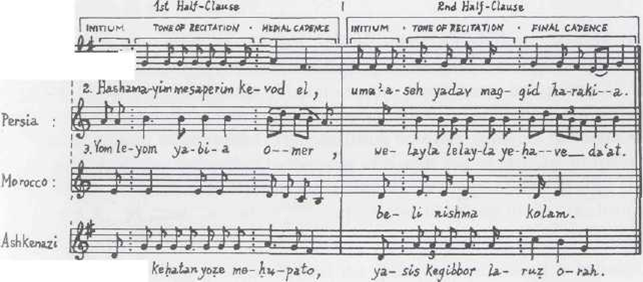
The following quotation and illustration, may give us a better idea—than the above by Edersheim—of how the psalms were sung:—
"In practice, the singer of a psalm reaches the 'recitation note' through a short initial motion of the voice, dwells on the former for the main part of the text, and concludes the first hemistich with a medial cadence. The second hemistich is performed in the same manner, but concludes with a final cadence. Thus basic psalmodic formula consists of:
initial motion/recitation note/medial cadence/
initial motion/recitation note/final cadence
The simple melodic material of this basic formula can be grasped and reproduced by an average audience after listening to a verse or two. In this respect, psalmody is a truly collective genre of music. Its aesthetic and psychological effect is governed by the recurrent repetition of the same melodic phrase—an element of stability coupled and contrasting with the constantly changing text. The tune, after a few repetitions, loses all interest: the attention automatically turns to the words, which continually offer something new. The accompanying vocal inflections merge and form an acoustical background which infiltrates the subconscious and creates a distinct mood, which eventually becomes associated with a certain feast or time of prayer or with grief and other emotions"
In 2 Chronicles 29:25-30 we have a brief description of the use of the psalms and music during the course of temple worship. The Levites stood in their designated place (most likely either side of the altar), poised ready to play their cymbals, psalteries, and harps.
At the command of the king, the burnt offering was placed atop the altar and as soon as the offering was ignited, the signal was given for the trumpets to sound first and then the other instruments followed. With these piercing and introductory strains calling God's attention to their dedication, the congregation bowed their head in silent worship, at which point the spirit Word was heard in glorious refrains coming from the joyful voices of the Levites. We are not aware of the exact choice of psalms which were selected on such occasions, but at the conclusion of the offering both Levite and worshipper bowed themselves in reverence and thanks, acknowledging that God had heard their prayers and accepted their heartfelt praises.
THE TITLES OF THE PSALMS
The significance behind the various titles was unearthed by J. W. Thirtle in his book, The Titles of the Psalms—their nature and meaning explained.1In this work, he examined the structure of the Hebrew and, on the basis of Habakkuk's psalm in chapter 3, arrived at the proper arrangement of the titles in connection with the psalter. A title is often defined as comprising a superscription and a subscription.
Most psalms generally consist of:—
1. a literary superscription at the top of the psalm which describes the psalm as either a song, psalm, michtam, etc. states the author as David, Asaph, or the sons of Korah, etc sets out the circumstances of its composition (This might be a historical setting or a special objective like "to bring to remembrance", or "for the Sabbath day"). the psalm itself, and a subscription at the end of the psalm containing the musical direction, which may assign the psalm to the specific care of the Chief Musician may describe how the psalm is to be sung (on strings, by the female choir, or at the Passover).
This structure is obscured by the AV and all other translations—except the Companion Bible, which follows Thirtle's findings—because the original Hebrew text did not have chapter breaks. Therefore, the translators, being unable to understand the purpose of the titles, joined superscription and subscription together at the commencement of the psalm. The confusion becomes apparent in Psalm 88 when the title attributes authorship to the sons of Korah and to Heman. In reality only the words, "Maschil of Heman the Ezrahite" belongs to Psalm 88. The preceding words constitute the subscription which should belong to the conclusion of Psalm 87.
Remember that until the work of Thirtle, the psalm to which the title belongs, was unknown to the Hebrew 'Authorities', so that their definitions, especially for rare words, were often only bad guesses. Therefore, we will give greater weight in this article to authorities such as Thirtle, and those who used his foundation research (Bullinger in the Companion Bible, and Rotherham in his Studies in the Psalms).
Superscriptions.
The classification of psalms into various categories like song, psalm, michtam, and so on, allows the reader to appreciate the character of the psalm and the spiritual intent of its author. A summary of the meaning behind the various classifications is as follows.
Maschil
(Attributed to Psalms 32, 42, 44, 45, 52, 53, 54, 55, 74, 78, 88, 89, 142).
This word is a participle of sachal that has the idea of looking and beholding and hence, 'to turn the mind, to become prudent'. These maschil psalms were therefore designed to instruct ['the public', CB], and teach wisdom by concentrating on major themes. Hence, Psalm 32 is specifically there to teach us about the principles of forgiveness, while Psalm 42 teaches the lesson of hoping in God during adversity, and so forth.
Michtam
(Attributed to Psalms 16, 56, 57, 58, 59, 60).
While the meaning of the Hebrew is uncertain, the thoughts of the majority of michtam psalms revolve around David's personal conflicts with his enemies. Thus Thirtle defines it as 'a private prayer or personal meditation'. "Four of them are in the first person singular of the pronoun, and have the nature of private prayers— 16, 56, 57, 59" (Thirtle). They were designed to teach—as the title of Psalm 60 indicates—by chastising and disciplining the mind as it absorbs the words of each psalm.
Praise (Heb., t'hillah)
(Attributed to Psalm 145).
This word is from the root halal which means 'to be clear', or 'to be brilliant' and refers to the clarity of mind and voice in one's praises to God. Psalm 145 is a hymn of praise which extols, in unmistakable terms, the honour and majesty of Yahweh's works.
Praise (Heb., shiggaion)
(Attributed to Psalm 7).
The plural is rendered shigionoth in Habakkuk 3:1. According to Thirtle and Bullinger, shiggaion means 'loud cries' or 'a crying aloud'. Thirtle says "in a word, the heading of Psalm 7 brings under notice one of the loud and bitter cries of David when pursued by enemies who threatened to 'tear his soul like a lion' (v. 2)".
Prayer (Heb., t'philah)
(Attributed to Psalms 17, 86, 90, 102, 142).
Gesenius informs us that the main idea behind the Hebrew is that of intercession and entreaty. It is used of Daniel's prayer when he set his face towards God to seek by prayer and supplications the mercy of God by fasting, sackcloth and ashes (Dan. 9:23). It speaks therefore of an intense, personal supplication.
Psalm (Heb., mizmowr)
(Attributed to psalms 3, 4, 5, 6, 8, 9, 12, 13, 15, 19, 20, 21, 22, 23, 24, 29, 31, 38, 39, 40, 41, 47, 49, 50, 51, 62, 63, 64, 73, 77, 79, 80, 82, 84, 85, 98, 101, 109, 110, 139, 140, 141, 143).
Mizmowr, is properly instrumental music; and by implication a poem set to notes— psalm. It is from the root zamar, perhaps with the idea of striking with the fingers; properly to touch the strings or parts of a musical instrument, i.e., play upon it; to make music, accompanied by the voice; hence to celebrate in song and music:— give praise, sing forth praises, psalms (S). Nearly half of these mizmowr psalms belong to Book 1 and delineate the struggles of David against his enemies.
Song (Heb. shir)
(Attributed to psalms 18, 30, 45, 46, 48, 65, 66, 67, 68, 75, 76, 83, 87, 92, 108, 120-134).
In the Psalms it occurs with other words such as mizmowr, 12 times; and by itself 15 times, all in the Songs of Degrees. The word is also used of the famous songs of Moses and of Deborah (Exod. 15:1, 21; Judges 5:1-3) and this reflects the joyful acclamation of victory and appreciation which is linked with this Hebrew word. In Psalm 65:13 and Psalm 66:1 it is paralleled with shouting for joy. The fact that it is sometimes associated with the marriage of Solomon in Psalm 45, the Songs of the Degrees in Psalms 120-124 and the Song of Solomon (1:1) suggests that these were public songs in which the congregation joined in with the choir.
To the chief Musician
(Belongs to Psalms 3, 4, 5, 7, 8, 10, 11, 12, 13, 17,18, 19, 20, 21, 30, 35, 38, 39, 40, 41, 43, 44, 45, 46, 48, 50, 51, 52, 53, 54, 55, 56, 57, 58, 59, 60, 61f 63 - 67, 69, 74, 75, 79, 80, 83, 84, 87, 108, 138, 139).
Of the 55 psalms with this musical notation, 20 occur in Book 1 and 24 in Book 2, with 39 having been written by David.
There were many musicians in the temple services, but only one had the responsibility of leading the choirs and directing the singing. This pre-eminent musician was not really a conductor; this was left to the pre-eminent sons of Heman, Asaph and Jeduthun by turn. Instead he was a precentor, which is equivalent to a director of music in our musical institutions.
In David's day Chenaniah was responsible to use his wisdom and skilfulness in instructing the Levites "about the song" [massah • 'bearing or carrying of the music'] (1 Chronicles 15:22, 27).
Any psalm that was committed to the chief musician in effect belonged to him. It was included in his repertoire so that he could train his singers and lead them in the meaning and significance of the psalm. By assigning these psalms to this man, the psalms in effect were being officially catalogued in the praises of Israel and in the official temple service.
Because most of the psalms in Books 1 and 2 were committed to Chenaniah's care by David, implies that the temple repertory was well organized and structured by the time the temple was built by Solomon.
Sometimes an additional instruction was given to the chief musician in the form of a catchword or musical classification (e.g. sheminith) which indicated that the psalm was more appropriately sung on a special occasion or with special instruments. If no other direction was given, then it was for the chief musician to use his discretion in selecting a psalm for the event. It meant that he not only had to understand the meaning and spiritual content of the psalm, but he also had to have the clear sighted ability to blend psalms carefully together to produce the right atmosphere and meaning for the worship in the house of God.
Aijeleth Shahar
(Belongs to Psalm 21).
The Hebrew means 'the hind of the dawn' (Thirtle, NASB) and is a phrase which depicts something beautiful and graceful. A hind represents someone who is beloved (Prov. 5:19), while the rising dawn is indicative of the time of the coming Kingdom (2 Sam. 23:3-4).
Psalm 21 would have been used to commemorate the coronation of kings and by its title points to the future Kingdom when God's beloved Son will be crowned King of Kings and Lord of Lords.
Alamoth
(Belongs to Psalm 45).
The Hebrew Alamoth means 'maidens' and indicated that Psalm 45 was reserved for the female section of the singers (cp. Ezra 2:65). The ecclesia is likened to a woman in the Scriptures (cp. Eph. 5:24-25) and Psalm 45 is peculiarly descriptive of the future marriage between Christ and the ecclesia.
Al-taschith
(Belongs to Psalms 56, 57, 58, 74).
The Hebrew means 'destroy not' (Thirtle). The phrase occurs in Deuteronomy 9:26 where Moses pleaded that God should not destroy the people for worshipping the golden calf. It also brings to mind the destroying angel of 2 Samuel 24:16-17 who was prevented from destroying any further. It is therefore a catch phrase indicating that these psalms were reserved for times when the nation would be overwhelmed by the enormous troubles which had arrived as a result of their sin. Their plea would have been a desperate one, appealing to God to "destroy not" although they deserved His judgements.
Gittith
(Belongs to Psalms 7, 80, 83).
The Hebrew which should be re-pointed1 as gittoth means 'wine-presses' (Thirtle), and is a catchword representing the time of autumn when the vintage is trodden down and the first fruits of the year are gathered (Deut. 16:13; Neh. 13:15). By extension the word points to the feast of tabernacles and therefore these psalms were specifically for this time of the year. The idea of pressing down the grapes is frequently employed to depict the time of future judgements (Isaiah 63:3-6). Hence, Psalm 7 speaks of the judgement of the wicked, Psalm 83 tells of the burning of Israel's enemies and Psalm 80 likens Israel to a vine brought out of Egypt.
Jeduthun
(Belongs to Psalms 38, 61, 76).
Jeduthun was a leader of a third section of the singers who led his brethren in thanks and praise to Yahweh (1 Chron. 25:3). Psalm 38 is thus a psalm of praise in that the psalmist remembers that God did make haste to help him. Psalm 61 is a psalm of thanks for delivering the psalmist from the enemy, and Psalm 76 is a psalm of praise for the victory over the enemies of Zion.
Jonath - Elem - Rechokim
(Belongs to Psalm 55).
The Hebrew means 'the dove of distant terebindis' (Thirtle). As v. 6 of the Psalm indicates, the dove was a bird that would fly off alone to seek rest. The word "moan" in v. 17 is used in Ezekiel 7:16 of the cooing or mourning of the dove. This suggests a rather plaintive note and tone to which the music was most likely set. A terebinth was a tree which grew in comparative solitude. It represents the solitude of those who stand in the midst of a hostile world.
It therefore appears that when David wished to remember his distresses and conflicts (such as the fleeing from Absalom as Psalm 55 depicts), this Psalm was selected that he might cast his burden upon Yahweh (v. 22) during times of reflection and solitude.
Mahalath
(Belongs to Psalm 52).
The Hebrew should be re-pointed to read M'holoth which means 'dancings' (Thirtle). The word occurs in 1 Samuel 18:6 where the women of Israel danced upon David's return from defeating the Philistines. Not losing sight of David's commanding place in the Psalter, the Psalm probably commemorates those days of victory when the enemies of God were put to silence.
Being a Psalm that was inspired by the events of Doeg the Edomite, David saw in Doeg the epitome of wickedness and predicts his speedy destruction. By applying this Psalm to the times of dancing and rejoicing David was pointing forward to the time when all the King's enemies would be removed and dancing would prevail everywhere.
Mahalath Leannoth
(Belongs to Psalm 87).
The Hebrew Leannoth means 'shoutings' (Thirtle) and is therefore a more intense action particularly when associated with M'holoth - 'dancings'. Looking to the life of David, again it is noted that the people shouted and danced when the ark was brought to Jerusalem (2 Sam. 6:5, 14, 15).
Psalm 87 was thus used to commemorate this event. It mentions that Yahweh had chosen Zion (v. 2), and describes the language of those dancing at the time (v. 7). It displays Zion as "Jerusalem which is above, the mother of us all" (Gal. 4:26).
Muth-labbert
(Belongs to Psalm 8).
As it stands in the AV, the Hebrew word means, 'death for the son' (S), or 'death of the Son' (Y, emphasis ours). The quotation of Psalm 8 in Hebrews 2 plainly shows that Christ's sacrifice is one of the underlying themes of the psalm. It is also the implication of the LXX title relating to Psalm 8: "concerning the secrets of the Son".
Alternatively, Thirtle makes a strong case for the word labben to be read labbeyn which means 'of the champion'. The subscription read thus would indicate that the Psalm was used to commemorate 'the death of the champion' (Thirtle), namely Goliath (cp. 1 Sam. 17:4, 23).
David saw the death of Goliath as the time of victory over all sin and death. When he stood upon the giant, he saw in prospect the dominion over all enemies, when "all things under his feet" would appear—a time when the King of Israel would put down all rule, authority and power (1 Cor. 15:25-28).
Neginoth
(Belongs to Psalms 3, 5, 53, 54, 60 [singular], 66, 75).
The Hebrew means 'stringed instruments' (Thirtle) indicating that the Psalm was to be accompanied with stringed instruments and not wind instruments. The use of harps and similar instruments would have made the Psalm very melodious.
In Ephesians 5: 19-20 Paul admonishes us to make melody in our hearts to the Lord. The Greek word he uses means 'to pluck the strings' and the idea is of plucking the chords of one's heart in harmony with the Word of God. So it is with these Neginoth Psalms. Our minds must be in tune with the Divine principles as we read them and absorb their power.
Nehiloth
(Belongs to Psalm 4).
If the word is re-pointed, the Hebrew is N'haloth which means 'inheritances' or 'possessions' (Thirtle) and thus LXX renders it "her that inherits". Psalm 4 was therefore chosen to commemorate the inheritance of the land by mentioning that Yahweh had chosen His people as His possession (v. 3), and will finally cause them to dwell safely in their inheritance in the future (v. 8). Perhaps it was sung on occasions when the inheritance of the land was in dispute.
Sheminith
(Belongs to Psalms 5, 11).
The Hebrew Sheminith means 'eight' and occurs in 1 Chronicles 15:21. In verse 20 of 1 Chron. 15 we have certain skilled men who were appointed "with psalteries over Alamoth" (or maidens) while in v. 21, as if by contrast, we have certain skilled men who were appointed "with harps over Sheminith". If the first class is over females, it seems logical to assume that the second class was over the males, "to excel" or, as it should be, "to lead", because this was the privilege of the males in Israel.
The number eight in Scripture is a symbol of circumcision because this rite was performed on the eighth day. When the male choruses sang Psalms 5 and 11, therefore, they were reminded of the evil qualities that must be cut off and removed.
Shoshannim
(Belongs to Psalms 44, 68).
This word means 'lilies' (Thirtle) and is a catchword symbolic of the time of spring when the flowers are in the earth (Song of Solomon 2:11-12). By extension it can be linked to the feast of Passover.
Passover spoke of freedom from oppression, and salvation by the blood of a lamb. These ideas permeate Psalms 44 and 68.
Shushan Eduth, Shoshannim Eduth
(Belongs to Psalms 59, 79).
The Hebrew means 'lily (lilies) of testimony' (Thirtle). Being associated with Shoshannim indicates that it was sung in spring. Eduth is frequently connected with the law of Moses (cp. Exod. 31:18).
Is there any spring feast which was kept to commemorate the law? Edersheim in The Temple—its Ministry and Services writes, "The feast of Unleavened Bread may be said not to have quite passed until fifty days after its commencement, when it merged in that of Pentecost, or 'of Weeks'. According to unanimous Jewish tradition, which was universally received at the time of Christ, the day of Pentecost was the anniversary of the giving of the Law on Mt. Sinai, which the Feast of Weeks was intended to commemorate. Thus, as the dedication of the harvest— commencing with the presentation of the first omer on the Passover—was completed in the thank-offering of the two wave-loaves at Pentecost, so the memorial of Israel's deliverance appropriately terminated in that of the giving of the Law".
Hence Shoshannim-Eduth was representative of psalms commemorating the Feast of Weeks or Pentecost. Shoshannim was used because Pentecost was considered to constitute the conclusion of Passover, and Eduth was used because Pentecost commemorated the giving of the Law.
Although the Feast of Weeks spoke of the time of first fruits when Israel entered the land (Lev. 23:9-22), Psalms 59 and 79 seem to have been selected to contrast this happy time with a note of solemnity. They both speak of the time when Gentile nations are in the ascendancy. David saw these events as indicative of the time when the surrounding nations were watching to destroy him, and therefore the solemn implication is for Yahweh to continue the blessings of the land.
Other Hebrew technical terms.
There are two Hebrew words, Higgaion and Selah, which, although they are not considered to be titles, nevertheless are best explained in this article. They occur in the body of some psalms, rather than in the superscription or subscription.
Higgaion
This noun is found untranslated in the AV at Psalm 9:16; translated "meditation" in 19:14; and "a solemn sound" in 92:3. It is also found in the plural in Lamentations 3:62 where it is translated "device" (AV), or "whispering" (NASB). It comes from a Hebrew root hagd, which is well known in the Psalms as referring to meditating (e.g., 1:2; 2:1, mg.). In Psalm 19:14 higgaion is parallelled with "the words of my mouth" i.e.,:—
"Let the words of my mouth,
And the meditation of my heart...
The NJV has prayer.
It is fairly well known that the process of meditation includes, among other things, the aspect of repeating half out loud the Scripture. When the word hagd is used in an evil sense, as it is in 2:1b ["imagine a vain thing"], what is being devised is also repeated half out loud (TWOT). BuHinger in the CB defines higgaion as 'soliloquy' which means 'to speak to one's self. As Thirtle says "there is no reason why it should not be rendered 'meditation' after Psalm 9:16 also".
 While higgaion is obviously related to music of the harp in 92:3, there is really no reason why it cannot refer to music suitable for, and accompanying, meditation. In fact the NJV has "with voice (Heb., higgaion) and lyre together".
Selah
The word Selah occurs 71 times in Psalms and three times in Habakkuk chapter 3. It occurs in 39 psalms, most of which are marked "for the Chief Musician". There does not appear to be any undisputed meaning of selah. But it seems probable that we can get close to the meaning. The idea of 'a musical interlude' was suggested by the way the LXX translated selah (Thirtle).
Bullinger, who followed for the most part Thirtle's work on the Titles, seems to have given the most thought to the word and has taken the study beyond theory into practice1. He rejects Thirtle's theory, of it starting a stanza, because selah sometimes occurs in the middle of a verse, i.e. Psa. 55:19; 57:3. He says:—
"...Selah neither ends nor begins a passage, but it connects the two passages between which it is placed...
An examination of each occurrence will show what this connection is. It is neither the pausing on one subject; nor the passing on from one subject to another; but it is the connecting of the two subjects together...
It is a thought-link, which bids us look back at what has been said, and mark its connection with what is to follow..." (Appendix 66, CB).
However, if selah is a thought-link then there must be a pause in the singing so that the singers and the audience can think about the connection of ideas. As we know from experience, what better time than this for a musical interlude? And if the singers were to stop, how did they know where to stop unless they are given some direction2? So while it may be argued [as does Thirtle] that selah is not a word to direct the musical instruments, it may be safely argued that it was to direct the singers to pause so that they and the audience might reflect on what ideas were being connected.
When selah occurs at the end of a psalm as it does in Psalm 3, 9, 24 and 46, we have an indication that the following psalm was originally joined to it when it was sung. So we should study such psalms jointly.
We must remember that the original Hebrew text was written continuously without punctuation or breaks of any type even between words. There wasn't even upper and lower case.
MUSICAL INSTRUMENTS
Music is a language—a language without words. In fact music could well be defined as a communication of emotion. A skilful composer carefully arranges and develops the ideas of composition so that it is clear and complete. Out of musical resources, a composer builds up structures both logical and emotional, in a similar way as a poet does with words. Musical instruments affect the emotions in an infinite variety of ways.
Each musical instrument in the Psalms has a spiritual significance. Our objective will be to describe the shape and sound of each musical instrument mentioned in the book of Psalms. We will then endeavour to draw out the spiritual lesson from each group of instruments. There are three groups of musical instruments:
stringed
wind
percussion.
It is interesting that David, the sweet psalmist of Israel (and a prophet), was also an inventor1 of at least some of the musical instruments that are mentioned in the Psalms. This would suggest that the special tones and moods reflected in the psalms were incapable of being expressed using the existing instruments of the day. They could only be suitably expressed in their full power with specially designed instruments.
THE STRINGED INSTRUMENTS
The expression "stringed instruments" is found on three occasions in the Bible.
"Praise him with the timbrel and dance: praise him with stringed instruments and organs" (Psalm 150:4).
The Hebrew here is men. It carries with it the idea of "a part". Strong's Concordance suggests its meaning is "a musical chord". The New Brown Driver Briggs Gesenius, has the "string of a harp".
"The LORD was ready to save me: therefore we will sing my songs to the stringed instruments all the days of our life in the house of the LORD" (Isaiah 38:20).
Here and in Habakkuk 3:19 the Hebrew word is negiynath. Strong defines this word as: "instrumental music; by implication a stringed instrument; by extension a poem set to music". According to Gesenius, it is "specially a song of derision, a satire, Lam. 3:14; Job 30:9". There were two types of stringed instruments, which we will now describe.
THE HARP
The Hebrew word kinnor1 is taken from a root word that indicates 'to twang'. The following is taken from The New Brown Driver Briggs Gesenius: "...stringed instruments used for popular as well as sacred music... 1 Sam. 16:16 a man skilled in playing on the lyre, cp. v. 23; at banquets Isa. 5:12, a token of merriment Isa. 24:8; Ezek. 26:13. Isa. 16:11 (of the murmuring sounds of bowels - heart, in pity); used also in praising, usually as accompaniment of song, 1 Chron. 15:16..."
This musical instrument which has strings and a wooden frame, is commonly associated with joy and gladness, and is linked in most references with a religious setting. A study of the joyful psalms associated with harps shows that the love, faithfulness and justice of Yahweh were central to Israel's rejoicing.
The most ancient harp was a type of lyre, probably square or oval in shape. It was made with pieces of wood united by 'animal' strings, of which there were six or nine. This instrument was usually played by drawing a plectrum across the strings, or sometimes it was plucked with the fingers.
"David took an harp and played with his hand: so Saul was refreshed, and was well, and the evil spirit departed from him" (1 Sam. 16:23).
The strings of the harp required the sacrifice of an animal and this peculiar construction of the harp blends together the ideas of sacrifice and joy. Sometimes when we remember the great sacrifice that Yahweh made on our behalf, and then we consider our own weakness, we feel sad and play a very solemn melody on our hearts. However, Paul, when writing to the Ephesians, made the following comment as translated by Rotherham:
"And be not getting drunk with wine in which is dissoluteness, but be getting filled in spirit; speaking to yourselves with psalms and hymns and spiritual songs; singing and striking the strings with your heart unto the Lord" (5:18, 19).
The strings are an echo of the heart, and as such they vibrate in praise to Yahweh as we think upon the divine principles.
THE PSALTERY
The Hebrew word translated psaltery is nebel from "Nabel", a skin bag. Also translated as 'bottle', 'pitcher', 'vessel', 'viol'. The nebel was the Greek equivalent to the harp or lyre. This was an instrument of 10 strings that were plucked with the fingers. It was larger than the kinnor, and had a deeper tone. It is translated psaltery 23 times and four times as "viol".
In Psalm 33:2 we read:—
"Praise Yahweh with the harp:
Sing unto him with the psaltery and an instrument of ten strings."
The RSV renders this as: "Praise Yahweh with the lyre, make melody to him with the harp of ten strings". Only one instrument is mentioned in the phrase: "Make melody to him with the harp of ten strings" since the word 'and' (AV) is in italics and therefore not part of the text. The nebel differed from the kinnor chiefly in the arrangement of the strings. In the following references the Hebrew word nebel is found: Psalm 33:2; 57:8; 71:22; 81:2; 92:3; 108:2; 144:9; 150:3. Of these references, Psalm 71:22 has a valuable piece of learning for us. Rotherham translates this as:—
"I also will praise thee by the aid of the harp ..."
This indicates that the harp was specially prepared for the worship of Yahweh, a point that is beautifully highlighted in Revelation 5:8; 14:2, 3:—
"And when {the Lamb} had taken the book, the four beasts and four and twenty elders fell down before the Lamb, having every one of them harps, and golden vials full of odours, which are the prayers of saints".
"And I heard a voice from heaven as the voice of many waters...and I heard the voice of harpers harping with their harps: And they sung a new song before the throne..."
Stringed instruments carry with them the lesson of a saint either joyfully worshipping Yahweh while reflecting on the glory soon to be revealed, or a saint sadly reflecting on his own weakness and asking God for forgiveness and strength to continue. In joy or sadness we need to be emotionally involved with the great hope we have before us. We also need to be skilful in our meditations and worship. To be a valuable musician, we need to blend carefully the emotions of joy and sadness while skilfully harping worship to Yahweh our God.
"Sing unto him a new song; play skilfully with a loud noise. For the word of Yahweh is right; and all his works are in truth" (Psa. 33:3-4).
THE WIND INSTRUMENTS
Three types of trumpets are spoken of in the Old Testament. In the Book of Psalms only trumpets and cornets are referred to.
THE TRUMPET
The most well known of these is the Hebrew Shofar, which is a ram's horn, a clear sounding trumpet, either made from a ram's horn or resembling a ram's horn in shape. This Hebrew word is found in Psalm 47:5; 81:3; 98:6 (translated as 'cornet'); and 150:3 (see mg).
The trumpet in Numbers 10 is different from the shofar. The Hebrew word is chatsotsrah. The word is onomatopoeic, imitating the clangour of the sound it made, like the Latin taratantara. The etymology of the word seems to suggest "to call together". This trumpet was made of beaten silver (Num. 10:2). According to Josephus; it was: "In length a little short of a cubit, it is a narrow tube, slightly thicker than a flute..." Moses was commanded to make a pair of trumpets. This number was later increased to seven (1 Chron. 15:24) and then to 120 (2 Chron. 5:12). With the possible exception of their use at the coronation of Joash (2 Kings 11:14; 2 Chron. 23:13), trumpets were used by the priests.
From a careful reading of Numbers 10:1-10 we can conclude with Paul, "God is not the author of confusion, but of peace" (1 Cor. 14:33). God instituted simple but effective arrangements for controlling the movement of two million Israelites. The trumpets were used to relay the commands of God. Trumpet calls were also used to warn of the advancing foe, "against the enemy oppressing them" (Num. 10:9). This trumpet call would be a signal to attack in the name of Yahweh, a call to valour. The two prominent functions of the trumpets were assembly and alarm.
A clear parallel is seen today in our Memorial Meetings and Public addresses. The trumpet calls us to assemble ourselves to remember the work of God in Christ Jesus. Thus, we are a body of people trumpeted out of the nations to reflect the Name of our God. We need to hear the clear note of the teaching of God's Word, and to fashion our lives, (keep in tune) with the divine example. Because the trumpet message of God is loud and clear, we have no excuse for not hearing it. Every first day of the week we are summoned to a solemn assembly. And as we set forth the Word of Life at our lectures, we are in fact sounding the alarm to those who have ears to hear. "... whosoever heareth the sound of the trumpet and taketh not warning; if the sword come and take him away, his blood shall be on his own head" (Ezek. 33:4). If we as watchmen see the sword of God's judgements coming and sound no alarm, the responsibility is on us. Our lecture work should be constant, clear, loud and simple. The concepts of alarm and assembly are clearly seen if we consider Joel 2:1, 15. Like the stringed instruments, the trumpet was used for both joyous and sad occasions. The apostle Paul gives us a clear warning of our responsibilities:—
"Even things without life, giving sound, whether pipe or harp, except they give a distinction in the sounds, how shall it be known what is piped or harped? For if the trumpet give an uncertain sound, who shall prepare himself to the battle?" (1 Cor. 14:7, 8).
"The last trumpet will bring fulfilment of all that was heralded by the first. The dramatic divine intervention in human affairs in the person of the Lord Jesus Christ will bring the Lord from heaven with manifestations which repeat the phenomena of Sinai: 'With a shout, with the voice of the archangel and with the trump of God, and the dead in Christ shall rise first'." (The Christadelphian, Vol. 108).
ORGANS
The Hebrew is uggab which signifies "to breathe". It is a reed instrument, ie. a flute reed pipe. The idea of 'organ' comes from the sense of an instrument made up of many pipes. Rotherham translates it as "flute", but a footnote adds, "or, more broadly: wind instrument". This word is found in Psalm 150:4; Genesis 4:21; and Job 30:31. Its use by Job to imitate the sound of mourning, and its use in the psalms for praise, indicates that it was a very versatile instrument.
THE PERCUSSION INSTRUMENTS
THE TIMBREL
The Hebrew word is taphaph and signifies to drum. See usage in Nahum 2:7, 8. It is a general term for tambourines and small drums, which were the most common percussion instruments of ancient times. "It was probably a drum... Kurt Sachs, A History of Musical Instruments, considers it to be made of 'a wooden loop and very probably two skins, without any jingling contrivance or sticks'. The instrument was, therefore, like a tom-tom..." (linger's Bible Dictionary).
This instrument was normally used in connection with rejoicing.
"And Jephthah came to Mizpeh unto his house, and behold his daughter came out to meet him with timbrels and with dances" (Judges 11:34).
See also 1 Sam. 18:6; 1 Chron. 13:8; Exod. 15:20. In Psalm 149:3 we read:— "Let them sing praises unto him with the timbrel and harp".
In verse 5 we have reference made to the saints singing loudly upon their 'beds'. The Hebrew for 'beds' is mishkab which signifies a bed for rest and for marriage. Surely it points forward to the unity of Christ and his Bride, to the unity of marriage and Sabbath rest. No wonder they praise Yahweh upon the timbrel, as they contemplate the most happy occasion in the history of mankind. The Hebrew word for timbrel is found also in Psalm 68:25; 81:2; and 150:4. The sound of the timbrel kept the time, and provided the rhythm for the orchestra.
THE CYMBALS
The Hebrew word is derived from the idea of vibrating, a clatter, a clanging instrument. The cymbal played an integral part in the ancient orchestra, especially on important occasions such as David bringing the Ark of the Covenant to Jerusalem (2 Samuel 6:5). In Psalm 150:5 two kinds of cymbals are mentioned. "Sounding cymbals" and "loud clashing cymbals." Rotherham has: "clear tone" and "loud clang." Probably there were two types: small and large. The cymbals were only used in worship, and they were designed to make the ear tingle in the awareness of Yahweh. In 1 Samuel 3:11 we read:—
"And Yahweh said to Samuel, Behold, I will do a thing in Israel, at which both the ears of every one that heareth it shall tingle".
The word "tingle" is translated from the Hebrew tsalal, the root word from which the Hebrew word for cymbal is derived. The clash of the cymbals was to remind the listener of the Majesty of God, to awaken the listener from his state of inattention.
Exhortation
In 1 Corinthians 13:1, Paul indicates that those who know the Truth but do not show its fruits of love, are as "sounding brass and tinkling cymbals". The cymbals make an impressive sound, but are not an end in themselves. They were designed to emphasize the musical score, or perhaps introduce the next psalm.
In Paul's mind, a life lacking love was like hearing the clashing of the cymbals without the rest of the orchestra. Clearly, also, the opposite is true. A life filled with love is like the fullness of the orchestra; balanced with wind, string and percussion instruments. Together in harmony and unity, they are "the instruments of God" (1 Chron. 16:42), and represent the worshippers themselves, who in their fullness of joy sound forth the praises of the Great King in love and appreciation of His wondrous works.
THE IMPRECATORY PSALMS
There are a number of Psalms1 and other scriptural passages2, where the writers pray for the unleashing of God's judgements upon others. These may be termed imprecatory3 writings. The following are two examples:—
"Let them be as chaff before the wind:
And let the angel of the LORD chase them" (35:5).
"Let their eyes be darkened,
That they see not;
And make their loins continually to shake" (69:23).
On the surface, it appears, as many in Christendom suggest, that these statements are not in harmony with the spirit of the New Testament. Therefore they say that these words cannot possibly be Divinely inspired, but must be evidence of a spirit of human hate and vengeance, in those unaware of the spirit of Christ—which is to love one's enemies (Matt. 5:44).
The implications of such teaching are unacceptable. Firstly, "all scripture is given by inspiration of God and is profitable for doctrine...for instruction in righteousness". To discount whole passages of scripture on that rather arbitrary basis is to disregard Paul's instruction. If we are to consider any verse or section of scripture as merely the thoughts of men—be it David, Nehemiah or Peter or Paul— every other part of scripture stands in jeopardy of not being heeded using the same reasoning.
Secondly, David is described as a "man after God's own heart", and Nehemiah's prayers were clearly answered. For these men to have such relationships with God indicates that their heart is close to Yahweh. Indeed the spirit of David was not one of revenge and vindictiveness; quite the opposite was the case. David possessed more than ordinary patience and forbearance. Toward men from whom David had received hatred and violence, David showed an enormous attitude of forgiveness and kindness—witness Saul, Abner (2 Sam. 3) and Shimei (2 Sam. 16). The first example bears repeating since Saul was a man who often had displayed a vindictive spirit against David:—
"...And Saul said to David, Thou art more righteous than I, for thou hast rewarded me good, whereas I have rewarded thee evil..." (1 Sam. 24:16-18).
Notably Psalms 7, 35, 58, 59, 69, 83, 109, 137 and 139 whose primary theme involves imprecation.
For example Neh. 4:4-5.
'Imprecation: n. prayer that a curse or calamity may fall on anyone' (Webster's).
More to the point still are the words of David himself in Psalm 35:13, 14:—
"As for me, when they were sick, my clothing was sackcloth. I humbled my soul with fasting, and my prayer returned unto my bosom. I behaved myself as though he had been my friend or brother: I bowed down heavily, as one that mourneth for his mother".
Against whom1 are the cursings directed then? A little consideration will show that many of the words objected to were not occasioned by resentment for personal injuries at all, but had as their objective the enemies of God and His people [and therefore of God Himself]. The Hebrew ah-yav (enemy) is used in many of the Psalms2 to describe those against whom the words are directed. The word is that used in the Covenant with Abraham, "by myself have I sworn, saith Yahweh...thy seed shall possess the gate of his enemies" (Gen. 22:16-17). This statement is itself an elaboration of the words of the promise given earlier to Abraham, that ".... I will curse him that curseth thee".
So David was not speaking for himself, but as the divinely-selected King and representative of God's covenant people. As a prophet (cf. Acts 2:30) he was speaking by inspiration (Matt. 22:43) those words God wanted him to speak. As such he was only calling upon God to do what God had in fact declared He will do when the time for judgement is ripe. One has only to read carefully the last few chapters of Jeremiah to find out how terrible and complete are the predetermined judgements of God spoken against the spoilers and persecutors of His people.
The enemies to whom the words are directed, have oft repeated characteristics:—
They are wicked 3,
They hate God and His people without a cause 4,
They persecute and fight against the people of God 5,
They speak lying words 6.
Psalms 7:5; 59:1; 69:4; 83:3; 139:20. Psalms 7:9; 58:3, 10; 139:19, 20. Psalms 69:4; 139:20. Psalms 7:13; 35:1-4; 58:2; 59:1-2; 109:5. Psalms 58:3; 59:12; 83:3; 109:2.
These characteristics of the enemies plainly number them among the seed of the Serpent. There is between them and the seed of the woman—God's chosen people, His anointed1—a continual state of enmity (Rom. 8:7). This is the battle of the Edenic Covenant, and the victory, for which all God's people long, will see the bruising in the head of the enemy by the seed of the woman. That this was the victory for which the Psalmist longed, "that this is the judgement thou (God) hast commanded" (Psa. 7:6, 13), is clear, even by the pictures the Psalmist presents. He describes their poison as like that of a serpent (Psa. 58:4). In the end the righteous "shall wash his feet in the blood of the wicked" (Psa. 58:10). He seeks that God would do unto them as unto Sisera2—that dramatic typical outworking of the victory of the Seed of the Woman when she crushed the head of the Seed of the Serpent. The Psalmist's words find echo in the warning of the Master toward the Pharisees, "ye serpents, ye generation of vipers, how can ye escape the condemnation of the grave" (Matt. 3:7; 23:32).
The Psalmist seeks the fulfilment of Yahweh's covenant in Eden, the final and essential destruction of the wicked. He prays as do the souls under the altar, bruised upon the heel for the truth of God3, for the avenging "of all the righteous blood shed upon the earth"4, for His city and His people that are called by His Name (Dan. 9:18-19). What we must remember is that David never prayed that he might be permitted to avenge himself. He always prayed that God would avenge His Anointed (Psa. 7:6; 35:1; 58:6, etc).
May we all be found longing:—
"Thy kingdom come, Thy will be done in earth as it is in heaven ... For thine is the kingdom the power and the glory for ever and ever Amen" (Matt. 6:10-13).
This last quotation, from the Lord's prayer, is obviously just another way of saying what the imprecatory psalms say, once it is realized that there is no personal vindictiveness involved. God's judgements are essential if the righteous are ever to fill the earth so that His name might be glorified.
MESSIAH IN THE PSALMS
INTRODUCTION
There are many types of literature in the Bible, each suited to its particular purpose. In the Book of Psalms there is a freedom of subject and expression not possible in other forms of literature, particularly history, letters or doctrinal expositions. The Psalms are the free outpourings of a mind filled with the contemplations of God, His works and His purpose. Many moods are exhibited, from extremes of sorrow to extremes of joy, but they are all underlined with confidence and love.
It must be understood, however, that the Psalms are much more than the outpourings of a human mind. They are neither limited by human weakness nor marred by human imperfections. They speak freely of prophecy and eternity. They portray the mind, development, and destiny of the multitudinous Christ, centring particularly in the training and perfecting of its glorious Head, the Messiah1.
The Psalter also expands the Gospel records. They, in fact, take us behind the scenes, and give us an inner view of the life of Christ. In them we are with Jesus during those years he was hidden from the world, and during those hours when he was alone with his Father. The very intimacy of his unique relationship with the Father is only sometimes fully appreciated when we have recourse to thoughts of some of the psalms.
Brother John Carter made this most interesting comment regarding the Psalms:
"The study of a psalm, to be complete, has two views, one backward the other forward. The backward view takes notice of the writer and the conditions under which the psalm was written. The forward view seeks the predictive element concerning Christ and his work. It is certain that a study of a psalm without Christ in view2 will not bring to light all its meaning."
Brother John Thomas had this to say about the Psalms:—
"These songs are full to overflowing of things pertaining to Christ. They celebrate his sufferings—his resurrection—his exaltation—his heroism—his kingly glory—the splendour of his dominion that is to be—the resurrection of the dead—the fall of anti-Christ—the benignity of his reign—the overthrow of the nations—the restoration of Israel—the riches of the world, etc. All these things and more they set forth to the admiration and inspiration of the diligent student of the sure prophetic word" (Apostasy Unveiled).
This is not to say that all psalms are Messianic. It is a general statement.
There are at least 283 New Testament quotations (i.e., Messianic & non-Messianic) from the Old Testament, and at least 116 are from the Psalms1. Many quotations or allusions from the Psalms refer directly to the Messiah.
We will briefly state examples of this in tabular form. Next we will have a look at the Messianic element in the books of Samuel, where the idea first becomes clear. We will then look more fully at the content of some examples, extracting various Messianic themes such as Messiah as the Suffering Servant, Messiah as King, Son of God, and so on. We will then be in a better position to define the extent of Messianic material in the psalms.
But firstly:
A SURVEY OF INTRODUCTIONS TO SOME OF THE N. T. QUOTATIONS FROM THE PSALMS CONCERNING CHRIST
1. When the Psalm was quoted by the Master Himself.
"Have ye never read..." Matt. 21:16 (Psa. 8:2)
"Did ye never read in the scriptures"...Matt. 21:42 (Psa. 118:22, 23)
"What is this then that is written..." Luke 20:17 (Psa. 118:22)
"And have ye not read the scripture..." Mark 12:10 (Psa. 118:22, 23)
Tor David himself said in the Book of Psalms..." Luke 20:42 (Psa. 110:1)
"How then does David in Spirit call him..." Matt- 22:43 (Psa. 110:1)
"For David himself said by the Holy Spirit..." Mark 12:36 (Psa. 110:1).
2. When the quotation from the Psalm was seen by the New Testament writer as being fulfilled.
"Which was spoken by the prophet..." Matt. 13:35 (Psa. 78:2)
"That it might be fulfilled which was spoken by the prophet..." Matt. 27:35
(Psa. 22:18)
"His disciples remembered that it was written... John 2:17 (Psa. 69:9) "That the scripture might be fulfilled..." John 19:24, 28, 36, 37 (Psa. 22:18) "For it is written in the Book of Psalms..." Acts 1:20 (Psa. 69:25) "David spoke concerning him..." Acts 2:25 (Psa. 16:8) "Whom also gave testimony and said..." Acts 13:22, 23 (Psa. 132:11) "As it is also written in the second Psalm..." Acts 13:33 (Psa. 2:7) "Wherefore he saith also in another Psalm..." Acts 13:35 (Psa. 16:10) "As it is written..." Rom. 15:3, 9 (Psa. 69:9; 18:49) "One in a certain place testified saying..." Heb. 2:6 (Psa. 8:4)
Wherefore also it is contained in the scripture..." 1 Pet. 2:6, 7 (Psa. 118:22). See T. H. Home, Quotations from the Old Testament in the New and W. H. Wright, New Testament Quotations from the Old.
THE LIFE AND MINISTRY OF CHRIST IN THE PSALMS —A BRIEF SURVEY
[Q = Direct quotation in NT. from the Psalms either English Version or LXX A = Allusion to the Psalms (readily perceived).]
SCRIPTURE OR THEME | PSALM | NOTES AND N.T. REFERENCE |
1. Messiah to be of David's family | 893-4 | A-Acts 13:23 |
| 132:11,17 | A-Luke 1:32,69 |
2. Christ to be anointed | 89:20-27 | Heb "David" v20 = "The Beloved" |
3. The curiously wrought veil | 40:6 | Q-Heb. 10:5 |
| 139:13-16 | A-Heb. 10:20 |
4. Foretaste of Messiah's ministry | 72:10,15 | Visit of the wise man: types future gold, |
|
| frankincense, myrrh; faith, prayer, suffering |
5. "Made a little lower than the angels" | 8:5 | Q-Heb. 2:6-8 |
6. Called a Nazarene | 22.6 | A-Matt. 2:23 (Nazareth = despised) John |
|
| 1:46; Isa533 |
7. "Lo I come to do Thy will" | 40:7-8 | Q-Heb. 10:7,9 |
8. Divine protection foreshadowed | 91:11-12 | Psalm Messianic misapplied Matt. 4:6; |
|
| but see Luke 4:10,11,28,30 |
9. A source of strength | 18:1-3 | A-Heb. 2:13 |
10. "Zeal of thine house" | 693 | Q-John2:17 |
11. A stranger from family and nation | 69:8 | A-Mark 3:31-32; John 1:11 |
12. "Depart from me" | 6:8 | Q-Mait. 7:23; Luke 13:27 |
13. I will open my mouth | 782 | Q-Matt. 13:35; see also Matt. 5:2 |
14. Messiah in popular prophecy | 89:36 | Q-John 12:34 |
15. Blessed is he that cometh | 118:26 | Q-Matt. 21:9; 23:39; Mark 11:9; |
|
| Luke 13:35; 19:38; John 12:13 |
16. Out of the mouths of babes | 82 | Q-Matt. 21:16 |
17. Rejected by the rulers | 11822 | Q-Matt. 21:42; Mark 12:10; Luke 20:17 |
18. Son of man goeth as written | 22 | A-Matt. 26:24; Luke 24:25,44 |
19. None lost save... | 109:7-8 | A-John 17:12 |
20. My own familiar friend | 41:9 | Q-John 13:18; Acts 1:16; see Psalm 55:13 |
21. Gather against Christ | 41:5 | A-Psalm 56:5-6 |
22. They hated me without cause | 35:19; 69:4 | A-John 15:25; also Psalm 109:3; 119:161 |
23. False witnesses | 27:12; 109:2 | A-Matt. 26:60 |
24. Buffeted | 22:7; 35:15-16 | A-Matt. 9:24 |
25. Rulers join against him | 2:1 | Q-Acts 4:25-26; also Psalm 71:10 |
26. They pierced my hands | 22:16-17 | Q-John 19:37 |
27. They parted my garments | 22:18 | Q-Matt. 27:35; John 19:24 |
28. They gave me gall | 69:21 | Q-Matt. 27:34 (John 19:29) |
29. Mocking | 109:25 | Q-Matt. 27:39 |
30. Let him deliver him | 22:8 | Q-Matt. 27:43 |
31. Reproaches of the crowd | 69:9 | Q-Rom. 15:3 |
32. Not a bone broken | 3420 | Q-John 19:36 |
33. Cry for help | 18:4-6 | A-Heb. 5:7 |
34. My God, My God | 22:1 | Q-Matt. 27:46, Mark 15:34 |
35. Into Thy hands | 315 | Q-Luke 23:46 |
36. Death in prime of life | 10224 | died at 33 |
37. Thou wilt not suffer my soul... | 16:8-11 | Q-Acts 2:27-28; 13:33-35; John 20:9 |
38. Son of God | 2:7 | Q-Acts 13:33; Heb. 1:5; 5:5 |
39. Man of thy right hand | 80:17 | A-John 5:21-27 |
40. Exalted to right hand | 110:1 | Q-Matt. 22:44; Mark 12:36; Luke |
|
| 20:42; Acts 2:34; Heb. 1:13 |
|
| A-Heb. 10:12 |
41. Ascend on high, give gifts | 68:18-19 | Q-Eph. 4:8 |
42. Thou hast put all things | 8:6 | Q-Heb. 2:6-10 |
|
| A-Matt. 28:18; 1 Cor. 15:27 |
43. Stone which the builders rejected | 118:22-23 | Q-Matt. 21:42; Mark 12:10-11; |
|
| Luke 20:17; 1 Pet. 2:6-7 |
|
| A-Acts 4:11 |
44. A high priest | 110:4 | Q-Heb. 7:17; 5:6 |
45. | will declare thy name | 22:22 | Q-Heb. 2:12 |
46. Exalted above brethren | 89:27 | A-1 Pet. 3:22; Rev. 3:21 |
47. Thy throne O God | 45:6-7 | Q-Heb. 1:8-9 |
48. Betrayer's death | 6925 | Q-Acts 1:20; see Psalm 55:12-16 |
49. His office for another | 109:8 | Q-Acts 120 |
50. Confessing Messiah | 18:49 | Q-Rom. 15:9 |
51. Preaching Christ | 19:4 | Q-Rom. 10:18 |
52. Joyful praise | 117:1 | Q-Rom. 15:11 |
53. Return of Christ | 97:7 | Q-Heb. 1:6 |
54. Kingdom Age | 110:1-7 | A-1 Cor. 15:25-27 |
Of all the Messianic citations' in the New Testament, from the Old, almost half are from the Psalms. Christ himself said that there are things "...written...in the Psalms concerning [himself] (Luke 24:44); and it is good that we should endeavour to discover what those things are.
What meaning did our Lord put on the Psalms, when he made use of them in his public devotions? What meaning did our Lord teach his disciples to put on them, when he opened their understanding? Surely these are questions which every reader of the Psalms must ask.
The anticipated coming of the great prophet and redeemer, which prevailed among the Jewish people, can be traced largely to the Psalms.
THE MESSIANIC ELEMENT IN THE BOOKS OF SAMUEL
This element is included since it portrays the development of Messianic thought as it was unveiled to Israel. It therefore serves as a useful preamble to a more detailed analysis of some of the Messianic psalms.
1. The Omniscient Judge
Yahweh was preparing Israel for a new era in history. Hannah was chosen as the mother of the prophet who was to introduce the Davidic age. Hannah, like Sarah of old, bursts forth in a song of praise inspired by the prophetic spirit in view of God's gift of a son to her, and her dedication of that son to God. She sings the praise of Yahweh in a song that is re-echoed through all subsequent prophecy, and especially in the song of Mary, the mother of the Messiah. The song is a clear description of the new era, in which the all-knowing Yahweh weighs the actions of men, and equitably adjusts the inequalities of human life.
Then Hannah prayed and said,
My heart doth exalt in Yahweh...
Yea, I rejoice in thy salvation...
Heroes of the bow are broken,
But stumblers gird on valour;
The full of bread hire themselves,
But the hungry keep holiday forever;
The barren doth bear seven,
But the one having many children doth languish.
Yahweh kills, and he quickens,
He brings down to Sheol, and he doth bring up;
Yahweh disinherits, and he enriches
He humbles, yea, he lifts up on high;
He raiseth up from the dust the weak,
From the dunghill he exalts the poor,
To enthrone him with nobles,
That he may give him a throne of glory as an inheritance...
The feet of his favoured ones he guards, But the wicked in darkness are silenced...
Yahweh judgeth the ends of the earth,
In order to give strength to his king,
In order to exalt the horn of his anointed."
(1 Sam 2:1-10, Translated by Briggs in Messianic Prophecy
The reign of Yahweh in judgement has in view the elevation of a king in Israel. These predictions of a royal dynasty in Israel moved toward realization through Samuel, who becomes at first a prophet like Moses, and the founder of the prophetic order, then is called to the judgeship, and finally transfers his political authority to the king.
2. God's Promise to David
The clearest and most complete early prophecy about Messiah was given by Nathan to David and forms a foundation stone of the Gospel.
"Therefore Yahweh doth tell thee,
That Yahweh will make thee a house,
And it will come to pass when thy days will be fulfilled,
And thou wilt lie down with thy fathers,
I will raise up thy seed after thee,
Him who will issue from thy bowels.
I will establish his kingdom.
He will build a house to my name,"
" And I will stablish the throne of his kingdom for ever.
I will his Father,
And he shall be My son...
And thine house and thy kingdom,
Shall be established for ever before thee...".
(2 Sam. 7:11-16; 1 Chron. 17:10-14, Briggs, AV)
There are three elements in this prophecy:—
The everlasting reign of the house of David
The erection of the house of Yahweh by the seed of David
The elevation of the seed of David to the rank of sonship with God, with
discipline and everlasting mercy.
These three elements are the basis of the Messianic idea throughout subsequent prophecy. They also unfold the previous prophecies of redemption.
THE PSALMS
We will now concentrate on the content of some Messianic themes, after which we will look at the extent of Messianic material.
A. PROPHECIES OF MESSIAH AS A SUFFERING SERVANT
There are many psalms, which, in the New Testament are said to have their fulfilment in the sufferings of the Messiah. Most of these will be commented upon in the exposition of the psalm concerned. However, for ease of reference the most significant are consolidated here.
The word 'servant' occurs infrequently in the Psalter (eg. 69:17; 86:2, 4, 16) as does the expression 'the servant of the LORD'. However, the idea of an innocent sufferer is used frequently and was very often the portrait in which Jesus recognized himself. The following quotation from Kidner sums it up well:-—
"Most of our Lord's references to the psalms are in fact to this element in them; indeed the tragic Psalm 69 is the New Testament's largest quarry of quotations and allusions to Christ in the whole collection, six or seven different verses or phrases being drawn from it to interpret His cross and passion. From this psalm and its companions (notably 22, 35, 40, 41, 109, 118} the Gospels, Acts and Epistles find their most telling words to highlight such matters as His reforming zeal (69:9a), His deliberate self-offering (40:6-8), His experience of isolation (69:8), betrayal, hatred and rejection (41:9; 69:4; 35:19; 118:22), His suffering of reproach (69:9b), mockery (22:7f.; 69:21), stripping (22:18)... They treat many of these explicitly as prophecies fulfilled...Jesus Himself, on the cross, found words in the psalms for His darkest hour and for His last breath (22:1; 31:5)B.
Suffering
The sufferings of David and other worthies of old were typical. They helped to familiarize men with the thought of the righteous suffering on behalf of others, and of suffering as a path to victory. They anticipated the afflictions of Christ. The Spirit so moulded the records, as to prefigure the sufferings of Christ even in circumstantial detail.
Just as David's brothers did not support him, "I am become a stranger unto my brethren" (Psa. 69:8), so Christ's mother and brothers (Mark 3:31, 21) added to his problems in the early part of his ministry.
Psalm 118:22 is cited by Christ in Matthew 21:42 in reference to his suffering at the hands of the religious leaders of his day:—
"The stone which the builders refused is become the head stone of the corner".
Betrayal
The exposition on Psalm 41 has several paragraphs on this theme, to which the reader is directed. The well known verse in this psalm which has a Messianic application is verse 9: "Yea, mine own familiar friend... which did eat of my bread, hath lifted up his heel against me". This clearly has relationship to Christ's betrayal at the hand of Judas (John 13:18).
The book of Acts gives us an inspired comment on Psalm 109:8, which refers to Judas' betrayal of Christ:—
"which the Holy Spirit by the mouth of David spake before concerning Judas, which was guide to them that took (betrayed) Jesus...For it is written in the book of Psalms, 'Let his habitation be desolate, and let no man dwell therein, and his bishoprick let another take'" (Acts 1:16, 20).
Other psalms also deal with this subject. Psalm 55:12-14 has obvious application to the betrayal of the Lord:—
"For it was not an enemy that reproached me; then could 1 have borne it...We walked unto the house of God in company".
Judas was one of the twelve chosen to be Christ's disciples. Together they had worshipped in his Father's house. What an utter betrayal of trust!
Crucifixion
Messiah was to experience agony on the stake, Psalm 22:1-21 fulfilled during his crucifixion, as recorded in Matthew chapters 26 and 27. His hands and feet were to be pierced (Psalm 22:16; fulfilled in Matt. 27:35). Evil men were to cast lots for his vesture (Psalm 22:18; fulfilled in Matt. 27:35). He was to be the object of scorn from his accusers (Psalm 109:25; fulfilled in Matt. 27:39). He would thirst while on the cross (Psalm 22:15; fulfilled in John 19:28). His bones would not be broken, as was the normal practise of the Romans (Psalm 34:20; fulfilled in John 19:36, 37). He would be offered vinegar for his thirst (Psalm 69:21; fulfilled in John 19:28-30). And finally Christ would commit his spirit into the hand of God (Psalm 31:5; fulfilled in Luke 23:46).
Resurrection
The concluding verses of Psalm 16 contain a well known prophetic reference to the resurrection of Messiah:—
"Thou wilt not leave my soul in hell,
Neither wilt thou suffer Thine Holy One to see corruption" (v. 10).
Peter in his discourse in Acts 2, explains the psalm as referring to Christ, and in deed of Messiah only, in such a manner that he controverts its reference to David, and assigns the reasons why David could not have spoken of himself (verses 25-31). Paul also not only refers Psalm 16 to Christ, but opposes the opinion that it was written about David (Acts 13:35-37).
Glorification
"The LORD said unto my Lord:
sit at my right hand
until I make your enemies
a footstool for your feet" (Psa. 110:1).
Peter records in Acts 2:33 that Christ "being by the right hand of the Father [was] exalted" to "both Lord and Christ" and that therefore the prophecy of the Psalm was fulfilled (v. 34, 35). When "he ascended on high" (Psa. 68:18-19; fulfilled in Acts 1:9), he gave gifts to men as Paul tells us in Ephesians 4:8-13.
B. MESSIAH AS SON OF GOD AND GOD MANIFEST
When Messianic prophecy began to take shape in Israel, the idea enshrined in the phrase, "the seed of the woman", was strengthened. The foundation on which the Messianic prophecies largely rest is the promise made to David, to which we have already referred: "I will be his father and he shall be my son" (2 Sam. 7:14; 1 Chron. 17:13). In earlier days there had been an allusion to divine sonship in relation to Israel, when their release was demanded from Egypt, "Israel is my son, my firstborn" (Exod. 4:22, RV), but no such language had been used in reference to an individual except in the promise made to David and in the Psalms—which we will now concentrate on.
Son of God
That Psalm 2 is Messianic is beyond question, since it is applied to Christ several times in the New Testament (Acts 13:33; Heb. 1:5; 5:5). Verse 7 is the key to demonstrate that Messiah would be Son of God for it says, "Yahweh said unto me, 'Thou art my Son, this day have I begotten thee'". This introduces the idea of begettal, not merely of birth. Messiah was to be begotten by God through the power of the Holy Spirit, and the relationship thereby involved is given as the reason for his exaltation in verse 6.
Psalm 2 depicts Messiah ruling the whole earth in righteousness, and couples Yahweh and His anointed as Father and Son in more than name. That this is no ordinary son of David, is confirmed by Psalm 110, which our Lord quotes to point out that David salutes this Son as his Lord (i.e., Sovereign).
Psalm 110:1, quoted above, is therefore, a clear indication that Christ was not only David's son but also Son of God and David's Lord (Matt. 22:41-46). The LXX of v. 3 mentions explicitly the Virgin Birth: "From the womb before the morning I begat thee".
Once again, in addressing the king as Son, the Old Testament has introduced a theme which, undeveloped, suits its immediate context, but outgrows it utterly as its implications fully unfold.
God Manifest
We will begin this theme by turning to the prophets, for there we have the outstanding passage of Isaiah: "Therefore the Lord Himself shall give you a sign; behold a virgin shall conceive, and bear a son, and shall call his name Immanuel" (7:14), which means 'God with us' (S). While it refers, in the first instance, to Hezekiah who was a type of the suffering Servant; it obviously refers primarily to Messiah since the prophecy includes the portion of Isaiah up to the first part of chapter 9:—
"his name shall be called Wonderful, Counsellor, the mighty God, the everlasting Father, the Prince of Peace. Of the increase of his government there shall be no end..." (Isa. 9:6, 7).
The psalms add to this picture of the Son manifesting the Father. During his first advent Jesus manifested God's character. In his second advent he will also manifest God's power. When the Psalmist declares:—
"The LORD reigneth;
Let all the earth rejoice" (Psa. 97:1),
it is Christ reigning for God, not Yahweh Himself. The same is true of Psalm 102:16, which looks forward to the glory of Revelation 14:1; and perhaps 22:3-4.
Other psalms and their quotation in the New Testament demonstrate Christ bearing the name of God, in much the same way as the angels bore the name Yahweh (Exod. 3:4, 2, 6). This is not the place to discuss God manifestation. This has already been discussed in Phanerosis, Theophany and Yahweh Elohim. Nor is it the place for a detailed look at these verses that are sometimes wrested by the trinitarian. For example, Psalm 45:6, 7 is quoted by Paul, to show the superiority of Christ Jesus over Judaism:—
But unto the Son he saith, 'Thy throne, 0 God, is for ever and ever: a sceptre of righteousness is the scepfre of thy kingdom. Thou hast loved righteousness, and hated iniquity; therefore God, evenihy God, hath anointed thee...' (Heb. 1:8, 9).
Obviously Messiah the Son will reign with the power and authority of his Father. He will manifest God. See also Wrested Scriptures, page 205.
C. MESSIAH AS SON OF MAN AND A PRIEST FOR EVER
These rare but essential themes greatly assist our understanding of salvation, remission of sins, and the atonement. The expression the son of man, Psalm 8:4, is explained by the Spirit in Hebrews 2:5ff as fulfilled by Messiah. See the exposition on that Psalm for a detailed explanation of the requirement that Jesus be "son of man", that is "flesh and blood".
Psalm 110:4 in speaking of the Lord says, "Thou art a priest for ever after the order of Melchizedek". Other verses in the psalm speak of him as ruling as King, so that the concept of Messiah as King-Priest is clearly stated, even though only in a single sentence. Of course it refers back to Melchizedek, the King-priest of Salem who, as a type of the greater King-Priest of Jerusalem, is mentioned in Genesis 14:18ff as blessing Abraham. This line in Psalm 110 is quoted in Hebrews 5:6, and becomes one of the great themes of Paul's epistle (cf. chapter 7-10), demonstrating the superiority of the Melchizedek priesthood over the Levitical. The high-priesthood of Christ will be expounded in detail, God willing, when we come to that psalm.
D. PROPHECIES OF MESSIAH AS KING
Psalms 2, 18, 45, & 72 have much in common and plainly refer to the same general subject. To David, the Messiah was announced as a king who would be his successor on his throne. And thus in his own contemplation, and in that of the other authors of the Psalms, the earthly head of the theocracy formed the basis of its future illustrious Renovator and Restorer.
Psalm 2 - The enthroned Messiah.
David (cf. Acts 2:30-31) in prophetic vision beholds a multitude of nations with their kings in mad rebellion against God and his Anointed, their rightful sovereign. When he raises his eyes from the wild tumult on earth to God enthroned in heaven Who declares that He will easily quell the powerless rebellion; he hears the voice of Yahweh proclaiming that He had established His Anointed as King. Consequently, all resistance to the King's authority, being likewise directed against the Omnipotent, must be fruitless. Immediately afterwards, the Psalmist hears another voice, that of the Anointed, declaring that Yahweh has given to him as His Son (whom He demonstrates to be such by powerful proofs), the people of the whole earth for his possession, with the right and the power to inflict the severest punishment upon all who should resist his lawful dominion.
A striking proof that the Messiah is intended is afforded by the Psalm itself. It plainly possesses features that correspond to no earthly king, but belongs to the Messiah alone. (Compare Isa. 11:4; Psa. 72:4; Psa. 110:6).
Psalm 45 - The Bride of Messiah.
After a brief introduction, the Psalmist celebrates the praises of a brilliant king, who is distinguished by beauty of person, sweetness of speech, heroism, and righteousness. In his kingdom (which is everlasting, and in which he appears with the highest dignity) the most remarkable joys and honour are enjoyed by him. This splendour is heightened by his wives, the daughters of kings, among whom one is particularly distinguished, who shines on his right hand in gold of Ophir. To her the Psalmist addresses himself, exhorting her to devote herself, with all her affections, to her lord and king, and sacrifice every thing else for him; thus will she enjoy his tenderest love, and with it the highest reverence of the most flourishing nations. He next describes the splendours of the bride, when introduced to the king, with other virgins, her intimate companions. Lastly, he again turns to the king, and promises him an illustrious progeny, who, under his control, should rule the whole earth; at the same time expressing the hope that his poem might, even in future ages, contribute to advance his glory among many nations.
The Messianic interpretation in sustained by the authority of the New Testament. Paul in Hebrews (1:8-9) quotes this Psalm to prove the exaltation of Christ above the angels. In this Psalm are those characteristics which are applicable to the Messiah alone.
The Psalmist contemplates the glories of the bridegroom, the splendours of the bridal ceremony, and the joys of the marriage.
Psalm 18 - The Messiah as a deliverer.
This Psalm reflects the historic experience of David as seen in 2 Samuel 22:44-51.
The adoption of David and his seed into the relation of Divine sonship secures them the favour, the everlasting mercy and interventions of God on their behalf. The Psalm described such an intervention in the coming of God in manifestation to deliver the Psalmist from great trouble. It then describes the exaltation of David, the subjugation of his enemies, the extension of his rule to distant nations, and the praise of God among them for wonders He has wrought.
"Thou hast delivered me from the strivings of my people Thou wilt set me at the head of the nations; A people I know not will serve me, At the hearing of the ear will they obey me; Strangers will fawn upon me, Strangers will fade away from their strongholds, Yahweh liveth, and blessed be my rock; Yea, exalted be the God of my salvation: The El who taketh vengeance for me, Who bringeth me out from my enemies, Yea, he will lift me up above those rising against me: From the violent thou wilt deliver me; Therefore I shall give thee thanks among the nations, To thy name will I sing praises, Yahweh; Who magnifies the great salvation of his king, And shows mercy to his anointed, To David and his seed forever." (2 Sam. 22:44-51; Psa. 18:43-50).
Psalm 72 - The Messiah as the Righteous King.
Here Messiah is a king ruling in righteousness, mercy and peace. The nations pay him homage. He is the object of universal blessings.
The Psalm presents the aspirations of Israel for the Messianic king, and with a prayer for divine blessings predicts the character of the monarch and his reign. None but Solomon could present the type for such an ideal. Never before or subsequently has there been such a reign of peace and glory in Israel. The predictions of the Messianic king were pointed in a more peaceful direction by the reign of Solomon. In this psalm a further unfolding of the blessings in respect to the nations is seen. These are present in the Abrahamic promise, but have assumed in the subsequent prediction of Jacob (Gen. 49), Balaam (Num. 23:21-24), and the above psalms (especially Psa. 2), the form of subjugation and crushing. Here the sceptre of iron is transformed into a sceptre of reconciliation and peace.
His kingdom is by no means confined to the limits of Palestine but is coextensive with the whole earth. All nations, even the most powerful, the most uncivilized, and the most remote, shall reverently obey him, not indeed as being subdued by the power of his arms, but freely choosing his service under the influence of his righteousness alone. Through him will be fulfilled the great promise made to Abraham, that in his seed all the nations of the earth should be blessed.
The proof from parallel passages is here peculiarly strong. On the one hand, the Psalm itself contains the most distinct reference to an older Messianic prediction, the words of which it employs; on the other, in a later prediction, the Messiah's kingdom is described in words taken from it. We cannot (for example) in the seventeenth verse, "and men shall be blessed in him, all nations shall call him blessed", mistake the allusion to the promise made to Abraham that in him should all the families of the earth be blessed. And in Zechariah (9:10) the extension of the Messiah's kingdom is described in words taken from the eighth verse of this Psalm: "and his dominion shall be from sea to sea, and from the river even to the ends of the earth" (cf. Psa. 2; 45; 110; Isaiah 9 and 11).
Everything in the Psalm is relevant to the Messiah and many of its features can belong to no other subject.
We will now try to come to grips with the extent of the Messianic element in the psalms. We mentioned earlier that Christ taught his disciples the things "written in the law of Moses, and in the prophets and in the psalms, concerning" himself (Luke 24:44). What psalms Christ talked about are not stated. But the subjects of suffering, resurrection, repentance and remission of sins were included, and it is almost without doubt that a significant proportion of his teaching would have come from the psalms.
There appears to be several categories of Messianic material in the psalms:
a very few psalms which are uniquely Messianic (eg. Psalm 2, 16). Christ is the speaker.
portions of psalms which are quoted in the N. T. (and sometimes in the O. T., eg. 72 above) as applying to Messiah.
portions of psalms alluded to which are readily perceived as Messianic. See previous table of allusions.
oblique references which indicate that Messianic applications in the psalms
are not exhausted by specific quotation or allusion in the New Testament.
This is implied, for example, in the way the New Testament handles Psalm 18, which is stated in the superscription to be the personal testimony of David. Romans 15:9 quotes verse 49 from the LXX: "Therefore I will praise thee among the Gentiles, and sing to thy name". The point to be noted is that there is a lack of identifying factors. The phrase does not cause us to look for a supernatural power to fulfill it, since it fits David (cf. Psalm 18:47, the subdued Gentiles of David's kingdom). The fact that Paul does not state that the psalm is Messianic, suggests that the New Testament writers take it for granted that David's psalms and probably the other psalms written by kings have this additional component.
e) Psalms that are not referred to in the New Testament, yet internal evidence suggests they have Messianic application. Included in this category are those defined loosely as:—
"the scriptures" (Luke 24:45)
"when they had fulfilled all that was written of him" (Acts 13:29)
"according to the scriptures" (1 Cor. 15:4).
Surely these last two categories imply that there is more than could be mentioned. It is also implied in the Proverbs that we need to do our own searching:—
"It is the glory of God to conceal a matter, But the glory of (those who wish to be) kings to search out a matter" (Prov. 25:2, NASB).
To illustrate what we are getting at here, it may help to point out that while few would disagree that Genesis 3:15 is Messianic, in fact no New Testament writer quotes it as being Messianic!
For a balanced statement on the difference between those psalms which have particular application to Messiah, and those which were useful to Messiah, we quote part of the exposition from Psalm 37:—
The Messianic application of the Psalm (i.e. 37) should be appreciated but not over emphasized.
As the captain of the upright, a message designed to exhort and encourage them, obviously will apply to the Lord. During his sufferings, he could look forward to inheriting the earth (v. 11), to being preserved for ever (v. 28), and to experiencing perfect peace (v. 37). As is often true of the upright, the wicked gnashed upon him with their teeth (v. 12); they watched him and sought to slay him (v. 32) and he was wrongly accused (v. 33).
The application to Jesus can be seen so clearly that there is actually a danger in overstating it. This likelihood is increased because some of the phrases seem uniquely applicable to the Christ: "righteous", "upright", "perfect", "none of his steps shall slide" (v. 31). In an absolute sense, he is the only man who was "perfect" (Heb., 7am) and "upright" (Yashar, v. 37). However, throughout the Old Testament, these words are used in a relative sense, being applied to humans other than Messiah. Tarn is used of Jacob in Gen. 25:27 in the word "plain"; and of the godly in general in Prov. 29:10. Yashar is applied to... the godly in general, Psa. 11:7; 33:1; Prov. 11:3, 6). Within the framework of Psalm 37, the relative sense of the words is employed, for it is many upright, not one, who are in mind: "those that wait" (v. 9), not him that waits: "delight themselves" (v. 11), not delight himself: "their inheritance" {v. 18), not his inheritance. The plural form used here can be contrasted with the singular form consistently used in Psalms which have particular application to Christ (e.g. Psalm 16, 18, 22, 40 all first person singular throughout, Psalm 72, 110 second and third person singular).
Therefore, while the Psalm was of utmost usefulness to the Lord Jesus, it is not directed solely at him but is written to all those who would serve God in truth' (Psalm 37, Introduction).
Summary
It is clear from our brief analysis that in many of the psalms the writer is expressing his own suffering, his deliverance in God's mercy, or at least his hope of deliverance. In addition to this, their lives were—particularly in the cases of David and Hezekiah—often types of the Lord Jesus Christ. Also the writers were obviously prophets guided by inspiration to write Messianically on certain occasions, so that many of the words they recorded were in the highest and truest sense those of, or about, Messiah. It may truly be said, therefore, that many psalms or portions thereof, comprise 'the fifth gospel'.
Hebrew poetry, in this regard, was the handmaid of prophecy in preparing the way for the coming of the Messiah. The continual use of the psalms in meditation and worship made the people familiar with them. Hope and longing for the Messiah was both aroused1 and kept vital.
It is hoped that our reading, meditations and study of the psalms with Messiah in view, will promote our desire for his return, and our determination to each day become more like him in thought and deed.
The subscription To the chief Musician may appear on the surface to be merely a musical instruction relevant to the context of the Psalm's use in the temple worship. However the Companion Bible (qv Appendix 64) has some exceedingly interesting comments on this phrase. Summarized, these indicate that LXX renders it to the end; that the Arabic, Ethiopic and Vulgate versions have at the end and that the "Talmudists hold that is related to him who is to come" (CB). These interpretations would point to Christ, as the one who is to come, the Alpha and Omega, the beginning and the ending. In addition, the Chaldee version translates the phrase as 1o the praise" in Psalm 45, which may possibly be linked to "thou that inhabitest the praises of Israel" (Psa. 22:3), a phrase in a psalm that clearly speaks of Messiah.
These evidences are clearly not conclusive as they stand, and no dogmatic conclusion can be arrived at here. These various interpretations do, however, seem to be entirely consistent with the abundant internal Scriptural evidence that many, if not most of the psalms speak of the Messiah, and in particular of his accomplishment, unto the end, and at the time of the end, of the purposes of his Father.
Many of the expositions in individual psalms in this present study comment on the Messianic connections found therein.
Comments