___________________
411. CHAPTER THIRTY-SIX - THE GENERATIONS OF ESAU
The Development of the Man of Sin (Chapter 36:1-8)
This chapter commences the tenth subdivision of the book of Genesis, inscribed as "The Generations of Esau, who is Edom". The previous subsection (Gen. 25:19-35:29) is entitled: "The Generations of Isaac" and narrates the development of the seed of promise. Alongside this, there is also the manifestation of the Man of Sin, of which Esau was a type, and which is now described.
Whilst Isaac lived a life of pilgrimage, and Jacob was a wanderer in a strange land, Esau established his power, wealth and status as by conquest, he extended his influence and secured his comfort.
Throughout the prophets, Esau and Edom type the power of the flesh in political manifestation. There is no future for such; it ultimately must give way to Chrisfs rule. Therefore, though for the time, "Esau" typically considered, may grow in might and influence, his power is limited to "Gentile times." True Israelites should not be dazzled by the power and wealth that accrues to men of flesh in the meantime. The typical parable presented in this section of the Scriptures is an encouragement to all "lovers ofZion".
Esau's Wives And Family —Vv. 1-5
Esau's family rapidly increases. However, his descendants drift further and further from the ways of God; recalling that his (Esau's) marriages were "a grief of mind unto Isaac and Rebekah" (Gen. 26:35).
VERSE 1
"Now these are the generations of Esau" — Esau is the profane man, the man of flesh (see note Gen. 25:27); and typically foreshadows the political power of the flesh. Mighty in power, splendid in riches, glorious in pageantry and position, such are destined to be supplanted by that which faith anticipates.
"Who is Edom" — Edom signifies Red, being the colour of sin. It is similar in meaning to Adam indicating that the flesh is in control. Typically Edom represents the flesh in political manifestation (see Obad. 15-16).
VERSE 2
"Esau took his wives of the daughters of Canaan" — We have already seen that his marital relationships were "a grief of mind" to his Godly parents. That did concern Esau unduly; he was governed by fleshly considerations.
"Adah" — The name signifies Ornament, Beauty. She is also called Bashemath (Gen. 36:34), for it was a frequent custom for girls to change their names at marriage.
"The daughter of Elon the Hittite" — See note Gen. 26:34.
"Aholibamah" — Her name signifies Tent of the High Place. Evidently she was a replacement for Judith (Gen. 26:34), who had either died or remained childless.
"The daughter of Anah" — His name signifies Answering.
"The daughter of Zibeon" — The Septuagint and Samaritan texts have son instead of "daughter." This conforms with v. 24 which describes Zibeon as the father of Anah. Zibeon signifies multicolored.
"The Hivite" — In v. 20 he is described as a Horite. Evidently, "Hivite'' designates the nation, or tribe, of which he was a member, whilst Horite describes the district where he lived.
VERSE 3
"And Bashemath IshmaePs daughter" — Her name signifies Fragrance. In Gen. 28:9 she is called Mahalath, but it was quite common for people to have more than one name.
"Sister of Nebajoth" — See note Gen. 25:13. His name signifies Husbandry or High Places.
VERSE 4
"And Adah bare to Esau Eliphaz" — Eliphaz signifies The Strength of El. This was the name of one of Job's friends who is frequently identified with this firstborn son of Esau. That being so he retained the influence of Isaac (Job 2:11 ).
"And Bashemath bare Reuel" — Reuel signifies The Friend of God; (El). This was also the name of Moses' father-in-law (Exod. 2:18).
VERSE 5
"And Aholibamah bare Jeush" — Dr. Strong gives the meaning of his name as Hasty, others give it as Collector.
"And Jaalam" — His name is given as meaning Occult.
"And Koran" — His name signifies Baldness.
"These are the sons of Esau, which were born in the land of Canaan" — The names given to Esau's sons at first honour God, though there is deterioration in the last two. This suggests that Esau was religiously inclined, but gradually the flesh asserted itself.
Esau Conquers Mount Seir —Vv. 6-8
The return of Jacob to the land established him as acknowledged head of the tribe, for the Divine blessing together with the status of firstborn, had been granted to him. At their previous meeting Esau had been compelled to acknowledge this (see Gen 33:9-11), and now, with Jacob at Hebron having large flocks and herds to pasture, it was obligatory upon Esau to leave him in possession of the territory that had been granted Jacob in promise. It is typical of what will be required of typical Esau in the future.
VERSE 6
"And Esau took his wives, and his sons, and his daughters, and all the persons of his house" — "Persons" is nepheshoth elsewhere rendered souls, and so translated in the R.V. Certainly, these were not immortal souls!
"And his cattle and all his beasts, and all his substance, which he had got in the land of Canaan; and went into the country from the face of his brother Jacob" — Evidently this took place on the return of Jacob, and is in accordance with the terms of their earlier reconciliation. On that occasion (see Gen. 33:9-11 and our notes thereupon), Jacob insisted upon Esau recognising his right to the blessing, and hence to the inheritance of the Land of Promise. Esau now carried out the terms of the agreement by withdrawing from the area. He went east, as Ishmael had done before him, from the presence of Isaac (Gen. 25:6), and in doing so partly fulfilled the prophetic "blessing" recorded in Gen. 27:38-40. His action anticipated the withdrawal of Gentiles from the Land of Promise in the Age to come.
VERSE 7
"For their riches were more than that they might dwell together" — Thus there was a repetition of the incident between Abraham and Lot (Gen. 13:6).
"And the land wherein they were strangers could not bear them because of their cattle" — This suggests that as nomads they were pasturing in the same district. Evidently both brothers lived adjacent to Hebron, where also Isaac living at the time.
VERSE 8
"Thus dwelt Esau in mount Seir"— When Jacob met Esau on his way to land of Canaan, he sent messengers to his brother Esau in Seir (see note Gen. 32:3).
The verse before us, however, suggests that though Esau had conquered "the land of Seir," he had not then completely with drawn from Canaan. The large flocks and herds of his brother, together with his numerous family, now induced him to do so, and so fulfil his agreement.
"Esau is Edom" — Edom signifies red. Prophetically and typically the nation represents the flesh in political manifestation (Obadiah).
THE FATHER OF THE EDOMITES IN MOUNT SEIR THE EXTENSION OF THE MAN OF SIN
(Chapter 36:9-Chapter 37:1)
This section comprises the eleventh subdivision of the book of Genesis. The things enumerated provide a development of the previous section, and narrate the political power, stability and glory of the sons of Esau. They are shown to be well organised, united and strong at a time when Jacob remained "dwelling in tents' (Heb. 11:9), and his children wandered disorganised, in weakness, and sometimes antagonistic. The Edomites grew in numbers (vv. 9-11), assumed high sounding titles (vv. 15-19), conquered the territory of neighbouring nations (vv. 20-30), exercised sovereignty (vv. 31-39), and extended their dominion by conquest (vv. 39-43).
In the narrative before us, therefore, an amazing contrast is shown between the two sons of Isaac, that has an important lesson to tell when the typical significance of this section of Genesis is appreciated. Israel, as a pilgrim in the land, dwelling in the temporary abode of a tent, is contrasted with the political sophistication and seeming permanent power of Edom. The type is fulfilled during Gentile times, in the state of Israel (both natural and spiritual) dwelling as "strangers and pilgrims" in the land, in comparison with that of the Flesh, in political power and national glory. The seeming permanence of the latter is but an illusion, and it will be "Israel" who will finally triumph, as the history of both nations shows when they are seen as types.
A gradual decline is discernible in the posterity of Esau. At first, when he dwelt at Hebron in the presence of his father, Esau seemed moved by religious convictions. He names his sons Eliphaz (Strength of El), and Reuel (Friend of El). But a measure of decline is obvious (v. 5), indicated by the naming of successive sons: Jeush (Hasty), Jaalam (Occult), Korah (Baldness). The naming of the sons of Eliphaz (vv. 11-12), suggests an extension of the power of the flesh: Teman (South); Omar (Eloquent); Zepho (Watchtower); Gatam (Their Touch); Kenaz (Hunting), Amalek (Warrior). Alternating success is suggested by the naming of the sons of Reuel (v. 13): Nahath (Declining), Zerah (Rising), Shammah (Wasting), Mizzan (Fear). The emergence of Dukes (v. 29) reveals growing power and settled organisation. The elevation of kings (v. 31) suggests growth of dignity. The increase of territory (vv. 40-43) implies extension by conquest.
Thus, whilst Israel remained a stranger and a pilgrim, the political development of "Esau which is Edom7 was rapid and extensive. From the viewpoint of the flesh, it would appear that Edom would overshadow and outlast Israel, but the record revealed that faith would triumph at the last (cp. Gen. 25:32; 27:28-29, 39-40). This contrast is not merely implied but clearly stated in the narrative (v. 31). Thus the warlike names and exploits of the kings of Edom, as the martial prowess of the nation developed (vv. 32-38), are contrasted with the final statement that "Jacob dwelt in the land wherein his father was a stranger, in the land of Canaan' (Ch. 37:1).
The repetition of names in this chapter could make uninteresting reading for some, and yet, when the contrast between Israel and Edom is compared, a tremendous exhortation emerges. Israel (both of the flesh and spirit) was taught thereby not to be concerned when the flesh gains the ascendancy in Gentile attainments, for faith must triumph at the end.
Esau's Sons — Vv. 9-14
The names of Esau's posterity illustrate the growing power of his tribe.
VERSE 9
"And these are the generations of Esau"— For the significance of the term generations see note on Gen. 2:4. For the meaning of Esau, and the type represented by him. see notes on Gen. 25:23-28.
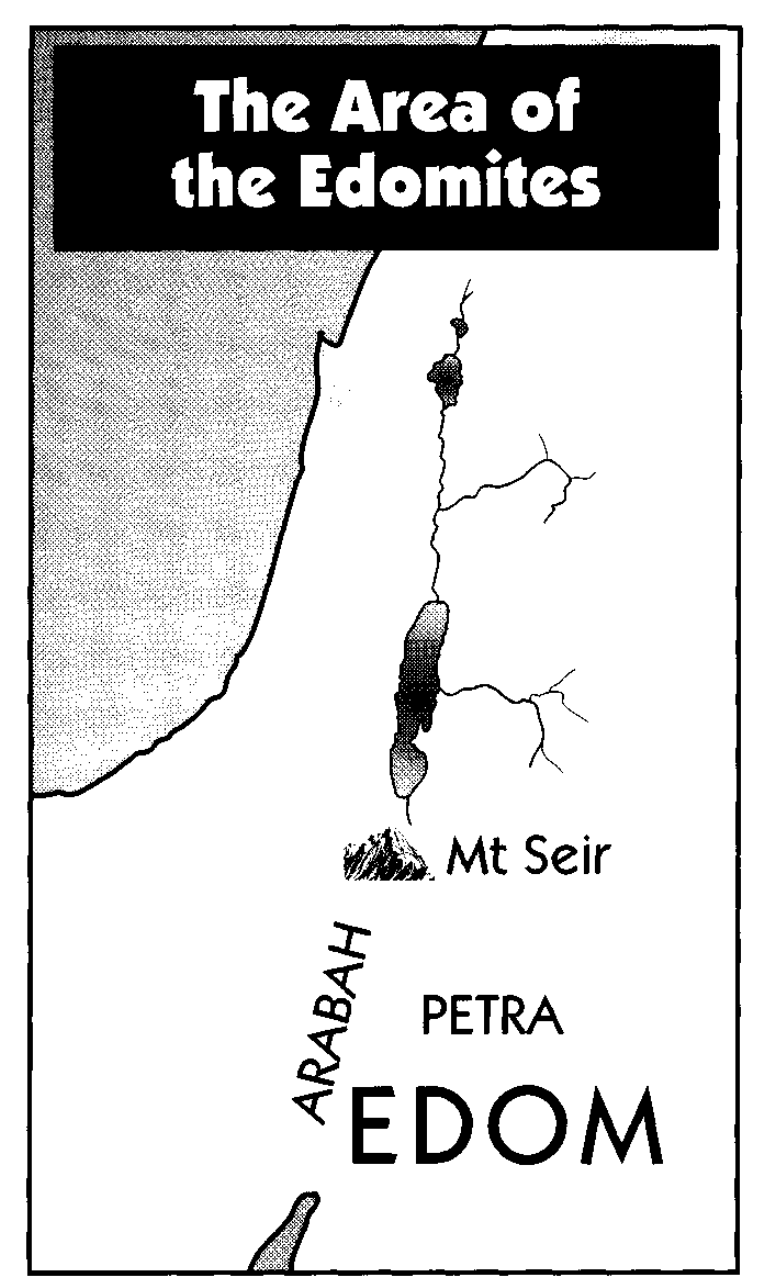
"The father of the Edomites in Mount Seir" — As he is their father, they are an extension of the type represented by him. His character is reflected in them. In the Hebrew, the singular number is given: the father of Edom. For the significance of Seir see comment on Gen. 32:3. Mount Seir is the range of mountains running southward from the Dead Sea, east of the valley of Arabah, to the Elanitic Gulf. Petra is a wellknown land-mark of the area, and became a strongpoint of Edomite power.
VERSE 10
"These are the names of Esau's sons; Eliphaz the son of Adah the wife of Esau, Reuel the son of Bashemath the wife of Esau" — Eliphaz (Strength of El) and Reuel {Friend of El), the names of Esau's eldest sons reflect the influence of his father, and are names honoring God. Eliphaz is identified by many with the Eliphaz of Job 2:11 who came from an area dominated by Edomites.
VERSE 11
"And the sons of Eliphaz"—The names of these sons reflect a spiritual decline, though an increase in power and prestige.
"Were Teman" — His name signifies South, or Right (as a point of direction). As a district, Teman became famous for wisdom (Jer. 49:7). It is described in Job as the home of Eliphaz (Job 2:11). In the future, it will witness the manifestation of the Lord in glory (Isa. 21:14; Hab. 3:3).
"Omar" — His name signifies Talkative, or Eloquent.
"Zepho" — Signifies Watchtower. His name is given as Zephi in 1 Chron. 1:36.
"And Gatam" — According to Gese-nius Gatam signifies Their touch, others give it as Dried up.
"And Kenaz"— Signifies Hunting.
VERSE 12
"And Timna was concubine to Eliphaz Esau's son"— Her name signifies Restraint.
"And she bare to Eliphaz Amalek" — Gesenius gives the meaning of Amalek as Labouring; others give it as Warrior. The Amalekites as a nation existed before the birth of this Amalek (Gen. 14:7), though he evidently manifested their warlike and hostile character.
VERSE 13
"And these are the sons of Reuel" — Cp. verse 4.
"Nahath" — Signifies Going down. Declining, (Ges).
"And Zerah" — Signifies Rising.
"Shammah" — Signifies Wasting.
"And Mizzah: these were the sons of Bashemath Esau's wife" — Sig. Trepidation.
VERSE 14
"And these are the sons of Aholibamah, the daughter of Anah the daughter of Zibeon, Esau's wife; and she bare to Esau, Jeush, and Jaalam and Korah" — These details have already been given in verse 5. They are repeated here to incorporate all the sons in the genealogy.
The Dukes Of Esau's Sons — Vv. 15-19
As Esau's descendants increased in number, they also increased in status.
Whereas the sons of Jacob remained shepherds, the prominent among Esau's sons assumed the title of "Dukes."
VERSE 15
"These were dukes of the sons of Esau"—The word "dukes" is Alluphim in Hebrew, and is derived from alaph (Strong), signifying to associate with, hence to range under as chief. Others see it as the plural of Aleph the first letter of the alphabet, and therefore as a title of the first or chief of a company. Young gives it as a leader, head of a thousand. The word aleph can signify chief, head, thousand or family. The word is rendered governor in Zech. 9:7; 12:5. Whatever rendering is used, the idea of power and authority is suggested.
"The sons of Eliphaz the firstborn son of Esau; duke Teman, duke Omar, duke Zepho, duke Kenaz" —The sons of Eliphaz (v. 11), now assume authority over others.
VERSE 16
"Duke Korah, duke Gatam, and duke Amalek: these are the dukes that came of Eliphaz in the land of Edom" — The dukes listed in vv. 15-16 are all listed earlier as sons of Eliphaz. The exception is "duke Korah," who though given here as a "son of Eliphaz the firstborn," is listed in v. 5 as a son of Esau by Aholibamah. Some, including Kennicott, claim that this is a copyist's error. However, Korah could have been the name of both a brother and a grandson of prominence of Eliphaz, and as such, listed among the dukes. These verses (Vv. 15-17) list grandsons of Esau who rose to prominence, whereas v. 18 lists the sons of Esau. In view of the suggestion above, there is no need to look for a copyist's error.
"These were the sons of Adah"— The Hebrew benim does service for grandsons as well as sons, providing room for Korah among the "sons of Adah."
VERSE 17
"And these are the sons of Reuel Esau's son; duke Nahath, duke Zerah, duke Shammah, duke Mizzah: these are the dukes that came of Reuel in the land of Edom; these are the sons of Bashe-math Esau's wife"— This verse shows that those listed in v. 13 developed into dukes.
VERSE 18
"And these are the sons of Aholibamah Esau's wife; duke Jeush, duke Jaalam, duke Korah; these were the dukes that came of Aholibamah the daughter of Anah, Esau's wife" — See v. 14.
VERSE 19
"These are the sons of Esau, who is Edom, and these are their dukes" — This verse describes a development of power and influence: Esau becomes a nation (Edom), and his sons become dukes.
The Sons And Dukes Of Seir The Horite —Vv. 20-30
Esau infiltrated into Seir, first by marriage, then by war. Aholibamah, his wife was a descendant of Seir (Vv. 2,24). Subsec/uently he occupied the land by conquest (v 6; Gen. 33:14; Deut. 2:12), and incorporated the Horites into the powerful nation with Dukes of their own, indicative of their organisation. That Esau should conquer such a nation illustrated his growing power and warlike ability.
VERSE 20
"These are the sons of Seir"—Seir signifies Rugged, Rough. He occupied the territory east of the Arabah, with headquarters at Mt. Seir, or Petra. He was the grandfather of Hori, the ancestor of the Horites (1 Chron. 1:38). The term sons often does duty for descendants (cp. Josh. 7:1,18).
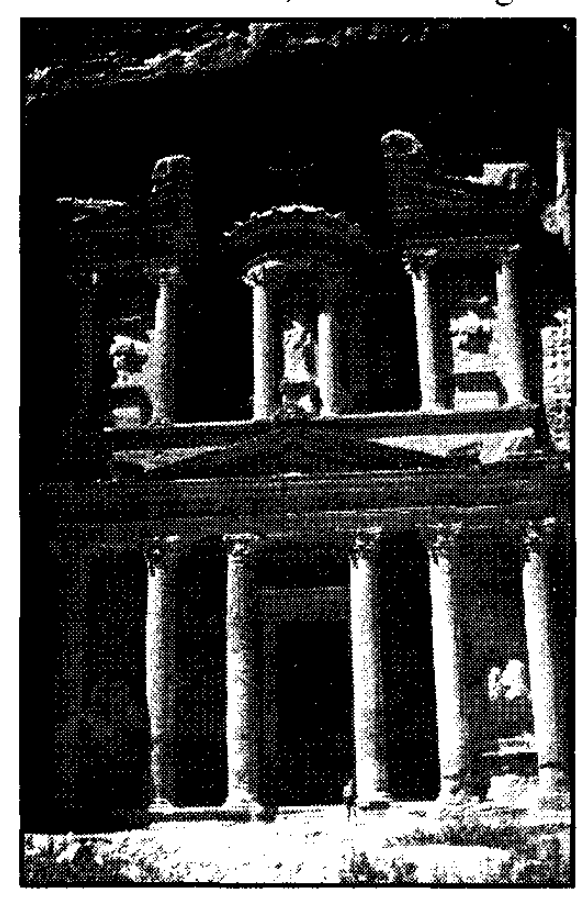
"The Horite, who inhabited the land"—The term Horite, from chor, a cave, signifies a race of troglodytes. The Horites were the original occupants of the land (Gen. 14:6), and dwelt in caves. The mountains of Edom abound with sandstone and limestone caves. The rock-hewn city of Petra, which later became the capital of Edom, was one of the great strongholds in ancient times. The temples and houses cut in the sides of the mountains surrounding Petra still exist, and though they do not date back to the times of Esau, they do show that the traditional method of cutting buildings out of the rock with great patience and skill was retained. Petra is described elsewhere as "the strong city" (Psa. 60:8-12), and is there used as a type of Babylon the Great (Rev. 16:19).
"Lotan" — Signifies Wrapping up (Ges.).
"And Shobal" — Signifies Flowing.
"And Zibeon, and Anah" — See Note v. 2. This Anah was uncle to the Anah of v. 25.
VERSE 21
"And Dishon" — Signifies Gazelle.
"And Ezer" — Signifies Treasure.
"And Dishan: these are the dukes of the Horites, the children of Seir in the land of Edom" — Sig. Gazelle.
VERSE 22
"And the children of Lotan"—In Hebrew, the same word is used for "children" as for "sons" in v. 20. Perhaps the A.V. rendered it as children because of the reference to a daughter in this verse.
"Were Hori" — Signifies Cavern. This is the name of the tribe.
"And Hemam" — Signifies Destruction.
"And Lotan's sister was Timna" — Timna whose name signifies Restraint, became the concubine of Eliphaz, Esau's firstborn son (v. 12). So there was intermarriage between the Edomites and the Horites, prior to the former dominating the latter by conquest.
VERSE 23
"And the children of Shobal were these; Alvan" — Signifies Unjust.
"And Manahath" — Signifies Rest.
"And Ebal" — Signifies Stripped of leaves.
"Shepho" — Signifies Nakedness.
"And Onam" — Signifies Strong.
VERSE 24
"And these are the children of Zibeon" — Since Esau's wife Aholibamah was the daughter of Anah, the son of Zibeon (cp. v. 2) here is further evidence of the infiltration of the Edomites by marriage. Now we learn that Aholibamah was from a family of high-ranking Hivites or Horites.
"Both Ajah"—Signifies Screamer.
"And Anah"—Signifies Answering. He was father-in-law to Esau.
"This was that Anah that found the mules in the wilderness"—The Hebrew eth hayemim is never translated "mules" except here. The ordinary word for "mules" is pered. What, in fact, did Anah find in the wilderness as he fed the asses of Zibeon his father?
The R.V. follows Jerome in translating it as "hot springs," and the verse then implies that having discovered these, he lay claim to them. But yemim is never translated "springs" or "waters" elsewhere in the Bible. The word should probably be rendered Emim. W. Saulez states: "The word Emim, translated 'mules' in the one version, 'hot springs' in the other, is the proper name of a people whom Anah encountered, and the passage should be rendered, 'This was that Anah who encountered the Emim in the wilderness'." Reference to the Emim is made in Gen. 14:5. They were a powerful people dwelling just north of the Horites, and, if the rendition above is accepted, Anah, as he tended the grazing of his father's animals, came upon some of them, and defeated them in battle, thus acquiring possession of territory previously dominated by them. Whatever Anah discovered and lay claim to, whether it be hot springs or the Emim, he became famous because of it. The verse implies fleshly fame and power on the part of Anah whose daughter married the ambitious and power-seeking Esau.
"As he fed the asses of Zibeon his father"—This, apparently inconsequential statement, is not so trivial as may be imagined. The possession of asses conferred status on rulers in ancient times, and became a symbol of rank (Jud. 5:10; 10:4; 12:14; 2 Sam. 16:1-4; 1 Kings 1:33,38). Thus, when the Lord rode towards Jerusalem upon the colt of an ass, the people recognised the status implied, and applauded him accordingly (Matt. 21:8-9). This verse therefore implies that Anah, whose daughter married Esau, came of a family of rulers, and in addition established his own personal claim to fame. The marriage of Esau into a family of such repute is a contrast to that of his brother Jacob — who married for love.
VERSE 25
"And the children of Anah were these; Dishon" — Signifies Gazelle — noted for its beauty and fleetness of foot.
"And Aholibamah the daughter of Anah" — cp. v. 2.
VERSE 26
"And these are the children of Dishon; Hemdan" — Signifies Pleasant. His name is given as Amram in 1 Chron. 1:41.
"And Eshban" — Signifies Reason, Understanding. The same as Heshbon.
"And Ithran" — The same as Jethro, signifying The Superior or Excellent One.
"And Cheran" — Signifies Harp.
VERSE 27
"The children of Ezer are these: Bil-han" — Sig. Modest.
"And Zaavan" — Signifies Disturbed
"And Akan" — Signifies Twisting.
VERSE 28
"The children of Dishan are these: Uz" — Signifies Sandy. Job is described as a man of the land of Uz. (Job 1:1).
"And Aran" — Signifies Wild goat.
VERSE 29
"These are the dukes that came of the Horites; duke Lotan, duke Shobal, duke Zibeon, duke Anah" — The use of the title shows that the Horites were a nation of power and organisation. Seven dukes are listed, implying the completeness of the political development of the tribes.
The Kings And Dukes Of Edom — Vv. 31-43
Now follows a list of kings, implying further development of power and organisation. From a single individual Esau grew to a family, a tribe, a dukedom, and finally a kingdom illustrating the growing might and organisation of Esau the profane man of flesh, in comparison with that of Israel. We see the Gentile antitype today. Whereas "Jacob" (whether of the flesh or spirit) is largely disorganised and in weakness, Gentile might is impressive and powerful. But this is just for a moment. As Israel ultimately came to the ascendancy, and Edom fell into decline, so it shall be when the Kingdom of God supplants Gentile power. That is the lesson of this section of Genesis. How important and significant are these apparently "dry" and uninteresting records of the Bible, when viewed in their typical import! History, archaeology and prophecy all testify to the power of Edom, in comparison to that of Israel. But today Edom is only a shadow across the pages of ancient history, whilst Israel remains and is growing in influence. It will do so even more completely under Messiah.
VERSE 31
"And these are the kings that reigned in the land of Edom" — Edom, red, always stands for the flesh in political manifestation. Though powerful at the present there is no future in it, as Obadiah predicts (Obad. 15-16). The Gogian confederacy (Ezek. 38) will comprise the latter-day manifestation of this power to be overthrown by the King of Israel.
"Before there reigned any king over the children of Israel" — It is sometimes urged that Moses could not have written these words, because they presuppose a king in Israel, and the first king was Saul. But kings had been promised to Israel (Gen. 35:11), as dominion had been predicted for Edom (Gen. 27:40), and the fulfilment of the latter prophecy provided a guarantee that the other would be fulfilled. Meanwhile, the dukes and kings in Edom evidently existed contemporaneously (Exod. 15:15; Num. 20:14). The names of the kings listed imply the strength and ruthlessness of Edom's power.
VERSE 32
"And Bela" — Signifies To make away, to devour at a gulp.
"The Son of Beor" — Signifies Burning like a lamp.
"Reigned in Edom" — This indicates that the political organisation of the nation was greatly established whilst the children of Israel still wandered disorganised as pilgrims in the land.
"And the name of his city" — Like Cain before him, in "whose way he walked" (Jude 11), he built a city to establish his influence and name (Gen. 4:17).
"Was Dinhabah" — Signifies A place of plunder. It is suggestive of Babylon the Great (Cp. Rev. 18:10-17).
VERSE 33
"And Belah died" — Again a repetition of the theme-song of the destiny of flesh. See note Gen. 5. All the strivings and ambitions of man are brought to nought in death — except those based on faith.
"And Jobab the son of Zerah" — Zobab signifies Shouter. Zerah was a duke, introduced in v. 17.
"Of Bozrah reigned in his stead" — Bozrah signifies Fortress. It became a
symbol of strength and is referred to in relation to the future in Isa. 63. The Lord Jesus Christ, as king over Israel, will destroy the fortress of Edom, even Babylon the Great.
Bozrah was situated in Arabia Deserta, east of the Arabah. It was later occupied by Moab; was given by Moses to Reuben, but ultimately reverted to Edom.
VERSE 34
"And Jobab died, and Husham of the land of Temani reigned in his stead" — Husham signifies Haste, or Speed. Teman was a son of Eliphaz, firstborn of Esau, who evidently gave his name to a portion of territory occupied by him.
VERSE 35
"And Husham died, and Hadad the son of Bedad" — Hadad signifies Shouting for joy, i.e. as a conqueror. Bedad signifies Separation.
"Who smote Midian in the field of Moab, reigned in his stead" — Midian was a son of Abraham by Keturah who was sent away to the east by Abraham (Gen. 25:6). His name means Strife, and the Midianites appear as warlike nomads. They had evidently conquered Moab, but, in turn, were conquered by Edom, indicative of the warlike ability of the latter.
"And the name of his city was Avith"— Avith means Ruin from a root, avah signifying to do evil. Compare note v.32.
VERSE 36
"And Hadad died, and Samlah of Masrekah reigned in his stead" — Samlah signifies Covering, and Masrekah signifies Vineyard.
VERSE 37
"And Samlah died, and Saul of Rehoboth by the river reigned in his stead" — Saul signifies Asked or Appointed. Rehoboth signifies Wide spaces, implying a large city. It is the name of a city founded by Asshur (Gen. 10:11), which was adjacent to the river Euphrates, and thus answers to the description of this verse. This would imply that the Edomites, at one stage of their development, ruled in Assyria, though the name Rehoboth has been given to other places (cp. Gen. 26:22). The verses before us certainly describe the power of the Edomites. A further point of significance is that the nation was ruled from various centres. How like Gentile power! Over the centuries the flesh (Edom) has reigned from various centres, such as Babylon, Persia, Greece, Rome, France, Britain, Russia and so forth. Each from his own centre.
VERSE 38
"And Saul died, and Baal-hanan the son of Achbor reigned in his stead" — These names signify, The Lord of Benignity, son of The mouse!
VERSE 39
"And Baal-hanan the son of Achbor died, Hadar reigned in his stead: and the name of his city was Pau; and his wife's name was Mehetabel, the daughter of Matred, the daughter of Meza-hab"— The name of this king is also given as Hadad, which was the name of a god Hadadezer, "Adad, Hadal was an ancient Mesopotamian Diety, god of the storm thunder, identified with Aramean, weather god Rimmon" (Unger, p. 437) (2 Sam. 8:3). Hadad signifies glory, pride. The death of this king is not recorded, suggesting that he was living when Moses wrote Genesis. By contrast his death is recorded in the parallel genealogical line in 1 Chron. 1 (see v. 51).
VERSE 40
"And these are the names of the dukes that came of Esau, according to their families, after their places, by their names" — The "dukes" whose names follow, evidently lived contemporaneously with, and under Hadad, executing delegated authority over the Edomite empire. Their names are not given, only the districts over which they ruled. Therefore, the title would better be rendered as Duke of....
"Duke Timnah" — Timna was concubine to Eliphaz, and gave birth to Amalek (v. 12). It could be that the territory of Amalek was named after his mother.
"Duke Alvah" — Alvah is referred to in v. 23; the location of the territory over which he ruled is unknown.
"Duke Jetheth" — Gesenius gives the meaning of his name as Nail. His identity and the place over which he exercised authority are both unknown.
VERSE 41
"Duke Aholibamah" — Aholibamah was one of the wives of Esau (v. 2). Possibly the territory over which her son exercised authority was given her name.
"Duke Elah" — According to some this name should be rendered Εlath, and is identified with modern Elat. Elah signifies strength, and if the identification with Elat is accepted, it shows that Edomite territory extended to the Gulf of Aqaba.
"Duke Pinon" — His name signifies Dark, and we are in the dark concerning his identity, or the locality over which he ruled.
VERSE 42
"Duke Kenaz" — See v. 11. He evidently developed into a tribe, over which he exercised authority.
"Duke Teman" — Teman gave his name to territory which thus formed an area of the Edomite empire. The men of Teman were noted for their wisdom, prudence, and counsel (Jer. 49:7 ).
"Duke Mibzar" — His name signifies Fortress. Nothing more is known of him than that he established an Edomite tribe.
VERSE 43
"Duke Magdiel" — His name signifies Prince of God. Nothing further is known of him.
"Duke Iram" — His name signifies Citizen. Nothing more is known of him. Like the flesh he had his moment of triumph and passed into obscurity.
"These be the dukes of Edom, according to their habitations in the land of their possession"—The descendants of Esau thus extended their rule over the adjacent territory. These profane men of the flesh illustrated the words of Psalm 49:11,
"Their inward thought is, that their houses shall continue for ever, And their dwelling places to all generations; They call their lands after their own names. Nevertheless man being in honour ahideth not: He is like the beasts that perish:"
All that remains of these men and the power they wielded, are the brief notices in the Word of God.
"He is Esau the father of the Edomites" — Esau the profane man of the flesh, thus extended his authority, built up his political organisation, and established his power. His descendants were also known for their wisdom and sagacity (Obad. 8; Jer. 49:7). The flesh has ever been noted for political power and fleshly wisdom. In fact, Paul taught "the world by wisdom knew not God" (1 Cor. 1:21). In every way Esau and his descendants represent the flesh.
Comments