___________________
413. CHAPTER THIRTY-EIGHT
BIRTH OF PHAREZ: PREDECESSOR OF THE LORD
Why was this story, so crude in its details, recorded in Holy Writ? It appears as a harsh intrusion into the account of Joseph. We pass for a moment out of an environment of faith, goodness and purity, into one of lust, evil and intrigue. It is not even in proper chronological sequence, for much of the story occurred before those events recorded in the previous chapter. Nevertheless, its inclusion comprises a proof of the impartiality of Inspiration; and its appearance, in this place, is obviously divinely selected to emphasise a most important principle. The facts, considered in themselves, reflect no credit to Judah, but reveal why he was disqualified to be the fourth-generation leader among the sons of Jacob, after Reuben, Simeon and Levi had demonstrated their incompetence for the position. At the same time, it was revealed to Jacob, that ultimately the royal dignity would be vested in the Lion of Judah (Gen. 49:10); but the incidents of this chapter show that this would be done on a basis of divine selection and foreknowledge, not on personal merit as far as the tribe was concerned, nor upon the flesh.
The chapter will be considered from three aspects. Firstly, as narrative; secondly, as exhortation; thirdly, as typical foreshadowing.
- As narrative, it reveals the circumstances leading to the birth of Pharez, the predecessor of the Lord, showing how he was "touched with the feeling of our infirmity."
- As exhortation, it sets forth the acute moral temptations which living among the Canaanites brought into the lives of Jacob's sons, and offers a partial explanation for the move into Egypt. If the integrity of the covenant people was to be preserved, they must, for a time, until properly constituted as a nation under God-given laws, be removed from the corrupting influence of Canaan's religious and social life. It is obvious from the record of
first Dinah, then Reuben, and now Judah, that the members were exposed to Canaanitish influences from which they had to be guarded. By manipulation of famine, Yahweh drew His people into an area where separation was forced upon them (Gen. 46:34); the design being to save lives (Gen. 50:20). - As a prophetic foreshadowing of the divine purpose, the chapter narrates how that Judah married a Canaanitish woman whose influence was manifested in his sons. Er, his firstborn, the token of the strength of the tribe, was married to the righteous Tamar, representative of the covenant of faith, but evidently was impotent to consummate the marriage, so as to produce fruit to the preservation of the name. On his judicial death, because of perversion, she was given in marriage to the second son, but though competent to do so, he refused to produce fruit to his deceased brother, though he was prepared to indulge his lust in the opportunity afforded him. He, too, was given over to death. The third son (more righteous than the other two) was held back from Tamar by Judah, who, in doing so, denied her right, so she was not able to bear fruit to the glory of God. She disguised herself, and Judah, ignorant of her true identity (as the nation later became blinded to the true significance of the covenant of faith), treated her as an harlot, gratifying the lust of the flesh at her expense, whilst manifesting no real responsibility towards her. He left with her his tokens of authority and support, which she retained in order to establish her integrity. Tamar gave birth to twins: Pharez and Zarah, representative of the law and of grace. The latter, though partly manifested first, was thrust aside by Pharez, who was thus born first. In fulfilment of the type, faith first appeared in the covenant made to Abraham, but was superseded by the Law, until the true Seed appeared (Gal. 4:17, 23).
In the type, Tamar represents the Abrahamic covenant in relation to Judah, the appointed royal tribe. It emphasises the lesson that the flesh profits nothing, and that the appointment was by divine foreknowledge and selection, and not by personal merit. As in the types presented by Sarah, Rachel and Rebekah, it reveals that the covenant of faith, though by contrast barren and unproductive for a time, will ultimately produce abundantly to the glory ofYahweh (cp. Isaiah 54:1), so that of antitypical Tamar it will be said: "Fear not; for thou shalt not be ashamed; neither be thou confounded, for thou shalt not be put to shame: for thou shalt forget the shame of thy youth, and shalt not remember the reproach of thy widowhood any more' (Isa. 54:4).
Judah Begets Er, Onan And Shelah — vv. 1-5
Judah marries a Canaanitish woman, and begets three sons.
VERSE 1
"It came to pass at that time" — At what time? The setting of the chapter would suggest after Joseph had been taken down into Egypt, but that could not have been so for the following reason: Joseph was 6 when Jacob came into Canaan (Gen. 30:31; 31:41), 17 when he was sold into Egypt (Gen. 37:2,25), 30 when he stood before Pharaoh (Gen. 41:46), and 39 when he was joined by Jacob (Gen. 46:5). This provides for only 22 years between the time that Joseph was sold into Egypt, to when Judah arrived there with two grandsons, the children of Pharez (Gen. 46:12), an insufficient period for all the events of this chapter to have happened. By eliminating the comma (not included in the Hebrew), the statement reads: "It came to pass at the time that Judah went down from his brethren," thus indicating some earlier period, possibly shortly after Jacob arrived at Shechem. Why are these events narrated at this place? Because of divine foreknowledge as manifested in the type.
It is appropriate that, in the midst of the life-history of the typical Christ (Joseph), the circumstances of the line through which the real Seed should come would be maintained. The record shows that it was not through personal merit of the tribe, but through divine selection, that the Lion of Judah would be revealed, to claim the privileged position conferred upon Joseph at that time. The type reveals that in spite of wickedness, and evil, and tragedy, the true Seed would ultimately be manifested.
"That Judah went down from his brethren" — This is an indication of deterioration comparable to Dinah's action (Gen. 34:1). Adullam and Timnath (v. 12) are in the area of Judah, the former not far from Hebron where Isaac was living at the time (Gen. 35:27-28). Perhaps Judah's original intention was to visit his grandfather.
"And turned in" — The Hebrew natah signifies to stretch, incline, or pitch. His inclinations were drawn to Hirah, and he pitched his tent close by to cultivate his acquaintance. This inclination towards forbidden associates later became characteristic of the tribe (2 Chron. 36:14).
"To a certain Adullamite" — The adjective suggests a man of prominence. Adullam signifies Enclosure. It was a town in the Hebron valley, a royal city (Josh. 12:15), the site of the cave where later David hid from Saul (1 Sam. 22:1-2).
"Whose name was Hirah" — Hirah signifies Splendour, perhaps indicative of his status. Judah moving among the great men of the land continued his downward course. In this he anticipated the action of the nation which, likewise, was attracted to the great among the Gentiles and courted their kings, nobles and priests.
VERSE 2
"And Judah saw there" — As in the first sin (Gen. 3:6), the lust of the eyes took possession of Judah (1 John 2:16).
"A daughter of a certain Canaanite" — Again the adjective suggests prominence. The Canaanites were enemies of the Truth (see note on Gen. 13:7), but the lust of the flesh blinded Judah to that fact. Later, the nation followed the same path (seePsa. 106:34).
"Whose name was Shuah" — His name means Affluence. He evidently was rich in this world's goods. In times of affluence, spiritual values become blurred (Rev. 3:16). Shuah was the name of Judah's father-in-law, not that of his wife. Seev. 12.
"And he took her, and went in unto her" — Judah thus repeated the sin of Esau which had been "a grief of mind to Isaac and Rebekah" (Gen. 26:34-35) and against which Abraham had solemnly warned (Gen. 24:3). He thus became yoked with an unbeliever, anticipating the apostasy of the nation (e.g. Isa. 30:1-3). The lust of the flesh possessed Judah.
VERSE 3
"And she conceived, and bare a son; and he called his name Er" — Er signifies Watchful, and in the type is suggestive of the lust of the eyes (1 John 2:16). Judah's first two sons who died could be representative of the nation, after civil war in the days of Rehoboam divided the monarchy into two parts.
VERSE 4
"And she conceived again, and bare a son; and she called his name Onan" — Onan signifies Strong, and is suggestive of the pride of life.
VERSE 5
"And she yet again conceived, and bare a son; and called his name Shelah" — Shelah signifies Request, Petition, Prayer. Apparently Judah withdrew him from the polluting Canaanitish environment. He was not involved in the tragedy that overcame the other two sons, and ultimately begat children who rose to prominence in the nation. In the story before us, he is like the remnant who returned to reestablish the nation after the political deaths that brought to an end the northern and southern kingdoms at the hands of the Assyrians and Babylonians.
"And he was at Chezib, when she bare him" — Chezib signifies Falsified, Deceitful. It is identified with Chozeba (1 Chron. 4:22), which was given to the sons of Shelah at the time of the partitioning of the land, and also with Achzib, a lie, referred to in Josh. 15:44; Mic. 1:14. In the latter place it is used to describe the attitude of kings of Israel: "the houses of Achzib (sig. a lie, deceitful) shall be a lie (Heb. achzab) to the kings of Israel." Micah was describing the confidence that these kings placed in Assyrian support, which would prove deceitful in the end; foreshadowed in the experiences of Judah in the chapter before us.
Er Marries Tamar — v. 6
Er, arriving at marriageable age, Judah selects Tamar as a wife for him, perhaps to save him from the same mistake as he, himself, had made.
VERSE 6
"And Judah took a wife for Er his firstborn, whose name was Tamar" — In the narrative of this chapter, Tamar appears more righteous than any of the other characters (cp. v. 26). Her name signifies Palm tree, which is elsewhere used as a symbol of the righteous (Psa. 92:12). Her nationality is not given, but her name is Semitic, suggesting that she could have been of Abrahamic descent. In the type she appears to represent the Abrahamic covenant. She gives birth to twin sons, the circumstances of which point forward to Law and Grace (vv. 28-30).
Judicial Deaths Of Er And Onan — Vv. 7-10.
In marriage Er reveals his Canaani-tish proclivities, and divine judgment and justice strikes him down. Onan is then given to Tamar, but manifesting a like wickedness, suffers a like fate.
VERSE 7
"And Er, Judah's firstborn, was wicked in the sight of Yahweh" — The nature of his wickedness is not specifically stated, but the context of the verse strongly suggests some form of moral perversion. The Hebrew word is ra, and in that language, comprises Er's name in reverse. The same expression is used to describe the abandoned wickedness of the men of Sodom (Gen. 13 :13, see note), and whilst the term is used for all forms of depravity, it could have been that the particular evil of which Er was guilty, was that for which the Sodomites were notorious. Because of this evil proclivity, Er, possibly, did not consummate the marriage with Tamar. He despised the code of divine law that was in existence even then (Gen. 26:5). Like Israel, the northern kingdom which after the division was cut off from the Temple, his perversion made it impossible for him to produce fruit to the glory of the Father. In regard to the type, see Hosea 12:1-2 where Ephraim (styled the firstborn: Jer. 31:9), Judah (representative of the southern kingdoms), and Jacob (the nation as a whole) are described in terms analogous to the suggested typology of the chapter before us.
"And Yahweh slew him" — The divine judgment and justice struck him down as, later, it brought the northern Kingdom to political death (see Hosea 6:4-5; 13:1.
VERSE 8
"And Judah said unto Onan, Go in unto thy brother's wife, and marry her, and raise up seed to thy brother" — The Hebrew word for marry in this place is not the normal one used. It is yagam and signifies to marry a brother's widow. The R.V. renders it in that way: to perform the duty of an husband's brother unto her. See the same expression used, and the law explained in Deut. 25:5. Evidently the law of the levirate marriage was in existence in patriarchal times. This word is not derived from Levi as is often thought, but from the Latin levir signifying husband's brother. It was the duty of the next of kin, as Redeemer, to marry the widow of his deceased brother if he died childless, and raise up seed to his brother: the object being that no house should perish in Israel. Faithful Boaz did this, foreshadowing the work of Christ in so doing. It is the duty and privilege of the believer, who is entrusted with the seed of the Word (1 Pet. 1:23), to raise seed to Christ his elder brother who died childless (cp. Isa. 53:8, 10). The political death of the northern kingdom (Ephraim is called the firstborn) was followed by added appeals to the southern kingdom to produce fruit to the glory of Yahweh, or it, too, would perish (see Hos. 6:4-7; 2 Chron. 36:15-17).
VERSE 9
"And Onan knew that the seed should not be his" — Onan did not want the responsibility of raising up seed to his brother, and so establish the house of the firstborn, for it would have been to the disadvantage of his own inheritance and house. He determined, therefore, to avoid the duty of the Redeemer.
"And it came to pass, when he went in unto his brother's wife" — According to the Hebraist Ewald, the Hebrew implies that he did this not once, but several times: "whenever he went in." Onan was prepared to enjoy sexual intercourse with Tamar, but was not prepared to consummate it so as to raise up seed to his brother. He revoltingly treated her as though she were a common harlot. Judah as a nation, though possessing the Temple, treated the Abrahamic Covenant in a similar manner.
"That he spilled it on the ground" — Literally this is "he destroyed it to the ground." As the fruit of the union would not be to his personal glory, to the building up of his power, he wasted his life and strength (cp. the meaning of his name), whilst enjoying the immediate pleasure such action gave him.
"Lest that he should give seed to his brother" — His manner of carrying out his responsibilities in regard to the levirate marriage, was a complete negation of the purpose of God, and the spirit of the Truth. It was particularly insulting to Tamar.
VERSE 10
"And the thing which he did displeased Yahweh" — The word "displeased" is from ra-beayin. It is compounded of ayin, eye and raa, to break in pieces, good for nothing, bad, etc. From the former we learn that what Onan did in secret was known and seen of God; from the latter we learn that it was particularly displeasing, being a sin against the covenant and redemptive provisions of God, as well as being grossly insulting to Tamar. In the sight of God, Onan's action was particularly bad, for it broke in pieces the law of redemption that He had established. Onan gave every appearance of fulfilling the will of God, but hidden from the eyes of others, he did not fulfil his obligations.
In passing, we might observe, that because of the motives that dictated Onan's action (v. 9) and inasmuch as this incident has specific reference to a levirate marriage and its significance, God's displeasure towards Onan should not be used as an argument against modern family planning (cp. 1 Cor. 7:3-5). At the same time, young people should bear in mind that the purpose of marriage is to produce a family, and that the first words spoken by God to man was the commandment: "Be fruitful". The real joy of marriage is found in the fruit of the union, despite the problems and trials that family life inevitably brings, or the sacrifices that it demands (cp. Psa. 127).
"Wherefore He slew him also" — God's displeasure again was manifested in the tragedy that overtook the family of Judah.
Judah Promises Shelah To Tamar — v. 11
Claiming that his third son is too young to fulfil the obligations of the family redeemer, Judah asks Tamar to wait in her father's house until he is fully grown.
VERSE 11
"Then said Judah to Tamar his daughter in law, Remain a widow at thy father's house" — It was normal for a widow to return to the house of her father (Lev. 22:13).
"Till Shelah my son be grown" — Judah was prepared to acknowledge the letter of the law, whilst searching around for some way to evade it. This, also, was the attitude adopted by the leaders of Judah.
"For he said, Lest peradventure he die also, as his brethren did" — Judah blamed Tamar for the death of his sons, and determined to avoid a third tragedy in the family. Many blame their alleged adherence to the covenant of promise, and the sacrifices that it imposes on them, as responsible for the problems they experience in life, instead of recognising that frequently they bring these upon themselves by their own folly. That was the case with Judah's sons. They died because they denied Tamar her right, even as the twofold division of the nation was brought to political death because both set aside their responsibilities to the Abrahamic covenant. The remnant alone was saved for a future inheritance, answering to Shelah in the type. The time seems to have a latter-day application as well, for Zechari-ah declared that "Two parts therein shall be cut off and die; but the third shall be left therein" to suitably respond to the call of Yahweh (Zech. 13:8-9).
"And Tamar went and dwelt in her father's house" — He is unnamed, but probably was of Abrahamic descent. See note v. 6. He evidently lived close to Tim-nath (v. 14), which is located on the border of Judah's territory, about two miles west of Beth-shemesh. Its name signifies an allotted portion, thus an inheritance. For a time Tamar, representative of the covenant of promise, is found among the Gentiles, in an allotted portion. This, too, was the state of the remnant that remained after the political death of the nation. In dispersion they carried the Abrahamic covenant back into the house of their fathers (see Josh. 24:2).
Tamar's Strategem To Win Her Husband — Vv. 12-23.
Judah's wife dies without any further children. Shelah grows up, but is not given to Tamar, who realises that her hopes of obtaining a husband of the covenant people will be dashed unless she forces Judah to honour his obligation. She disguises herself, and is mistaken by Judah for a harlot. He promises payment for her services, and leaves a pledge as a guarantee for this, but when his friend seeks for her in order to redeem it she cannot be found.
VERSE 12
"And in process of time the daughter of Shuah Judah's wife died" — The hand of God is seen in these events. It is openly apparent in the deaths of Er and Onan; less conspicuous in the death of Judah's wife; unnoticed in the trivial incident of Judah's going up to his sheep shearers, yet in all these circumstances working out His purpose. The significance of all this could not be properly understood until fifteen hundred years later with the birth of Christ, and the proclamation of the Gospel in his name, for God was clearing the way for the birth of Pharez and Zarah, and through Pharez for the coming of the Lord.
In the same way today, God works out His purpose in the lives of those called to the Gospel. The Judgment Seat will reveal the truth of Yahweh's declaration: "I have not done without cause all that I have done" (Ezek. 14:23). The recording in Genesis of these minor events that had such tremendous consequences hundreds of years later, is a clear indication of Inspiration.
"And Judah was comforted" — He ceased to mourn, and resumed normal life.
"And went up unto his sheepshear-ers to Timnath" — This trivial incident was overshadowed by God to provide Tamar with her opportunity.
"He and his friend Hirah the Adul-lamite" — Judah's name is linked with that of Hirah in a way that does him no credit. See James 4:4.
VERSE 13
"And it was told Tamar, saying, Behold thy father in law goeth up to Timnath to shear his sheep" — Tamar intended to hold Judah to his promise, but realised by now that he was attempting to evade it. She was not anxious for marriage in general, but desired a particular marriage: one linked with the hope of Israel. If she merely desired marriage, she doubtless could have been satisfied by marrying a Gentile. Instead, she patiently awaited the redemption of the promise.
VERSE 14
"And she put her widow's garments off from her" — To prevent detection by Judah.
"And covered her with a vail" — To conceal her features, after the fashion of a harlot (v. 15; Job 24:15).
"And wrapped herself — Probably with a large mantle.
"And sat in an open place" — The A.V. margin renders: in the door of eyes or of Enajim. The former suggests a public and open place where all could see her; the latter would identify the place with Enam, mentioned in Josh. 15:34, as being adjacent to Timnath. The R.V. renders: sat in the gate ofEnaim.
"Which is by the way to Timnath" — The town of Enam was adjacent to Timnath. See Josh. 15:34. Judah would have to pass that way.
"For she saw that Shelah was grown, and she was not given unto him to wife" — We are not told what Tamar hoped to accomplish by her action. It could have been that she merely intended to impress upon Judah that he was driving her to this extremity by his action in withholding Shelah, and denying her rights, and then leaving the issue to be divinely directed as God willed. However, when Judah made the advance that he did, she complied. Nothing more is revealed concerning Shelah and Tamar. Judah accomplished all that was required under the levirate law. However, it could have been that subsequently Tamar was given to Shelah to wife. The record reveals that Shelah married for it refers to his descendants, the Shelanites (Num. 26:20), as becoming prominent in Judah, noted for their skill and industry (1 Chron. 4:21-23).
VERSE 15
"When Judah saw her, he thought her to be an harlot; because she had covered her face" — The Hebrew word for "harlot" is zonah, and signifies one that is wanton. An entirely different Hebrew word is used by Hirah when he enquired as to the whereabouts of Tamar (vv. 21-22). Judah, as an Israelite, recognised harlotry for what it is; Hirah as a Canaanite camouflaged it with a religious title.
VERSE 16
"And he turned unto her by the way, and said, Let me come in unto thee; (for he knew not that she was his daughter in law)" — Though Judah, whose wife was dead, was prepared to satisfy his cravings by committing adultery or fornication, he would have shrunk from the sin of incest.
"And she said, What wilt thou give me, that thou mayest come in unto me?" — Tamar seized the opportunity that presented itself to her. Her conduct is not to be attributed to lust, or inordinate desire for offspring, but rather an attempt to secure her right to a place among the ancestresses of the patriarchal family. It seems quite evident that she had been educated regarding the family hopes based upon the divine promises made to Jacob, and that she had earnestly embraced these principles. Therefore she was not prepared to be set aside from her right. She probably also knew that Judah misinterpreted the cause of the judgment that had fallen upon his two sons. Later, Judah acknowledged that she was more righteous than he (v. 26).
VERSE 17
"And he said, I will send thee a kid from the flock" — By such means, Judah sought to pay for the sin he had committed. It suggests the attitude of the nation which sought justification by the works of the Law.
"And she said, Wilt thou give me a pledge, till thou send it?" — In the Hebrew this is presented in the form of a statement If thou wilt give me a pledge.
VERSE 18
"And he said, What pledge shall I give thee? And she said, Thy signet" — The signet, or seal, was the token of identification and authority. It was either worn on the finger, or suspended round the neck by a pathiyl or cord.
"And thy bracelets" — The R.V. renders this as thy cord (Heb. pathiyl). The pathiyl was a cord or chain by which the signet was attached to the person, thus establishing the identity of the owner of the signet or seal.
"And thy staff that is in thine hand" — His support.
"And he gave it her" — He delivered up to her the tokens of his authority, identity and support. Typically, Judah here represented the nation which treated the covenant of promise as a man would a harlot — a thing of personal convenience and fleshly satisfaction; and in doing so lost its authority, true identity and real support.
"And came in unto her, and she conceived by him" — How a man could enter into such intimate relationships with a maid, and yet remain ignorant of her identity is surprising. Obviously, Tamar kept the veil on her face. How typical of the nation! It was brought into intimate relationship with the covenant of promise without properly comprehending the significance of it. The nation was blind to its true import (Rom. 11:7-8; 2 Cor. 3:12-18).
VERSE 19
"And she arose, and went away, and laid by her vail from her, and put on the garments of her widowhood" — She resumed her previous way of life.
VERSE 20
"And Judah sent the kid by the hand of his friend the Adullamite, to receive his pledge from the woman's hand; but he found her not" — Hirah's failure to find Tamar concerned Judah deeply. The harlot (as he imagined Tamar to be) was acting out of character with her profession. He expected her to be anxious to obtain the agreed payment.
VERSE 21
"Then he asked the men of that place, saying, Where is the harlot" — A different word for harlot is used by Hirah than that used by Judah in v. 15. There the word is zonah, and signifies one who sells herself for money. Here the word is kedeshah and signifies a separated or sacred person. It was the term given to a temple prostitute, which was a feature of the evil Canaanitish worship at the time.
"Was openly by the wayside" — See note v. 14, and compare the margin. The statement can be rendered: that was in Enaim.
"And they said, There was no harlot in this place" — Again the word in Hebrew is kedeshah. The woman, whom Hirah took to be a sacred person, was to Judah, a harlot. So with the religious world in the past and present. An apostate church system is described as "the mother of harlots and abominations of the earth" (Rev. 17:5), but to the world its officials are sacred persons. Jeremiah indicted Judah for committing "adultery with stones and with stocks" (Jer. 3:9), or for engaging in false worship.
VERSE 22
"And he returned to Judah, and said, I cannot find her; and also the men of the place said, that there was no harlot in this place" — Again the word is kedeshah, rendered devotee by Rother-ham.
VERSE 23
"And Judah said, Let her take it to her, lest we be shamed"—The Berkeley Bible renders: "Let her keep them for herself, we do not want to be ridiculed. I sent the kid and you failed to find her." Judah
was concerned lest he be held up to contempt — not in regard to the act he had committed, but by the raillery of others who would mock him for being tricked out of his possessions.
"Behold I sent this kid, and thou hast not found her" — As though to say; "I have done all that is necessary in the case". So Judah wiped the incident from his mind.
Judah Vindicates Tamar's Action — Vv. 24-26
Three months after this incident the rumour comes to Judah that Tamar is with child. This infuriates him, and he demands that she be put to death. Brought out for execution, however, Tamar requests the privilege of identifying the man responsible. Judah is shown the tokens of his own identity and is compelled to recognise that Tamar is more righteous than he.
VERSE 24
"And it came to pass about three months after, that it was told Judah, saying, Tamar thy daughter in law hath played the harlot; and also, behold, she is with child by whoredom" — As a widow, Tamar had the right to marry; but so long as she remained a widow, she had obligations to Judah's remaining son. Though it became obvious that she was with child, she had remained strictly silent as to the identity of the father.
"And Judah said, Bring her forth, and let her be burnt" — This was the punishment that the Law set down for the wife of a priest who proved unfaithful (Lev. 21:9). Thus the principle was recognised and practised before its incorporation into the Mosaic law. Tamar was the wife of Judah's firstborn, and one of the privileges of such was to act as priest on behalf of the family. Such a penalty possibly was preceded by public stoning (cp. Deut. 22:20-24).
VERSE 25
"When she was brought forth" — To heighten the drama, she maintained her
silence unto the crucial point of execution.
"She sent to her father in law, saying, By the man, whose these are, am I with child" — To his amazement, Judah saw again the missing tokens, and instantly comprehended the purpose behind Tamar's action.
"And she said, Discern, I pray thee, whose are these, the signet, and bracelets, and staff — Evidently, Judah was struck dumb at the sight of the evidence, causing Tamar to again demand that he identify them.
VERSE 26
"And Judah acknowledged them, and said, She hath been more righteous than I" — The Hebrew term tsedaqah signifies to be in the right, or to have a just cause. In the terms of the levirate marriage law, Tamar was in the right. She had obtained a child by the man who was responsible for seeing to it that a relative of her husband be given to her as a substitute husband. Judah was publicly shown to be derelict in his duty of giving Shelah to Tamar, as well as being the man responsible for making pregnant the woman he had condemned to death. Tamar's desire to have children by a levirate marriage was motivated by the promise to Abraham in relation to the Seed that should come; and this was remarkably fulfilled in her case.
"Because that I gave her not to Shelah my son" — Judah publicly acknowledged that he had been derelict in his duty in this regard.
"And he knew her again no more" — Whether or not she married Shelah subsequently is not revealed; though, as we commented in v. 14, Shelah did marry and have children.
Tamar Gives Birth To Pharez And Zarah — Vv. 27-30
Tamar gives birth to twin sons, the circumstances of which foreshadow the divine purpose.
VERSE 27
"And it came to pass in the time of her travail, that, behold, twins were in her womb" — See also the case of Rebekah (Ch. 25:24).
VERSE 28
"And it came to pass, when she travailed, that the one put out his hand" — The hand of the second son was revealed before the birth of the first. A remarkable type is presented in the birth of Tamar's twin sons, pointing forward to the two covenants of God: the Abrahamic covenant of faith; and the Mosaic covenant of law. The "hand" of the one was revealed before the other was brought to the birth, though the fulness of the former was not revealed until afterwards. Paul, in Gala-tians 3:17 shows that whilst the covenant of faith made its appearance before the law, its fulness was not revealed until later. "Before faith came, we were kept under the law, shut up unto the faith which should afterwards be revealed .... But after that faith is come we are no longer under a schoolmaster" (Gal. 3:23-25). We might say that "the hand" of the covenant of faith was seen from the beginning, (Gen. 3:15), but its fulness was not revealed until the Seed was born. So, in the type before us, Pharez represents Law, and Zarah represents Grace.
"And the midwife took and bound upon his hand a scarlet thread, saying, This came out first" — The words scarlet thread are from the Hebrew shaniy elsewhere translated crimson, and used frequently for the colour used in the Tabernacle to symbolise sacrifice and redemption. The scarlet thread, like the scarlet cord let down from the window of Rahab's home (Josh. 2:18) which saved first the spies (v. 15), and afterwards her household, became typical of the Atonement. So, also, in the verse before us. The "hand" of the Abrahamic covenant first appeared, but the full birth occurred afterwards. Paul taught: "Jesus Christ was a minister of the circumcision for the truth of God, to confirm the promises made unto the fathers" (Rom. 15:8).
VERSE 29
"And it came to pass, as he drew back his hand, that, behold, his brother came out: and she said, How hast thou broken forth? this breach be upon thee" — The words of the midwife suggest that Pharez had violently pushed Zarah aside that he might be first brought to the birth. The latter part of her statement in Hebrew, aleycha peretsjor thyself a breach, can be paraphrased: "Thou shalt bear the name of the breach that thou hast made."
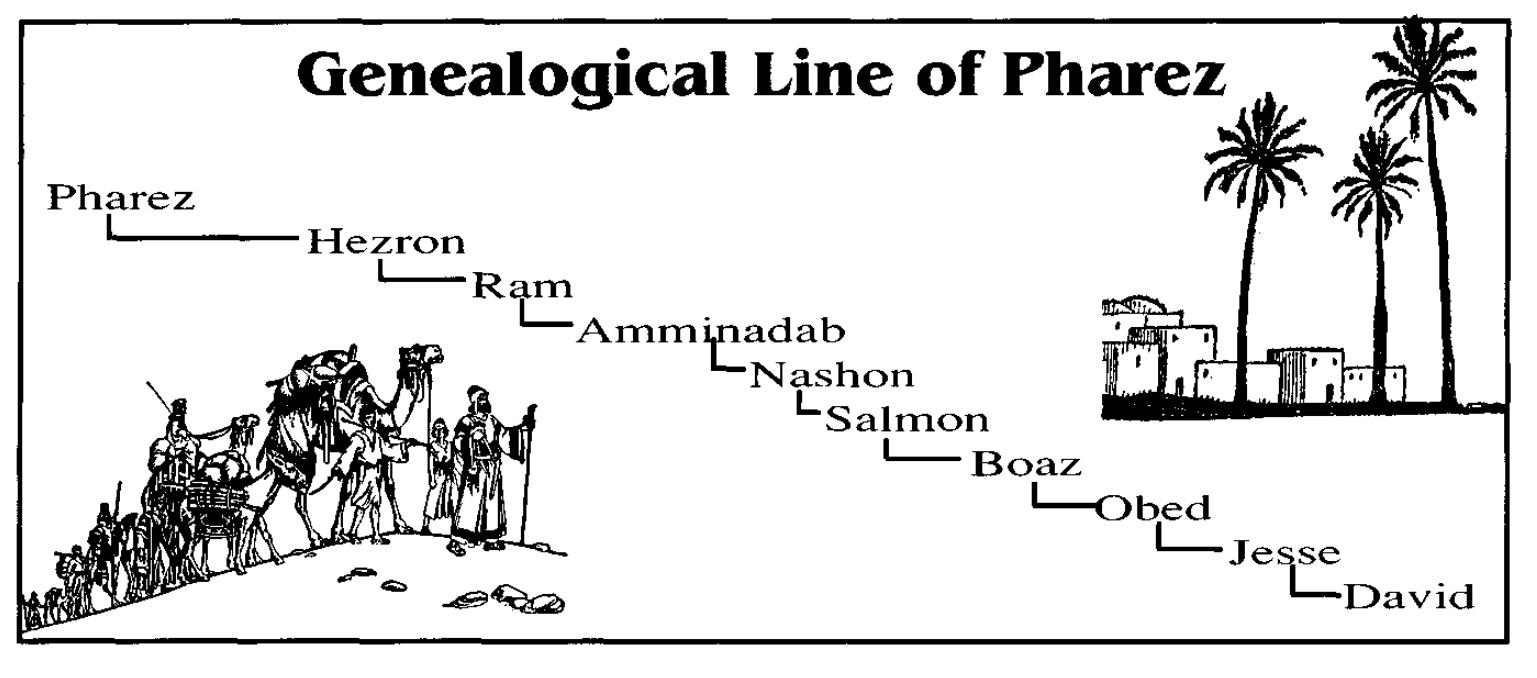
"Therefore his name was called Pharez" — Pharez, or Perez, signifies A breach. But for the breach that he made, Zarah would have been born first, but Pharez temporarily pushed him aside. What a significant birth, and how it points forward typically to the purpose of God! Though the covenant of Faith first made its appearance, and extended a hand to help those who came under its influence, it was temporarily pushed aside by the covenant of Law, which made obvious the breach by convicting men of sin. From Pharez came David (Ruth 4:18-22), and ultimately the Lord Jesus (Matt. 1:3). How does that fit the type if Pharez is aligned with the Law? Perfectly, for Paul taught: "When the fulness of the time was come, God sent forth His Son, made of a woman, made under the law, to redeem them that were under the law that we might receive the adoption of sons" (Gal. 4:4-5). Again: "Jesus Christ our Lord, which was made of the seed of David according to the flesh; and declared to be the Son of God with power, according to the spirit of holiness, by the resurrection from the dead" (Rom. 1:3-4). The Lord "magnified the Law and made it honourable" by rendering complete obedience to all that it required. But he also came under its curse, that he might redeem mankind from its death-dealing power (Gal. 3:13). In doing so, he led them from Pharez (A Breach) to Zarah (Sunrise).
VERSE 30
"And afterward came out his brother, that had the scarlet thread upon his hand" — This was the token of redemption through atonement.
"And his name was called Zarah" — Zarah signifies Sunrise, suggested by the crimson thread on his hand. The Law with its curses and sanctions, unaccompanied by the power of faith, came as a breach in the redemptive purpose revealed to Abraham, but the covenant of grace confirmed by the Lord, was as the breaking forth of light. Consider the wonderful words of Zacharias in regard to the impending birth of the Lord, culminating in the statement: "The dayspring from on high hath visited us, to give light to them that sit in darkness and in the shadow of death, to guide our feet into the way of peace" (Luke 1:68-79); the comment of John: "That was the true Light, which lighteth every man that cometh into the world;" and the blessing pronounced upon the marriage of Boaz and Ruth: "Let thy house be like the house of Pharez, whom Tamar bare unto Judah, of the seed which Yahweh shall give thee of this young woman" (Ruth 4:12). That seed anticipated the true Seed, which, as the Sun of righteousness (Mai. 4:2), healed the breach that had been caused by the Law, making possible the covenant of Grace.
Comments