___________________
406. GENESIS CHAPTER THIRTY-ONE
JACOB'S RETURN TO THE LAND OF PROMISE (Gen. 31:1-33:20)
The conditions of Jacob's service having been thus altered, he entered on an entirely new life. Instead of being a hired shepherd, he became a sheep-master. Together with his wives and children, he lived apart from Laban, in his own house, and only occasionally had communication with his uncle and his uncles sons. Laban soon became dissatisfied with the agreement that he had made with his son-in-law, and insisted on altering its terms. Jacob could have kept him to his bargain, but he submitted, and allowed God to direct the issues of his life. He continued to prosper, and this caused the jealousy and antagonism of Laban and his household. Jacob realised that it was only a matter of time before an open breach would occur, perhaps with tragic results. He felt dissatisfied with his position, and desired to make some change in it. It was under these circumstances, that he once more heard the voice of God speaking directly to him, and distinctly pointing out the course which he was to take. Thus commenced his pilgrimage back to the land; his escape from Laban, his unfounded fear of Esau, his wrestling with the angel, his ultimate arrival at Shechem in peace, and his erection of the altar El-elohe-Israel.
Jacob Plans To Leave Laban Secretly — Vv. 1-8.
Jacob, overhearing Laban's sons secretly accusing him of dishonesty, observes that Laban also believes this. He begins to fear for his life, and, seeking guidance from God, is instructed to return to the Land of Promise. He outlines his problems, stresses God's presence in his life, his personal diligence as a shepherd, the dishonesty of their father, and discloses to them the message he has received from God. His wives agree that their father is unjust. They recall with keen resentment that he had debased them by selling them like animals and then had kept the money which really belonged to them and their children, and willingly concurred with his decision.
VERSE 1
"And he heard the words of Laban's sons" — Jacob had now served forty years with Laban (cp. v. 38), and was now in his ninety-seventh year. The conversation he overheard alerted him to the change in Laban's attitude and the rising hostility towards him manifested by all in his father-in-law's household.
"Saying, Jacob hath taken away all that was our father's" — This exaggerated statement (Laban still had some possessions, v. 18) accused Jacob of dishonesty.
"And of that which was our father's hath he gotten all this glory" —They conveniently overlooked that Laban's wealth had been received through the service of Jacob (Ch. 30:30); and, moreover, that Laban had withheld that which rightly belonged to Leah and Rachel (Ch. 31:16).
VERSE 2
"And Jacob beheld the countenance of Laban and, behold, it was not toward him as before" — He took careful cognisance of Laban, and detected an attitude of increasing resentment towards him. Laban accepted the explanation of his sons as to the failure of schemes, and, overlooking his own dishonesty, manifested increasing impatience towards Jacob. This caused Jacob to fear for his life, so that he sought guidance of God.
VERSE 3
"And Yahweh said unto Jacob, Return unto the land of thy fathers, and to thy kindred; and I will be with thee" — Evidently Jacob made his problem a matter of prayer, which was answered in the matter described in this verse. He received Divine permission to return, and was given the promise: "I will be with thee."
VERSE 4
"And Jacob sent and called Rachel and Leah to the field unto his flock" — Relationships between Laban and Jacob had become so strained and critical, that Jacob could not trust most of those at the main camp, and therefore requested this family council in the field far from the prying eyes and treacherous ears of any who might report back to Laban. Whilst Jacob placed implicit trust in God, he realised that he should exercise discretion. It is important that we also do that.
It is significant that Rachel is placed before Leah in the narrative, doubtless because she was the more favored of the two. It is also significant that he called them unto "his flock." Evidently he was no longer caring for Laban's flocks. Perhaps Laban had come to the conclusion that it was more profitable for him to care for them himself!
VERSE 5
"And said unto them, I see your father's countenance, that it is not toward me as before" — There had been a change in relationships, and Laban's hostility was no longer disguised.
"But the God of my father hath been with me" — He rejected any suggestion of dishonesty, such as his wives may have been led to believe from the remarks of their brothers, and gave full credit for his prosperity to God to Whom it was due.
VERSE 6
"And ye know that with all my power I have served your father" — They knew this, for they realised how hard their husband had to work for their father in order to secure them as his wives; they also knew how their father had cheated him time and again. The word rendered "power", kowach signifies strength or vigour. Jacob had labored hard for Laban desiring his prosperity as well as his own.
VERSE 7
"And your father hath deceived me" — The Hebrew hathal signifies to cheat or
to plunder. It is a harder word than what we use to describe deception.
"And changed my wages ten times" — The term signifies to frequently do so,
as in Num. 14:22, Job 19:3 and elsewhere. Some of these changes are described in vv. 8,39.
"But God suffered him not to hurt me" — Whatever Laban did fell out to Jacob's
advantage. Jacob had personal experience of the overshadowing providence of Yah-weh. He gave God full credit for whatever prosperity had come to him.
VERSE 8
"If he said thus, The speckled shall be thy wages; then all the cattle bare speckled: and if he said thus, The ringstraked shall be thy hire; then bare all the cattle ringstraked" — By the original contract, Jacob had been promised all the parti-coloured animals (Ch. 30:32), but when these remarkably increased, Laban altered its terms by limiting Jacob's share to the speckled animals. When they suddenly increased, he changed the terms again. Jacob submitted to these changes because he realised that he prospered by the hand of God, and was prepared to allow Him to direct the issues. Being a man of faith, he recognised that whatever Laban did could not affect him if God continued with him.
VERSE 9
"Thus God hath taken away the cattle of your father, and given them to me" — This is Jacob's explanation of his amazing rise in prosperity. He put no confidence in the stratagem he had used (Ch. 30:42), but saw it only as a means to an end. God was with him, and he desired to impress his wives with that fact. He wanted to emphasise the fact that they need not fear the consequences of his proposal to leave Haran.
VERSE 10
"And it came to pass at the time that the cattle conceived, that I lifted up mine eyes, and saw in a dream"—This is Jacob's explanation of the statement he had already made to his wives, that God had taken away the cattle of Laban and given them to him. His increase in prosperity was the result of miracle, not of the artifice of the peeled rods. He was following Divine guidance in all that he did.
"And, behold, the rams which leaped upon the cattle were ringstraked, speckled, and grisled" — The word, grisled is translated from the Hebrew baruddim from a root barad, to scatter hail, and thus signifies spotted. What Jacob saw in a dream was not according to fact; for Laban had removed all such animals from the flock (Gen. 30:35). But God was revealing to him that though Laban had attempted to overreach him by removing such animals from the flock, and though all the animals that remained were outwardly perfect, the rams that begat lambs would be as though they were ringstraked, speckled, and spotted. Jacob recognised that the hand of God was prospering him; and the contrivance of the peeled rods was merely the external witness that what happened was not according to chance, but by divine direction.
VERSE 11
"And the angel of God spake unto me in a dream, saying, Jacob: And I said, Here am I" — Jacob was ever conscious of the overshadowing care of this angel, and referred to it towards the end of his life (Gen. 48:16). Angels overshadow the lives of believers now as much as they did in the days of Jacob (cp. Matt. 18:10), acting as a bridge between heaven and earth. The dream that Jacob saw, and the reassuring words of the angel that he heard, brought home to him the reality of the vision of Bethel, with angels ascending and descending the stairway between heaven and earth.
VERSE 12
"And he said, Lift up now thine eyes, and see, all the rams which leap upon the cattle are ringstraked, speckled, and grisled" — As we have noted above, they were in fact externally unmarked, but in reality, as far as genetics were concerned, they were so marked.
"For I have seen all that Laban doeth unto thee" — Thus Jacob explained to his wives that his artifice of the peeled rods was not the cause of his sudden prosperity, but that it came by the hand of God. Jacob had not acted "as a cheat and a rogue" as some claim, but had meekly submitted to the cheating of Laban, and had followed the direction of God in all that he did.
VERSE 13
"I am the God of Bethel" — This is an important title of God. The word is El (or Ail) in Hebrew, concerning which, Brother Thomas states in Phanerosis (p. 49 Logos edition) "As often as this word ail passed before his mind, the idea of Power, might, strength, would stand out in bold relief. 'It always,' says Gesenius, 'presented to the Hebrews the idea of strength and power.' Nebuchadnezzar is styled in Ezek. 31:11, Ail Goyim, the Mighty One of Nations; and in Isaiah 9:6, Messiah is termed Ail Givbor, the Mighty Warrior."
"God of Bethel," therefore, signifies Strength of the House of Power. God became Jacob's strength; He can become our strength. Jacob was learning the lesson that it is not in one's own power that things of eternal value are accomplished, but by leaning upon that One Who has promised: "I will never leave thee, nor forsake thee" (Heb. 13:5). We must allow God to work through us by His Word (Phil. 2:13), and we will be incorporated as elements in the House of God, "whose house are we, if we hold fast the confidence and the rejoicing of the hope firm unto the end" (Heb. 3:6). Christ is the channel of that divine strength (Phil. 4:13). It is "made perfect in (physical) weakness" (2 Cor. 12:9), and is adequate for the building up of a character well pleasing unto God (Eph. 3:16), as well as for coping with the fretting anxieties of life (Col. 1:11). Isaiah says: "He giveth power to the faint; and to them that have no might He increaseth strength" (Isa. 40:29-31). Yahweh has promised: "I will strengthen thee; yea I will help thee" (Isa. 41:10). This has enabled some to say: "In Yahweh have I righteousness and strength" (Isa. 45:24). Thus Paul exhorts: "Finally, my brethren, be strong in the Lord, and in the power of His might" (Eph. 6:10).
But though the Strength of Beth-el was with Jacob, the patriarch had to endure many trying times, and many sore trials, until he learned the lesson of Bethel— that Yahweh was with him. This reminds us that the adversities, evil circumstances, oppositions and difficulties we may experience from day to day do not mean that we are abandoned of God, but rather that there is some lesson that He desires us to learn; some aspects of our character that need purifying or developing.
"Where thou anointedst the pillar"— See Gen. 28:18. The pillar pointed forward to the main support of the House of God (Bethel), and therefore to Christ, and those in him. Now, by explaining the dream to his wives, Jacob reminded them of the great hope that he had, and which he shared with them.
"And where thou vowedst a vow unto Me" — By this vow (Gen. 28:21), Jacob dedicated himself unto Yahweh. The vision of Bethel, therefore, foreshadows the basis of all true conversions. As part of his household, his wives likewise must endorse the vow.
"Now arise, get thee out from this land, and return unto the land of thy kindred" — The Gospel is a call to separation and dedication. The time had come for Jacob to return, and for his wives to leave the land of their nativity for the promised inheritance. A similar appeal will one day be made to Israel after the flesh: "Return, thou backsliding Israel, saith Yahweh" (Jer. 3:12).
VERSE 14
"And Rachel and Leah answered and said unto him, Is there yet any portion or inheritance for us in our father's house?" — They recognised that there was no future for them as far as their father was concerned, and that their hope lay only with their husband. So it is with those who would follow the voice of God. Their natural father is the devil, that is: the flesh (John 8:44), the wages of which is death (Rom. 6:23); whereas by following God a person "has fruit unto holiness, and the end everlasting life" (Rom. 6:22).
VERSE 15
"Are we not counted of him strangers?" — That is what the world does with its own when they separate themselves to follow the dictates of God. Abraham had already demonstrated this principle (Heb. 11:14).
"For he hath sold us" — Laban had treated them as animals or chattels: he had bargained with Jacob for them as one would for beasts or for goods. His mercenary meanness rankled long in their minds, and had destroyed any love they once had for him. So it is with "our father the devil," the flesh. As we are brought under the influence of God's truth, we learn that "it profits nothing," and we lose any love we may once have had for it.
"And hath quite devoured also our money" — He had appropriated to his own use the dowry paid by Jacob. But how much was that? A considerable sum if the weekly wages for fourteen years were added up! On current (1992) wages of approximately $500 per week (and a master-shepherd of Jacob's ability would be able to command a significant rate as the state of Laban's flocks at the conclusion of his son-in-law's service revealed), the dowry paid by Jacob amounted to $350,000.
VERSE 16
"For all the riches which God hath taken from our father, that is our's, and our children's" — In this statement, they recognised the providential care of the God of Jacob, and accepted Jacob's explanation of his growing prosperity.
"Now then, whatsoever God hath said unto thee, do" — Like Rebekah before them, they announced their willingness to follow in the footsteps of Abraham, in a pilgrimage to the land of promise.
VERSE 17
"Then Jacob rose up, and set his sons and his wives upon camels" —
Having received the agreement of his wives, and fearing the intentions of Laban and his sons, Jacob acted with the greatest alacrity, instantly preparing for his departure.
VERSE 18
"And he carried away all his cattle, and all his goods" — The Hebrew nahag, here rendered "carried" signifies to pant and implies the urgency, haste and fear with which he made his preparations.
"Which he had gotten, the cattle of his getting" — Those animals that he had acquired through his service as shepherd to Laban.
"Which he had gotten in Padan-aram, for to go to Isaac his father in the land of Canaan" — See note, Gen 25:20.
Rachel Steals Her Father's Images — vv. 19-21.
Jacob shrewdly takes advantage of Laban's absence when visiting his distant flocks at shearing time, in order to leave Padan-aram for the land of Canaan. Unknown to anyone else, Rachel takes with her certain images which were equivalent to the title-deeds of her father's property. Verse 19 should be in parenthesis.
VERSE 19
"And Laban went to shear his sheep" — This sentence should be in parenthesis. It is explanatory of Jacob's urgent haste and instant action in leaving Haran. He seized the opportunity of Laban's absence to effect his escape. Rotherham renders the verb in the past tense: "And Laban had gone to shear his sheep."
"And Rachel had stolen the images that were her father's" — Rotherham puts this verb in the present tense: "So Rachel stole..." She also grasped the opportunity of her father's absence to do this. The word "images" is teraphim, as rendered in the margin. Apparently these teraphim were not so much gods to worship, as tokens of ownership of property. This is borne out by archaeological excavations at the small but important city of Nuzi, about twenty kilometres southwest of modern Kirkuk. They reveal that the possession of household gods, or teraphim, implied leadership of the family, and in the case of a married daughter assured her husband the right to the property of her father. Rachel had no legal right to those images, even though she did not steal them for purposes of worship, for as Laban had sons, they alone had the right to their father's goods. Evidently
Rachel rankled under a sense of injustice at the way in which her father had made profit out of her marriage to Jacob, and had proceeded to try and over-reach the family ever since. See her comments in v. 16. Possibly Rachel took these teraphim as security for the increase obtained by Jacob at the expense of Laban.
VERSE 20
"And Jacob stole away unawares to Laban the Syrian, in that he told him not that he fled" — The literal Hebrew is most expressive: "And Jacob stole the heart of Laban the Aramean." Thus, as Rachel stole the Teraphim of Laban, Jacob stole his heart. To the Hebrew, the heart is the seat of intelligence; Jacob "stole" this inasmuch as he did not disclose his intention of fleeing from Haran.
VERSE 21
"So he fled with all that he had" — This was a considerable company. Not only did he have four wives and twelve children mounted upon camels, but
Parable of Jacob's Return
Haran
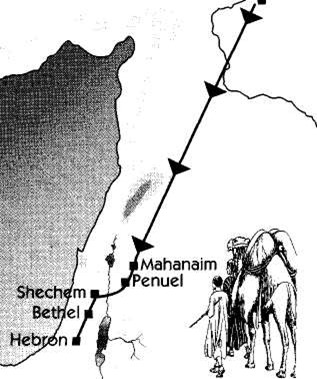
"menservants," and "maidservants," his household goods, cattle, camels and asses (Gen. 30:43; 31:18), a large flock of sheep and goats, a considerable number of horned cattle, bulls and kine (Gen. 32:15), numerous asses, "milch camels with their colts," furniture, tents (Ch. 31:33); in all a considerable caravan.
"And he rose up, and passed over the river" — By the river is meant the Euphrates, pre-eminently the river of the north.
"And set his face toward the mount Gilead" — He moved down south past Damascus to the east of the Sea of Galilee.
Laban's Pursuit — Vv. 22-24
Three days later, Laban was apprised of Jacob's action. On returning home, he discovered that the teraphim have been taken. He determines on pursuit. Taking with him some of his tribesmen, he pursues after Jacob, and moving at great speed, overtakes him in the northern part of Gilead. Meanwhile, however, he is warned by God to be careful how he treats Jacob.
VERSE 22
"And it was told Laban on the third day that Jacob was fled" — Laban's flocks were three days' journey from those of Jacob (Gen. 30:36). This suggests that no sooner had Jacob left, than somebody rushed to Laban with the news.
VERSE 23
"And he took his brethren with him" - He gathered together sufficient of his relations, men of his own tribe, to overawe Jacob with his company.
"And pursued after him seven days' journey; and they overtook him in the mount Gilead" — From Haran to Gilead is about five hundred kilometres. Riding on camels, Laban might well cover this in seven days; but Jacob with his household and his flocks would take considerably longer. Evidently Laban had delayed before leaving. Possibly he did not decide to do so until he discovered the loss of the teraphim.
VERSE 24
"And God came to Laban the Syrian in a dream by night, and said unto him" — This was evidently the night before he overtook Jacob as described in the previous verse.
"Take heed that thou speak not to Jacob either good or bad" — If this were the message that Laban received, it would mean that he could not speak at all! But the literal Hebrew is: "from good to bad," and evidently signifies in a deceitful manner: pretending to greet him in a friendly fashion, and then proceeding to accuse him; "blessing with his mouth, but cursing inwardly" (cp. Psa. 62:4).
Laban Rebukes Jacob But Fails To Find The Images — Vv. 25-35.
The dramatic meeting of Laban and Jacob is skilfully recorded. Varied emotions are subtly revealed and suspense is maintained to the end, with twists of irony flavoring the whole. Though the warning of God prevents the interview from being more stormy than might have been expected, it is still pretty tense. Laban makes an angry assault on Jacob, accusing him of being a thief trafficking in human lives. He accuses him of lacking the common courtesy of permitting him to bid a proper farewell to his daughters and grandchildren; and finally of being a common thief in stealing his gods. Jacob indignantly refutes the accusation of Laban, invites him to search for the gods which his father-in-law does confidently, but in vain.
VERSE 25
"Then Laban overtook Jacob. Now Jacob had pitched his tent in the mount: and Laban with his brethren pitched in the mount of Gilead" — Tension must have mounted in the camp of Jacob as he saw the approach of Laban; and now that the two encampments were side by side, great fear must have been experienced in that of Jacob.
VERSE 26
"And Laban said to Jacob" — He assumed the pose of an injured, innocent party, overlooking his own failings in the transactions with Jacob.
"What hast thou done, that thou hast stolen away unawares to me, and carried away my daughters, as captives taken with the sword?" — Laban's frustration and anger causes him to use extreme language, and indulge in hyperbole which cannot be justified. In reality, he had sold his daughters as slaves, and they had willingly departed with Jacob, thoroughly disillusioned with their father.
VERSE 27
"Wherefore didst thou flee away secretly, and steal away from me; and didst not tell me" — The literal Hebrew is: "And hast stolen me" for which see notes on v. 20.
"That I might have sent thee away with mirth, and with songs, with tabret, and with harp?" — Laban might have done so, but more probably would not have. The tabret, or toph, was a hand drum or timbrel, something like a tambourine, or a tom-tom. It was associated with merrymaking (Exod. 15:20), and with dancing. The harp (kinnor) was a stringed instrument. Laban pretends that he would have entertained Jacob lavishly in a going-away party. If so, he would have had to alter his normal attitude.
VERSE 28
"And hast not suffered me to kiss my sons and my daughters?" — With a touch of self-pity, Laban portrays himself as a generous grandparent who had been selfishly deprived from displaying affection towards his offspring.
"Thou hast now done foolishly in so doing" — The charge of folly is normally associated with wrongdoing, as in 1 Samuel 13:13.
VERSE 29
"It is in the power of my hand to do you hurt: but the God of your father spake unto me yesternight, saying, Take thou heed that thou speak not to Jacob either good or bad" — There is a play on words here. The el (power) of my hand is contrasted to the Elohim of your father. Laban sternly warns Jacob to take heed, as he had the power to have taught him a lesson, and would have done so but for the warning of God.
VERSE 30
"And now, though thou wouldest needs be gone, because thou sore longest after thy father's house" — Laban now belittles Jacob as a homesick boy, who must needs go back to his father's house!
"Yet wherefore hast thou stolen my gods?"—The final accusation. Jacob is called a common thief who has stolen the treasured possessions of his benefactor.
VERSE 31
"And Jacob answered and said to Laban" — He replies with dignity, not attempting to hide anything, but frankly confessing to his motives.
"Because I was afraid: for I said, Peradventure thou wouldest take by force thy daughters from me"—Jacob did not attempt to defend himself. He frankly admitted that he was moved by fear and the dread of Laban's irresponsible use of force.
VERSE 32
"With whomsoever thou findest thy gods, let him not live: before our brethren discern thou what is thine with me, and take it to thee" — The accusation of dishonesty stung Jacob, and he impulsively gave Laban permission to search the camp, and confidently promised that the offender would be punished with death.
"For Jacob knew not that Rachel had stolen them" — Otherwise he would have been more cautious in his reply.
VERSE 33
"And Laban went into Jacob's tent, and into Leah's tents, and into the two maidservants' tents; but he found them not. Then went he out of Leah's tent, and entered into Rachel's tent" — Each had his or her individual establishment. Laban carefully searched each tent to Jacob's growing indignation and resentment.
VERSE 34
"Now Rachel had taken the images" — It must have been a very tense and fearful Rachel who listened to the conversation between her father and husband. She would have had many an anxious moment, as the probing, merciless hands of Laban picked and moved over all that was in the tent.
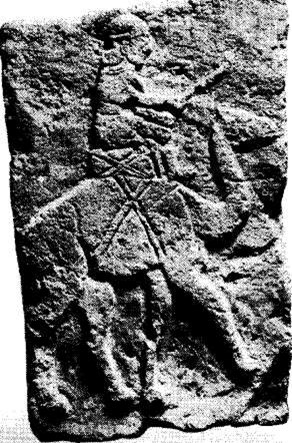
"And put them in the camel's furniture, and sat upon them" — The RSV renders this as "the camel's saddle." At Tell Halaf, archaeologists found a stone slab sculptured in relief, dating from about the ninth century B.C., depicting a camel, with a rider sitting on a saddle which looks very much like a square box, fastened on the animal by crosswise girths. Such a saddle would be exactly the kind in which Rachel could readily have hidden the household idols (Light From The Ancient Past, p. 67).
"And Laban searched all the tent, but found them not" — The literal Hebrew is "Laban felt in all the tent." His probing fingers searched every part, but to his annoyance and frustration, he found them not.
VERSE 35
"And she said to her father, Let it not displease my lord" — Let it not irritate you.
"That I cannot rise up before thee" — It was normal for children to rise up before their parents (Lev. 19:32), but this would have been difficult for Rachel seated upon the camel.
"For the custom of women is upon me" — Literally, "the way of women." A reference to menstruation (cp. Gen. 18:11). Under the law, females were then considered as ceremonially unclean, and were set apart (Lev. 15:19). Evidently the same custom prevailed before the law, with the result that Laban could not search the saddle upon which Rachel was seated, without being ceremonially defiled.
"And he searched, but found not the images" — He searched everywhere but in vain.
Jacob Reproaches Laban For His Harshness — Vv. 36-42.
Embarrassed at the failure of his search, Laban is silenced before his son-in-law. His anger subsides, whilst Jacob's confidence increases. He now decries Laban's attitude as indicative of the selfish, suspicious nature he ever revealed. Moved with righteous anger, Jacob demands the reason of such conduct. Laban has accused Jacob of being a common thief, but let him supply the evidence. On the other hand, Jacob presses Laban with dishonesty, accusing him of deceiving him in his wages, in spite of the diligent and unstinted service rendered by his son-in-law. Only the overshadowing care of God had protected him from such as Laban.
VERSE 36
"And Jacob was wroth, and chode with Laban" — The Hebrew signifies to glow, blaze up. Jacob burned with indignation the more Laban was abashed. The word "chode" is from ruwb, to toss, tear, grapple, and is expressive of action with the hands or with words of a highly demonstrable kind. He possibly gesticulated as he spoke, his very indignation giving him added eloquence.
"And Jacob answered and said to Laban, What is my trespass? What is my sin, that thou hast so hotly pursued after me?" — It is claimed that "in the Hebrew there is a selection of poetical forms of expression and of rythmical movement" as the hotly indignant Jacob upbraided his father-in-law with an avalanche of words. This stemmed from his sense of grievance, his realisation of being hopelessly wronged.
VERSE 37
"Whereas thou hast searched all my stuff — The literal Hebrew is felt. "Your prying fingers have dug into all my possessions, have handled all my goods".
"What hast thou found of all thy household stuff? set it here before my brethren and thy brethren, that they may judge betwixt us both" — To the chagrin of the crestfallen Laban, he had nothing to show! One can imagine how the eyes of his kinsmen would turn towards him as they listened to Jacob. They had travelled some five hundred kilometres for this — and still had another five hundred kilometres to return! The term judge in this place signifies to correct, instruct. The onlookers are invited to be instructed as to the character of either party by what they have witnessed and are about to hear.
VERSE 38
"This twenty years have I been with thee" — Jacob was ninety-seven years of age when he fled from Laban. If he were with his father-in-law only twenty years, the events of his life are compressed in too narrow a compass to be practical, and introduce contradictions.
Consider the following:
At the end of two years' famine (Gen. 45:6) Joseph would have been between 39-40 (Gen. 41:46), and Jacob was 130 (Gen. 47:9).
Joseph was thus born when Jacob was 90-91, and this is dated just prior to the six years that he served Laban for his cattle (Gen. 30:25).
If, to that point of time, he had been only fourteen years with Laban, it would mean that he fled from Esau to seek a wife when he was about 77!
Assuming that he first worked seven years for Leah, his first son would not be born before he was 85; and if Joseph were born when he was 90, he had eleven sons and at least one daughter in five years!
In that case, also, he had children and grandchildren to the number of sixty-six in the short space of forty-five years.
At that rate, Judah, the fourth son could not have been born before he was 88, and would have been about 42 when the events of Genesis 38 took place, or 48, if Jacob married Leah before the completion of the seven years that he worked for Laban to obtain her.
Esau visited Ishmael and married his daughter after Jacob left for Haran at the age of 77, though Ishmael died when Jacob was 63 (Gen. 25:17). Isaac married at 40 (Gen. 25:20). Jacob was born twenty years later (Gen. 25:26). Ishmael, thirteen years older than Isaac died at 137 (Gen. 25:17).
These problems are solved if we can add a further twenty years to Jacob's sojourn with Laban, making his age 57 when he fled from Esau, though still 97 when he left Laban. This would allow for forty years with Laban, the period of probation or trial. And that forty years seem to be provided for in Jacob's conversation with Laban. He makes reference to two periods of "twenty years" each (cp. vv. 38,41). The first twenty years, he was with Laban as a friend: "I have been with thee." The second twenty years, he was there as a covenant servant: "I have been twenty years in thy house; I served thee..." The first fourteen years he served Laban for his two daughters; the following twenty years, he was with Laban in his capacity as shepherd; the final six years, he served him for his cattle. The first fourteen years, and the last six years, represented twenty years of servitude; the intervening twenty years he was employed as a shepherd, during which Laban's flocks remarkably increased.
The Hebrew provides some warrant for this interpretation which also disposes of the difficulties mentioned above. The Hebrew zeh (rendered this: v. 38, and thus v. 41) when used in conjunction one with the other is often used by way of distinction as in Exodus 14:20, there rendered one and other; Ecc. 6:5-8: this and that; Job 21:23-25: one and another. And so here. Jacob could have meant "this twenty years have I been with thee" and "that twenty years I have been in thy house." The first twenty years he served Laban as a friend. At some personal loss, but in gratitude to his father-in-law, he cared for his flocks (Vv. 38-40), the other twenty years he profited from his labour: first in the acquisition of his wives; and then from Laban's herds.
The Hebrew zeh li esrim signifies "this for myself (li) twenty years..." In other words, during one twenty years he showed a profit; whilst during the other twenty years he showed a loss. In all, he was in Haran forty years: fourteen for his wives; twenty as a friend and son-in-law; six for the cattle. In all, forty years, a period of probation.
"Thy ewes and thy she goats have not cast their young" — He looked after the flock of Laban with the greatest skill.
"And the rams of thy flock have I not eaten" — He received no pay for this twenty years of labour, a contrast to the other twenty years when he did receive payment.
VERSE 39
"That which was torn of beasts I brought not unto thee; I bare the loss of it" — Shepherds were normally required to make good any loss incurred in the flock whilst it was in their care. The exception was when a wild beast attacked the sheep and took one despite the efforts of the shepherd to protect them. In that case, the shepherd brought pieces of the torn animal to demonstrate the cause of death to the owner, and to show that the fault was not with him.
"Of my hand didst thou require it, whether stolen by day, or stolen by night" — This is expressive of the severe conditions imposed by Laban on Jacob.
VERSE 40
"Thus I was; in the day the drought consumed me, and the frost by night" — He was parched with thirst in the daytime in the heat of the sun; and bitterly cold by night. Extremes of temperature between day and night are a feature of the inland, and severely felt by shepherds. The Land And The Book (Thompson) makes reference to this variation "between blazing sun and biting frost" (p. 364). It was so extreme, he reported, that "there was a sharp frost, and ice appeared on all the little pools about the camp."
Jacob's description of his trials is significant from another viewpoint. It demonstrates that he was not exempt from trial, even though God was with him.
"And my sleep departed from mine eyes" — Jacob's words show how conscientious he was in his duties, even though he did not receive adequate payment for them. As the result of his labours, Laban found his herds and riches increased. Jacob had explained this as "Yahweh blessing him" (Ch. 30:30). However, this also entailed hard work. This is something we need always remember in the work of the Truth, or in regard to our personal welfare.
VERSE 41
"Thus have I been twenty years in thy house" — Jacob's use of the Hebrew zeh rendered thus could be intended as a note of contrast, as indicated in above comments. He now begins to describe his years of servitude.
"I served thee fourteen years for thy two daughters, and six years for thy cattle" — This represents the twenty years that he had worked for Laban as a paid servant.
"And thou hast changed my wages ten times" — See notes on Vv. 7-8.
VERSE 42
"Except the God of my father, the God of Abraham" — See this sentiment repeated by the descendants of Jacob (Psa. 124:1-2).
"And the fear of Isaac, had been with me" — The word pachad suggests reverential awe, a fear of offending. That was Isaac's attitude towards God. See his immediate reaction when he learned that his preference in bestowing the blessing upon Esau instead of Jacob was opposed to the will of God (Gen. 27:33). See also Psa. 76:11-12. Let us also develop a reverential fear of offending Yahweh.
"Surely thou hadst sent me away now empty" — In these words Jacob accused Laban of hypocrisy. If he merely wished to bid his children and grandchildren farewell, why the need of gathering such a large company of associates to pursue Jacob? In view of his obvious intention in so doing, his polite words were merely a cover to his true motives, as Jacob clearly stated.
"God hath seen mine affliction and the labour of my hands, and rebuked thee yesternight" — God read the heart of Laban, was cognisant of the sufferings of Jacob, and the unfair treatment he received at the hands of his father-in-law, and so had intervened to prevent him carrying out his true intentions.
The Covenant Between Jacob And Laban — Vv. 43-55.
In face of Jacob's spirited defence, Laban has little to say. He can neither justify himself nor condemn Jacob. He is not willing to own himself in a fault, nor to ask Jacob forgiveness and to compensate him, as he ought to have done. Instead, he weakly urges that Jacob's wives and cattle are all his; which is incorrect. He then proposes a covenant of friendship between them, which Jacob readily agrees to, without demanding an apology from Laban. In this Jacob sets a good example. When quarrels happen, we should be willing to cease arguing and establish the bonds of friendship. Better sit down losers than go on in strife.
VERSE 43
"And Laban answered and said unto Jacob, These daughters are my daughters, and these children are my children, and these cattle are my cattle, and all that thou seest is mine" — That certainly was true once, but was the case no longer. Jacob had paid for it all; but the patriarch does not insist upon establishing his right. He realised that Laban was trying to make out a case to save face, and made it easy for him to do so. Laban claimed that he would not attack Jacob, for in doing so he would injure his own flesh and blood. The reason was puerile, but it was all that he could urge in the face of Jacob's complete fidelity.
"And what can I do this day unto these my daughters, or unto their children which they have born?" — Laban was forced to be apologetic. He dropped his charge of theft (in ignorance that he had been cheated by his daughter, as he had formerly cheated his son-in-law), and now stated that he desired to do something to contribute to their welfare.
VERSE 44
"Now therefore come thou, let us make a covenant, I and thou" — Literally, "Let us cut a covenant." A covenant confirmed by sacrifice was completely binding on both parties. Laban requested that Jacob enter into such a binding agreement with him.
"And let it be for a witness between me and thee" — The Hebrew word for witness is ed. It finds its place in the word Galeed referred to subsequently.
VERSE 45
"And Jacob took a stone, and set it up for a pillar" — The word massebah "pillar" signifies a memorial. It was probably in the form of an obelisk. These were sometimes set up at places noted for special manifestations of divine goodness. See Gen. 28:18; 35:14; Exod. 24:4; Josh. 22:10, 26-28. In this case, Jacob doubtless saw in it a memorial of the El of Bethel Who had preserved him, and whose overshadowing care had been manifested in the rebuke that Laban had received.
VERSE 46
"And Jacob said unto his brethren"
— Probably Laban's relations, and so Jacob's brethren by marriage.
"Gather stones; and they took stones, and made an heap" — The word "heap" which appears so frequently in the subsequent verses is gal in Hebrew and is from a root, galal, signifying to roll, or to move in a circle. The name Gilgal is derived from the same root, and was named upon the place which witnessed the rolling away of the reproach of Egypt from Israel. Here it probably had a similar meaning, and signified the rolling away of any reproach that previously may have existed between Laban and Jacob.
"And they did eat there upon the heap" — Their reconciliation and agreement was confirmed by a sacrifice and a sacrificial meal. This took the form of a peace offering in which both were brought together. See notes on Gen. 15 for the form of sacrifice used to confirm a covenant.
VERSE 47
"And Laban called it Jegarsa-hadutha" — This is an Aramaic term signifying Heap of witness. Concerning this statement, The Christadelphian for 1893 comments: "Laban called the heap of witness Jegarsahadutha, while Jacob called it Galeed. Laban is not yet dead. He is still to the front with his high-sounding vocabulary. We must not be afraid of big words, nor must we always assume that he is the wisest man who makes use of them. Such words are often used as 'bogies' by which to frighten the timid and unthinking. It is meanings we must look into. Laban, representing today's scientists, employs vocabulary largely made up of words of the Jegarsahadutha type." Man uses long words to confuse and overawe his fellows; the Truth, though profound, is essentially simple in its expression.
"But Jacob called it Galeed" — This word is compounded of Gal signifying circular heap, and ed signifying witness. Both words mean the same thing, but one was Gentile and the other Hebrew. The altar of witness, for such the heap of stones really was, united both divisions of the human race as one. Christ as our altar of witness (Heb. 13:10) does likewise.
Each altar has a significance peculiar to itself. Some were named; others were built at sites of particular importance under circumstances that pointed forward typically to Christ. All of them dramatised the purpose of Yahweh in some way as bearing upon the sacrificial mission of the Lord Jesus.
In the joint altar of Jacob and Laban, we have the unity of tongues in a common witness, pointing forward to that unity of many languages predicted in Rev. 5:9; 7:9. It is significant that despite Jacob's forty years sojourn with Laban, he had not forgotten, nor ceased to use, the Hebrew tongue (cp. Zeph. 3:9). It is also significant to note that though both Laban and Jacob descended from one common ancestor, Terah, they spake different languages. Abraham had either retained or reverted to the use of Hebrew, and this was continued by Isaac and Jacob. The use of Hebrew points to the unifying, though unique, language of Truth which will ultimately replace the multitudinous dialects of the nations (Zeph. 3:9).
VERSE 48
"And Laban said, This heap is a witness between me and thee this day" —
The heap represented the covenant expressed. So the Ecclesia is a witness to the reality of the uniting covenant of the nations, and it is founded upon the Altar of Ed or Christ's witness (see Acts 1:8). That altar unites Jew and Gentile in one common fellowship.
"Therefore was the name of it called Galeed" — It was called such, first by Jacob on this occasion, and later by his descendants in commemoration of this event. We read of it later as Gilead.
VERSE 49
"And Mizpah" — Mizpah signifies A beacon, or watchtower. It afterwards became the site of a town of that name in the district of Gilead (Jud. 10:17; 11:11, 29,34), though doubtless it was originally given this name by Jacob and Laban.
"For he said" — Laban said; and his reference to God is significant.
"Yahweh watch between me and thee, when we are absent one from another" — How can Laban be represented as using the Divine Name when it had not then been pronounced (Exod. 6:4)? Because, though the Name itself as such had not been pronounced, the principles of the Name were well known. The Edenic covenant (Gen. 3:15), itself, is a declaration that God would manifest Himself in a Son whom He would provide (the seed of the woman), and sons in whom He would be manifested. Abraham, at the altar of Yahweh Yireh had been shown that this son would be revealed only through sacrifice.
The name Yahweh is a proper noun, the third person singular, of a common Hebrew verb hayah, signifying will be. As God had already revealed Himself to man as the One Who will be manifested, it would be quite possible for Him to be referred to in that way without using the word as a proper noun, and as the declared Name of the great Increate. Later (Exod. 3:14), He appropriated that Name to Himself as His memorial.
Meanwhile, it is significant that Laban should refer to God in such a way. It suggests that Jacob had not been silent concerning his beliefs, and that, in measure, Laban endorsed their truth.
Laban's subsequent comment is frequently misunderstood. It is generally interpreted to mean that absent friends may safely entrust each other to the protecting care of God. But that is not what the suspicious Laban had in mind. He called upon Yahweh to keep a watch on Jacob to see that he faithfully carried out the terms of the covenant. He wanted Jacob to remember that though he was personally absent, God was not, and would see that he fulfilled the part of his agreement.
It is a statement, therefore, that is expressive of suspicion, and a call to God to see that the terms of the compact are faithfully carried out by both parties. Thus "when you are out of my sight, God will keep an eye on your behaviour; if you insult or injure my daughters, you are still within His sight and reach". It is indicative of Jacob's true character, that fear of the divine retribution was evidently the one feature in his nature upon which Laban felt he could work.
VERSE 50
"If thou shalt afflict my daughters" — This clause in the compact was surely puerile. When had Jacob done that? He had faithfully carried out the terms of marriage as far as Leah was concerned; and had such deep love for Rachel that he would protect her from the affliction of her father! Such a clause is indicative of Laban's hypocrisy.
"Or if thou shalt take other wives beside my daughters" — Here he assumed something that Jacob had given no indication of doing. But perhaps Laban's thoughts were on the inheritance! Such a marriage would divide the inheritance that otherwise would go exclusively to Laban's grandchildren.
"No man is with us" — The R.V. renders this: "Although no man is with us, remember..." There may not be a fellow-witness who might help enforce the covenant.
"See, God is witness betwixt me and thee" — He shall testify against you.
VERSE 51
"And Laban said to Jacob, Behold this heap, and behold this pillar, which I have cast betwixt me and thee" —
Laban had not set these up. Jacob had erected the pillar (v. 45), and had directed the setting up of the heap or altar (v. 46). However, Farrar points out that "the Arabic version and Samaritan text read yaritha, thou hast erected, instead of yarithi, I have erected or cast up." However, the word "cast" in its Hebrew form is yarah, which, according to Dr. Strong, has the figurative significance of pointing out, as if by aiming the finger. The R.V. renders the statement: "Behold this heap, and behold this pillar, which I have set betwixt me and thee." Laban could set the heap and pillar as the limit of the boundary beyond which he would pass, without being responsible for the actual setting up of them. This explanation avoids altering the text of the present Hebrew text.
VERSE 52
"This heap be witness, and this pillar be witness, that I will not pass over this heap to thee, and that thou shalt not pass over this heap and this pillar unto me, for harm" — Laban evidently feared the growing power of his son-in-law. By this compact it was agreed that Jacob should forgive and forget all the wrongs he had received, and not remember them against Laban or his family in after-times, but instead, on the basis of forgiveness, he should submit to a covenant of peace. The steps to that covenant were important to note: (1) A revelation from God to Laban, which warned him of the consequence of harming the seed of Abraham; (2) Laban's failure to sustain his accusation against Jacob; (3) A review of how God had been with Jacob in his wanderings. Typically it pointed forward to the future acknowledgment on the part of many endorsing the hope of Israel who were previously antagonistic to it.
VERSE 53
"The God of Abraham, and the God of Nahor" — Nahor, with Abraham, had been moved by the voice of God to leave Ur for Haran, and thus could be said to share a common worship with him. Of course, Abraham's understanding of God and His revelation was greatly enhanced after he had entered the land of promise.
"The God of their father" — This would be the God of Terah, and the remarks above would apply equally to the father of the two brothers. Joshua's comment upon the family worship suggests that originally all three worshipped other gods, but having received the call, they obeyed the dictates of the true God, though Abraham went further in his worship than did the others (cp. Josh. 24:2-3). However, it is claimed that several manuscripts have abichem, "your father", instead of abihem, "their father" as in v. 29.
"Judge betwixt us" — Though the Hebrew has shaphat in its plural form implying a multiplicity of agents acting as judges, and issuing sentences of punishment or otherwise, the Septuagint, Syriac and Samaritan versions have it in the singular. The term "God" is elohim in the plural, but when attached to a verb in the singular, as it frequently is, it denotes a multiplicity of agents through whom one (even Yahweh) manifests Himself. When a plural verb is used, as here, it implies many working to accomplish whatever the verb describes. Thus if the Hebrew text is accepted, the Elohim of this verse relate to those angels whom Jacob saw ascending and descending the stairway into heaven. Laban made reference to the angels judging the actions of Jacob, and himself.
"And Jacob sware by the fear of his father Isaac" — Such an oath would signify the most scrupulous observance. See note v. 42.
VERSE 54
"Then Jacob offered sacrifice upon the mount" — The heap of stones which formed an altar, became the table of Yahweh, around which all were united in covenant-fellowship (cp. Mal. 1:7).
"And called his brethren to eat bread: and they did eat bread, and tarried all night in the mount" — The sacrificial meal was the integral part of the ancient ritual of confirming a covenant. See notes on Gen. 15:10.
VERSE 55
And early in the morning Laban rose up" — This dawning of a new day, also constituted the commencement of new relationships between Jacob and Laban. Around the altar, on the basis of the covenant, and the sacrificial victim provided with it, reconciliation had been effected. So it will be between the followers of the Lord and unbelievers in the age to come. The dawning of the millennial day (Mai. 4), will see the Truth revealed in its fulness, and men united as never before present themselves at the altar, the Lord Jesus Christ, who then will be as the Altar of Witness to all mankind.
"And kissed his sons and his daughters, and blessed them" — He bid farewell to Leah, Rachel and their children. He did not kiss Jacob as he had at their first meeting (Gen. 29:13); but this is understandable! Their association would be somewhat strained!
"And Laban departed, and returned unto his place" — He returned crestfallen, having failed in every department of his intentions. On the other hand, Jacob had received tangible evidence of the value of the covenant made at Bethel: "I am with thee, and will keep thee in all places whither thou goest, and will bring thee again into this land; for I will not leave thee, until I have done that which I have spoken to thee of (Gen. 28:15). This heritage of Jacob's can become our's (Heb. 13:5-6).
Comments