___________________
408. GENESIS CHAPTER THIRTY-THREE
RECONCILIATION WITH ESAU
It is the purpose of God to bless all nations through Christ, the seed of Abraham (Gal. 3:16). That means that ultimately there must be reconciliation between those at present who are antagonistic to God, and those who seek to obey Him. This can only come by the former recognising the status of the latter, and submitting to it. In that typical sense Jacob and Esau must be reconciled as foreshadowed in this chapter. However, the events herein narrated, also foreshadow the restoration of natural Israel and the termination of the age-old controversy between Jew and Gentile. In Jacob returning from Haran, the Jewish people are pictured returning to the land in fear; in the reconciliation between Jacob and Esau there is foreshadowed the future reconciliation that will take place between Jew and Gentile; and in the establishment of worship in peace around the altar of Shechem, there is typified the future conversion of Israel after the flesh to the truth in Christ Jesus.
Jacob And Esau Reconciled — Vv. 1-11.
The meeting of the two brothers is an anti-climax after all the tension and fear that preceded it. In view of the angelic revelation and on the approach of Esau, Jacob re-arranges his family. He places his secondary wives with their children in front, next to them Leah with her children, last of all his most dearly beloved Rachel and young Joseph. Then, he himself, goes before them all, and as his brother approaches, he bows himself to the ground seven times. At this act of extreme humility, Esau runs forward to affectionately greet his brother, and reconciliation is effected after Esau acknowledges Jacob's right to the birthright and blessing.
VERSE 1
"And Jacob lifted up his eyes, and looked, and, behold, Esau came, and with him four hundred men"— Esau's intentions were still obscure. If he merely wished to greet his brother, there was no need for the accompaniment of four hundred warriors. Moreover, he did not bring with him the present of cattle, camels, and asses, which Jacob had sent on in advance to propitiate him — he had not as yet accepted it (cp. v. 11); so that it remained uncertain whether he approached as friend or foe.
"And he divided the children unto Leah, and unto Rachel, and unto the two handmaids" — He was unsure of Esau, but no longer dominated by fear. Nevertheless, Jacob took precautions in case of an attack.
"And he put the handmaids and their children foremost, and Leah and her children after, and Rachel and Joseph hindermost" — This is the familiar order in which he loved and valued his wives and apparently the order into which the general encampment was divided. The camp on Gilead displayed a similar division (Gen. 31:31,33).
VERSE 3
"And he passed over before them" — He took the lead as shepherd. It was the place of danger in the event of an attack.
"And bowed himself to the ground seven times, until he came near to his brother" — This was an act of humility, as Israel after the flesh will one day be humbled before all humanity (Ezek. 39:21-29). He did not bow down seven times in the one place, but as he advanced to meet Esau. He would move forward a distance, then bow; move forward again, and bow, and so on, seven times. This was not done in obsequious servility and timidity, but with personal humility in a desire to conciliate.
"And Esau ran to meet him, and embraced him, and fell on his neck, and kissed him: and they wept" — Esau was a man of fleshly emotions, and unpredictable turns of temper, always governed by feelings brought into play by the flesh. At one time he is about to murder Jacob — the next time he is kissing him. On the other hand, Jacob is more balanced in his emotions, more governed by the will of God in any emergency. Therefore we must not be deluded by the appearance of charity and goodwill on the part of Esau, because they were not always characteristic of him. He left home with four hundred warriors; he ends by kissing Jacob. What brought about the change? Circumstances, with perhaps the munificent gift of Jacob playing an important part. Who controlled the circumstances? God did. In the unexpected attitude of Esau, Jacob had an answer to the prayers he had so eloquently and urgently sent heavenwards. Jacob learned once again, that "when a man's ways please Yahweh, He maketh even his enemies to be at peace with him" (Prov. 16:7). It is quite obvious from the subsequent verses of this chapter, that Jacob placed little confidence in Esau's affectionate greeting (v. 14). He was familiar with Esau's changing affections and unpredictable temper.
VERSE 5
"And he lifted up his eyes, and saw the women and the children" — The expression lifted up his eyes denotes surprise.
"And said, Who are those with thee?" — Literally to thee.
"And he said, The children which God hath graciously given thy servant" — Jacob takes the opportunity of impressing upon his profane brother that the blessings he had received were from God.
VERSE 6
"Then the handmaidens came near, they and their children, and they bowed themselves" — They and their children are presented to Esau as a witness to the power and goodness of God.
VERSE 7
"And Leah also with her children came near, and bowed themselves: and after came Joseph near and Rachel, and they bowed themselves" — The very order in which the various members of the family were presented emphasise the increasing goodness of God, until the climax is reached in Joseph and Rachel.
VERSE 8
"And he said, What meanest thou by all this drove which I met?" — The word drove is mahaneh, camp. He is referring to the large present sent him (Ch. 32:13-21)
"And he said, These are to find grace in the sight of my lord" — They were designed to secure forgiveness for any failing in the past.
VERSE 9
"And Esau said, I have enough, my brother; keep that thou hast unto thyself — The word for "enough" is rab and signifies abundance. Esau implies that he has lost nothing in material possessions through Jacob obtaining the birthright and family blessing.
VERSE 10
"And Jacob said, Nay, I pray thee, if now I have found grace in thy sight, then receive my present at my hand" — This was designed to test the genuineness of Esau's appearance of friendship. If he accepted the present, he was obligated to overlook any past failings on the part of Jacob.
"For therefore I have seen thy face, as though I had seen the face of God, and thou wast pleased with me"— He would know that Esau was genuine in his affection, and would view the act of friendship as providential. He secretly bore in mind the encounter at Peniel and saw its fruits in the changed attitude of Esau.
VERSE 11
"Take, I pray thee, my blessing that is brought to thee" — The R.V. renders "blessing" as gift. By it Jacob blessed Esau.
"Because God hath dealt graciously with me" — Jacob's present affluence was indicative of the Divine blessing on his life, the Divine interest in his welfare and the Divine endorsement of the birthright and blessing secured by him.
"And because I have enough" — Literally, I have all. The word kol signifies all, from Kalal, complete. What does Jacob mean, for, in fact, he did not have everything? He meant that God had not only blessed him with material wealth, but also with the complete possession. In this, Jacob seems to refer to the most important and complete possession of all: the family birthright and blessing. This was his greatest privilege, and because he possessed it, he was more than ready to share material things with his brother. Both Jacob and Esau were men of affluence at that stage, but in addition, Jacob possessed the assurance of a future hope. This is the complete blessing, the "all" of his desire. Thus Jacob, tactfully, but firmly, made reference to the birthright and blessing he had secured earlier, and which, in fact, Esau had sold to him. It was a courageous thing for him to do, because it could excite the anger of Esau at the head of his four hundred warriors. Why did he do so, and so risk the antagonism of the unpredictable Esau? Because, if Esau accepted the gift in the light of such a statement, it would constitute his endorsement of the birthright and blessing bestowed upon his brother. And such endorsement was necessary before true reconciliation was possible. So it will be antitypically when the world comes to endorse the status of privilege enjoyed by the saints, and when Gentiles accept the status of "first dominion" to be granted to natural Israel in the Age to come (Mic. 4:8).
"And he urged him, and he took it" — In doing so, Esau virtually acknowledged Jacob's right to the birthright and blessing, and so endorsed the terms of complete reconciliation. It will be only on the basis of Jewry's recognition of the privileged position of the saints, and Gentile endorsement of the privileged status of the nation of Israel, that they will be incorporated into the Kingdom in the Age to come (Zech. 12:10; 8:23; Ezek. 37:28).
Jacob's Distrust Of Esau — Vv. 12-16
Esau proposes that Jacob journey back with him to Seir, but Jacob excuses himself on the grounds that the state of his family, and the condition of his flocks and herds require that he travel slowly. He suggests that he will visit Esau in Seir some time in the future, and refuses the assistance of a guard of warriors that is offered him, placing his trust in God. Thus the two brothers go their own ways.
VERSE 12
"And he said, Let us take our journey, and let us go, and I will go before thee" — Esau proposes that he lead the way for Jacob back to Seir.
VERSE 13
"And he said unto him, My lord knoweth that the children are tender, and the flocks and herds with young are with me"—The R.V. renders "with young" as give suck. The condition of Jacob's flocks and herds was such that he could only move along slowly.
"And if men should overdrive them one day, all the flock will die" — Jacob was solicitous for the welfare of his flocks and herds. As a hunter Esau was indifferent to the comfort of animals.
VERSE 14
"Let my lord, I pray thee, pass over before his servant: and I will lead on softly" — "I will move along slowly as is necessary".
"According as the cattle that goeth before me and the children be able to endure" — The literal Hebrew is: "According to the feet of the property and according to the feet of the children." His progress was limited to the pace at which the young lambs and children could travel. They could not match the marching warriors, and would lag far behind.
"Until I come unto my lord unto Seir" — Apparently Jacob intended to visit Seir, but was diverted from so doing. At that time Esau had not taken up permanent residence there (Gen. 36:6), and perhaps it was this that dissuaded Jacob from attempting to make Seir at that time.
VERSE 15
"And Esau said, Let me now leave with thee some of the folk that are with me" — The obvious intention was to act as a guard. At that time, Esau had not fully occupied Seir, and it could have been that travel was dangerous. Perhaps this was what finally dissuaded Jacob from proceeding there at that time.
"And he said, What needeth it?" — Literally: Why then? There is no need.
"Let me find grace in the sight of my lord" — Grant me the favour of permitting me to come along at my own pace.
VERSE 16
"So Esau returned that day on his way unto Seir" — Where he had begun to settle.
Jacob's Altar At Shechem — Vv. 17-20
Esau having departed, and Jacob being free to go where he pleased, he turns westward into the Jordan valley and beyond to Shechem. At this most important site in the history of the patriarchs, he purchases afield, sets up his abode there, and builds an altar as a centre of worship.
VERSE 17
"And Jacob journeyed to Succoth" — He was almost exactly halfway between the Sea of Galilee and the Salt Sea, between two spots that figuratively represent life and death. In that regard, he was like Abram and Lot between Bethel and Ai (Gen. 13:3), and from this point he moved westward to build an altar and establish his worship in the Land. Succoth later became a city of Gad, and incurred the anger of Gideon when its inhabitants failed to assist him in his pursuit of the enemy (Jud. 8:15-16). The site has not been identified with certainty.
"And built him an house" — He made a secure dwelling place. The tension he had been under and the exhausting circumstances of his journey, demanded a measure of rest.
"And made booths for his cattle" — The word for "booths" is sukkoth, and signifies huts, a more permanent form of shelter than the previous nomadic existence. The same word is translated as tabernacles. When Israel came out of Egypt, they made booths at a place that they also called Succoth (Exod. 13:20), and later this was incorporated into the Festival of Tabernacles (Lev. 23:43). The Festival of Tabernacles was a time of great rejoicing in Israel, and foreshadowed the millennium (Rev. 7:9-12). That is the type before us in this narrative of Jacob's life.
"Therefore the name of the place is called Succoth" — Succoth is the Hebrew word translated booths, and tabernacles.
VERSE 18
"And Jacob came to Shalem" —How long Jacob remained at Succoth we are not told. But in due time he removed from Succoth, across the Jordan, on to Shechem. Shalem does not identify a city, but a state of being. The word signifies peace or safety. The R.V. renders: "Jacob came in peace to the city of Shechem." The tension, fears and forebodings that he experienced in his journeying from Haran to Succoth were at an end; and in peace with God and man he made his way to Shechem in the very heart of the Land of Promise. So it will be with the restoration of Israel both of the flesh and of the spirit. The agonising striving of the present will give place to a glorious peace at the presence of the Prince of Peace (Isa. 9:6).
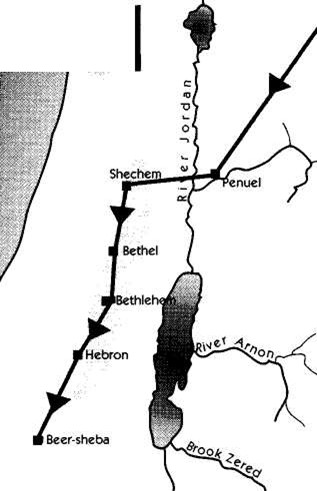
Jacob's Journeys
"A city of Shechem" — Jacob came to the city of Shechem. The word signifies Burden-Bearer, and as a city of refuge, types Christ, our burden-bearer. See this discussed and the site described in our notes on Genesis 14:6. It was here that Abram first received the promise in the Land, and here, too, where he built his first altar in the land (Gen. 12:7). Thus Jacob had re-enacted the journey of his forefather Abraham: a journey of faith, and came, at last, to the Burden-bearer, typically unto Christ.
"Which is in the land of Canaan" — See note Gen. 12:6.
"When he came from Padan-aram" — He thus had followed in the footsteps of Abraham (cp. Gen. 28:2).
"And pitched his tent before the city"— In remaining outside the city, he maintained his separateness from the Canaanites.
VERSE 19
"And he bought a parcel of a field" — The parcel of a field purchased by Jacob apparently comprised the site of Abram 's encampment when he first entered the land. Stephen referred to "a sepulchre that Abraham bought for a sum of money of the sons of Emmor of Sychem" (Acts 7:16). Though nothing is recorded of this transaction in the O.T., it evidently did take place, and now that Jacob arrived at the same place, he took steps to repossess this plat of ground, which later, according to Stephen, became the burial-ground of some of his sons. This is suggested by the use of the verb in this place. The word "bought" in the statement before us, is from qanah, and, according to Gesenius, signifies to acquire by purchase or redemption. The word is rendered recover in Isa. 11:11, "recover the remnant," and redeem in Neh. 5:8, "We have redeemed our brethren," and therefore can refer to the repossession of something — in this case, the family inheritance at Shechem, originally purchased by Abraham. Subsequently, Jacob had to defend his right to this piece of land (Gen. 48:22), though, again, nothing is recorded of the circumstances. These facts reconcile Genesis with Stephen's account of Abraham's purchase.
"At the hand of the children of Hamor, Shechem's father" — Hamor signifies an ass, from a root meaning to boil, ferment, and referring to high-spiritedness.
"For an hundred pieces of money" — For "pieces of money," the Hebrew has
one word: Kesitah. Philologists are uncertain as to what this word signifies. The Septuagint translators render the word as lambs, and the margin of the A.V. does likewise. Others, however, such as Gese-nius, link it with the word kasat, to weigh, and believe that it was a certain weight of metal now unknown. Accordingly, Joshua 24:32, where the same transaction is recorded, renders the word "pieces of silver." Some suggest that both ideas should be combined, and that the earliest pieces of money were stamped with a lamb, as appropriate to a rural people. For example, A.P. Stanley writes: "The very pieces of money with which he buys the land are not merely weighed, as in the bargain with Ephron — they are stamped with the earliest mark of coinage, the figures of the lambs of the flocks."
This linking together of silver money and lambs is remarkably appropriate. For silver is the metal of redemption (Exod. 30:13; Lev. 5:15), and the lamb is the animal of redemption. It is significant that Jacob should redeem this piece of land, which became the symbol of his inheritance, with money which points forward so completely to the means of redemption by which he will obtain his eternal inheritance.
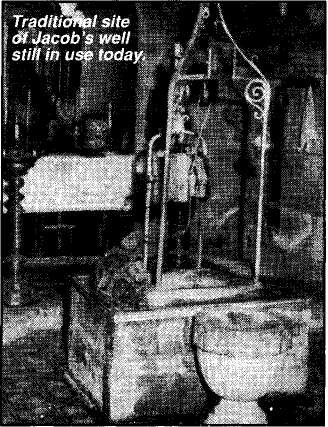
In this secluded field, under the shadow of Gerizim and Ebal (the mounts of Blessing and of Cursing), and in sight of Shechem, the Burden-bearer, Jacob maintained his separate existence. He arranged it so that he was completely independent of the Canaanites. Probably, in order to guard against the chance of disputes as had arisen between his father and Abim-elech during a time of drought, he dug himself a capacious well deep into the limestone rock, which exists near Nablous, the ancient Shechem, to the present day (cp. John 4:5-6). It was at this spot that the true Burden-bearer sought rest and refreshment from the woman of Samaria. The width of the bore is nine feet (2.74m), and its depth about one hundred feet (30.48m). For Jacob to sink such a shaft involved an undertaking demanding great skill, much labour, and considerable time. The water of the well is still used to this day; and the writer has had the great privilege of drinking of it. The "piece of field," the silver-lamb purchase money, and the well of living water, used by Christ as a contrast to his own life-giving Truth, points to the typical significance of this stopping-place of Jacob.
VERSE 20
"And he erected there an altar" — For the significance of altars thus built, see notes on Gen. 12:7.
"And called it El-elohe Israel" — The name signifies The Strength of the Powerful Ones of Israel, and being associated with the altar, it represented this in sacrificial manifestation. The altar symbolised Christ (Heb. 13:10). All who make personal contact with that altar are constituted holy (Exod. 29:37) and they comprise the Powerful Ones of the Name. Their Strength is El manifested in the Lord Jesus Christ. Thus "God was in Christ reconciling the world to Himself" (2 Cor. 5:19), and he became the channel of divine strength to all those who put their trust in him (Phil. 4:13). The manifestation of divine strength in a believer's life entails the sacrifice of self — hence the association of this name with an altar. In Phanerosis, p. 122, the comment is made: "The Altar of Burnt-Offering prefigured the Messiah's Body in sacrificial manifestation. The idea of an altar of sacrifice representing a personal and divine plurality is frequent in Scripture. Thus, Jacob erected an altar at Shechem, in the land of Canaan, and called it Ail-Elohai Yisraail, that is, The "Strength of the Mighty Ones of Israel." Again (p. 50-51): "Now the altar erected by Jacob was typical of those referred to in the title he bestowed upon it. When the Spirit descended upon the Apostles, and shone through them, holding forth the word of life confirmed by power, there were many other Elohim in Israel. They were full of power, and therefore full of El, as Jesus promised they would be, saying, 'Ye shall receive power of the Holy Spirit coming upon you' (Acts 1:8); and when Jacob poured oil upon the pillarstone of Bethel,
he represented this anointing of the Elohim of Israel with El. The marginal reading of the title of Jacob's Altar expresses nothing of this. 'God, God of Israel' is an unmeaning phrase: rendered after the Saxon version of 'God,' it is 'Good, Good of Israel'! But with the promises before us, we interpret the Altar as typical of the Power of the Powerful Ones of Israel in sacrificial manifestation1.
As Jacob made his way to Shechem (the Burden-Bearer) and built his altar for worship, so ultimately all his sons, both of the flesh and spirit will make their way to the antitypical Burden-Bearer, the Christ altar. There, around that altar (Heb. 13:10), in the age to come, they will be united as one; and there the powerful ones of Israel (the glorified elect) will acknowledge that their Strength is, and has been, the El of Israel in sacrificial manifestation.
Comments