___________________
416. CHAPTER FORTY-ONE JOSEPH'S DRAMATIC RISE TO POWER
Joseph's case seems hopeless until after two years Pharaoh has dreams that defy the ability of Egypt's wisest men to interpret. When every assistance is tried in vain, the cupbearer recalls that Joseph is an uinterpreter of dreams." He is hurriedly summoned from prison, and having interpreted the dreams, gives such sound counsel to Pharaoh that he is rewarded by being elevated to a position of power next to the monarch himself.
Pharaoh's Two Dreams — Vv. 1-8
Pharaoh is troubled by two dreams, the interpretation of which his wisest counsellors find to be beyond them.
VERSE 1
"It came to pass at the end of two full years" — Joseph was thirty at this time (v. 46), and therefore about twenty-eight when the cupbearer was released from prison. If he was seventeen when sold into slavery (Ch. 37:2), he would have "wasted" (as some might imagine) some thirteen years in captivity. In fact, all that he suffered was essential to the purpose of Yahweh in him. Not only did it develop in him a character that fitted him for eternity in the Kingdom of God, but his very experiences were designed to save lives (Gen. 50:20).
"That Pharaoh dreamed: and, behold, he stood by the river" — There are several different Hebrew words translated river (see note: Gen. 15:18). Here the word is ye 'or, and is of Egyptian origin, signifying channel, canal, shaft, etc. It refers to the Nile with its channels.
VERSE 2
"And, behold, there came up out of the river"—The prosperity or otherwise of Egypt is dependent upon the flooding of the Nile. It does so during the summer months.
"Seven well favoured kine and fat-fleshed" — It is said that the male ox is the symbol of the Nile, and sacred to Osiris, who was the Egyptian god of agriculture. "The Osiris steer often appears accompanied by seven cows, e.g. on the vignettes of the old and new Book of the Dead" (Skinner). The seven kine of Pharaoh's dream, therefore, were familiar figures in the mythology of the nation, and drew attention to the prevailing superstition regarding agriculture. The cow-goddess Hathor was given prominence in the worship of Egypt. A statue survives of King Amenhotep II standing beneath the protecting head of the cow-goddess. According to one belief, the sun, as a god, was represented as a calf born each day to Hathor. Thus the kine seen by Pharaoh could very easily be identified with Egypt.
"And they fed in a meadow" — The R.V. renders this as reedgrass. In the dream, the seven well favoured kine were plump and contented, grazing in the lush growth on the banks of a Nile channel.
"And, behold, seven other kine came up after them out of the river, ill favoured and lean fleshed; and stood by the other kine upon the brink of the river" — As seven kine was an Egyptian emblem of agriculture and prosperity, the identification with the nation was not difficult. But what was represented thereby? Surely the ill-favoured kine represented failure in agriculture upon which Egypt was utterly dependent.
VERSE 4
"And the ill favoured and lean-fleshed kine did eat up the seven well favoured and fat kine" — This remarkable cannibalism illustrated the extremity to which they were brought, for it was a most unnatural thing for kine to do. In fact, it would suggest a state of things considered utterly impossible!
"So Pharaoh awoke" — He awoke troubled and worried, convinced that the dream had a message of vital importance.
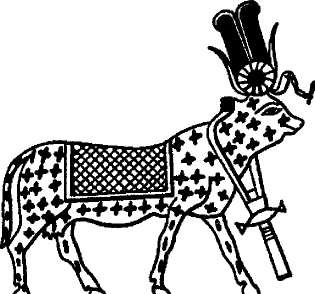
The Egyptian goddess Hathor is sometimes shown in the form of a cow.
VERSE 5
"And he slept and dreamed the second time" — The second dream was to impress that the message it was intended to convey, was important, and had been "established by God" as to surely come to pass (v. 32).
"And, behold, seven ears of corn came up upon one stalk" — Wheat and barley were the staple grains of Egypt. The corn of the Egyptian Nile bears seven ears of grain on one stalk.
"Rank and good" — The Hebrew signifies "fat" and good (see mg.).
VERSE 6
"And behold, seven thin ears and blasted with the east wind sprung up after them" — The southeast wind, blowing during March or April is most destructive, completely withering up the grass if it continues too long. It is known as the dreaded sirocoq or hamsin. Sweeping across the desert, the cutting sand can blot out the sun, and cause havoc to life in all
its forms. The reference to the wind speaks of divine judgment. It is used frequently in Scripture in that relationship.
VERSE 7
"And the seven thin ears devoured the seven rank and full ears" — This, again, is an impossibility. Whilst the figures of seven kine and seven ears of corn could well indicate Egypt, and thus be easy of interpretation, the devouring of kine by kine, and of corn by corn presents something considered absolutely impossible.
"And Pharaoh awoke, and, behold it was a dream" — Obviously it was a variation of the previous dream, impressing Pharaoh with the fact that the message it was intended to convey was vitally important.
VERSE 8
"And it came to pass in the morning that his spirit was troubled" — Pharaoh was deeply agitated and worried as to the import of the dreams.
"And he sent and called for all the magicians of Egypt" — The Hebrew chartomim is from a root signifying to engrave, and relates to the Egyptian priests who understood the sacred hieroglyphic writings engraven on stone. They had a knowledge of art and science, pretended to reveal secrets, interpret hidden things, and foretell the future. It is said that they were divided into four classes, and five men were taken from them to act as the king's counsellors.
"And all the wise men thereof — These constituted the king's counsellors, and comprised learned men capable of judging and advising.
"And Pharaoh told them his dream; but there was none that could interpret them unto Pharaoh" — They were as incapable of doing that, as the world, today, is incapable of properly understanding the significance of the signs. Later, in a similar predicament over a dream, Nebuchadnezzar likewise found his clergy and political advisers to be inadequate (Dan. 2:2-23,28).
The Butler Recommends Joseph To Pharaoh —Vv. 9-13
At this juncture the cupbearer recalls the occasion in prison when he and the baker had dreamed and Joseph had correctly interpreted their dreams. He confesses his fault in this regard to Pharaoh.
VERSE 9
"Then spake the chief butler unto Pharaoh, saying, I do remember my faults this day" — This is probably a diplomatic manner of approach, suggesting that he had been reviewing his past conduct as far as Pharaoh was concerned, and then introducing Joseph's ability as a secondary matter.
VERSE 10
"Pharaoh was wroth with his servants, and put me in ward in the captain of the guard's house, both me and the chief baker" — The cupbearer recapitulates his experiences from the beginning.
VERSE 11
"And we dreamed a dream in one night, I and he; we dreamed each man according to the interpretation of his dream" — The latter part of this statement is rendered by the RSV as a dream with its own meaning. The dream was one, but it had two aspects to it. The Gospel is one, but it proclaims life or death to two different types of persons (2 Cor. 2:16).
VERSE 12
"And there was there with us a young man, an Hebrew, servant to the captain of the guard; and we told him, and he interpreted to us our dreams; to each man according to his dream he did interpret" — The Lord commenced his ministry as "a young man, an Hebrew," and interpreted the hidden things of the Word to those with ears to hear (cp. Luke 2:46-47). He made known "the revelation of the mystery," which was previously "kept secret" (Rom. 16:25).
VERSE 13
"And it came to pass, as he interpreted to us, so it was; me he restored unto mine office, and him he hanged"—
This is the case inevitably with the revelation of God. His Word never returns unto Him void; it will accomplish that which He intends to be done by sending it forth (Isa. 55:11). He can speak of the future with certainty, for whatever He promises He is able to perform (Rom. 4:21).
Joseph Before Pharaoh — Vv. 14-24
In view of the cupbearer's words, Joseph is sent for, and after hastily preparing for an audience with Pharaoh, he is ushered into his presence. He disclaims that he can interpret dreams, declaring that the power to do so belongs to God. The dream is described, and is interpreted by Joseph. In the story of Joseph's elevation, Pharaoh types Yahweh.
VERSE 14
"Then Pharaoh sent and called Joseph, and they brought him hastily out of the dungeon" — The Lord was brought out of the prison-house of death, and presented to the Father (Dan. 7:13).
"And he shaved himself, and changed his raiment, and came in unto Pharaoh" — Shaving was a custom of Egyptians. Budge in The Dwellers On The Nile writes: "The Egyptians of the upper classes paid great attention to their personal appearance and to the physical well-being of the body. As a rule men shaved off their beards and sidewhiskers, but not the hair of their head." According to Herodotus (2.37), "The priests shave their whole body every third day," this being for purposes of cleanliness. Joseph, therefore, followed the custom, knowing that it would please Pharaoh. Figuratively, he said: "Not my will, but thine be done." His action illustrates the type, for shaving symbolised the state of one cleansed (Lev. 14:8), and the Lord was physically cleansed after he had risen from the dead. Next, Joseph "changed his raiment," which points to a change of nature (cp. Zech. 3:4, Rom. 6:4). Finally, he came in unto Pharaoh, as the Lord did unto the Ancient of Days in heaven (Dan. 7:13). The verse before us finds comment in Psalm 105:16-22:
"Moreover He called for a famine upon the land: He brake the whole staff of bread. He sent a man before them, Even Joseph, who was sold for a servant; Whose feet they hurt with fetters; He was laid in iron; Until the time that His word came; The word of Yahweh tried him. The king sent and loosed him; Even the ruler of the people and let him go free. He made him lord of his house, And ruler of all his substance; To bind his princes at his pleasure: And teach his senators wisdom."
The description of the Psalm illustrates the type expressed in the teaching of Acts 2:23-24: "Him, being delivered by the determinate counsel and foreknowledge of God, ye have taken, and by wicked hands have crucified and slain: whom God hath raised up, having loosed the pains of death: because it was not possible that he should be holden of it."
VERSE 15
"And Pharaoh said unto Joseph, I have dreamed a dream, and there is none that can interpret it" — Pharaoh recognised that the two dreams were actually one, but found nobody who could "unseal" it for him. In similar manner, there was none who could unseal the divine Revelation, but the Lord Jesus (Rev. 5:3-5).
"And I have heard say of thee, that thou canst understand a dream to interpret it"—The margin gives the Hebrew idiom: when thou hearest a dream thou canst interpret it. Pharaoh attributed the ability to interpret to Joseph, not to God.
VERSE 16
"And Joseph answered Pharaoh, saying, It is not in me" — Joseph, like Daniel (see Dan. 2:30), another type of Christ, disclaimed the ability to interpret dreams, foreshadowing the attitude of the Lord. See John 5:19.
"God shall give Pharaoh an answer of peace" — Christ also declared that the doctrine of peace is God inspired. "My doctrine is not mine, but His that sent me" (John 7:16). The interpretation of the dreams would set Pharaoh's mind at peace.
VERSE 17
"And Pharaoh said unto Joseph, In my dream, behold, I stood upon the bank of the river" — Pharaoh relates his dreams in substantially the same terms as those in which they have already been described. However, he added certain facts concerning the lean kine.
VERSE 19
"Such as I never saw in all the land of Egypt for badness" — Thus emphasising the extremity of the famine.
VERSE 21
"And when they had eaten them up, it could not be known that they had eaten them; but they were still ill favoured, as at the beginning. So I awoke" — After consuming all that was before them, they remained as destitute and in want as previously.
VERSE 23
"And, behold, seven ears, withered, thin, and blasted with the east wind, sprung up after them" — Pharaoh also described the seven blasted ears of corn as "withered" which the margin gives as small. This suggests that the grain was hard, undeveloped, dead.
Joseph Interprets The Dreams — Vv. 25-32
The dreams reveal that the plenty of Egypt would be followed by dire famine.
VERSE 25
"And Joseph said unto Pharaoh, The dream of Pharaoh is one" — Pharaoh already recognised that. See note on v. 15.
"God hath shewed Pharaoh what He is about to do"—The Hebrew includes the definite article ha-Elohim, the Elohim, thus distinguishing Almighty God from the Egyptian gods. What the magicians could not reveal (v. 24), Yahweh would do through the Elohim. This comprised the third set of double dreams that Joseph was called upon to interpret.
The first two, relating to family relations, concern national Israel; the second two, relating to the butler and baker, concern the destinies of the just and unjust; the third two, now before us, concern God's purpose with Gentiles. A little consideration will reveal that these three sets of double dreams take in the whole purpose of God.
VERSES 26,27
Joseph now provides the basic meaning of the dreams. He does so by the power of God (v. 25; cp. Dan. 2:28).
VERSE 28
"This is the thing which I have spoken unto Pharaoh: What God is about to do He sheweth unto Pharaoh" —
Again the definite article is linked with the word Elohim to emphasise that it was the
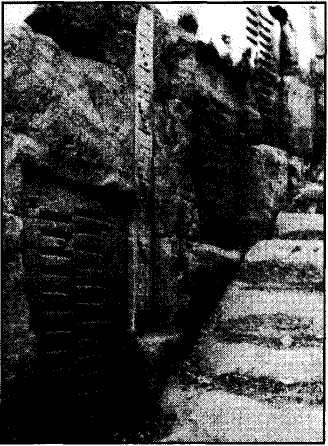
The Nilometer on the island of Elephantine at Aswan, used for measuring the Nile flood.
God of the Hebrews to whom reference was made.
VERSE 29
"Behold, there come seven years of great plenty throughout all the land of Egypt" — Answering to the good kine and corn of the dreams.
VERSE 30
"And there shall arise after them seven years of famine" — Answering to the ill-favoured kine and withered corn.
"And all the plenty shall be forgotten in the land of Egypt; and the famine shall consume the land" — Note Pharaoh's description of the kine in v. 21.
VERSE 31
"And the plenty shall not be known in the land by reason of that famine following" — The word "reason" is paniym, faces, and can be rendered: "from the faces." The effects of the famine would stare the nation in the face and would drive away the pleasurable aspects of the years of plenty.
"For it shall be very grievous" — The grievous effects of dire famine in Egypt are indicated on "an inscription on a rock on the island of Sahal in the First Cataract which tells of a seven year famine which took place in the reign of Pharaoh Djoser (the builder of the famed Step Pyramid) who reigned about 1000 years before Joseph. It reads: Ί was in distress on the great throne, and those who are in the palace were in affliction of heart because of a very great evil, for in my time, the Nile has not overflowed for seven years. There was scarcely any grain; fruits were dried up; and everything which they ate was short. Every man robbed his neighbour. The men who want to walk cannot move, the child wails, the young man drags his body about, and the hearts of the older men are crushed with despair. Their legs give way under them, they sink down on the ground, and they clutch their bodies with their hands (in pain). Their nobles have no counsel to give, and there is nothing to be obtained from the storehouses, but wind. Everything is in a state of ruin" (from Dwellers On The Nile, E.A.W. Budge).
This inscription and description was in existence in Joseph's day so that the Pharaoh of the time would have realised what the dread news of seven years' famine signified.
Another seven years famine in 1066-1072 nearly ruined the country. "A loaf sold for $17, and an Qgg for a dinar (approx. $1.20). When all the animals were eaten men began to eat each other, and human flesh was sold in public. Passengers were caught in the streets by hooks let down from the windows, drawn up, killed and cooked. During the famine in 1201 people ate human flesh habitually. Parents killed and ate their children and a wife was found eating her husband raw. The graves were ransacked for food" (Lane Poole, Middle Ages, pp. 146, 216).
So dependent was Egypt on the flood waters of the Nile, that Nilometers (ancient Nile gauges) were cut on the rocks to measure the height of the yearly flood.
VERSE 32
"And for that the dream was doubled unto Pharaoh twice; it is because the thing is established by God, and God will shortly bring it to pass" — Paul makes reference to the promise and the oath as "two immutable things, in which it was impossible for God to lie" (Heb. 6:18). Repetition, which is a frequent feature in the Word is designed to emphasise the certainty of God's purpose coming to pass.
Joseph Recommends A National Policy — Vv. 33-36
Joseph, realising that the situation is urgent, recommends that immediate steps be taken to counter the problem and suggests that a man be appointed to examine the situation.
VERSE 33
"Now therefore let Pharaoh look out a man discreet and wise, and set him over the land of Egypt" — These characteristics form an essential part of the parable of Joseph spoken by both Solomon (Ecc. 4:14), and the Lord (Matt. 24:45). Solomon described him as coming out of prison to reign, and the Lord as being "faithful and wise".
VERSE 34
"Let Pharaoh do this, and let him appoint officers over the land" — The word for "officers" here is different to that which we have met with previously (e.g. Ch. 39:1). It is the word paqiydim from paqad, to visit, and signifies overseers or superintendents.
"And take up a fifth part of the land of Egypt in the seven plenteous years"— They normally gave a tenth, so this tax was not over-burdensome in view of the prevailing prosperity. Five is the number of grace, and is appropriate to the circumstances, for that which was taken from them was designed to provide for them in a time of need.
VERSE 35
"And let them gather all the food of those good years that come, and lay up corn under the hand of Pharaoh"
— In the type this reminds us of the "treasure in heaven" that one is able to store up for future use. See Matt. 6:20; Luke 16:9.
"And let them keep food in the cities" — It would be retained under the care of Pharaoh through his officers throughout his realm.
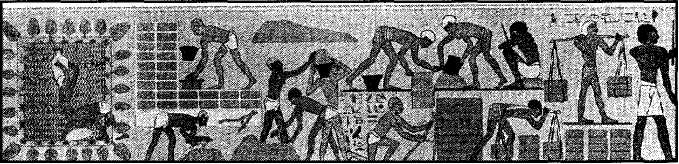
VERSE 36
"And that food shall be for store to the land against the seven years of famine, which shall be in the land of Egypt; that the land perish not through the famine" — Joseph suggests that the people be asked to sacrifice in the years of plenty so that they may have that upon which they could draw in the time of want. This, he declared, would save them from "perishing," or, as the Hebrew expresses it, "from being cut off". His suggestion was an extremely wise one. Let us apply it spiritually. We should sacrifice something of the present that we may in a time of want (at the Judgment Seat) have that upon which we can draw in order to save us from being "cut off."
Joseph Is Appointed In Charge — Vv. 37-40
The suggestion is applauded as excellent and it is recognised that Joseph has all the qualifications necessary to implement it. He is appointed to the position. So ''from a prison he comes forth to reign," So, also, did the Lord Jesus.
VERSE 37
"And the thing was good in the eyes of Pharaoh, and in the eyes of all his servants" — The purpose of redemption in and through the Lord is pleasing to the Father and the angels (1 Pet. 1:12).
VERSE 38
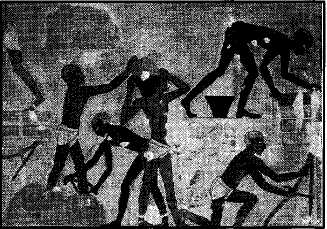
Mosaic of Egyptian building activity showing the industry of the times.
"And Pharaoh said unto his servants, Can we find such a one as this is, a man in whom the Spirit of God is?" — In relation to the type, see John 3:34. In the Hebrew, there is no definite article attached to the word Elohim in this verse, in contradistinction to when Joseph spake. As an Egyptian, Pharaoh spake of many gods.
VERSE 39
"And Pharaoh said unto Joseph, Forasmuch as God hath shewed thee all this" — See John 5:20.
"There is none so discreet and wise as thou art" — Paul wrote that "in whom (the Christ) are hid all the treasures of wisdom and knowledge" (Col. 2:3). Joseph foreshadowed that aspect of the Lord.
VERSE 40
"Thou shalt be over my house, and according unto thy word shall all my people be ruled" — In the Hebrew this is a remarkable statement. "Word" is from the Hebrew peh, mouth, and "ruled" is from nashaq signifying to kiss (see mg. of A.V.). The idea is that whatever Joseph said or commanded they would be agreeable to, and would obey. Figuratively they would kiss his mouth. This remarkable figure of speech finds its use throughout Scripture. In ancient times, a kiss had far greater meaning than today. It was the token of allegiance (1 Sam. 10:1); friendship (1 Sam. 20:41); affections (Gen. 45:15); true love (1 Pet. 5:14); adoration (Hos. 13:2). It is the natural sign of sympathy. Absalom won the hearts of the people by kissing those who came to court with their suits (2 Sam. 15:5. Ct Prov. 27:6; Luke 22:47-48). True and right words are as a kiss of the mouth, thus: "Every man shall kiss his lips that giveth a right answer" (Prov. 24:24-26), and such words demand homage and obedience, hence the use of the expression in the verse before us. This figurative use of the kiss is the reason why, in the beautiful expressions of The Song of Songs the Bride (the perfected ecclesia) speaks ardently of the kisses of the groom (the Lord). She desires to hear the words of his mouth, and is pleased to do all that he commands. In answer to the type, Christ has been placed over the house of God (Heb. 3:6), and all must submit to him.
"Only in the throne will I be greater than thou" — For the antitype, see John 14:28; 1 Cor. 15:28.
Joseph's High Authority And Marriage —Vv. 41-45
Joseph is made Prime Minister. He is given the seal of office, arranged in special garments, and permitted to use the chariot of state. His name is changed, and he marries into high society.
VERSE 41
"And Pharaoh said unto Joseph, See, I have set thee over all the land of Egypt"—The Lord Jesus was also given a name above all others, being subject only to Yahweh (Phil. 2:9-11). Already he exercises power over the nations (Matt. 28:18). Moreover, his work of redemption was broadened to extend to Gentiles.
VERSE 42
"And Pharaoh took off his ring from his hand, and put it upon Joseph's hand" — This ring was the seal of authority (cp. Est. 3:10; 8:2,10). Christ was sealed with the divine authority (see John 6:27).
"And arrayed him in vestures of fine linen" — Herodotus states (Book 2:81) that the priests of Egypt, who constituted the aristocracy of the nation, wore linen garments. Christ will exercise both religious and civil authority.
"And put a gold chain about his neck" — This was the symbol of authority to rule (see Dan. 5:29).
VERSE 43
"And he made him to ride in the second chariot which he had" — Special chariots were constructed for the Pharaohs, some of which were discovered in Tutankhamen's tomb. These chariots gilded over with gold, and with vanquished and bound enemies as their principal decorative motif, were the official vehicles for the Pharaohs, and were resplendent as the sun. There was no mistaking them. The appearance of Joseph in one of the royal chariots would establish his status in the sight of all.
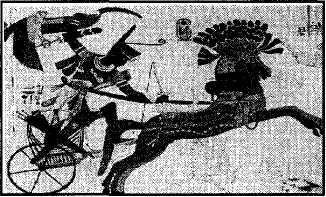
"And they cried before him, Bow the knee" — The Hebrew is Abrek, which the margin gives as Tender Father, deriving the latter word from Ab, Father, in the Hebrew. There seems warrant for this from the words of Joseph in Gen 45:8, where the Hebrew Ab is rendered "father." It also suits the antitype, for the Lord is described as the Father of eternity (Isa. 9:6), and the Redeemed are called his "sons" (cp. Isa. 53:10; Heb. 2:13-14). However, this rendition is disputed by others. Some see in it an Egyptian title signifying, literally, Thy heart to thee, and thus likening it to a call to attention, or allegiance. Others give it as the A.V., or, according to Gesenius, "Bow the head."
"And he made him ruler over all the land of Egypt" — For the antitype see Mic. 5:2; Matt. 2:16; Rev. 11:15.
VERSE 44
"And Pharaoh said unto Joseph, I am Pharaoh" — My authority is absolute.
"And without thee shall no man lift up his hand or foot in all the land of Egypt" — Delegated authority and status was vested in Joseph as it has also been in Christ. See John 5:26-27; Matt. 11:27.
VERSE 45
"And Pharaoh called Joseph's name Zaphnath-paaneah" — Josephus interprets this as signifying Revealer of Secrets (see Ant. 2:6:1), which expresses its Hebrew form. Jerome gives it as Saviour of the World, deriving the meaning from the Coptic p-sot-om-ph-eneh. Some Egyptologists see in it the Egyptian form of de-pnute-ef-onh signifying, The God speaks and He Lives. The Septuagint has Pson-thom Phanech or Saviour of the Age, whilst Stanley prefers Rescuer of the World. All these meanings are closely related, and show that the "new name" given to Joseph witnessed to his ability, and honoured him before man. See Phil. 2:9-10.
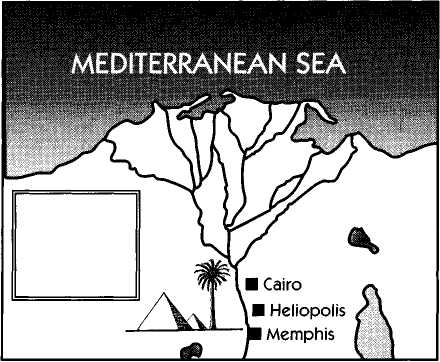
Heliopolis and the Land of Goshen
"And he gave him to wife Asenath the daughter of Potipherah priest of On" — This was a position of high authority and prestige in the land. Asenath is an Egyptian name signifying She Who is of Neith, the Minerva of the Egyptians. She is described as the "daughter of Potipherah," the same name as occurs in Gen. 39:1. However, Potipherah is a common Egyptian name, and the priest of this verse doubtless was a different man to the one who bought Joseph as a slave, for he was a eunuch. By marriage, Joseph became associated with the priesthood, and so, by a remarkable type, the elevation of the Lord Jesus as priest was foreshadowed. See Heb. 7:12-13. The marriage with Asenath took place, and was recorded, for the purpose of foreshadowing the purpose of God in Christ. We can be quite sure that Joseph would have educated his wife in the principles of true worship, and that his home in Egypt would be a centre for such.
"On" signifies Strength. It is also known as Heliopolis, the City of the Sun, being dedicated to the sun-god Ra. It was situated about seven miles N.E. of Cairo. Heliopolis was the chief city of Egyptian science with which religion was closely related. Herodotus speaks of it as one of the four great cities of his day, noted for its religious festivals in honour of the sun. In Joseph's day it was noted for its huge and ornate Temple, which, in Jeremiah 43:13 is styled Beth-shemesh, the House of the Sun. The site has been robbed of its magnificent ruins, to become the rich adornment of other cities like Rome, Constantinople and London. Today, the Cairo airport is in the vicinity of the site.
Of the ancient splendour of On, nothing remains above ground but a red granite obelisk from Aswan erected to celebrate the jubilee of Pharaoh Sesostris I. Originally this obelisk marked the entrance to the great temple of On. Tradition says that Joseph and Mary sojourned in On with the infant Jesus (cp. Matt. 2:13-14). Isaiah 19:18 prophetically refers to a future time when five centres in Egypt shall be set up to proclaim the Truth, one being called The City of Destruction. Some apply this to City of the Sun and identify it with Heliopolis.
"And Joseph went out over all the land of Egypt" — He did so in the discharge of his vice-regal duties.
Joseph's Age, Administration and Family — Vv. 46-52
Though only thirty, Joseph manifests great maturity, confidence and skill in the administration of the nation. Meanwhile, two sons are born to him.
VERSE 46
"And Joseph was thirty years old when he stood before Pharaoh king of Egypt" — He had been 17 when he experienced the hostility of his brethren (Gen. 37:2), so that thirteen years had passed in exile. If he was three years in prison (cp. Ch. 40:4 with 41:1), he must have served ten years in the house of Potiphar. Isaac died the year before Joseph's elevation (Gen. 35:28-29). His age at this time is significant. Thirty was the age that the Levites commenced their duties (Num. 4:3), and the age that David began to reign in Hebron (2 Sam. 5:4). More significantly, it was the age at which the Lord commenced his public ministry before his Father (Luke 3:23).
"And Joseph went out from the presence of Pharaoh, and went throughout all the land of Egypt" — He did so in the performance of his official duties, establishing and superintending the district overseers. By divine power conferred upon him (Matt. 28:18), the Lord does likewise. As chief shepherd he appointed under-shepherds to supervise the affairs of his administration (cp. 1 Pet. 5:1-4). His activity in that direction is illustrated by his seven messages to the "angels" of the Asian Ecclesias in spiritual Egypt (Rev. 2,3).
VERSE 47
"And in the seven plenteous years the earth brought forth by handfuls"— The RSV renders this as "abundantly." The plenteous years of Apostolic days, which brought many to the Truth, have been followed by times of famine, during which few have "ears to hear."
VERSE 48
"And he gathered up all the food of the seven years, which were in the land of Egypt" — He gathered up all the portions levied (v. 34).
"And laid up the food in the cities" — It is always a wise provision, not usually observed in this age of reckless waste, to conserve resources in times of plenty, for use in days of famine, or want. Joseph laid up the corn in granaries provided. This was normal in Egypt. The monuments depict men bringing corn into granaries.
"The food of the field, which was round about every city, laid he up in the same" — He compelled the people to labour in days of plenty, even though it did not seem necessary. There was such abundance, that the people may have been disposed to allow it to waste in the field, but he ordered that it be brought into the confines of the city and there stored.
VERSE 49
"And Joseph gathered corn as the sand of the sea, very much" — The verb signifies to heap up. He heaped up corn very much.
"Until he left numbering; for it was without number" — At first he kept a very careful record of the amount of corn received in order that it might be fairly apportioned in the years of famine. But ultimately, as it was seen that sufficient was gathered in, this practice was discontinued.
VERSE 50
"And unto Joseph were born two sons before the years of famine came"— In the blessing of Moses, recorded in Deut. 33:17 it is obvious that these two sons represent Israel spiritual and natural, described by Isaiah as "the sons of Zion" (Isa. 66:8-9; cp. Zech. 4:11).
VERSE 51
"And Joseph called the name of the firstborn Manasseh" — Manasseh signifies "forgetting" from nashah to forget.
"For God, said he, hath made me forget all my toil" — The word "toil" is amal in Hebrew, and signifies the wearing effort of such labour on mind or body, and hence, worry. For the antitype, see Isa. 53:11.
"And all my father's house" — The loss of his father's house was in measure compensated by the building of a house for himself.
VERSE 52
"And the name of the second called he Ephraim" — Ephraim signifies double fruit or fruitfulness. He superseded Manasseh in the matter of the firstborn and so represented spiritual Israel.
"For God hath caused me to be fruitful in the land of my affliction" — This language shows that Joseph viewed his present glory as of a temporary nature; Egypt still remained for him the land of affliction. For the application of fruitful-ness in regard to the antitype, see John 14:12; 15:16; Isa. 53:10.
Plenty Followed By Famine — Vv. 53-57
Due to Joseph's crop-conservation policy, Egypt has plenty of food stored for the years of famine. Other countries are not so fortunate. The drought extends beyond Egypt to Palestine and elsewhere, and as its impact is felt more and more, people make their way south to buy corn.
VERSE 53
"And the seven years of plenteous-ness, that was in the land of Egypt, were ended" — In the antitype, the "fulness of the Gentiles" was typically gathered in. Cp. Rom. 11:25.
VERSE 54
"And the seven years of dearth began to come, according as Joseph had said" — The extreme effect of famine in Egypt is described in our comments on v. 31.
"And the dearth was in all lands"— It spread beyond the borders of Egypt.
"But in all the land of Egypt there was bread" — Due to the sound conservation policy of Joseph. In the same way, though there may be spiritual famine in all the world (cp. Amos 8:11), there is always food wherever the antitypical Joseph is found.
VERSE 55
"And when all the land of Egypt was famished, the people cried to Pharaoh for bread" — There is no word for "when" in the original: the statement is made: "all the land of Egypt hungered, and the people cried unto Pharaoh ...."
"And Pharaoh said unto all the Egyptians, Go unto Joseph; what he saith to you, do" — Pharaoh placed supreme confidence in Joseph, as Yahweh does in Christ. He delegated to him his full authority, and directed the people to heed
his wisdom and obey his word. In like manner, the Voice from heaven directed the Apostles to hearken unto the Lord (See Matt. 17:5; John 1:14-16; Phil. 4:19; Col. 1:19).
VERSE 56
"And the famine was over all the face of the earth" — It extended to those parts which did not have the benefit of Joseph's administration. See Ps. 105:16; Acts 7:11. For the antitype, see Amos 8:11.
"And Joseph opened all the storehouses, and sold unto the Egyptians" — The storehouses were granaries established throughout the land. From them Joseph dispersed corn to the people. See Prov. 11:26.
"And the famine waxed sore in the land of Egypt" — Literally, the famine was strong. It increased in its severity as food became increasingly scarce.
VERSE 57
"And all countries came into Egypt to Joseph for to buy corn" — Joseph became the symbol of salvation "to the end of the earth" (Isa. 49:6). There is a spiritual famine in the earth at present (Amos 8:11), and men must seek Joseph in Egypt (Christ, in the Gentile times) if they would be fed.
"Because that the famine was so sore in all lands" — It became more and more severe throughout the earth.
Comments